

Your consulting firm’s ledger should be a roadmap for growth, not a source of late-night anxiety. Many firm owners in Cleveland and Akron view bookkeeping for consulting firms as a tedious compliance chore, often struggling with messy QuickBooks records or the stress of separating personal and business expenses. It's common to feel like revenue is slipping through the cracks due to inaccurate time tracking or uncertainty about specific Ohio tax obligations. You deserve a financial system that works as hard as you do for your clients.
We're here to help you turn those financial records into a powerful tool for scaling and project profitability. This 2026 strategic guide explains how to master automated invoicing, maximize your deductions, and navigate the latest updates from the IRS and the Ohio Department of Taxation. We'll cover everything from the new $6 million Ohio CAT exclusion threshold to the significant 2026 QuickBooks Online price increases. By the end of this guide, you'll have a clear path to financial reporting that supports your long-term success while providing the peace of mind that comes with professional oversight.
Key Takeaways
- Capture every billable hour by treating your time as inventory, which ensures your revenue recognition matches the actual work performed.
- Identify the warning signs of "messy books" to understand why a professional QuickBooks Online cleanup is necessary before you can scale your firm.
- Master project-based bookkeeping for consulting firms to calculate your true effective hourly rate and focus your energy on your most profitable contracts.
- Stay compliant with the Ohio Department of Taxation by learning how the $6 million CAT threshold and local municipal taxes affect your Northeast Ohio business.
- Reclaim your time by understanding the opportunity cost of DIY accounting and how professional oversight provides the clarity needed for long-term growth.
The Unique Financial Architecture of Consulting Firms
Effective bookkeeping for consulting firms involves much more than just recording expenses and balancing bank statements. While standard methods of bookkeeping focus on general accuracy, a consulting practice requires a specialized intersection of time tracking, revenue recognition, and expense management. For a consultant in Cleveland or Akron, your financial records must act as a mirror for your operations. If your books don't reflect the hours your team spends on specific deliverables, you're flying blind when it comes to pricing and profitability.
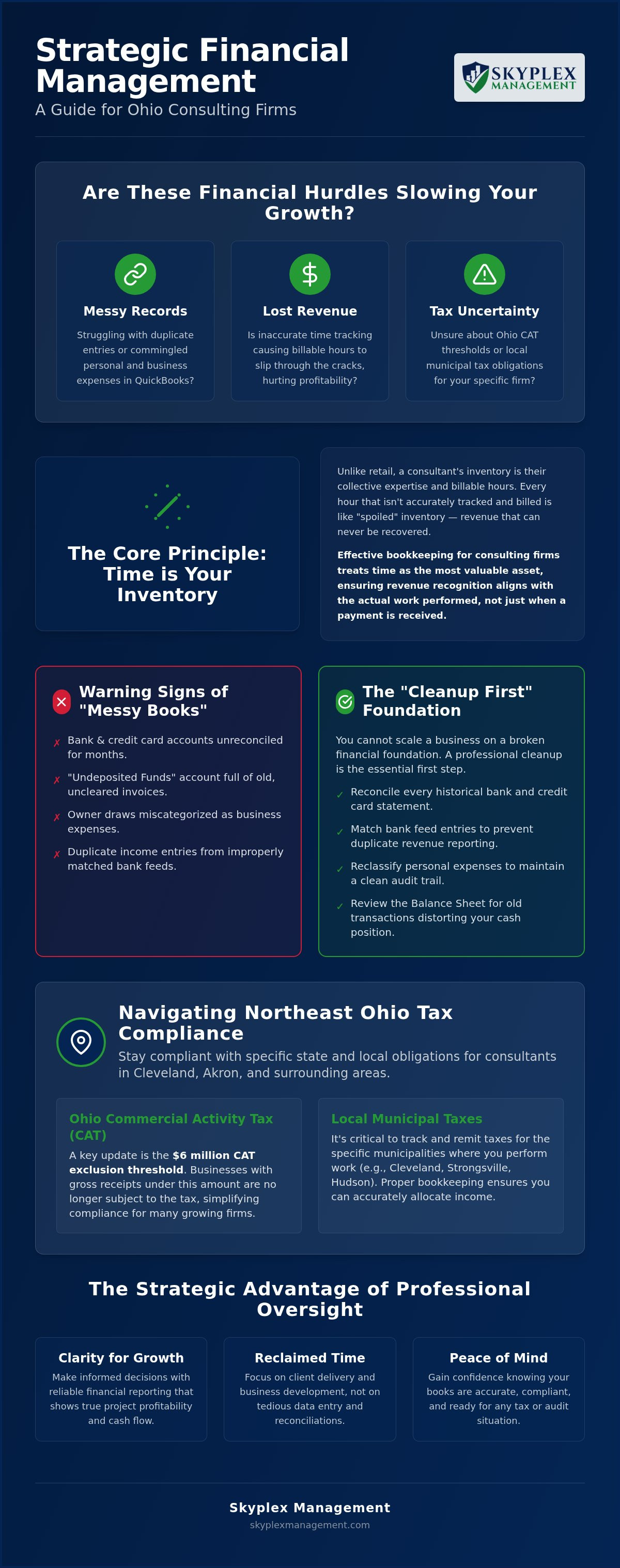
In the professional services world, we view "Time-as-Inventory." Unlike a retail shop in Medina that stocks physical goods, your inventory is the collective expertise and billable hours of your staff. When an hour passes without being tracked or billed correctly, that inventory is "spoiled" and can never be recovered. Many firms make the mistake of relying solely on cash-basis reporting for high-value, multi-month contracts. This approach can be dangerous because it creates a false sense of wealth when a large deposit hits, followed by a "starvation" period while work is being performed. Revenue recognition is the accounting process of recording income when it's earned through service delivery rather than simply when the client's check clears the bank.
Why General Bookkeeping Falls Short for Consultants
General bookkeeping often ignores unbillable hours, but these are critical for understanding your true cost of doing business. If your financial reports don't account for the time spent on business development or internal training, your profit margins are likely inflated. Lumpy cash flow is another common hurdle that generic systems fail to address. A specialized Chart of Accounts for consultants helps you separate direct project costs from firm overhead, allowing you to see which service lines are actually driving growth and which are draining resources.
The Role of QuickBooks Online in Modern Consulting
Cloud-based systems are no longer optional for firms in Northeast Ohio that embrace remote or hybrid work. Using a platform like QuickBooks Online allows your team to log time and expenses from anywhere, whether they're at a client site in Strongsville or working from home in Hudson. These systems excel at automating the bridge between a signed proposal and the final payment. By integrating your project management tools with QuickBooks Online Support, you can ensure that every billable minute is captured and invoiced without manual data entry. This automation reduces human error and speeds up your collections cycle, keeping your cash flow steady and predictable.
Establishing a Clean QuickBooks Online Foundation
Many consulting firm owners in Northeast Ohio discover that their financial records have become a tangled web over time. Common signs of "messy books" include duplicate income entries, bank accounts that haven't been reconciled in months, and personal draws miscategorized as business expenses. These errors aren't just annoying; they're dangerous. We follow a strict "Cleanup First" rule because you simply cannot scale a consulting practice on a broken financial foundation. Reliable bookkeeping for consulting firms requires a pristine starting point to ensure that your profitability reports actually mean something. Historical accuracy is the only way to ensure 2026 tax compliance.
The Anatomy of a Professional Account Cleanup
A professional cleanup starts with reconciling every historical bank and credit card statement to ensure the balance in QuickBooks matches the real world. We often find that the "Undeposited Funds" account is a graveyard of old invoices that were never properly cleared, leading to inflated income figures. If you're struggling with these issues, you can learn more about how to fix messy QuickBooks records through our specialized reconciliation services. This process is vital for calculating your Self-Employment Tax accurately, as overstating income leads to overpaying the government. Our team follows a methodical approach to restoration:
- Reviewing the Balance Sheet for old, uncleared transactions that distort your cash position.
- Matching bank feed entries to existing invoices to prevent duplicate revenue reporting.
- Reclassifying owner draws and personal expenses to maintain a clean audit trail.
- Performing a deep reconciliation of all liability accounts, including payroll and sales tax obligations.
Optimizing Your Chart of Accounts for Professional Services
For firms in Cleveland, Akron, and Medina, your Chart of Accounts should be a strategic tool rather than a generic list. We categorize direct project costs separately from general overhead like office rent or software subscriptions. This structure allows you to use classes or tags in QuickBooks Online to track the performance of different service lines or specific partners. When your CRM or time-tracking software maps correctly to these categories, your financial reporting becomes automated and insightful. Mapping software integrations is another critical step; if your proposal tool isn't talking to QuickBooks correctly, you'll end up with manual entry errors that compound over time. If your current setup feels more like a burden than a benefit, it's likely time to schedule a QuickBooks Online cleanup to get your records back on track.
Project-Based Accounting: The Key to Scalable Growth
Most business owners in Cleveland and Akron stop at general bookkeeping, but effective bookkeeping for consulting firms requires a deeper level of financial intelligence. While general bookkeeping tells you if your firm is profitable as a whole, it won't tell you which specific clients or projects are draining your resources. Project-based accounting, or job costing, allows you to track every dollar of revenue and every cent of direct labor against a specific contract. This clarity is essential for creating financial projections that help you decide when to hire new staff or pivot your service offerings.
| Feature | General Bookkeeping | Project-Based Accounting |
|---|---|---|
| Revenue Tracking | Total firm income by month | Income tracked to specific client contracts |
| Expense Analysis | Broad categories (Rent, Software, Payroll) | Direct labor and project-specific costs |
| Insight Level | Historical "What happened?" | Actionable "Which project was most profitable?" |
One of the most critical metrics for any consultant is the Effective Hourly Rate (EHR). You calculate this by dividing the total project revenue by the total hours spent on that project, including unbillable research or administrative time. If you bill a flat fee of $10,000 but spend 200 hours on the work, your EHR is $50. If you finish in 40 hours, it jumps to $250. Without tracking direct labor costs against specific project revenue, you can't identify where your margins are being eroded by scope creep or inefficient workflows.
Tracking Billable vs. Non-Billable Efficiency
Scaling a firm in Northeast Ohio requires a firm grasp on utilization rates. Administrative bloat often eats into consulting margins when senior advisors spend too much time on tasks that don't generate revenue. We recommend using the QuickBooks Online "Projects" feature to gain real-time visibility into your team's efficiency. By setting targets for billable hours, you can ensure your staff stays focused on high-value work while identifying gaps in your internal processes before they impact your bottom line.
Managing Retainers and Deferred Revenue
Handling upfront deposits correctly is a common struggle for consultants in Medina and Strongsville. If you record a $20,000 retainer as income the moment it hits your bank account, you'll distort your monthly P&L and potentially face a massive tax bill before the work is even performed. The professional approach involves placing these funds into a liability account and "earning" them as the work progresses. This method ensures your financial reporting remains accurate and helps you manage recurring invoices for long-term advisory contracts without creating cash flow spikes.
Tax Compliance and Local Obligations for Ohio Consultants
Tax season often feels like a looming deadline, but proactive bookkeeping for consulting firms turns that anxiety into a simple administrative task. For firms based in Northeast Ohio, the tax landscape has seen significant shifts recently. The Ohio Department of Taxation maintained an annual exclusion threshold for the Commercial Activity Tax (CAT) at $6 million for 2026. This change effectively exempts the vast majority of small and medium-sized consulting practices from CAT liability, though you must still monitor your gross receipts to ensure you remain below this limit. Maintaining audit-ready digital receipts is the single most effective way to defend your deductions if the IRS or state authorities ever request a review of your records.
Local municipal income taxes present another layer of complexity for consultants in Cleveland, Akron, and Medina. If your team works remotely or visits client sites across different jurisdictions, you may trigger a tax nexus in multiple cities. Agencies like RITA (Regional Income Tax Agency) or CCA (Central Collection Agency) handle these filings, and failing to withhold correctly can lead to expensive penalties. Additionally, the IRS increased the filing threshold for Form 1099-NEC to $2,000 for the 2026 tax year. This means you only need to issue tax forms to subcontractors who received $2,000 or more for their services, which reduces the paperwork burden for many firms.
Navigating Ohio Department of Taxation Requirements
New professional service firms must register with the state, but you should also be aware of how remote work impacts your local obligations. While general consulting services are not subject to Ohio sales tax, you might inadvertently create a taxable event if you bundle your advice with tangible goods or certain IT services. We help you identify these "taxable services" early to avoid surprise assessments. Clear records ensure you stay on the right side of the law while focusing on your clients' success.
Maximizing Deductions for the Modern Consultant
Maximizing your bottom line involves more than just increasing revenue; it requires capturing every legal deduction. For 2026, the IRS standard mileage rate is 72.5 cents per mile for the first half of the year and 76 cents for the second half, making accurate travel logs more valuable than ever. You can also leverage Section 179 deductions to immediately expense technology and equipment purchases rather than depreciating them over several years. For a deeper look at these opportunities, see our Small Business Financial Strategy Guide. Properly categorizing your continuing education and home office expenses ensures you aren't leaving money on the table come April.
The Strategic Advantage of Outsourced Bookkeeping
For a high-billing consultant in Cleveland or Akron, the most expensive way to handle your finances is to do them yourself. If your billable rate is $250 per hour and you spend five hours a month wrestling with bank reconciliations, that's $1,250 in lost revenue every month. This "opportunity cost" often exceeds the price of professional bookkeeping for consulting firms. Beyond the math, professional oversight acts as a shield against IRS red flags. While DIY software might suggest you're "done" after a few clicks, an expert ensures your records are actually accurate, preventing the audit triggers that often stem from misclassified expenses or inconsistent reporting.
Moving your firm from simple data entry to strategic financial management involves a shift in perspective. A traditional bookkeeper records what happened in the past, but a fractional controller helps you plan for the future. This transition is vital for firms in Medina or Strongsville that are ready to move from a solopreneur model to a team-based agency. Having a professional watch your ledger means you can focus on your clients' success while we handle the background complexities of your financial health.
When to Hire an Outsourced Controller
You'll know your firm has outgrown basic data entry when your financial reports no longer provide the answers you need to make decisions. If you're unsure which service line is most profitable or if you're consistently surprised by your tax bill, it's time for higher-level support. We provide monthly advisory meetings that go beyond the balance sheet. We perform a detailed budget-to-actual analysis to ensure your spending aligns with your growth goals. If you're wondering about the specific differences in these roles, you can explore our guide on an outsourced controller vs. CFO to see which level of service fits your 2026 objectives.
Partnering with Skyplex Management for Peace of Mind
Skyplex Management serves as the local partner for Northeast Ohio consulting firms that value both technical mastery and approachable service. We create customized reporting packages that focus on the metrics that matter most to service-based businesses, such as utilization rates and project margins. Our proactive approach to payroll and compliance ensures you never miss an Ohio Department of Taxation deadline or an IRS filing requirement. We act as a trusted advisor, handling the meticulous details so you can lead your firm with confidence and clarity.
Powering Your Firm’s Future Through Financial Intelligence
Scaling a consulting practice in Cleveland or Akron requires shifting your focus from simple expense tracking to strategic financial intelligence. By implementing project-based accounting and maintaining a pristine QuickBooks foundation, you gain the clarity needed to identify your most profitable service lines. We've explored how specialized bookkeeping for consulting firms transforms messy records into a roadmap for growth, ensuring you stay ahead of 2026 tax obligations like the Ohio CAT and local municipal filings. You don't have to navigate these complexities alone while trying to serve your own clients.
Our team of QuickBooks Online Certified ProAdvisors brings almost a decade of expertise in Ohio tax compliance and specialized reporting for professional service agencies. We handle the technical details and historical cleanups so you can focus on leading your team with confidence. Investing in professional financial oversight is the most effective way to protect your margins and ensure your firm remains audit-ready and profitable for years to come.
We're ready to help you turn your financial data into a powerful tool for sustainable success. Reach out today to see how a partnership with local experts can provide the peace of mind you deserve.
Frequently Asked Questions
Do consulting firms need a specialized bookkeeper?
Consulting firms benefit from specialized oversight because their financial structure differs significantly from retail or manufacturing. You need a partner who understands "time-as-inventory" and how to manage complex revenue recognition for multi-month contracts. Firms in Cleveland and Akron often struggle with generalists who miss the nuances of project-based profitability. We provide specialized bookkeeping for consulting firms that goes beyond basic data entry to offer real-time insights into your firm's operational health.
What is the best accounting software for a small consulting business?
QuickBooks Online is the premier choice for consultants due to its robust integration capabilities and cloud-based access. As of August 2026, the popular Plus tier is priced at $140 per month, while the Advanced tier costs $340. These levels provide the project tracking and reporting tools necessary for scaling a professional services firm. Our team provides expert QuickBooks Online Support & Cleanup to ensure your software is configured correctly for your specific business model.
How should I track my billable hours for bookkeeping purposes?
You should use a time-tracking tool that integrates directly with your accounting software to prevent manual entry errors. This ensures every billable minute is captured and mapped to the correct project or client. For consultants in Medina or Strongsville, this automation speeds up the invoicing process and improves cash flow. Tracking both billable and non-billable time allows you to calculate your true effective hourly rate and identify where administrative bloat is eating your margins.
What are the most common bookkeeping mistakes consultants make?
The most frequent errors include mixing personal and business expenses and failing to reconcile bank accounts monthly. Many solopreneurs in Northeast Ohio also neglect to track unbillable time, which hides the true cost of client acquisition. These mistakes lead to "messy books" that make tax season a nightmare and provide an inaccurate picture of profitability. Professional QuickBooks Online Support & Cleanup can resolve these historical issues and establish a reliable foundation for future growth.
How does the Ohio CAT tax affect my consulting firm?
For the 2026 tax year, the Ohio Department of Taxation has set the annual exclusion threshold for the Commercial Activity Tax (CAT) at $6 million. This means that approximately 90% of previous filers, including most small consulting firms in Hudson or Stow, are now exempt from this tax. However, you must still track your taxable gross receipts carefully to ensure you stay below this limit and maintain compliance with all state reporting requirements.
Can I use QuickBooks Online to track project profitability?
Yes, you can track project-specific margins using the "Projects" feature available in the QuickBooks Online Plus and Advanced tiers. This tool allows you to assign labor costs and expenses directly to specific contracts, giving you a clear view of which clients are most profitable. For firms in Akron or Canton, this level of detail is essential for making informed hiring decisions and adjusting your pricing strategy to reflect the actual work performed.
How much does outsourced bookkeeping for consultants typically cost?
Outsourced service costs are based on the volume of transactions and the complexity of your financial reporting needs. Rather than focusing on a flat fee, consider the opportunity cost of handling your own ledger. If your billable rate is high, spending hours on reconciliation is a poor use of your time. Partnering with a professional firm provides peace of mind and ensures your records are audit-ready while you focus on high-value client work.
Should I use cash or accrual accounting for my consulting firm?
While many small firms start with cash accounting, accrual accounting is generally better for consulting practices with long-term contracts. Accrual accounting matches your revenue to the period when the work was actually performed, providing a more accurate view of your monthly profitability. This method helps firms in Cleveland and Medina manage "lumpy" cash flow and ensures that large upfront retainers don't distort your financial reports or lead to unexpected tax liabilities.
Disclaimer
The information provided in this article is for general educational purposes only and should not be considered accounting, tax, or legal advice. Every business is unique. Consult a qualified accounting professional before making financial or tax decisions. Contact Skyplex Management for guidance specific to your business.


