
Imagine it is midnight in Medina, and you are staring at a QuickBooks screen that simply does not add up while a 2026 tax deadline looms. You know your business needs professional support, but you might be unsure if you need someone to record yesterday’s transactions or someone to strategize for next year’s expansion. Most business owners across Northeast Ohio feel this exact tension between daily data entry and long-term financial health. It is natural to feel anxious when messy records make you fear an inquiry from the Ohio Department of Taxation.
This guide clears the fog by explaining the critical differences in the bookkeeper vs accountant for small business debate. You will discover how to choose the right level of support to protect your time, ensure compliance, and drive growth. We will explore how these roles function in the current 2026 landscape, from managing the updated $6 million Ohio CAT threshold to leveraging fractional controller services for scaling. By the end, you will have a clear roadmap to transition from financial uncertainty to total peace of mind with records that are clean, accurate, and ready for the future.
Key Takeaways
- Understand the fundamental distinction in the bookkeeper vs accountant for small business debate, where one builds your data foundation and the other interprets it for growth.
- Identify the specific warning signs that your messy QuickBooks records require professional cleanup to protect you from Ohio Department of Taxation inquiries.
- Discover how the outsourced controller model provides high level financial oversight and strategic planning without the cost of a full time executive hire.
- Learn how 2026 regulatory changes, such as the updated Ohio Commercial Activity Tax thresholds, affect your small business compliance and reporting needs.
- Gain the clarity needed to choose a financial partner in Northeast Ohio who handles background complexities so you can focus on your core business operations.
Defining the Roles: What Does a Bookkeeper vs. Accountant Actually Do?
Many business owners in communities like Brecksville or Cuyahoga Falls find themselves confused by the bookkeeper vs accountant for small business distinction. It isn't just about job titles; it's about the specific stage of the financial lifecycle they manage. Think of a bookkeeper as the architect who builds a sturdy foundation of data, while the accountant is the inspector and strategist who ensures the building stands up to external pressures like tax season. Both are essential, but they serve different purposes in your growth journey.
Modern cloud tools like QuickBooks Online have shifted the traditional boundaries. Today, many professional bookkeepers perform tasks that used to be reserved for accountants, such as generating monthly reports. Conversely, accountants often dive into the records to fix categorization errors. Despite this overlap, your business needs both functions. Without clean data from a bookkeeper, your tax strategy is built on sand. If you're looking for specialized Small Business Bookkeeping, it's vital to know where data entry ends and advisory begins.
The Daily Responsibilities of a Professional Bookkeeper
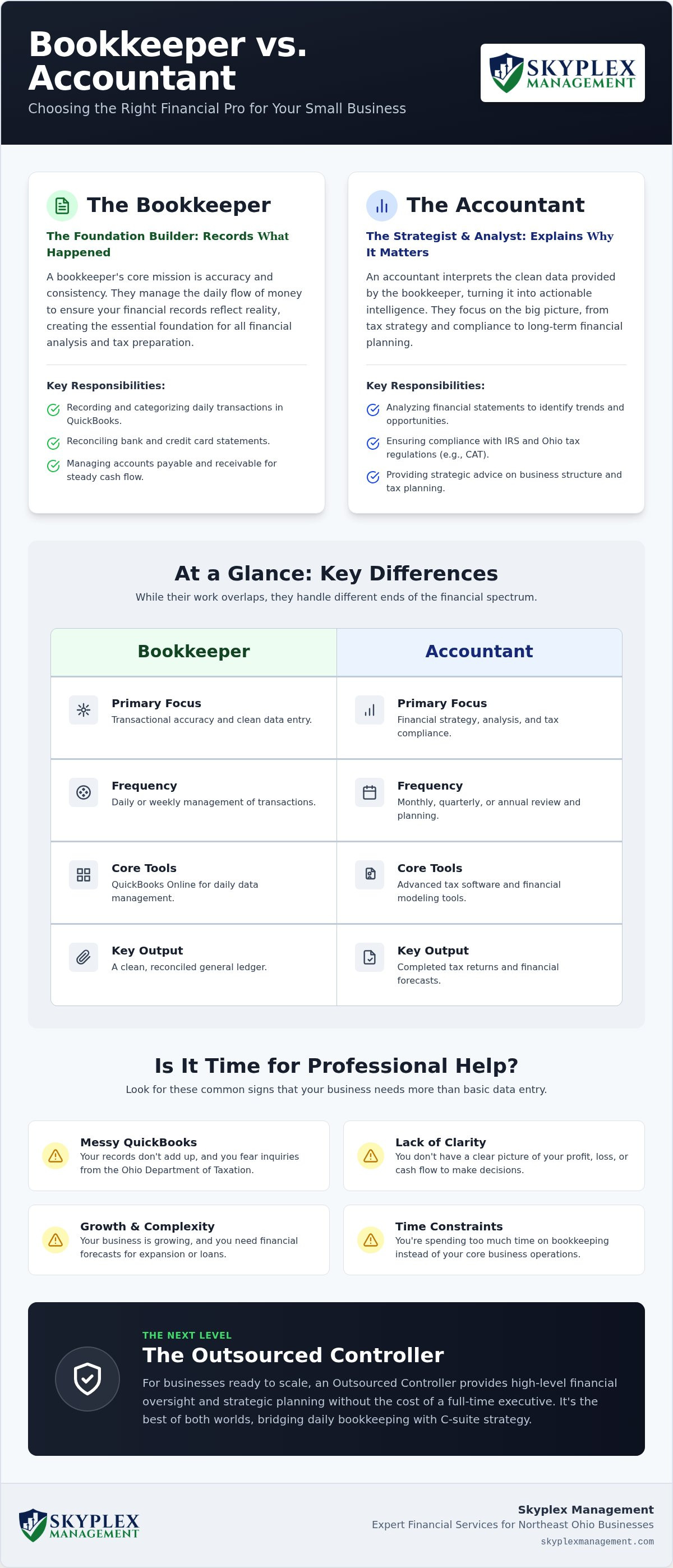
A bookkeeper's core mission is accuracy and consistency. They manage the daily inflow and outflow of every dollar to ensure your general ledger reflects reality. By following standard methods of bookkeeping, they provide the organized records necessary for any higher level analysis or tax filing.
- Recording daily transactions and ensuring every expense is properly categorized.
- Reconciling bank and credit card statements to catch errors or unauthorized charges.
- Managing accounts payable and receivable to keep your cash flow steady and predictable.
- Maintaining the general ledger so your financial history is always up to date.
Bookkeeping serves as the essential foundation of your company's financial health.
The Strategic Oversight of a Small Business Accountant
If the bookkeeper records what happened, the accountant explains why it matters. They take those clean records and turn them into actionable intelligence. For a business in Akron or Medina, this means looking at financial statements to spot trends before they become problems. They focus on the big picture, ensuring you stay compliant with the IRS and the Ohio Department of Taxation.
Their oversight typically includes:
- Analyzing profit and loss statements to identify growth trends or unnecessary overhead.
- Ensuring compliance with federal and Ohio specific tax regulations, such as the Commercial Activity Tax.
- Providing high level advice on business structure and tax planning to maximize your long term savings.
By interpreting your data, an accountant helps you make informed decisions about hiring, equipment purchases, or expansion plans. This oversight provides the peace of mind that your business is not just surviving, but moving in the right direction.
Bookkeeper vs. Accountant: A Side-by-Side Comparison for 2026
Choosing the right professional help depends on the specific needs of your operation. For an auto repair shop in Canton or a boutique in Hudson, the bookkeeper vs accountant for small business decision defines your daily efficiency. While their work overlaps, they handle different ends of the financial spectrum. The following table provides a quick reference to help you distinguish between these two vital functions in the 2026 business environment.
| Feature | Professional Bookkeeper | Small Business Accountant |
|---|---|---|
| Primary Focus | Transactional accuracy and data entry | Financial strategy and tax compliance |
| Frequency | Daily or weekly management | Monthly, quarterly, or annual review |
| Core Software | QuickBooks Online (Daily workflows) | Tax software and advanced reporting |
| Key Output | Clean ledger and reconciled accounts | Tax returns and financial forecasts |
Transactional Management vs. Financial Analysis
The core difference lies in how deep the professional dives into the "why" behind your numbers. A bookkeeper’s primary goal is to ensure that every dollar is accounted for and categorized correctly. This transactional precision keeps your bank reconciliations clean and your records audit-ready. According to the U.S. Bureau of Labor Statistics, Bookkeeping, accounting, and auditing clerks are the essential guardians of the data that every subsequent decision relies upon.
An accountant takes that clean data to answer strategic questions. They look for patterns in your cash flow to help you decide if you can afford to hire a new crew in Akron or invest in new diagnostic equipment for your shop in Medina. Accurate data entry is the only way to ensure your tax returns are reliable and your growth projections are based on reality. Without the bookkeeper's foundation, the accountant's strategy is merely a guess.
Compliance and Reporting Requirements
Reporting is a collaborative effort between these two functions. Your bookkeeper is typically the one who generates the essential documents, such as your Profit and Loss statement and Balance Sheet. These reports are the raw materials for your accountant, who then signs off on their validity and interprets the tax implications for the 2026 fiscal year. Understanding these documents is vital for any owner; for instance, a Small Business Balance Sheet Analysis can reveal hidden strengths or weaknesses in your company's equity that you might otherwise miss.
Hiring an accountant to do basic data entry is an expensive use of resources. Conversely, relying on a bookkeeper for complex tax strategy can lead to costly errors with the Ohio Department of Taxation. Most growing firms find that a hybrid approach is the most cost-effective way to gain both accuracy and foresight. If you're feeling overwhelmed by these financial choices, you can always reach out to our team to discuss which model fits your current stage of growth.
Signs Your Small Business Needs More Than Basic Bookkeeping
Many entrepreneurs in communities like North Royalton and Strongsville start by handling their own entries or hiring a part-time clerk. While this works during the early stages, the bookkeeper vs accountant for small business choice becomes more urgent as your operations gain complexity. You might notice that your bank balances don't quite match your software's reality or you're constantly worried about a surprise notice from the Ohio Department of Taxation. These aren't just minor inconveniences; they're signals that your business has outgrown its current financial structure.
Specialized industries face unique hurdles that demand more than basic recording. Whether you're managing a heavy equipment fleet for construction in Akron, tracking high-volume parts inventory for an auto repair shop in Medina, or balancing billable hours for a service-based firm in Cleveland, standard data entry often falls short. As you transition from survival mode to strategic scaling, the need for professional oversight becomes the bridge between daily survival and long-term stability.
The Danger of Messy QuickBooks Records
When your financial records are disorganized, the consequences go far beyond a cluttered screen. Reconciliation errors often hide significant cash flow leaks or lead to massive tax overpayments because you've missed valid deductions. This "financial fog" takes a heavy psychological toll, leaving you anxious and hesitant when it's time to make big decisions. If you've reached a point where you can't trust your profit and loss statement, it's time to learn How to Fix Messy QuickBooks Records through professional intervention. Clean data provides the clarity you need to lead your company with confidence.
Scaling Challenges in Cleveland and Akron Markets
Expanding a business in Northeast Ohio brings specific financial hurdles, such as managing complex payroll withholdings or staying ahead of 2026 regulatory shifts. Moving from a solo bookkeeper to a comprehensive firm like Skyplex allows you to access deep expertise in construction accounting and specialized service industry needs. This move resolves the bookkeeper vs accountant for small business dilemma by providing both functions under one roof, ensuring your data entry supports your high-level strategy.
This is where outsourced controller services become a strategic asset. A fractional controller handles the background complexities of your financial reporting and cash flow management without the overhead of a full-time executive hire. They act as a supportive partner, managing the technical details so you can focus on your core strengths and the individual success of your clients in the local market.
The Outsourced Controller: The Best of Both Worlds for 2026
When weighing the bookkeeper vs accountant for small business options, many owners feel trapped between basic data entry and expensive annual tax firms. The outsourced controller model breaks this binary by acting as your strategic financial partner. This role bridges the gap between daily recording and year-end filing, ensuring your records are not just accurate but also strategically meaningful. By providing high level oversight, a controller helps you understand the story behind your numbers long before you meet with your tax preparer.
For a growing company in communities like Richfield or Brecksville, having a professional who understands both the "how" and the "why" is invaluable. A controller ensures that the work of the bookkeeper is verified and that the data is ready for the accountant to use in tax planning. This collaborative approach removes the friction that often occurs when records are handed off at the last minute. It transforms your financial department from a historical record keeper into a forward looking engine for growth.
Expert Finance for Startups and Growing Firms
Growing businesses in Akron or Canton face operational risks that a standard bookkeeper might miss. Implementing strict internal controls is a priority for a controller to prevent fraud and clerical errors that could drain your cash reserves. They also lead the charge on detailed budgeting and forecasting for the 2026 fiscal year. This proactive planning is why many owners compare an Outsourced Controller vs. CFO to see which level of expertise fits their current trajectory in the Northeast Ohio market.
Fractional services are significantly more cost-effective than a full time hire. You gain access to a seasoned professional who can manage complex payroll or inventory systems without the burden of a six figure executive salary and benefits package. This model allows you to scale your financial support as your business grows, ensuring you always have the right amount of oversight for your specific needs.
Monthly Financial Strategy and Advisory
Waiting until April to talk to a professional is a recipe for missed opportunities and surprise tax bills. Monthly financial reporting allows you to adjust your strategy in real time based on actual performance. Custom reports help you decide when to invest in new service vehicles for your shop in Medina or when to expand your crew in Cuyahoga Falls. These insights turn a static balance sheet into a roadmap for your next big move.
Skyplex Management acts as an empowering expert for local owners, handling background complexities so you can focus on your core strengths and long term vision. We provide the professional descriptors of your business health that banks and investors look for, all while keeping the language grounded and practical. This ongoing advisory relationship ensures that you are never left guessing about the state of your company's finances.
Choosing Your Financial Partner in Northeast Ohio
Deciding on the right bookkeeper vs accountant for small business needs is a pivotal step toward scaling your operations without the stress of messy records. For owners in Cleveland, Akron, and Medina, the choice isn't just about technical skill. It's about finding a partner who understands the local economic landscape and the specific regulatory burdens placed on Ohio businesses. Skyplex Management specializes in bridging these roles to provide a seamless financial back office that grows alongside you.
Why Local Knowledge Matters for Ohio Businesses
Ohio’s tax structure is notoriously complex. This is especially true when you consider municipal income taxes and the 2026 updates to the Commercial Activity Tax. A national firm might miss the nuances of local filings in communities like Strongsville or Stow. A local expert ensures every deadline with the Ohio Department of Taxation is met with precision. You can learn more about our commitment to the region on the Skyplex Management About Page. This regional focus allows us to act as a dependable fixture in your community. We provide the peace of mind that your compliance is handled by someone who actually knows your neighborhood.
Mastery of tools like QuickBooks Online is non-negotiable. It's the engine that drives your financial reporting. We prioritize QuickBooks Online support and cleanup to ensure your data is always audit-ready and actionable. By streamlining these background tasks, we help you transition from a state of constant anxiety to one of proactive growth. Having a partner who can troubleshoot software issues in real time prevents small errors from snowballing into major headaches.
Next Steps: Reclaiming Your Time and Peace of Mind
Transitioning from DIY bookkeeping to professional oversight is the most effective way to reclaim your time. When you stop spending your Sundays reconciling bank statements, you can finally focus on your core business operations. Use this checklist when evaluating your next financial partner:
- Confirm they hold active QuickBooks Online certifications.
- Ask about their specific experience with service-based or construction accounting.
- Verify they provide monthly financial strategy sessions, not just historical data entry.
- Ensure they stay current on Ohio-specific regulations, such as the $6 million CAT exclusion threshold.
Reclaiming your peace of mind starts with a single conversation about your goals. We're here to handle the background complexities so you can lead with confidence. Contact Skyplex Management for a Financial Strategy Session to see how we can streamline your path to success.
Empowering Your 2026 Business Growth
Understanding the bookkeeper vs accountant for small business dynamic is the first step toward reclaiming your time and mental energy. By integrating transactional accuracy with high level strategic oversight, you move beyond mere survival and into a phase of intentional scaling. You now have the roadmap to choose the right level of support, whether it's cleaning up messy records or implementing a fractional controller model.
Skyplex Management has provided dependable, local expertise to Northeast Ohio owners since 2016. Our team offers QuickBooks Online Certified ProAdvisor support alongside comprehensive payroll and advisory solutions. We act as your dedicated partner, managing technical complexities so you can focus on your core strengths and your community.
Your business deserves financial records that drive growth rather than causing anxiety. We look forward to helping you achieve total peace of mind and long term success.
Frequently Asked Questions
Can a bookkeeper do my taxes for my small business?
A bookkeeper focuses on maintaining accurate daily records, but they typically do not file federal or state income tax returns. While they ensure your data is organized and tax-ready, an accountant or Enrolled Agent is usually required for final filing and strategy. This partnership ensures your records are precise throughout the year so your tax professional can maximize deductions without searching for missing receipts at the last minute.
How much does a bookkeeper vs. an accountant cost in 2026?
In 2026, industry data shows the average hourly rate for a bookkeeper in Ohio is approximately $23 per hour, with an annual salary around $48,080. In contrast, the median annual salary for an accountant in Ohio is roughly $79,320. These figures illustrate the significant cost difference between transactional recording and high level analysis. Many firms in Medina or Canton find that outsourcing these roles is more efficient than hiring full time staff.
Do I need an accountant if I use QuickBooks Online?
QuickBooks Online is a powerful tool, but it is not a replacement for professional oversight. The software records what you enter, but it cannot interpret complex tax laws or provide strategic growth advice. An expert ensures your software is configured correctly and that your reports are accurate. Without professional guidance, small errors in categorization can lead to significant compliance issues with the Ohio Department of Taxation.
What is the main difference between bookkeeping and accounting?
The main difference in the bookkeeper vs accountant for small business debate lies in the scope of work. Bookkeeping is the process of recording daily financial transactions and keeping the general ledger balanced. Accounting is the higher level analysis of that data to create tax strategies and financial forecasts. Think of the bookkeeper as the person who builds the foundation, while the accountant interprets the structural integrity of the entire business.
When should a small business hire a CPA?
You should consider a CPA when your business reaches a level of complexity that requires specialized tax representation or certified financial statements. While a professional bookkeeper manages your monthly reporting and payroll, a CPA is essential for navigating intricate federal regulations or representing you during an official inquiry. Most growing firms in Northeast Ohio benefit from a team approach that combines daily bookkeeping with periodic CPA level strategic review.
How do I know if my QuickBooks records need a professional cleanup?
Your records likely need a cleanup if your bank balances in the software do not match your actual bank statements. Other warning signs include a large volume of uncategorized transactions or profit and loss reports that simply do not look right. If your financial records cause anxiety rather than providing clarity, a professional cleanup can restore data integrity. This process ensures your records are accurate before you make major expansion decisions.
What are outsourced controller services?
Outsourced controller services provide high level financial management on a fractional basis. This role bridges the gap between basic data entry and annual tax filing by overseeing your internal controls, budgeting, and monthly reporting. It is a cost effective way for businesses in communities like Hudson or Brecksville to gain executive level financial strategy without the expense of a full time hire. This service effectively transforms your back office into a strategic asset.
Does Skyplex Management serve businesses outside of Cleveland and Akron?
Yes, Skyplex Management serves a wide range of communities across Northeast Ohio. We provide specialized support to business owners in Medina, Strongsville, Hudson, Stow, and Cuyahoga Falls. Our reach also extends to Canton, Wooster, and Richfield, ensuring local expertise is accessible throughout the region. Whether you are in Macedonia or North Royalton, our team is positioned to act as a dependable fixture in your specific geographic community.
Disclaimer
The information provided in this article is for general educational purposes only and should not be considered accounting, tax, or legal advice. Every business is unique. Consult a qualified accounting professional before making financial or tax decisions. Contact Skyplex Management for guidance specific to your business.


