

A sale does not fully support your business until the customer’s payment is recorded and available to support cash flow. Accounts receivable is money customers owe for goods or services already provided. To manage accounts receivable effectively, set clear payment terms, send accurate invoices promptly, match incoming payments to invoices, and follow up consistently on overdue balances.
It is easy to focus on the invoice and overlook the controls behind it. Clear records and timely follow-up help you spot disputes, see what remains outstanding, and make informed cash flow decisions. This guide explains how accounts receivable works and how payment processing, cash application, automation, collections, and internal controls fit together.
Key Takeaways
- Set payment terms customers can understand, then make it straightforward to pay and match each payment to the right invoice.
- Review customer credit risk and the mix of customers you rely on to spot potential collection concerns early.
- Use automation for routine reminders and payment records, while keeping a person involved when an account needs individual attention.
- Track overdue invoices by age and follow up promptly, with a consistent process for resolving disputes and discussing payment arrangements.
- Separate invoicing, payment recording, and account review where practical so errors and unusual activity are easier to catch.
Payment processing and cash application
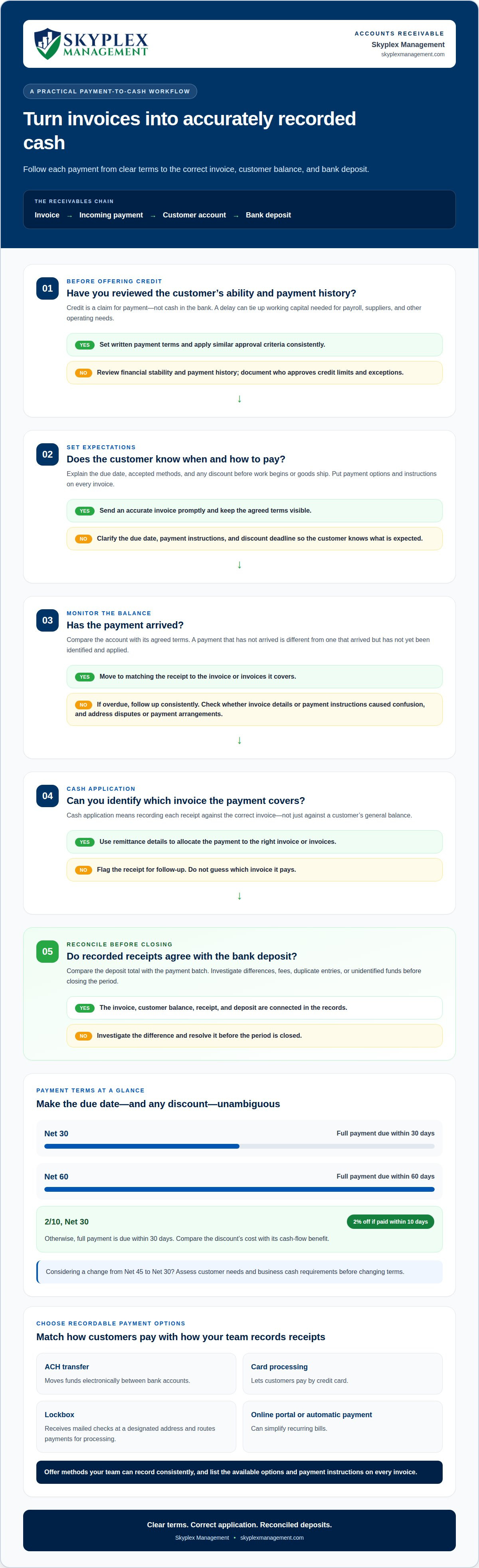
Payment processing covers how customers send money; cash application records each receipt against the right invoice. Both steps affect cash flow and the accuracy of customer balances. For example, a payment may reach the bank before anyone identifies which invoices it covers. Until staff apply it, the books may show an overdue balance even though the customer has paid. A reliable process connects the invoice, incoming payment, customer account, and bank deposit.
Payment terms make expectations specific. Net 30 means full payment is due within 30 days, while Net 60 allows 60 days. Under 2/10, Net 30, a customer receives a 2% discount for paying within 10 days; otherwise, full payment is due within 30 days. An early-payment incentive can support faster receipts, but compare the discount’s cost with its cash-flow benefit. If you are considering Net 45 to Net 30 terms, assess customer needs and business cash requirements before changing them.
Offer payment methods that suit how your customers operate. ACH transfers move funds electronically between bank accounts, while card processing lets customers pay by credit card. A lockbox service receives mailed checks at a designated address and routes payments for processing. Online payment portals and automatic payments can simplify recurring bills. Choose methods your team can record consistently, then list the available options and payment instructions on every invoice.
Apply each receipt to the corresponding invoice, not just to the customer’s general balance. If a customer sends one payment for several invoices, use the remittance details to allocate it correctly. If the details are missing, flag the receipt for follow-up rather than guessing. Then reconcile recorded receipts against bank deposits. For example, compare the deposit total with the payment batch and investigate differences, fees, duplicate entries, or unidentified funds before closing the period.
Preserve customer relationships with clear, consistent communication. Explain the due date, accepted methods, and any early-payment discount before work begins or goods ship. A 2/10, Net 30 offer works only when the customer understands that payment must arrive within 10 days to earn the discount. If a customer pays late, confirm whether an invoice detail or payment instruction caused confusion before escalating the conversation.
Train staff to explain payment terms consistently across sales, billing, and collections. Give them a sample invoice and ask them to identify its due date, payment options, and discount deadline. In a service business, staff can confirm the billing contact and preferred payment method when a job is approved. Clear handoffs set customer expectations and help the team record payments accurately.
What are accounts receivable?
Accounts receivable, or AR, is money customers owe for goods or services a business has already provided. It represents a claim for payment, not cash available in the bank. For example, when Company A sells $10,000 of goods on credit to Company B, Company A records $10,000 in accounts receivable. Company B records the same amount as accounts payable. If a business makes a $5,000 sale on net-30 terms, that balance remains receivable until the customer pays.
Offering credit lets customers buy before paying, but it also ties up working capital. When a customer pays later, less cash is available for payroll, suppliers, and other operating needs. Assess credit risk before extending terms by reviewing the customer’s financial stability and payment history. Consider whether the sale fits the customer’s ability to pay and whether your business can manage the delay. Even a familiar customer may need a fresh review if order size or payment behavior changes.
Written credit policies help staff make consistent approval decisions instead of relying on personal judgment. A practical policy can describe:
- Which customer information staff collect before approving credit.
- Who reviews applications and authorizes a credit limit.
- Which payment terms apply and how exceptions are approved.
- How staff respond when a customer misses a due date or disputes a charge.
For example, a policy might require a manager to review a request for longer payment terms before sales confirms the order. The goal is consistency: apply similar criteria to similar customers, and document any exceptions.
Customer screening can include checking business references, reviewing available financial information, and asking about expected purchasing volume. A new customer with limited payment history might start with a smaller credit limit, followed by a review once transactions establish a record. Existing customers also need monitoring. Compare invoice due dates with actual payment dates, note repeated short payments, and investigate shifts from reliable payment to growing past-due balances.
Set terms that reflect both customer expectations and the business’s cash needs. Net 30 means full payment is due within 30 days; it does not guarantee the customer will pay on time. Monitor each account against its agreed terms, and update limits when payment behavior, order size, or business circumstances change. Diversifying customers also helps reduce dependence on one buyer. If one customer accounts for much of expected sales, a delayed payment can put greater pressure on available capital.
If credit approvals, customer balances, and payment history are difficult to review together, discuss your receivables tracking needs with an accounting professional.
Accounts receivable automation
Accounting software improves receivables management by keeping invoice status, customer balances, and receipts together. Automation can handle repeatable tasks, such as recurring invoices and reminders, so staff can focus on exceptions and customer relationships.
Automated Invoices and Payment Reminders
Automated invoicing creates recurring invoices and sends payment reminders based on each invoice’s status. For a service business that bills the same customer regularly, scheduled invoices reduce manual entry and help prevent missed billing cycles. Reminder rules can send a notice before the due date and follow up when software marks an invoice overdue. Review the wording and timing to keep reminders accurate, professional, and consistent with agreed payment terms.
Automation and Collections Performance
Collections automation organizes follow-ups around invoice status. Days sales outstanding (DSO) measures the average number of days it takes to collect after a sale. Timely reminders can prompt customers to pay or raise a dispute sooner, giving staff a chance to resolve issues before balances age further. Compare DSO over time and investigate whether changes relate to billing delays, customer payment patterns, or unresolved invoices.
Automation also helps staff prioritize accounts instead of treating every overdue invoice alike. A system can group open invoices by age, amount, or customer history, then flag accounts that need a personal conversation. In 2026, accounts receivable tools can offer predictive insights to help identify accounts that may need a more personal approach. Use those signals as prompts for review, not as a substitute for understanding the customer’s circumstances.
Optical Character Recognition (OCR) can extract invoice or receipt details and reduce repetitive data entry. A practical workflow is to review the extracted fields, match the payment to the correct customer and invoice, then confirm the accounting record reflects the transaction. If software connects with an enterprise resource planning (ERP) system, shared invoice and payment information can reduce duplicate entry across financial processes. Staff should still investigate unmatched receipts and unusual balances.
Automation works best when customer records and invoice rules are kept current. An outdated billing contact, for example, can send an accurate reminder to the wrong person, while a duplicate customer record can split payment history. Assign responsibility for reviewing customer details, checking reminder templates, and resolving system exceptions. This keeps automated messages useful and helps prevent avoidable confusion from affecting customer relationships.
Review DSO monthly and examine a rolling 12-month view to distinguish a lasting collection trend from a short-term fluctuation. If DSO rises, trace open invoices back through the workflow: confirm invoices were issued, review delivery or billing disputes, and check whether reminders reached the right contact. Automation makes that review easier by keeping dates and statuses visible, while staff judgment determines what action fits each account.
Collections processes and overdue reminders
A consistent collection process starts before an invoice becomes overdue and gives each late account a clear next step. In the United States, applicable collection rules depend on who collects the receivable, the type of debt, and relevant state requirements. Keep communications accurate and professional, and have qualified legal counsel review policies before escalating collection activity.
Invoicing and Collection Practices
Invoicing and collection practices are the documented steps for issuing bills, tracking due dates, and following up on unpaid balances. Clear invoices give customers the information they need to pay without avoidable delays. Include the invoice number, due date, amount, and payment instructions, then retain the invoice and delivery record. The U.S. Government Accountability Office notes that financial systems can support aging accounts, calculating interest and overdue charges, and pursuing amounts due.
If a customer questions a service charge, for example, record the disputed line and assign someone to resolve it. Keep the undisputed amount visible so the full balance does not disappear from follow-up. Consistent records help staff explain what remains due.
Follow-Up and Escalation
Follow-up and escalation are planned contacts based on an account’s payment status. Contact the customer on the first day payment is late, using a polite reminder or phone call. Confirm that the invoice reached the right contact, ask whether there is a dispute or processing delay, and record the response. If the customer needs more time, document any agreed payment plan and its dates.
Escalate based on the account’s age, amount, and communication history, not frustration. A later notice can summarize prior contacts and explain the next step under your written policy. Avoid waiting until an invoice is 30 days past due before making the first contact.
Aging Reports and Collection Risk
An accounts receivable aging report sorts open invoices by how long they have remained unpaid, helping staff focus on rising collection risk. Common bands include current, 1 to 30 days, 31 to 60 days, 61 to 90 days, and over 90 days. Review the report weekly and assign follow-up to specific accounts, especially those entering the 60-plus-day range.
Compare current balances with earlier reports to spot patterns. If one customer’s invoices move from the 31-to-60-day band into 61-to-90 days, review payment history and unresolved issues before extending more credit. Record promised dates and missed commitments, so the next contact reflects the actual account history.
Collection Agencies as a Last Resort
A collection agency is an outside party a business may involve when direct, documented efforts have not resolved an overdue balance. Before referring an account, verify the invoice, delivery records, payment history, customer correspondence, and any dispute. A complete file helps explain the claim and prevents an unnecessary referral for a payment already received or a billing error that has not been resolved.
Consider the customer relationship and likely effects before escalating or referring an account. Legal action can be costly and may end the relationship, so weigh the outstanding balance and collection history against the value of continued business. Apply the same approval process to each referral and preserve records of the decision and account activity.
Accounts receivable best practices and internal controls
Strong receivables controls connect accurate billing, clear responsibility, and regular review. They help protect outstanding balances, reduce avoidable corrections, and support customer relationships. For example, a documented invoice approval step can catch an incorrect quantity before a bill reaches a customer. To manage accounts receivable effectively, start by assigning a clear owner to each control.
Start with the source transaction. Match each invoice to an approved sale, service record, or delivery confirmation, then review the customer, amount, and due date. Send accurate invoices promptly after delivery. Clearly show the payment amount, due date, and instructions, so customers can act without requesting missing details. Incorrect invoices or disputed charges account for 53% of late B2B payments, making invoice accuracy a practical control, not just an administrative preference.
Separate duties where practical. The person who approves customer credit or prepares an invoice should not be the only person recording receipts and reviewing account adjustments. In a small team, an owner or manager can review exception reports and unusual credits. For example, compare a credit memo with its supporting explanation before approving it. This additional review makes unauthorized changes and data-entry errors easier to spot.
Use a repeatable close process to confirm that the receivables ledger agrees with the general ledger. Review unapplied cash, credit balances, duplicate invoices, and write-offs before closing each period. Assign an owner and resolution date to every exception. A payment recorded to the wrong customer can distort both balances, so trace it to the source record and correct the account before relying on the report.
Document policies for invoice changes, customer credits, write-offs, and approval limits. Tell customers when payment is due, how they can pay, and what late-payment penalties apply. Review policies annually and update them when billing workflows or customer practices change. Train staff using a sample invoice and adjustment scenario, then retain approval records so every change has a clear reason and reviewer.
Measure control performance with a small set of consistent indicators. Review days sales outstanding monthly and examine a rolling 12-month view to spot changes over time. Track the share of receivables that remain current, disputed invoices, and write-offs. A target of more than 85% of accounts receivable outstanding current can help frame review, while a bad debt ratio target is less than 0.5% of total credit sales. Teams deciding how to manage accounts receivable effectively can treat a missed target as a prompt to investigate causes, such as billing errors or weak follow-up, rather than as proof of one specific problem.
For a practical review of your receivables controls, discuss your bookkeeping needs.
Skyplex Management: Small Business Bookkeeping
Skyplex Management helps small businesses across Northeast Ohio keep receivables records organized through Small Business Bookkeeping and Small Business Accounting. If invoices, customer payments, and outstanding balances are difficult to reconcile, consistent bookkeeping can clarify what has been billed, received, and remains due.
QuickBooks Online Support & Cleanup can help organize disordered records, while Payroll Service supports accurate payroll processing alongside routine accounting work. Keeping these financial tasks current gives owners clearer information for planning cash needs and reviewing customer balances. For businesses with growing transaction volumes or limited time for regular bookkeeping, outsourced support can bring structure to recurring records and reporting.
Contact Skyplex Management to discuss bookkeeping and accounting support for your business.
Make Receivables a Routine Part of Your Financial Planning
Set a regular time to review how receivables inform your business decisions. Assigning clear responsibility for follow-up and review helps prevent tasks from slipping between sales, billing, and bookkeeping. As your customer base or workload changes, revisit whether your process still gives you useful information for planning.
A practical approach to managing accounts receivable effectively connects the records to the decisions you make. Small Business Bookkeeping and Small Business Accounting can help maintain dependable financial records, while QuickBooks Online Support & Cleanup can help adapt a system that no longer fits your workflow. Skyplex Management provides these services to businesses seeking more organized accounting support.
Start with the part of your process that creates the most uncertainty, then consider how consistent records and oversight could help your team. A thoughtful next step can make financial decisions feel more manageable.
With a workable process in place, you can move forward with greater clarity.
Frequently Asked Questions
What is AR automation?
AR automation uses accounting software to handle repeatable receivables tasks, such as creating invoices, sending reminders, and recording payment information. It can also help staff identify records that need attention, including unmatched receipts or disputed bills. For example, a system might route an invoice with no payment match to a review queue instead of marking it resolved. Staff still need to check exceptions and decide how to handle customer-specific issues.
What are the common challenges of managing receivables?
Common challenges include slow customer payments, billing disputes, incomplete payment details, and records that do not match bank activity. These problems can compound: a missing purchase-order reference may delay approval, while a misapplied receipt can make a paid invoice appear outstanding. Investigate the underlying cause before escalating. Categorizing issues as billing, delivery, approval, or payment-recording problems helps pinpoint where a process needs attention.
What are the steps in the AR process?
The AR process follows a sequence from an approved sale through payment recording and account review. A useful workflow is:
- Confirm the sale, customer details, and billing basis.
- Issue the invoice and retain its supporting records.
- Track its status and address customer questions.
- Record the receipt, resolve any difference, and review the account.
For a service job, compare the final invoice with the approved work record before closing the customer balance.
Which AR KPIs Should a Finance Team Track?
Track days sales outstanding (DSO), accounts receivable turnover, aging balances, and write-offs to understand collection speed and risk. DSO equals average accounts receivable divided by net credit sales, multiplied by the number of days in the period. Turnover equals net credit sales divided by average accounts receivable. Read both alongside changes in sales volume: a higher receivables balance may reflect growth, slower collection, or both.
What are the best practices for managing accounts receivable?
Use written procedures, assign responsibility for exceptions, and connect supporting records to each customer account. One practical improvement is to tag disputes by cause, such as missing approval or incorrect service details, then review recurring patterns. This adds useful context beyond an overdue list. Teams can also record who approved adjustments so later reviewers understand why a balance changed.
How do you create an effective invoicing and billing process?
Build billing around a clear handoff from the person confirming completed work to the person preparing invoices. For each transaction, retain the contract or order, evidence of completion, and billing contact details. Before sending an invoice, compare it with those records and confirm the customer reference matches. For recurring work, review the billing schedule whenever the scope or customer contact changes.
What payment terms should small businesses offer customers?
Choose payment terms based on cash needs, customer payment history, the nature of the sale, and the time required to approve invoices. Net 30 and Net 60 are common structures, while 2/10, Net 30 offers a 2% discount for payment within 10 days. Apply terms consistently, document approved exceptions, and consider whether an early-payment discount is worth its effect on your margin.
How can businesses reduce days sales outstanding (DSO)?
Reduce DSO by cutting avoidable delays between completing a sale, issuing its invoice, and resolving questions that hold up payment. Identify the stage causing the delay before changing terms. If invoices are waiting for job completion records, for example, improve that handoff; if customer approvals are stalling, make invoice references easier to identify. Compare DSO with sales and dispute trends to see whether changes address the actual bottleneck.
Disclaimer
The information provided in this article is for general educational purposes only and should not be considered accounting, tax, or legal advice. Every business is unique. Consult a qualified accounting professional before making financial or tax decisions. Contact Skyplex Management for guidance specific to your business.


