
What if the most important document for your company's future isn't your bank statement or your latest sales report, but the one you usually ignore because it looks like a wall of accounting jargon? For many owners in Northeast Ohio, a small business balance sheet analysis feels like a chore rather than a strategy session. It's frustrating when messy QuickBooks data makes your reports feel unreliable, leaving you uncertain about whether your business is truly solvent or just treading water.
We understand that you started your business to serve your customers, not to spend your nights staring at assets and liabilities. This article will show you how to transform that confusing spreadsheet into a powerful diagnostic tool for your financial health. You'll learn how to gain absolute clarity on your business's net worth and how to spot red flags early. By the end, you'll have the technical mastery needed to speak with confidence when talking to lenders in Akron or Cleveland. We'll walk through the essential ratios, common cleanup mistakes to avoid, and how to use your balance sheet to fuel long term growth.
Key Takeaways
- Understand how a small business balance sheet analysis provides a real-time snapshot of your company's net worth and overall financial stability.
- Learn to identify and correct messy QuickBooks data so your financial reports are accurate enough for strategic decision-making.
- Master the Current and Quick ratios to evaluate your liquidity and ensure you can meet short-term obligations without stress.
- Recognize early financial red flags within your assets and liabilities to protect your business from insolvency.
- Build the confidence needed to discuss your financials with lenders in Cleveland and Akron by understanding the story behind the numbers.
What is a Small Business Balance Sheet and Why Does Analysis Matter?
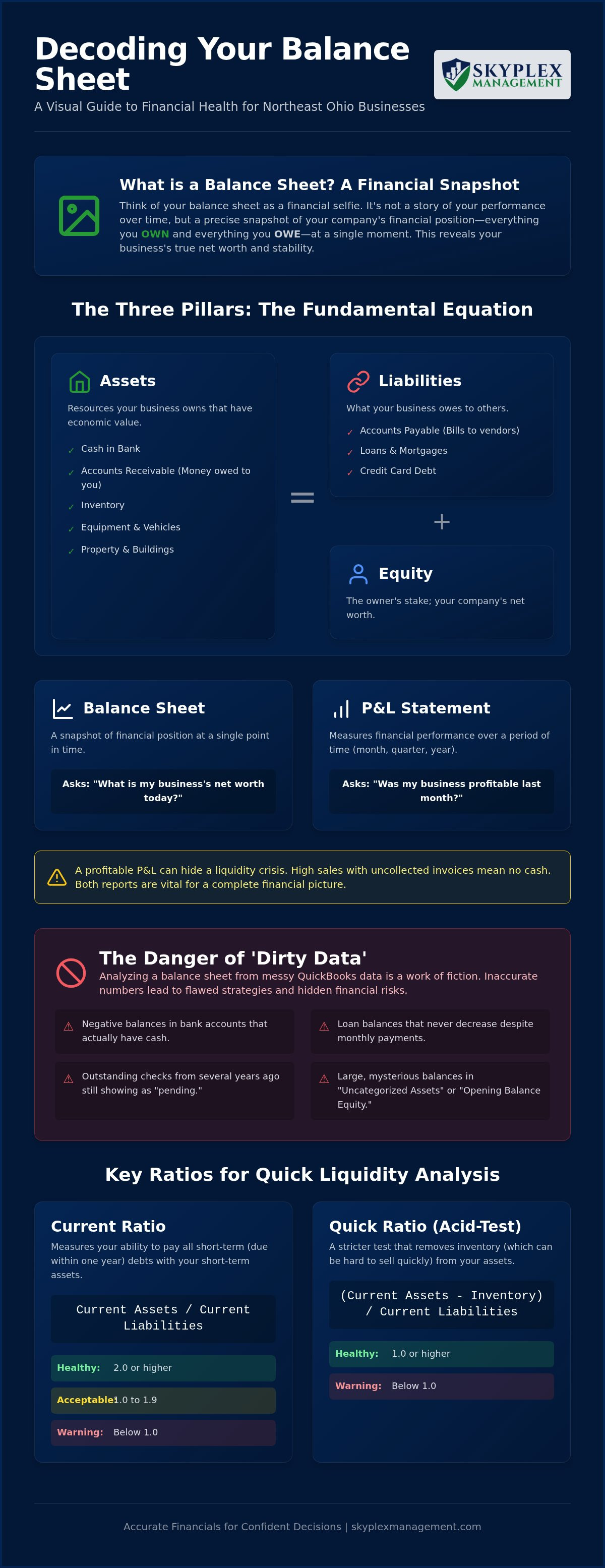
Think of your balance sheet as a financial selfie. Unlike your bank account, which only shows cash on hand, a balance sheet captures everything you own and everything you owe at a single moment. To understand What is a Balance Sheet?, you have to look at the three pillars: assets, liabilities, and equity. These must always stay in balance through the fundamental equation: Assets = Liabilities + Equity. This simple formula is the backbone of your entire financial structure.
For a local shop in Strongsville or a service firm in Hudson, performing a regular small business balance sheet analysis isn't just an academic exercise. It's how you determine if your business is solvent. Solvency means you have enough assets to cover your long-term debts. Without this clarity, you might find yourself struggling to secure an SBA 7(a) loan, especially with the 2026 prime rate sitting at 6.75%. Lenders want to see stability, and your balance sheet is the primary proof of your company's health and reliability.
Balance Sheet vs. Profit and Loss (P&L) Statement
Many owners confuse the P&L with the balance sheet, but they serve very different roles. Your P&L tracks performance over a period, like a month or a year. In contrast, the balance sheet shows your cumulative value. It's entirely possible to show a healthy profit on your P&L while your balance sheet reveals a crisis. For example, if you have high profits but all that cash is tied up in aging inventory or uncollected invoices, your balance sheet will show a liquidity problem that the P&L misses. These reports work together to provide a 360-degree view of your operations, helping you make smarter choices about growth and spending.
The Danger of Analyzing 'Dirty' Data
The biggest mistake we see is trying to analyze a report that's built on messy data. If your accounts aren't reconciled, your small business balance sheet analysis is essentially a work of fiction. Unreconciled transactions create "phantom" assets that don't exist or hide liabilities that could sink your cash flow. This is why professional QuickBooks reconciliation services are the essential first step. You can't make strategic decisions based on guesses. Common red flags that your data needs a professional cleanup include:
- Negative balances in bank accounts that actually have cash.
- Outstanding checks from several years ago still showing as "pending."
- Loan balances that never seem to decrease despite your monthly payments.
- Large balances in "Uncategorized Assets" or "Opening Balance Equity."
Cleaning up these records ensures your financial reporting reflects reality. It gives you the peace of mind to plan for taxes or expansion without worrying about hidden financial landmines.
The Three Pillars of Your Balance Sheet: Assets, Liabilities, and Equity
Every successful small business balance sheet analysis relies on a clear understanding of three primary categories. These pillars represent everything your company has, everything it owes, and the value that remains for you as the owner. By categorizing these items correctly, you gain a clearer picture of your financial strength and your ability to weather economic shifts in Northeast Ohio. The SBA provides excellent guidance on understanding your balance sheet to help you see how these numbers influence your borrowing power.
Assets are the resources your business uses to generate revenue. These range from the cash in your Huntington or KeyBank account to the equipment in your shop. On the other side of the ledger, liabilities represent your obligations to others, such as vendors, employees, or the bank. Equity is the residue; it's the 'book value' of your interest in the company after all debts are satisfied. Distinguishing between 'current' and 'long-term' items is essential for a proper small business balance sheet analysis, as it tells you how much cash you'll need in the next twelve months versus the next five years.
Managing Your Assets for Better Cash Flow
Your assets are tools for maintaining liquidity rather than just a list of items you own. Accounts Receivable is a critical asset for service-based businesses in Akron and Cleveland. If your AR balance grows too large, it means your cash is trapped in your customers' pockets instead of your own. Similarly, construction or auto repair shops must watch inventory levels to avoid tying up capital in parts or materials that aren't moving. Current assets are resources expected to be converted to cash within one year. Managing these effectively ensures you have the funds needed for daily operations and unexpected repairs.
Liabilities and the Burden of Debt
Liabilities are a standard part of business growth when managed with professional oversight. Current liabilities include items like payroll, sales tax owed to the state, and short-term vendor debt. Long-term liabilities usually involve multi-year commitments, such as commercial mortgages or SBA 7(a) loans. Many businesses in Medina and Cuyahoga Falls experience seasonal liability fluctuations, especially those in the landscaping or retail sectors. Balancing these debts is significantly easier when your records are accurate and up to date. If you find your debt levels are becoming difficult to track, it might be time to speak with a professional advisor about streamlining your financial reporting.
Key Financial Ratios for Small Business Balance Sheet Analysis
Raw numbers tell a story, but ratios provide the context you need to act. Performing a small business balance sheet analysis is about more than just checking your bank balance. It's about understanding the relationships between what you own and what you owe. These formulas act as a diagnostic health check for your company. They help you identify if you're over-leveraged or if you have enough breathing room to handle a slow month. For a deeper look at how these components interact, you can refer to the SBA's guide to understanding your balance sheet.
When you approach a lender in Akron or Canton for a line of credit, they don't just look at your revenue. They want to see your liquidity and solvency. Liquidity measures your ability to meet immediate obligations, while solvency looks at your long-term viability. By mastering a few key ratios, you can walk into those meetings with the confidence of a seasoned professional who knows exactly where their business stands.
Liquidity: Can You Pay Your Bills Tomorrow?
The Current Ratio is your first line of defense. You calculate it by dividing your current assets by your current liabilities. This number tells you if you can cover your upcoming debts using only the resources you expect to turn into cash within the next year. If your ratio is below 1.0, it's a major red flag. It means you owe more in the short term than you have readily available. This often leads to a stressful cycle of juggling payments just to keep daily operations running.
The Quick Ratio, often called the Acid-Test, goes a step further. It removes inventory from the equation, focusing only on cash and receivables. This is a more conservative look at your immediate liquidity. To improve these numbers without taking on more debt, consider these practical steps:
- Accelerate your accounts receivable by offering small discounts for early payment.
- Negotiate longer payment terms with your reliable vendors to keep cash in your pocket longer.
- Reduce excess inventory that isn't moving, as stale stock is essentially cash sitting on a shelf.
Solvency: Is Your Business Built to Last?
While liquidity handles tomorrow, solvency handles next year. The Debt-to-Equity ratio is a vital part of your small business balance sheet analysis because it shows how much of your growth is fueled by debt versus your own investment. High leverage can be risky, especially for service-based businesses in Northeast Ohio that may have fluctuating monthly billings. A healthy Debt-to-Equity ratio varies by industry but generally stays below 2.0 for stability. Keeping this ratio in check ensures you aren't over-burdened by interest payments that eat away at your hard-earned profits.
How to Perform a Balance Sheet Analysis in 5 Steps
Performing a small business balance sheet analysis doesn't have to be overwhelming if you follow a logical path. When you break the process down into manageable tasks, you'll find that the numbers start to tell a clear story about where your business is heading. This methodical approach ensures you aren't just looking at data, but gaining the clarity needed to make confident moves in the Northeast Ohio market. It's about moving from uncertainty to a position of strength where you can lead your company with precision.
Follow these five steps to conduct a thorough review of your financial position:
- Step 1: Verify and Reconcile. Ensure every account matches your bank and credit statements exactly.
- Step 2: Calculate Key Ratios. Use the formulas we discussed earlier to establish your current baseline.
- Step 3: Benchmarking. Compare your results to industry averages in cities like Akron or Medina to see how you stack up against peers.
- Step 4: Trend Analysis. Review your balance sheet side by side with the previous year's data to see the direction of your growth.
- Step 5: Identify Red Flags. Look for patterns of increasing debt or shrinking cash reserves before they become crises.
Step-by-Step Data Verification
Your analysis is only as good as the data behind it. Before you run any reports, you must check for unapplied payments or duplicate entries in QuickBooks that could skew your totals. It's also vital to verify that your loan balances perfectly match the year-end statements provided by your bank. Small discrepancies in these areas can lead to significant errors in your final ratios. Many owners find that professional ledger management is the best way to handle this phase, as it removes the burden of cleanup and ensures every transaction is accurately categorized.
Trend Analysis: Seeing the Big Picture
A single balance sheet shows you where you are, but a trend analysis shows you where you're going. By comparing your "Total Assets" year-over-year, you can measure the actual growth of your company's value. You should also watch if your liabilities are growing faster than your assets, which could signal that your debt is becoming unsustainable. Utilizing financial reporting and advisory services simplifies this small business balance sheet analysis, giving you a high-level view of your trajectory without the headache of manual spreadsheet work. This perspective is especially helpful when you're planning for seasonal shifts in Hudson or Cuyahoga Falls.
Finally, use your findings to spot red flags early. If your cash reserves are dwindling while your accounts payable is rising, you're looking at a potential liquidity crisis. Catching these issues now allows you to adjust your spending or collection strategies before they impact your ability to operate. This proactive mindset is what separates successful owners from those who are constantly reacting to financial surprises.
Leveraging Expert Analysis for Strategic Business Growth
While the steps for a small business balance sheet analysis are straightforward, the interpretation of that data is where many owners find the most value. It's one thing to calculate a current ratio; it's another to understand how a 1.2 ratio impacts your ability to hire a new crew in Medina next quarter. DIY analysis often misses the subtle financial warning signs, such as creeping debt or mismatched asset lifecycles, that a trained professional identifies instantly. By partnering with an expert, you move from simply maintaining records to using them as a roadmap for scaling your operations.
Utilizing outsourced controller services provides the high-level oversight your business needs without the cost of a full-time executive. We act as a bridge between your raw data and your long-term strategy. This partnership ensures your financial foundation is solid, which is critical since research from Investor Relations in May 2026 shows that 93% of small businesses expect growth this year. We help you stay ahead of the curve by turning your financial statements into a competitive advantage.
Custom Financial Reporting for Owners
Standard QuickBooks reports often leave owners with more questions than answers because they lack context. We specialize in creating custom financial reporting that translates rows of numbers into actionable insights tailored to your specific industry. Through monthly advisory meetings, we review your progress and adjust your strategy to keep you on track toward your goals. Having a professional second set of eyes on your books provides more than just accuracy. It offers the peace of mind that comes from knowing your financial health is being monitored by experts who understand the Northeast Ohio business climate.
Schedule Your Financial Health Assessment
Taking the next step toward financial clarity is a simple process. During a consultation with Skyplex Management, we'll review your current records to identify any immediate needs for cleanup or reconciliation. We don't just fix past mistakes; we provide ongoing business advisory to help you navigate future challenges with confidence. Whether you're based in Cleveland, Strongsville, or Akron, we're here to help you achieve a deeper understanding of your company's value.
Ready for clarity? Contact Skyplex Management today for a professional review of your financial statements and take the first step toward strategic growth.
Transforming Your Financial Data Into a Growth Engine
You've seen how a balance sheet is much more than a tax document. It's a living diagnostic tool that reveals your true net worth and solvency. By focusing on accurate reconciliation and monitoring key liquidity ratios, you protect your business from cash flow surprises. Mastering your small business balance sheet analysis gives you the clarity to make bold decisions for your company's future. It turns a static report into a roadmap for sustainable expansion.
Skyplex Management has spent nearly a decade helping owners in Cleveland, Akron, and Canton move beyond messy spreadsheets. We specialize in QuickBooks Online cleanup and provide strategic fractional controller services that turn confusing reports into actionable growth plans. You don't have to handle these technical complexities alone. Our team acts as your dedicated partner, ensuring your books are accurate and your strategy is sound.
Your financial peace of mind is within reach. We look forward to helping you build a more stable and profitable business right here in Northeast Ohio. Let's start building your financial legacy together today.
Frequently Asked Questions
What is the most important ratio in balance sheet analysis for a small business?
The Current Ratio is arguably the most critical metric for your daily peace of mind. It measures your ability to pay off short term debts with the assets you have on hand. For most businesses in Northeast Ohio, a ratio of 2.0 is considered healthy. This means you have twice as much in assets as you do in liabilities. Keeping this number strong ensures you can handle unexpected repairs or a slow sales month without panic.
Why does my balance sheet not match my bank account balance?
Your balance sheet includes several items that aren't reflected in your bank balance, such as accounts receivable and depreciation. It's a snapshot of your total value, not just your available cash. Timing differences also play a role; checks you've written that haven't cleared yet will lower your book balance while your bank balance remains higher. Regular reconciliation is the only way to ensure these two numbers eventually align and provide a clear picture.
How often should I perform a balance sheet analysis?
You should perform a small business balance sheet analysis at the end of every month. Waiting until tax season to review these numbers is a common mistake that leads to missed opportunities and hidden risks. Monthly reviews allow you to spot trends in your debt levels and cash reserves early. This consistency helps you make proactive adjustments to your spending and collection strategies before a small dip becomes a major financial hurdle for your company.
Does the IRS require a balance sheet for my small business taxes?
The IRS typically requires a balance sheet for corporations and partnerships with gross receipts or total assets exceeding $250,000. While sole proprietorships filing Schedule C might not be strictly required to submit one, maintaining an accurate balance sheet is still essential for professional record keeping. It provides the documentation needed if you're ever selected for a review or if you decide to apply for an SBA loan in the future.
What are 'red flags' I should look for on my balance sheet?
Negative owner's equity is a major red flag that suggests your business owes more than it's worth. You should also watch for accounts receivable that grow faster than your total sales; this indicates you're struggling to collect payments from customers. Another warning sign is a steady increase in long term liabilities without a corresponding increase in revenue generating assets. Spotting these issues early allows you to seek professional advice before your solvency is threatened.
Can I perform balance sheet analysis in QuickBooks Online automatically?
QuickBooks Online can generate the basic report automatically, but the software cannot interpret the data for you. A true small business balance sheet analysis requires a human touch to verify that every transaction is categorized correctly. Automated reports often hide errors like duplicate entries or unreconciled bank feeds. To get real strategic value, you need to look beyond the automated totals and understand the reason behind your changing asset and liability balances.
What is the difference between current and non-current liabilities?
Current liabilities are debts you must pay within the next twelve months, such as accounts payable and short term loans. Non-current liabilities, also known as long term debts, are obligations that extend beyond one year. This distinction is vital for managing your cash flow. Knowing exactly when your debts are due helps you plan your capital expenditures and ensures you always have enough liquidity to meet your immediate financial commitments in Cleveland or Akron.
How do I fix a balance sheet that doesn't actually 'balance'?
Modern software like QuickBooks is designed to always balance, so a discrepancy usually points to a data entry error or a broken link in your accounts. You should start by checking your Opening Balance Equity account for unexpected entries. Often, an out of balance report is caused by a manual journal entry that only hit one side of the ledger. Fixing these errors usually requires a professional cleanup to ensure your historical data is accurate and reliable for future planning.
Disclaimer
The information provided in this article is for general educational purposes only and should not be considered accounting, tax, or legal advice. Every business is unique. Consult a qualified accounting professional before making financial or tax decisions. Contact Skyplex Management for guidance specific to your business.


