
Imagine opening your mail in Cuyahoga Falls and finding a notice from RITA claiming thousands in unpaid municipal taxes, despite your best efforts to keep clean records. It's a stressful scenario that many local owners face when they inadvertently fall into common small business payroll mistakes. You started your company to build something meaningful, not to spend your weekends deciphering the Ohio Department of Taxation's latest bulletins or manually double-checking data entry in a spreadsheet. The complexity of managing payroll in 2026, especially with Ohio's move to a flat tax rate and shifting local requirements, can feel like a heavy burden on your shoulders.
This guide will show you how to identify and fix these frequent errors before they lead to IRS audits or costly state penalties. We'll explore the critical shifts in 2026 regulations, from the updated $10.65 minimum wage to RITA and CCA compliance. You'll gain a clear path to streamlined administrative workflows that keep your employees paid correctly and give you back your peace of mind. By the end of this article, you'll have a practical roadmap to navigate the high-stakes intersection of local tax law and clean financial records.
Key Takeaways
- Learn how to avoid common small business payroll mistakes like worker misclassification to protect your firm from unexpected IRS audits and back taxes.
- Navigate the complexities of Ohio’s municipal tax system, ensuring accurate RITA and CCA filings for employees who live and work in different Northeast Ohio communities.
- Understand why reconciling payroll within QuickBooks Online is essential for eliminating "shadow records" and maintaining clear visibility into your actual cash flow.
- Stay ahead of 2026 regulatory changes, including updated state minimum wage requirements and overtime coding, to maintain employee morale and legal compliance.
- Discover how professional payroll oversight shifts your focus from tedious data entry to strategic growth, providing the peace of mind that comes with expert financial management.
Why Payroll Accuracy is the Foundation of Small Business Stability
For most service-based businesses in Northeast Ohio, payroll is the single largest expense on the profit and loss statement. It's also the area where a single oversight can lead to the most significant compliance risks. When you manage a team in Cleveland or Akron, you aren't just cutting checks; you're managing a complex web of federal, state, and local obligations. Payroll compliance is the adherence to federal, state, and local labor laws. While it sounds straightforward, the 2026 regulatory environment demands more digital transparency than ever before. The IRS and the Ohio Department of Taxation have moved toward modernized, real-time reporting systems that leave very little room for the common small business payroll mistakes that used to fly under the radar.
One small error in a spreadsheet creates a ripple effect that touches every corner of your business. If a worker's hours are miscalculated, your payroll tax liabilities become inaccurate, your workers' compensation premiums may be misquoted, and most importantly, your employee's trust is shaken. Stability comes from knowing your records are bulletproof, allowing you to focus on growth rather than damage control. Developing a deep baseline for understanding payroll taxes is a vital first step for any owner who wants to protect their company's financial health.
The True Cost of Payroll Non-Compliance
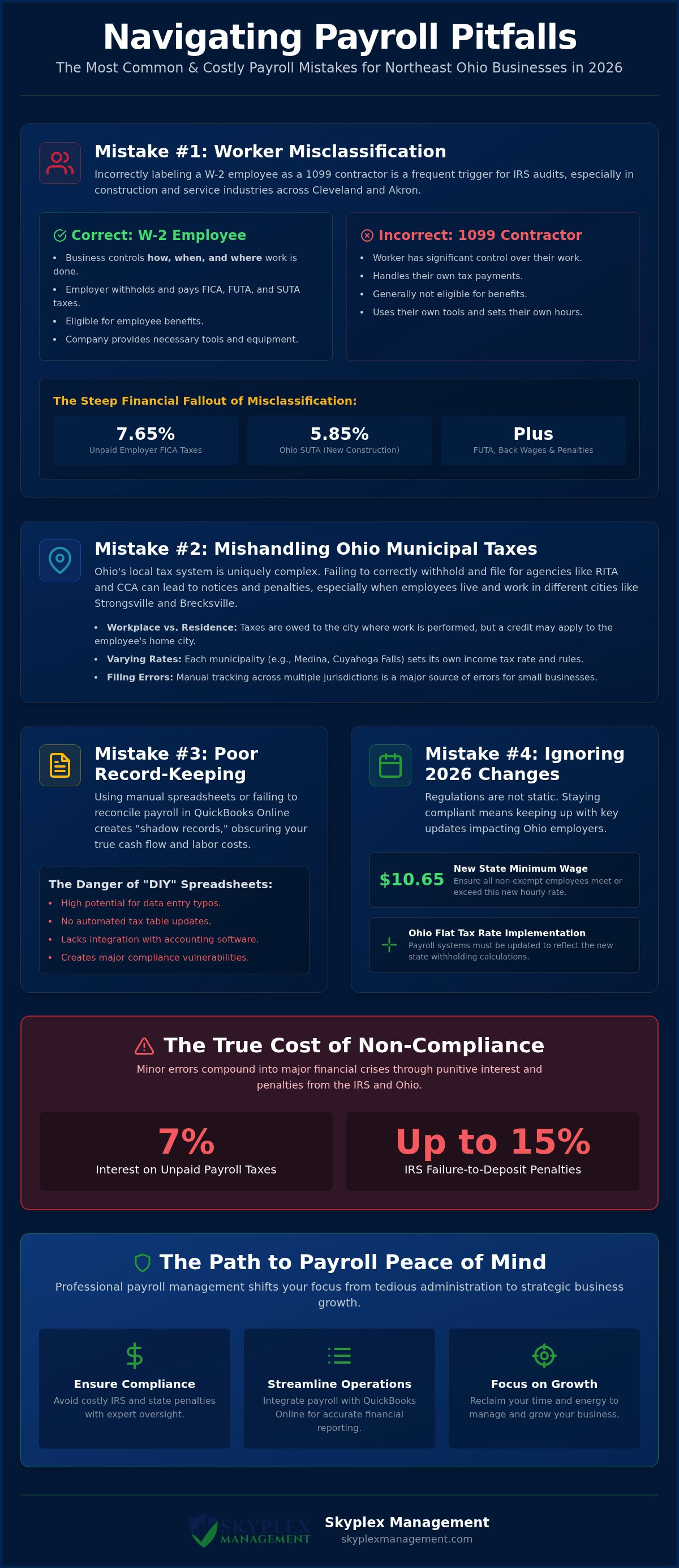
The financial penalties for payroll errors are designed to be punitive. As of July 2026, the interest rate on unpaid payroll taxes sits at 7%, and the IRS failure-to-deposit penalties can climb as high as 15% if a notice goes ignored for more than 10 days. These costs compound quickly, turning a minor clerical slip into a major cash flow crisis. Beyond the numbers, legal liabilities under the Fair Labor Standards Act (FLSA) can lead to expensive litigation or back-pay requirements. Your reputation in communities like Medina or Strongsville depends on being a reliable employer. Inconsistent pay or tax errors can drive away your best talent, leading to high turnover costs that far exceed any tax penalty.
Moving Beyond Manual Spreadsheets
The Most Common Employee Classification and Data Entry Blunders
Administrative slip-ups often feel minor until they trigger a formal notice from the IRS or the Ohio Department of Taxation. Misclassifying workers is one of the most common small business payroll mistakes, particularly in the construction and service sectors throughout Cleveland and Akron. Many owners mistakenly believe that simply signing a contract makes someone an independent contractor. However, the IRS prioritizes the actual nature of the working relationship over any written agreement. If you control when, where, and how a person performs their job, they're likely an employee, not a contractor.
The financial fallout of misclassification is steep. When a worker is reclassified from a 1099 contractor to a W-2 employee, the business becomes liable for the unpaid employer share of FICA taxes, which is 7.65% for Social Security and Medicare, plus the employee's share if it wasn't withheld. Combined with federal unemployment (FUTA) and Ohio's 2026 SUTA rates, which are 5.85% for new construction firms, the back-tax bill can easily cripple a growing company's cash flow.
W-2 vs. 1099: The Mistake That Triggers Audits
The IRS "Right to Control" test is the primary tool used to identify these common small business payroll mistakes. In industries like auto repair or home services in Medina and Strongsville, the line often blurs. If you provide the shop tools, set the shift schedule, and supervise the daily workflow, that worker is an employee. Beyond back taxes, you may also be liable for unpaid workers' compensation premiums and employee benefits. Ensuring your team is classified correctly from the start is the only way to avoid these compounding liabilities.
Overtime and Hourly Calculation Errors
Hourly calculations present another set of risks, especially regarding overtime. Many private-sector employers in Canton or Hudson mistakenly offer "comp time" in lieu of overtime pay, but this practice is generally prohibited under the Fair Labor Standards Act. You must also be careful with employees who work at multiple pay rates. For example, if a staff member earns $20 per hour for specialized service work and $15 per hour for administrative tasks, their overtime must be calculated using a weighted average of both rates, not just the lower one.
Accurate record-keeping is your best defense against wage claims. Staying current with federal payroll requirements helps you maintain the necessary documentation for SSN verification and withholding forms. You must also manage payroll garnishments, such as child support or tax levies, with absolute precision. Missing a court-ordered deadline can make your business legally responsible for the employee's personal debt. If these administrative details are taking too much time away from your core business, scheduling a consultation can help you implement a more reliable system.
Navigating Ohio’s Unique Payroll Tax Compliance Challenges
Operating a business in Northeast Ohio requires navigating one of the most complex municipal tax systems in the country. Unlike many states where tax collection stops at the state level, Ohio allows hundreds of cities to levy their own income taxes. Failing to track where your employees actually perform their work is one of the most common small business payroll mistakes that leads to unexpected delinquency notices. The burden falls on you to ensure that every dollar is sent to the correct agency, whether it's the city of Cleveland or a smaller township.
If your employee lives in Akron but works at your office in Cleveland, you must handle withholding for both jurisdictions correctly. While reciprocity agreements can sometimes simplify things, they don't always eliminate the filing requirement. The IRS often highlights costly tax errors for small businesses, and in Ohio, failing to register with the correct local agency is a frequent trap for new owners. Staying current with the Ohio Department of Taxation's 2026 reporting requirements is essential for maintaining your standing as a compliant employer.
Managing RITA and CCA in Cleveland and Akron
Agencies like the Regional Income Tax Agency (RITA) and the Central Collection Agency (CCA) manage filings for dozens of communities, including Strongsville, Medina, and Hudson. One of the most common small business payroll mistakes in our region is withholding tax only for the city where the business is headquartered while ignoring the city where a remote employee works. Your payroll system must be configured to track work-location versus home-location with precision to avoid double-taxation or under-withholding penalties that frustrate staff and attract audits.
Ohio Workers' Compensation and Unemployment Insurance
Beyond municipal taxes, you must stay current with the Ohio Bureau of Workers' Compensation (BWC) and the Department of Job and Family Services. For 2026, the SUTA taxable wage base is $9,500 per employee, and new construction firms face a rate of 5.85%. Missing these quarterly deadlines triggers late fees and interest that compound quickly. This is why a Cleveland-based bookkeeping partner who understands these specific local nuances is often more effective than a generic national service. They can help you manage these background complexities so you can focus on serving your customers.
Record-Keeping Failures and the Risk of Messy QuickBooks Data
Many business owners in Northeast Ohio treat payroll as a separate island, keeping records in spreadsheets or third-party portals while neglecting their main accounting ledger. This "shadow payroll" is one of the most common small business payroll mistakes because it creates a massive disconnect between your bank balance and your financial reports. When your payroll data doesn't live inside your accounting system, you lose visibility into your true labor costs, making it nearly impossible to manage cash flow accurately in a competitive market like Cleveland or Akron.
The danger of phantom cash flow is real. If you fail to reconcile your payroll bank accounts monthly, your books might show a healthy balance that doesn't account for uncleared tax payments or pending direct deposits. This lack of oversight leads to year-end tax filing nightmares where your W-2 totals don't match your general ledger. You should also remember the IRS 4-year rule. While many believe three years of record retention is sufficient, the IRS actually requires you to keep all employment tax records for at least four years after the tax becomes due or is paid, whichever is later.
Integrating Payroll with QuickBooks Online
Avoiding the "double entry" trap is essential for scaling your business in communities like Strongsville or Brecksville. When you sync your payroll provider with QuickBooks Online, every wage payment, tax withholding, and benefit contribution should map automatically to the correct account. Common mapping errors often result in employer taxes being lumped in with gross wages, which distorts your financial reporting. Investing in a professional QuickBooks Online cleanup ensures your chart of accounts is structured correctly before you run your next pay cycle.
The Audit Trail: What the IRS Actually Looks For
In the event of an audit, the IRS looks for a clear trail that connects your bank statements to your tax filings. They pay close attention to non-taxable reimbursements and fringe benefits. If you're paying for an employee's cell phone or travel without proper documentation, the IRS may reclassify those payments as taxable income, triggering back taxes and penalties. Accurate time-tracking logs are also mandatory for all hourly staff to prove compliance with overtime laws. Providing consistent financial oversight ensures that every transaction is backed by a digital paper trail, protecting your business from the "he-said, she-said" of a wage dispute.
How Professional Payroll Management Protects Your Business Growth
Moving beyond the stress of compliance allows you to view payroll as a strategic asset rather than a monthly chore. When you transition from a basic payroll processor to a strategic financial partner, you gain a clearer picture of your company's trajectory. Most owners in Northeast Ohio reclaim more than 10 hours a month by outsourcing their tax compliance and administrative tasks. This time is better spent on business development in communities like Stow or Cuyahoga Falls, where your presence directly impacts growth and team leadership.
Accurate payroll data is the fuel for effective cash flow forecasting. By integrating your labor costs directly into your financial reporting, you can predict exactly how much cash is needed for upcoming tax liabilities and benefit contributions. This level of oversight is a core benefit of working with an Outsourced Controller. They help you manage labor costs in real-time, ensuring that your payroll stays aligned with your revenue goals and protecting you from the common small business payroll mistakes that drain capital and stall momentum.
Proactive vs. Reactive Payroll Management
Reactive management means waiting for a notice from the city of Akron to fix a withholding error. Proactive management involves identifying tax-saving opportunities through optimized benefit structures before the year ends. Planning for the 2026 Ohio minimum wage increase to $10.65 per hour requires looking at your budget now, not when the first January paycheck is due. You can also use detailed payroll reporting to analyze department-level profitability, showing which service lines are generating the best returns.
Your Next Steps for a Clean Payroll System
Cleaning up your system starts with a mini-audit of your current employee files and tax settings. You should verify that your withholding forms match the current 2026 rates and that your software correctly handles the unique RITA and CCA requirements we discussed earlier. If your current provider struggles with Ohio’s multi-city filings, it may be time to evaluate a more specialized local solution. A clean system doesn't just prevent common small business payroll mistakes; it provides the stability you need to lead with confidence.
Securing Your Business with Proactive Payroll Oversight
Managing payroll in 2026 requires a balance of technical precision and local tax knowledge. By cleaning up your records and ensuring your team is classified correctly, you eliminate the most common small business payroll mistakes that lead to costly audits. You've worked hard to build your reputation in communities like Cleveland and Akron. Protecting that legacy means staying ahead of shifting regulations, from RITA and CCA filings to Ohio's updated minimum wage requirements.
At Skyplex Management, we bring nearly a decade of experience to your back office. As Certified QuickBooks Online ProAdvisors, we specialize in the specific municipal tax nuances that national providers often overlook. We handle the background complexities so you can focus on the work you love. Whether you're in Medina, Strongsville, or anywhere in Northeast Ohio, we're your local safeguard against regulatory headaches. Our team provides the peace of mind you need to grow without the fear of IRS penalties.
Your business deserves a foundation of stability and professional oversight. We're here to help you navigate every tax change with confidence and ease. Let's work together to keep your finances clear and your employees happy.
Frequently Asked Questions
What are the most common payroll tax penalties for Ohio small businesses?
The most common payroll tax penalties in Ohio include failure-to-file and failure-to-pay assessments. For 2026, the failure-to-file penalty is the greater of $50 per month, up to a $500 limit, or 5% per month of the tax due. Failure-to-pay penalties typically reach 10% of the delinquent amount plus double the applicable interest rate. These costs add up quickly, making it essential to avoid common small business payroll mistakes related to filing deadlines.
How long should I keep payroll records for my Cleveland-based business?
You should keep all employment tax records for at least four years after the tax becomes due or is paid. This includes time-tracking logs, tax forms, and copies of issued W-2s. For a Cleveland-based business, maintaining these records digitally within your accounting software provides a secure audit trail. While federal law requires four years, keeping these documents for up to seven years is often recommended to handle potential state-level inquiries or workers' compensation audits.
What is the difference between RITA and CCA in Ohio payroll?
RITA and CCA are two separate agencies that collect municipal income taxes for different Ohio communities. While they serve similar functions, they represent different cities and have unique filing portals. For example, Brecksville uses RITA, while Cleveland typically utilizes CCA. You must determine which agency oversees the specific cities where your employees live and work to ensure your withholdings are sent to the correct entity and avoid delinquency notices.
Can I be held personally liable for payroll tax mistakes?
Yes, business owners and responsible parties can be held personally liable for unpaid payroll taxes through the Trust Fund Recovery Penalty. The IRS views withheld taxes as money held in trust for the government. If these funds aren't paid, the agency can look past the corporate shield and pursue the personal assets of those responsible for the financial decisions. This risk underscores why professional oversight is vital for maintaining compliance and protecting your personal financial health.
How do I fix a payroll mistake after the checks have already been issued?
You can fix a payroll mistake after issuance by either voiding and reissuing the check or making a catch-up adjustment in the next pay cycle. If the error involves an underpayment, issuing a manual check immediately is often the best way to maintain employee morale. For overpayments or tax withholding errors, you'll need to record a manual adjustment in your accounting software to ensure your quarterly filings remain accurate and your bank reconciliation stays clean.
Is it better to handle payroll in-house or outsource it in 2026?
Outsourcing is generally the superior choice in 2026 due to the increasing complexity of multi-city tax regulations and automated IRS reporting. Handling payroll in-house often leads to common small business payroll mistakes when owners miss updated state rates or local filing deadlines. By partnering with a local firm, you reclaim significant administrative time and gain the security of expert oversight. This allows you to focus on high-level strategy while professionals manage background complexities.
What happens if I misclassify an employee as an independent contractor?
Misclassifying an employee as an independent contractor triggers a liability for unpaid employer taxes, back wages, and workers' compensation premiums. You'll be responsible for the 7.65% employer share of FICA taxes plus the employee's portion if it wasn't withheld. Additionally, the Ohio Bureau of Workers' Compensation may assess penalties for missing coverage. These financial burdens often exceed the cost of simply hiring the worker as a W-2 employee from the beginning.
How does QuickBooks Online handle local Ohio municipal taxes?
QuickBooks Online automates federal and state tax filings, but it requires precise manual setup to handle Ohio's specific municipal taxes correctly. You must manually map each employee to the correct RITA or CCA jurisdiction based on their work and home addresses. Without this specialized configuration, the software may miss local withholding requirements. Working with a ProAdvisor ensures your system is mapped accurately, preventing the local tax notices that often plague Northeast Ohio business owners.
Disclaimer
The information provided in this article is for general educational purposes only and should not be considered accounting, tax, or legal advice. Every business is unique. Consult a qualified accounting professional before making financial or tax decisions. Contact Skyplex Management for guidance specific to your business.


