
Did you know that a staggering 82% of businesses fail not because they lack customers, but because of poor cash flow management? It's a frustrating reality for many owners in Cleveland and Akron who see high revenue on paper but feel a constant tightening in their bank accounts. When you're busy serving clients, it's easy to fall into the common financial mistakes small businesses make, such as neglecting messy QuickBooks records or feeling confused by evolving Ohio tax compliance.
You've worked hard to build your brand, and you deserve to lead with confidence rather than a constant fear of an IRS audit. This guide will identify the hidden traps draining your profits and show you how professional advisory services can transform your books into a strategic growth engine. We'll explore the 2026 tax landscape, the path to audit-ready records, and how a dedicated financial partner gives you the freedom to grow your business in communities like Medina and Strongsville without the background noise of accounting stress.
Key Takeaways
- Learn why mixing personal and business funds is a major IRS red flag and how to establish clear boundaries for audit-ready records.
- Understand the critical difference between profit and cash flow to ensure your business stays liquid during growth phases.
- Discover how to identify and correct the common financial mistakes small businesses make before they lead to costly penalties or stagnant revenue.
- Navigate Ohio payroll compliance by correctly classifying workers and meeting state-specific filing requirements.
- See how professional advisory services transition your role from a stressed bookkeeper to a strategic leader focused on long-term expansion.
The Hidden Cost of Common Financial Mistakes Small Businesses Make
Financial errors are rarely just simple "math problems." In reality, they act as invisible growth inhibitors that prevent you from reaching your full potential. For many owners in Cleveland and Akron, the common financial mistakes small businesses make often start as small oversights but eventually lead to missed opportunities and stalled expansion. By 2026, the competitive landscape in Northeast Ohio requires more than just basic record-keeping; it demands precision and a clear understanding of small and medium-sized enterprise (SME) finance to stay ahead of the curve.
Messy books take a heavy psychological toll on a leader. When you aren't sure where your money is going, a constant sense of anxiety sets in, which often leads to owner burnout. This uncertainty forces you into "reactive mode," where you make poor decisions because you're operating in a fog. There is a vast difference between simply "keeping the books," which is just recording history, and strategic financial management. Strategic management involves using business advisory services to look at the "why" behind the numbers to predict your future success.
The Ripple Effect of Inaccurate Data
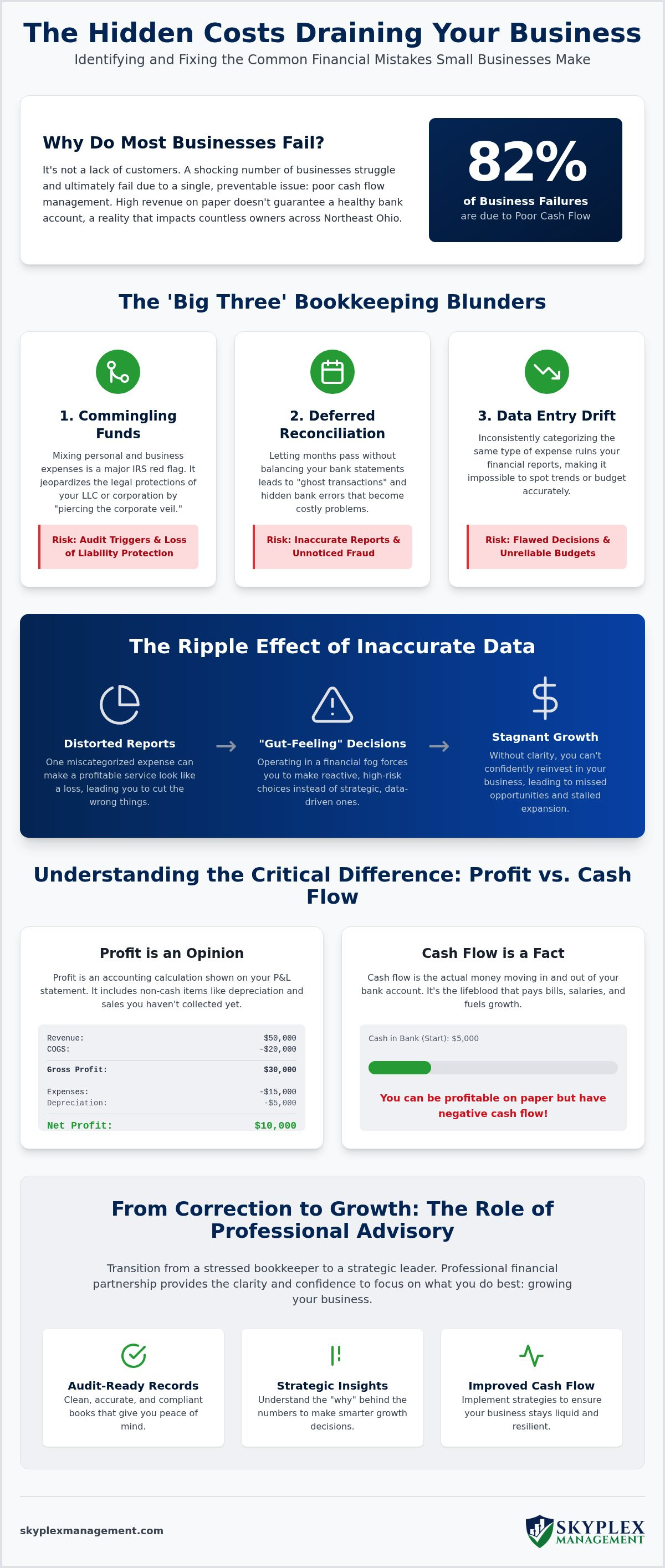
One miscategorized expense might seem minor at the moment, but it can distort your entire Profit and Loss report. If your data is skewed, you might believe a specific service line is profitable when it's actually draining your resources. Making "gut-feeling" decisions based on flawed financial statements is a dangerous gamble that often backfires when it's time to reinvest. Financial clarity is the foundation of sustainable business scaling.
Why 'Doing It Yourself' Often Costs More
Many entrepreneurs in Medina and Strongsville try to save money by handling their own accounting, but they rarely calculate the opportunity cost. If your value as a business owner is high, spending several hours a week struggling with software is an expensive way to manage a ledger. It's also a leading cause of the common financial mistakes small businesses make, as technical errors can snowball over time.
Common DIY errors in QuickBooks Online, such as incorrect bank feed mappings or duplicate entries, often require professional small business accounting services to clean up later. Investing in a professional ledger management system from the start provides the stability needed for long-term growth. When a professional handles the background complexities, you gain the freedom to focus on your core strengths while knowing your records are audit-ready and accurate.
The 'Big Three' Bookkeeping Blunders to Avoid
While the hidden costs discussed earlier are broad, the technical errors that cause them are often very specific. Three primary bookkeeping blunders consistently appear when we review records for local businesses in Brecksville and Richfield. These aren't just minor slips; they are among the most common financial mistakes small businesses make that directly impact your bottom line and tax liability. Understanding these traps is the first step toward building a more resilient organization.
First is commingling. Mixing personal and business expenses is a major IRS red flag because it suggests a lack of corporate formality. If you pay for personal groceries with your business debit card, you risk "piercing the corporate veil," which can jeopardize the legal protections of your LLC or Corporation. Second is deferred reconciliation. Letting months pass without balancing your bank and credit card statements against your ledger leads to "ghost transactions" and hidden bank errors that go unnoticed until they become expensive problems. Finally, data entry drift occurs when you categorize the same type of expense differently each month. This inconsistency ruins your monthly financial reporting, making it impossible to spot trends or budget accurately. We also frequently see the "ghost asset" problem, where owners fail to track depreciation or remove disposed equipment from their records, resulting in an overvalued business and unnecessary tax payments.
The QuickBooks Cleanup: Reversing Historical Errors
If your balance sheet shows accounts with negative balances that should be positive, or if your "uncategorized expenses" folder has grown into a mountain of data, your records likely need a professional "deep clean." Signs that you need QuickBooks Online support & cleanup include unbalanced accounts and a persistent fear that your tax filings are based on guesswork. We help owners in Hudson and Stow by performing a thorough historical data cleanup, ensuring every transaction is verified for accurate year-over-year comparisons. This process provides the reliable data you need to make informed growth decisions in 2026.
Establishing Clear Boundaries with Business Accounts
Correcting these blunders starts with a dedicated business structure. If you're still using a single account for everything, the transition begins with opening separate business checking and savings accounts. Using a business credit card for all company-related purchases simplifies categorization and keeps your personal life separate from your professional one. Understanding the truth behind your numbers is essential for success, and debunking certain misconceptions is a great place to start, as explored in our guide on improving business financial clarity: 5 dangerous myths about small business metrics. If you aren't sure if your current account structure is audit-ready, a quick professional review can help you establish those boundaries correctly.
Operational Pitfalls: Cash Flow, Payroll, and Industry Errors
Many business owners in Canton and Cuyahoga Falls are surprised to find that a profitable Profit and Loss statement doesn't always translate to a healthy bank balance. This "paper profit" trap is one of the common financial mistakes small businesses make, often leading to a crisis when bills come due. While your reports might show high revenue, poor timing between outgoing expenses and incoming payments can stall your operations. Relying on profit alone without managing cash flow is like driving a car based on the fuel gauge from yesterday; you might be empty before you realize it.
Operational success also depends on pricing for profit rather than just for exposure. Many service-based businesses in Northeast Ohio fall into the trap of lowering their margins to win a contract, only to realize later that the overhead costs consumed any potential gain. Professional accounting oversight helps you identify these leaks by analyzing your true margins and ensuring every job contributes to your bottom line. Without this clarity, you're essentially working harder for less money, which isn't a sustainable way to run a business.
Industry-Specific Mistakes: Construction and Auto Repair
In the construction sector, inaccurate job costing and unallocated overhead are the primary reasons projects lose money. If you don't track every nail and hour back to a specific job, your estimates will always be off. Auto repair shops face a different struggle, often failing to track the specific margins on "parts vs. labor" or mismanaging inventory levels that tie up valuable cash. For service businesses, underestimating the cost of client acquisition in your P&L can make a seemingly successful marketing campaign a financial burden. Each industry has unique nuances that require specialized reporting to avoid these operational drains.
Payroll and Tax Management for Growing Teams
As your team grows, payroll compliance becomes a high-stakes responsibility. One of the most expensive errors is misclassifying employees as independent contractors to save on taxes, a move that the IRS and the Ohio Department of Taxation monitor closely. Common payroll tax filing errors can lead to heavy penalties that far outweigh the cost of professional management. Utilizing outsourced payroll management ensures that your filings are accurate and timely, protecting you from avoidable legal and financial headaches. To help you choose the right tools for your business, we've put together a guide on the best small business payroll solutions for 2026: a buyer’s guide.
The Compliance Trap: IRS and Ohio Department of Taxation Mistakes
Tax compliance is the process of adhering to all federal, state, and local filing requirements to avoid legal and financial penalties. While it sounds straightforward, the reality is a maze of shifting deadlines and complex codes. Falling into the compliance trap is one of the common financial mistakes small businesses make, often because owners rely on outdated advice or "tax hacks" found online. In 2026, the cost of an error is higher than ever, with automatic penalties for simple oversights reaching into the thousands of dollars.
A frequent source of trouble is the "write-off" myth. Many entrepreneurs believe that if a purchase is even tangentially related to work, it's fully deductible. However, the IRS requires expenses to be both ordinary and necessary for your specific trade. For example, as of July 1, 2026, the business standard mileage rate is 76 cents per mile. If you guess your mileage rather than keeping a contemporaneous log, you risk losing the entire deduction during an inquiry. Similarly, missing the January deadlines for 1099 filings is a simple mistake that triggers immediate, non-negotiable fines for every missing form.
Sales tax confusion also plagues Northeast Ohio businesses, particularly those in the service or construction industries. Failing to collect or remit sales tax correctly creates a massive liability that the state will eventually uncover. Because sales tax is technically the state's money held in trust, the Ohio Department of Taxation can hold business owners personally liable for unpaid balances, regardless of their corporate structure.
Navigating Ohio-Specific Tax Obligations
In 2026, the Ohio Commercial Activity Tax (CAT) landscape offers a significant advantage for many local firms; there is no CAT for businesses with 6 million dollars or less in taxable Ohio gross receipts. However, once you cross that 6 million dollar threshold, a rate of 0.26% applies. This makes accurate revenue tracking essential for businesses in Cleveland, Akron, and Medina. Furthermore, the complexity of local municipal income taxes can be overwhelming if your team works across multiple city lines. Resolving past-due notices requires a proactive approach and a clear understanding of how to communicate with state authorities to mitigate potential damage.
Audit-Proofing Your Business Records
Transitioning from a physical filing system to a "digital shoe box" is your first line of defense. Utilizing cloud-based receipt management within QuickBooks ensures that every transaction is backed by documentation that the IRS accepts. Professional financial reporting acts as a shield during an inquiry because it demonstrates that your records are organized, consistent, and managed with professional oversight. When your books are audit-ready, you can face any regulatory request with peace of mind.
From Correction to Growth: The Role of Business Financial Advisory Services
Identifying the common financial mistakes small businesses make is a vital first step, but simply fixing past errors isn't enough to drive a company forward. For businesses in Northeast Ohio generating between 1 million and 5 million dollars in revenue, a fractional controller often becomes the missing link between basic survival and long term expansion. This professional doesn't just record what happened; they help you understand why it happened and what should happen next. While a bookkeeper handles the essential day to day data entry, an advisor provides the high level strategy needed to move from reactive management to proactive leadership.
The true power of professional oversight lies in the transition from looking backward to looking forward. Traditional bookkeeping is historical. It tells you where your money went last month. Strategic business consulting, however, identifies untapped profit centers within your existing data. By analyzing your margins and operational efficiency, we help you uncover opportunities that were previously hidden by messy records or incomplete reporting. Skyplex Management serves as your dedicated partner for outsourced accounting and financial strategy, ensuring that your books are not just a record of the past but a roadmap for your future.
What to Expect from Professional Advisory
When you move into a strategic partnership, you receive custom financial reporting that highlights the key performance indicators (KPIs) most relevant to your specific industry. Whether you are managing a construction firm or a service based business, seeing your data through a clear lens allows you to make better decisions. We focus heavily on cash flow forecasting, which is essential when you are planning for expansion, large equipment purchases, or bringing on new hires. You can learn more about how these insights drive success through our Business Advisory Services.
Scaling with Confidence in Northeast Ohio
Professional oversight helps businesses in Strongsville, Hudson, and Canton outpace their competitors by removing the friction of financial uncertainty. When you know your payroll and bookkeeping are handled by experts, you gain the peace of mind required to focus on your core strengths. This stability allows you to bid on larger projects and invest in your team with confidence. Leading a business is challenging enough without the added burden of technical accounting stress. By delegating the "money stuff" to a trusted advisor, you position your company for sustainable growth in 2026 and beyond.
You deserve the peace of mind that comes from having a strategic partner to handle the complexities while you focus on your strengths. Let's work together to make 2026 your most profitable and organized year yet in the Cleveland and Akron area.
Frequently Asked Questions
What is the most common financial mistake small businesses make?
Poor cash flow management is the most frequent error, often causing profitable companies to fail because they lack liquid funds for daily operations. This is one of the common financial mistakes small businesses make that usually stems from delayed invoicing or failing to account for overhead timing. Monitoring your "burn rate" and maintaining a cash reserve can prevent these crises and provide the stability needed for long term growth.
How do I know if my QuickBooks records need a professional cleanup?
You likely need a professional cleanup if your balance sheet shows negative balances in bank accounts or thousands of dollars in "uncategorized expenses." Other red flags include bank feeds that never seem to match your monthly statements or a Profit and Loss report that doesn't reflect your actual bank balance. A deep clean ensures your historical data is accurate, allowing for reliable year over year comparisons in 2026.
What is the difference between a bookkeeper and a business financial advisor?
A bookkeeper focuses on accurately recording historical transactions, while a business financial advisor uses that data to create forward looking strategies. While bookkeeping ensures your records are organized and audit ready, advisory services provide insights into profit margins, cash flow forecasting, and operational efficiency. Transitioning to an advisory model helps you move from simply "tracking money" to actively growing your business valuation and market share.
Do I really need a separate bank account for my side hustle or small business?
Yes, maintaining a dedicated business bank account is essential for protecting your legal liability and simplifying your tax filings. Mixing personal and business funds, known as commingling, is a major IRS red flag that can jeopardize your corporate protections. A separate account ensures that every deduction is easily verifiable and provides a clear trail for your bookkeeping professional to manage your ledger with precision.
What are the specific tax requirements for small businesses in Ohio?
Ohio businesses must navigate several layers of compliance, including the Commercial Activity Tax (CAT) for those with high gross receipts and municipal income taxes for work done in cities like Akron or Cleveland. Additionally, the Ohio Business Income Deduction allows many owners to exempt the first 250,000 dollars of business income from state tax. Staying current with these specific requirements is vital for avoiding the heavy penalties often associated with state level filings.
How much does it cost to outsource bookkeeping for a small business in Cleveland?
The cost of outsourced bookkeeping varies significantly based on your transaction volume, the number of accounts managed, and the complexity of your industry. Professional services are typically structured to provide a high return on investment by saving you time and preventing costly tax errors. Most owners find that the freedom to focus on revenue generation far outweighs the monthly investment in professional oversight and strategic ledger management.
Can professional financial reporting actually help my business grow?
Professional financial reporting helps your business grow by identifying which service lines are truly profitable and which are draining your resources. Clear reports are also essential when applying for SBA loans or seeking private investment, as they demonstrate your company’s stability and professional management. By understanding your key performance indicators, you can confidently invest in new equipment or hire additional staff in communities like Medina and Strongsville.
What should I do if I haven't reconciled my business accounts in over a year?
If your accounts haven't been reconciled in a year, you should immediately seek a professional historical catch up service to correct the backlog. Attempting to fix a year of errors on your own often leads to more common financial mistakes small businesses make, such as duplicate entries or missed deductions. A professional will methodically match every transaction to your bank statements, ensuring your records are accurate and ready for tax season.
Disclaimer
The information provided in this article is for general educational purposes only and should not be considered accounting, tax, or legal advice. Every business is unique. Consult a qualified accounting professional before making financial or tax decisions. Contact Skyplex Management for guidance specific to your business.


