
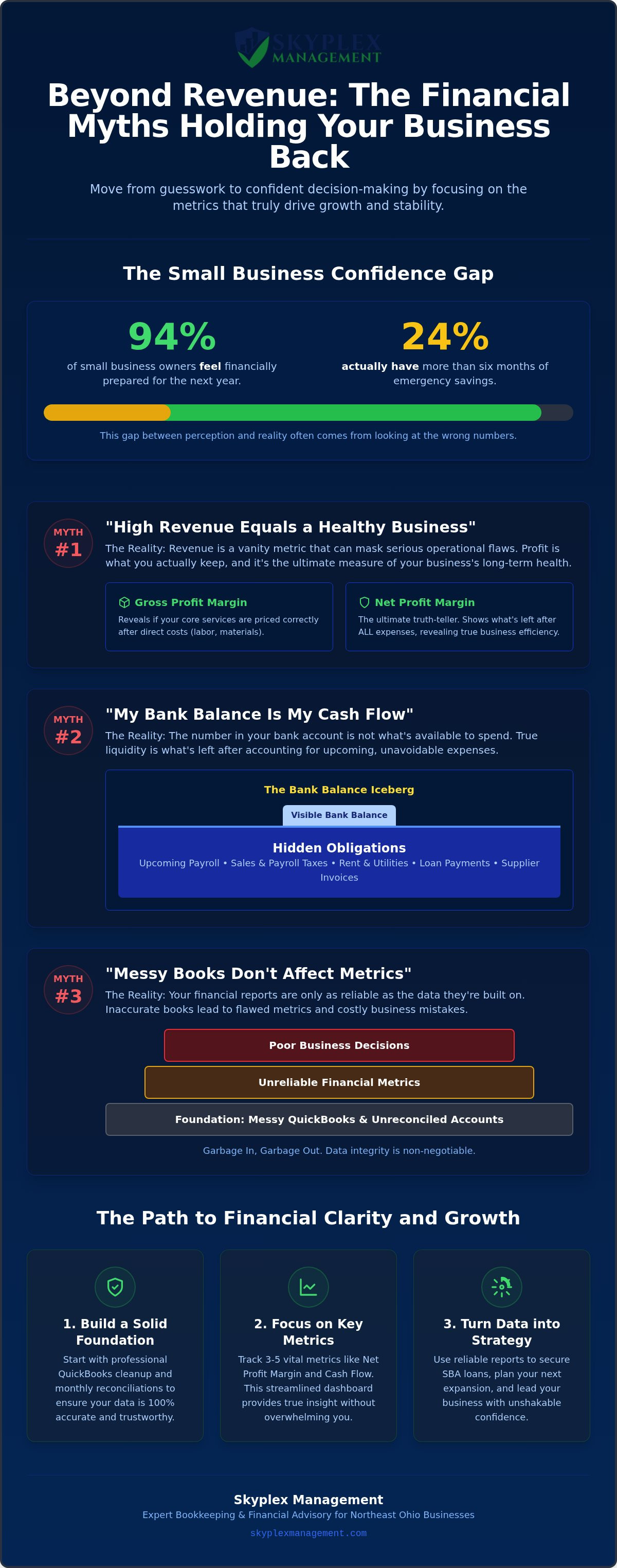
Did you know that 94% of small business owners feel financially prepared for the next year, yet only 24% actually have more than six months of expenses in emergency savings? This staggering gap between perception and reality often comes down to looking at the wrong numbers. If you feel like you're flying blind despite seeing revenue hit your bank account, you aren't alone. Many business owners from Cleveland to Medina struggle with messy QuickBooks records and the constant anxiety of unexpected cash flow gaps.
It's time to stop guessing and start leading with confidence. We're going to clear the fog by debunking five dangerous myths about financial performance metrics for small business so you can finally achieve true peace of mind. This article provides a roadmap to help you move past the clutter and focus on a streamlined dashboard of three to five metrics that drive real growth. Whether you're aiming for local expansion in Akron or preparing for an SBA 7(a) loan, you'll learn how to turn your financial data into a reliable tool for decision-making.
Key Takeaways
- Learn why chasing revenue alone can hide operational inefficiencies and how to shift your focus toward metrics that protect your bottom-line profitability.
- Identify the three vital financial performance metrics for small business that provide clarity for local owners without the need for a full-time, in-house CFO.
- Avoid the "Bank Balance Trap" by understanding the critical difference between the cash you see in your account and the actual liquidity available for upcoming payroll and taxes.
- Discover why professional QuickBooks Online cleanup and monthly reconciliations are non-negotiable steps for ensuring your financial reports are accurate and reliable.
- Understand how moving from simple data entry to professional oversight helps you use your numbers to secure SBA loans or plan your next expansion across Northeast Ohio.
The "Revenue is Everything" Myth: Why Profitability Metrics Tell the Real Story
Many business owners in Akron and Cleveland get caught in the "top-line" trap. It's easy to feel successful when your monthly deposits are growing, but revenue often acts as a vanity metric that masks deep operational flaws. If your expenses climb just as fast as your sales, you aren't actually building a more stable business; you're just running a faster treadmill. High revenue doesn't guarantee a healthy business. In fact, without a focus on the right financial performance measures, rapid growth can actually lead to a cash flow crisis.
To find true clarity, you must shift your focus toward results that prioritize bottom-line health. Revenue is what you collect, but profit is what you keep; only one of them pays for your future growth. At Skyplex Management, we emphasize that financial performance metrics for small business must always center on net profitability. This is the ultimate truth-teller for your company's longevity and your own peace of mind.
Gross Profit Margin vs. Net Profit Margin
Understanding the difference between these two margins is essential for every service-based business. Your Gross Profit Margin tells you if your core services are priced correctly after accounting for direct costs like labor and materials. It's the first line of defense against underpricing. However, your Net Profit Margin is the most critical indicator of long-term sustainability. It accounts for every "leaky" expense, from underutilized software subscriptions to excessive administrative overhead. If your sales are climbing but your net profit is shrinking, your business is becoming less efficient as it grows. We use our small business accounting services to help owners identify these leaks before they drain the company's reserves.
The Hidden Costs of High-Revenue Jobs
Consider a construction firm in Cleveland that wins a massive, high-profile contract. On paper, it looks like a major win for the portfolio. But if that project requires specialized equipment rentals, unexpected overtime pay, and heavy fuel costs that leave a razor-thin margin, it might actually be a liability. The firm is doing more work for less reward, increasing its risk without increasing its stability.
We often see this pattern during our monthly bookkeeping reviews. Without detailed job costing, it's impossible to see if your biggest clients are actually your least profitable. Tracking specific financial performance metrics for small business allows you to identify which projects drain your resources. Sometimes, the most professional decision you can make is to say "no" to low-margin revenue. This allows you to protect your team’s time and focus on the high-value work that truly drives your business forward.
The "Metrics are Only for Big Corporations" Myth: Scalable KPIs for Local Shops
You don't need a corner office in a downtown skyscraper to benefit from data. Many owners in Medina or Strongsville assume that tracking financial performance metrics for small business is a task reserved for companies with a full-time CFO. This misconception often keeps local shops stuck in a cycle of reactive decision-making. In reality, metrics are just "vital signs" for your business. Just as a doctor checks your pulse and blood pressure, you should check a few specific indicators to ensure your company remains healthy and resilient.
When you walk into a local branch of KeyBank or Huntington to discuss a line of credit, they aren't just looking at your personality or your history in the community. They want to see that you have a firm grasp on your numbers. Providing clear reports on key financial performance indicators shows lenders that you are a low-risk, professional operator. This level of preparation is what separates businesses that struggle from those that successfully expand into new markets like Cuyahoga Falls or Richfield.
Essential Metrics for Service-Based Businesses
If you run a service firm in Hudson or Stow, your most valuable asset is time. Tracking your Customer Acquisition Cost (CAC) helps you understand exactly how much you're spending on marketing to bring in a new client. If your CAC is higher than the initial profit from a job, your growth is actually costing you money. Additionally, measuring revenue per employee provides a quick look at your team's productivity. For professional firms, monitoring the ratio of billable hours to non-billable time is the best way to identify where your team might be getting bogged down in administrative tasks instead of revenue-generating work.
Local Benchmarking in Northeast Ohio
Context is everything. A profit margin that looks great for a retail shop in Canton might be dangerously low for an auto repair business in Wooster. It's helpful to look at industry averages for the Midwest to see how you stack up against similar businesses. Local economic factors, such as regional labor costs or Ohio-specific tax regulations, can shift what your target metrics should be. If you aren't sure where to start, our Business Advisory Services can help you set realistic benchmarks based on your specific industry and location. Identifying these goals early allows you to spot trends before they become problems. If you'd like to see how your current numbers compare to local standards, feel free to contact us for a professional review of your reporting.
The "Bank Balance Equals Cash Flow" Myth: Understanding Liquidity
It's a common Friday afternoon scenario for many owners in Northeast Ohio. You log into your online banking, see a healthy five-figure balance, and feel a wave of relief. This is the "Bank Balance Trap." While seeing cash in the account is encouraging, it doesn't account for the payroll due next Tuesday or the quarterly tax payment looming on the horizon. To gain true clarity, you must look at liquidity, which is one of the most vital key metrics for small business success.
Relying solely on your bank balance is like checking your fuel gauge without knowing how many miles are left in your trip. You might have a gallon of gas, but if you have ten miles to go, you're still in trouble. This is why we integrate our Payroll Services with your broader financial reporting. When we manage your payroll, we can help you predict these large outflows before they happen, ensuring your "available" cash is enough to cover your actual obligations. Tracking financial performance metrics for small business like the Quick Ratio gives you a much more accurate picture of your immediate health. Unlike a simple balance check, these ratios compare what you have against what you owe right now.
The Current Ratio and Quick Ratio Simplified
These two ratios are the gold standard for measuring liquidity. The Current Ratio looks at all your short-term assets, including inventory. However, the Quick Ratio is even more conservative; it only counts cash and accounts receivable. For small businesses, maintaining a ratio of 1.0 or higher is the "safety zone." This means you have at least one dollar available for every dollar you owe. Using these ratios is especially important for planning for seasonal dips in the Northeast Ohio market, such as the winter slowdown experienced by many local landscaping or construction firms.
| Metric | What it Measures | Why it Beats the Bank Balance |
|---|---|---|
| Current Ratio | Total Assets vs. Total Liabilities | Shows if you can cover all bills due within a year. |
| Quick Ratio | Cash + AR vs. Total Liabilities | Measures your ability to pay immediate bills without selling inventory. |
Managing Accounts Receivable (AR) Aging
Revenue on paper is useless if it never reaches your bank account. Accounts Receivable Aging tracks how long your invoices have gone unpaid, serving as an early warning system for potential cash flow droughts. If your AR aging is consistently over 60 days, your cash is essentially trapped in your customers' pockets. In tight-knit communities like Brecksville or Richfield, collecting payments requires a delicate touch. We help our clients implement professional collection strategies that protect these valuable relationships while ensuring the business stays liquid. Monitoring financial performance metrics for small business ensures you aren't just "busy," but actually getting paid for the value you provide.
The "Messy Books Don’t Affect Metrics" Myth: Why Data Integrity is Non-Negotiable
Many business owners believe they can ignore messy records as long as their bank account looks healthy, but this is a dangerous gamble. In the world of accounting, we call this the "Garbage In, Garbage Out" principle. If your underlying data is flawed, every report you generate becomes a work of fiction. This is why our QuickBooks Online Support & Cleanup is often the first step we take with new clients. Without a clean foundation, you cannot trust your financial performance metrics for small business to guide your next big move.
Imagine you are considering opening a second location in Strongsville or North Royalton. You look at your Profit and Loss report and see a healthy margin, so you sign the lease. Later, you realize that half of your expenses were never categorized and your income was double-counted because of a sync error. Now, you're locked into an expansion you can't actually afford. Data integrity isn't just about being organized; it's about making sure your decisions are based on reality rather than assumptions.
The Impact of QuickBooks Reconciliation Errors
Double-counted income is one of the most common errors we find during a cleanup. This usually happens when a user records a payment on an invoice and then also "adds" the bank deposit from the feed, effectively telling the software they were paid twice. Missed expenses are just as common, especially when personal and business accounts get mixed. These errors don't just mess up your tax return; they fundamentally skew your profitability metrics, making your business look more successful than it truly is. Professional cleanup identifies these duplicates and missing pieces, finally restoring the "truth" to your financial dashboard.
Leading vs. Lagging Indicators
Your Profit and Loss statement is what we call a lagging indicator. It's like looking in the rearview mirror. It tells you where you've been, but it doesn't necessarily tell you where you're going. To steer the business proactively, you need leading indicators like your sales pipeline or employee utilization rates. These metrics require real-time data to be effective. When you utilize our Monthly Bookkeeping, your records stay current, giving you the clarity to see obstacles while you still have time to avoid them.
Turning Data into Strategy: How Professional Oversight Drives Growth
Collecting your numbers is only the first half of the battle. Many owners feel a sense of relief once their QuickBooks accounts are reconciled, but raw data is simply a record of the past. To drive real growth, you must move from passively tracking your numbers to actively using them for strategic planning. This shift is what transforms a business from one that merely survives into one that thrives in the competitive Northeast Ohio market. When you have professional oversight, your financial performance metrics for small business become a roadmap rather than just a history book.
The biggest difference lies in the level of expertise applied to your books. A traditional bookkeeper focuses on the "what" by ensuring every transaction is entered and categorized correctly. While this is essential, an outsourced controller focuses on the "why" and the "what's next." This professional interpretation allows you to spot opportunities for expansion or identify risks before they impact your cash flow. Additionally, having this level of clarity significantly reduces the stress of tax season. You'll feel a sense of calm knowing your filings for the IRS and the Ohio Department of Taxation are based on verified, strategic data.
The Role of an Outsourced Controller
Our Outsourced Accounting & Controller Services provide local businesses with executive-level financial guidance without the cost of a full-time C-suite salary. This fractional approach is perfect for a growing company that needs help scaling operations. For example, if you own a shop in Wadsworth and are considering a major capital investment in new equipment, a controller uses your specific metrics to determine if the business can comfortably handle the debt service. We recommend a monthly "Financial Health" meeting to review these findings, ensuring you stay on track with your long-term goals.
Custom Financial Reporting for Strategic Planning
Generic reports from QuickBooks Online often fail to capture the nuances of specialized industries. A construction firm needs to see detailed job costing and over/under billings, while an auto repair shop might focus on technician efficiency and average repair orders. We believe in designing a streamlined, one-page dashboard that highlights your unique "North Star" metric. This allows you to see the health of your business at a glance, giving you the freedom to focus on your team and your customers. If you're ready to see what your data can actually do for you, we invite you to reach out for a custom financial reporting assessment.
Reclaiming your time and gaining peace of mind starts with having a partner who understands the background complexities of your finances. If you feel ready to move beyond basic bookkeeping and start using your numbers as a competitive advantage, we're here to help you navigate that transition with confidence.
Building a Stronger Financial Future in Northeast Ohio
Achieving true financial clarity doesn't happen by accident, but it doesn't have to be a source of constant stress. By moving beyond surface-level bank balances and focusing on the right financial performance metrics for small business, you gain a clear view of your company's trajectory. You've seen how clean data in QuickBooks and professional interpretation can transform your decision-making process from guesswork into a reliable strategy for growth.
Skyplex Management has spent nearly a decade helping business owners across Cleveland and Akron scale through expert QuickBooks Online support and strategic reporting. Whether you need a comprehensive cleanup to restore your data's integrity or an outsourced controller to interpret your results, we're here to handle the background complexities. This allows you to lead your team with the confidence that comes from knowing your numbers are accurate and your business is profitable.
Take the first step toward a more organized and predictable future. Your business deserves the peace of mind that comes with professional oversight and a clear path forward.
Frequently Asked Questions
What is the single most important financial metric for a small business?
Net profit margin is generally considered the most important indicator because it reveals the actual percentage of revenue your business keeps after all expenses are paid. While revenue shows activity, net profit shows sustainability. For a business in Cleveland or Akron, this metric helps you understand if your pricing model is actually covering your overhead and providing a return on your hard work.
How often should I review my financial performance metrics?
You should review your financial performance metrics for small business at least once a month. This cadence allows you to spot trends and fix errors before they become major problems. Monthly reviews ensure that your QuickBooks Online data remains current and that you can make proactive adjustments to your spending or marketing efforts before the next quarter begins.
Can I track metrics myself using just QuickBooks Online?
You can track basic metrics in QuickBooks Online, but the reports are only as reliable as the bookkeeping behind them. Many owners in Medina or Strongsville find that while the software is powerful, they lack the time to reconcile accounts correctly. Without professional oversight, your QBO dashboard might show misleading numbers that lead to poor financial decisions.
What is a "good" net profit margin for a service-based business in Ohio?
A healthy net profit margin for most service-based businesses in Northeast Ohio typically ranges between 10% and 20%. However, this target can change based on your specific industry and stage of growth. For example, a mature consulting firm in Brecksville might aim higher, while a growing construction company might see tighter margins due to high labor and material costs.
How does messy bookkeeping specifically hurt my ability to get a loan?
Messy bookkeeping creates perceived risk for lenders, often leading to immediate loan denials or higher interest rates. Banks like Huntington or KeyBank require clear, reconciled financial statements to verify your ability to repay debt. If your records are disorganized, you won't be able to provide the accurate Profit and Loss statements needed for SBA 7(a) or Express loan applications.
What is the difference between a bookkeeper and an outsourced controller?
A bookkeeper focuses on recording daily transactions and keeping your accounts organized, while an outsourced controller provides high-level analysis and strategic planning. While you need a bookkeeper for data entry, a controller helps you understand what those financial performance metrics for small business actually mean for your future. This executive-level oversight is vital for businesses in Cuyahoga Falls looking to scale.
Is revenue growth always a sign of a healthy business?
Revenue growth is not always a sign of health and can sometimes hide deep operational inefficiencies. If your expenses are growing faster than your sales, you might find yourself in a cash crunch despite record-breaking revenue. We often see local businesses take on too many low-margin projects, which increases their risk without adding to their bottom-line stability.
How do I know if my cash flow is actually positive or just a high bank balance?
Positive cash flow means you have more money coming in than going out over a specific period, while a high bank balance is just a snapshot of a single moment. To know the difference, you must account for upcoming liabilities like payroll, sales tax, and vendor payments. A high balance in your Cleveland business account can be misleading if you have significant debt payments due the following week.
Disclaimer
The information provided in this article is for general educational purposes only and should not be considered accounting, tax, or legal advice. Every business is unique. Consult a qualified accounting professional before making financial or tax decisions. Contact Skyplex Management for guidance specific to your business.


