
What if your bank balance is actually the least important number on your screen right now? For many business owners in Cleveland, Akron, and across Northeast Ohio, learning how to analyze financial statements for small business often feels more like deciphering a foreign language than reading a simple health report. You might see a positive number at the bottom of the page, yet still feel that familiar anxiety over cash flow gaps or messy data in your QuickBooks account. It's a common professional burden, but it doesn't have to be your reality.
Mastering these reports is the bridge between simply "getting by" and achieving total financial oversight. This article will help you move past the jargon so you can identify growth opportunities and spot red flags before they become crises. We'll show you how to turn confusing numbers into a clear strategy for scaling your operations with confidence. We are going to provide a logical, methodical framework for reading your business's story through its data, ensuring you stay ahead of the curve in an increasingly complex financial and regulatory environment.
Key Takeaways
- Move beyond basic tax compliance by learning how proactive financial oversight transforms your daily records into a long-term strategy for growth.
- Master how to analyze financial statements for small business by focusing on the Profit and Loss and Balance Sheet to understand your true profitability.
- Identify critical red flags early, such as declining net profit margins or liquidity issues, so you can protect your cash flow before it impacts operations.
- Establish a consistent monthly review routine in QuickBooks Online to ensure your data is clean, reconciled, and ready for strategic decision-making.
- Discover how to scale your Northeast Ohio business by leveraging outsourced controller services to gain high-level advisory without the cost of a full-time executive.
Understanding Financial Oversight for Small Business
Many business owners view their monthly reports as a chore required by their CPA or the IRS. This mindset treats accounting as a historical record rather than a steering wheel. True financial oversight is the proactive monitoring of your company's fiscal health that goes far beyond mere tax compliance. It acts as the essential bridge between your daily bookkeeping tasks and your long-term business strategy. Without it, you are essentially flying blind, making major choices based on gut feelings rather than hard data. You might feel like you're winning because the bank account is full, but hidden costs could be eroding your future stability.
Financial oversight is the process of verifying data integrity and using it for decision-making. By understanding financial statement analysis, you gain the ability to spot trends before they become problems. If you've ever wondered why your revenue is up but your cash flow is down, you're already asking the right questions. Learning how to analyze financial statements for small business allows you to answer those questions with precision, turning messy spreadsheets into a roadmap for growth.
The Difference Between Bookkeeping and Financial Analysis
It's easy to confuse having a bookkeeper with having financial clarity. Bookkeeping is the vital foundation; it involves the meticulous recording of every transaction and receipt. Analysis, however, is the interpretation of those results to find meaning. You can have perfectly reconciled accounts in QuickBooks Online and still not understand your true profit margins. This is where professional ledger management becomes critical. It ensures your data is clean and analysis-ready, allowing you to see the "why" behind the numbers rather than just the "what."
Why Northeast Ohio Owners Need a Strategic Lens
Running a business in communities like Cleveland, Akron, or Medina requires a specialized approach. Local economic shifts can happen quickly, and your financial oversight must be sharp enough to catch them. Whether you are managing a high-overhead construction firm in Strongsville or an auto repair shop in Cuyahoga Falls, your margins are your lifeblood. You must stay compliant with the Ohio Department of Taxation while simultaneously looking for ways to reinvest in your operations. Strategic oversight prevents common pitfalls by identifying which services are truly profitable and which are draining your resources. It gives you the confidence to bid on larger projects or hire new staff because you know exactly what your balance sheet can handle. If you're ready to stop guessing and start growing, our team is here to help you manage these complexities.
The Three Pillars of Small Business Financial Statements
Mastering how to analyze financial statements for small business requires looking beyond a single report. Think of these three documents as a tripod; remove one, and your financial oversight collapses. They work together to tell the complete story of where your money came from, where it sits now, and where it's going. By viewing them as a single unit, you can see if your growth is sustainable or if you're simply trading long-term stability for short-term revenue. This holistic view is what allows you to make informed decisions about hiring, equipment purchases, or expanding your service area.
Mastering the Profit and Loss (Income) Statement
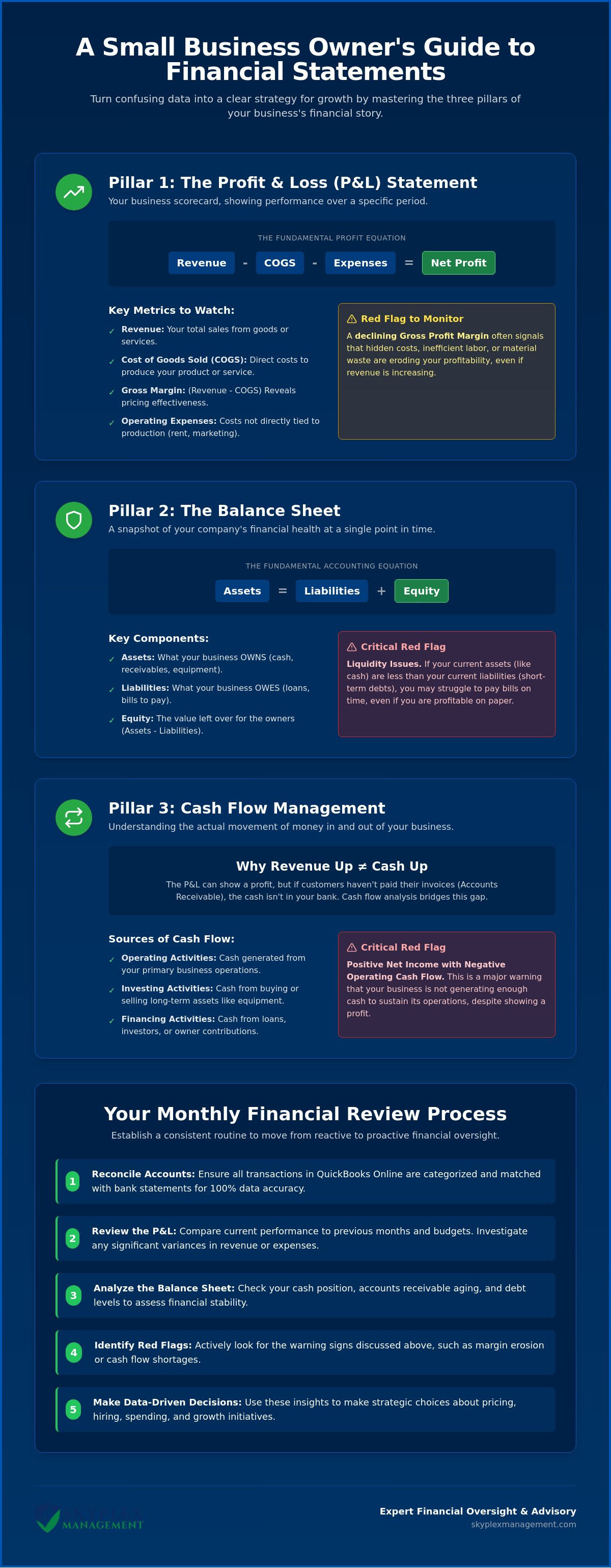
The Profit and Loss (P&L) statement is your scorecard over a specific period, such as a month or a fiscal year. It breaks down your Revenue, Cost of Goods Sold (COGS), and Operating Expenses to show your bottom line. For service-based businesses in Medina or Strongsville, Gross Margin is often the most critical number to watch. It reveals whether your pricing effectively covers your direct labor and materials before you even consider your office rent or marketing costs. We often find that "hidden" expenses, such as neglected software subscriptions or inefficient material waste, quietly erode the bottom line for many local firms. Regularly reviewing your P&L helps you identify these leaks before they drain your annual profits.
Decoding the Balance Sheet and Cash Flow
While the P&L shows performance over time, the Balance Sheet is a snapshot of your business health at a single moment. It lists Assets (what you own), Liabilities (what you owe), and Equity (the value left for you). Many owners find how to read financial statements confusing because they expect the "Net Income" on their P&L to match the cash in their bank account. It rarely does, as profit is an accounting concept while cash is a physical reality. This disconnect is often caused by timing differences in when you bill customers versus when they actually pay you.
This is where the Cash Flow Statement becomes your most practical tool. It tracks the actual movement of "green dollars" in and out of your accounts. You might have a highly profitable month on paper, but if your clients in Akron or Cleveland haven't paid their invoices yet, you won't have the liquidity to pay your own suppliers. Managing small business cash flow is especially important during the seasonal dips common to Northeast Ohio industries like landscaping, construction, or outdoor retail. If you're tired of guessing why your bank balance doesn't reflect your sales, schedule a consultation with us to get your reports back on track and gain total clarity.
Key Performance Indicators and Red Flags to Watch
Once you understand the basic structure of your reports, the next step in learning how to analyze financial statements for small business is identifying the specific metrics that signal health or distress. Think of Key Performance Indicators (KPIs) as the vital signs of your company. While your bank balance tells you what's available today, KPIs tell you if your business model is sustainable for the next year. A declining gross margin is a primary red flag for pricing issues, suggesting that your costs are rising faster than your rates.
One of the most practical ratios to monitor is the Current Ratio, which is calculated by dividing your current assets by your current liabilities. This simple number helps you see if you can pay your bills over the next 12 months without needing an emergency loan. Similarly, your Net Profit Margin reveals if you're actually keeping enough of every dollar earned after all expenses are paid. If you're looking for a foundational guide on these concepts, how to read small business financial statements offers a great perspective on why these metrics matter for your long-term stability.
Identifying Financial Red Flags Early
Financial trouble rarely happens overnight; it usually leaves a trail of breadcrumbs in your reports. A common warning sign is consistently low cash reserves despite having record-breaking sales. This often points to an issue with Accounts Receivable Aging. If your customers in Canton or Hudson are taking 60 or 90 days to pay their invoices, your growth will eventually stall due to a lack of liquidity. Another major red flag is a high balance in "Uncategorized Expenses" within QuickBooks Online. This is a clear sign of messy records that make accurate analysis impossible. We also watch for "lifestyle creep" in business overhead, where small, unnecessary subscriptions and perks begin to stunt your ability to reinvest in the company.
Industry-Specific KPIs for Ohio Businesses
Different industries in Northeast Ohio require different lenses for oversight. For our construction clients, we focus heavily on project-based profitability and labor burden to ensure every job is actually contributing to the bottom line. Service-based businesses should track revenue per employee and client acquisition costs to measure efficiency. If you run a retail shop or an auto repair center in Medina, metrics like inventory turnover and bay efficiency are your best indicators of operational success. Monitoring these specific data points allows you to spot trouble early and pivot your strategy with confidence. Having this level of detail ensures you aren't just working hard, but working profitably.
Establishing Your Monthly Financial Review Process
Establishing a consistent routine is what separates reactive owners from proactive leaders. Knowing how to analyze financial statements for small business is only half the battle; the real value comes from a disciplined monthly review process that turns raw data into strategic action. By setting aside just one hour each month to go over your reports, you can gain total clarity on your business health and spot potential trouble before it impacts your operations. This methodical approach ensures you're making decisions based on your actual performance rather than a feeling about your bank balance.
Your monthly review should follow these five logical steps to ensure nothing is missed:
- Step 1: Ensure all bank and credit card accounts are reconciled in QuickBooks Online to verify that every transaction is accurate and accounted for.
- Step 2: Review your Profit and Loss statement against the previous month and the same month last year to identify unusual spending or revenue trends.
- Step 3: Check the Balance Sheet for accurate liability tracking, ensuring your loans and tax obligations are correctly stated.
- Step 4: Analyze your cash flow forecast for the next 30 to 60 days to prepare for upcoming payroll or inventory needs.
- Step 5: Document two or three actionable insights or changes you will make based on what the data is telling you.
The Role of QuickBooks Online Cleanup
You simply cannot analyze "garbage data." If your records are behind or your accounts aren't reconciled, your financial statements are essentially fiction. This is why QuickBooks Online support & cleanup is the non-negotiable first step for any meaningful analysis. Common reconciliation errors, like duplicate entries or old outstanding checks, can skew your financial reality and lead to poor decisions. A clean ledger provides the peace of mind that Northeast Ohio owners need to focus on growth rather than fixing past errors. When your data is accurate, your analysis becomes a powerful tool for stability.
Questions to Ask Your Bookkeeper or Controller
A great review process is often a collaborative effort. If you work with a professional, use your monthly meeting to dive deeper into the "why" behind the figures. Ask specific questions that bridge the gap between accounting and operations. For example, you might ask why your office expenses spiked by 20% this month or if you are properly accruing for your Ohio commercial activity tax (CAT) to avoid year-end surprises. You should also ask if your current payroll burden is sustainable for your Q3 growth goals in markets like Akron or Cleveland. These questions turn a standard report into a proactive partnership that protects your bottom line.
Scaling with Professional Financial Oversight and Advisory
Learning how to analyze financial statements for small business is a vital skill, but there comes a point where your time is better spent growing the company than managing the ledger. As your operations expand in cities like Strongsville or Brecksville, the financial complexities grow alongside them. You might find that basic bookkeeping no longer provides the depth of insight needed to navigate the evolving regulatory landscape of 2026. Moving toward outsourced controller services allows you to bridge the gap between simple data entry and high level strategic growth.
This fractional approach provides you with "Big Company" expertise without the overhead of a full time executive salary. Having a strategic partner in Northeast Ohio who understands the local economic pulse in Akron and Cleveland is invaluable. We act as that essential bridge, turning messy records into a clear roadmap for your future. Whether you are navigating new SBA loan interest rates or preparing for the increased IRS audit scrutiny expected this year, professional oversight ensures you are never making decisions in the dark. It is about moving from a state of reactive troubleshooting to proactive leadership.
The Benefits of Outsourced Accounting Oversight
One of the most immediate benefits of professional oversight is reclaiming your schedule. Most owners find they can save 10 or more hours every month by offloading complex financial management to a dedicated expert. This freedom allows you to focus on your strengths, like closing new deals or refining your service offerings. Additionally, professional payroll and compliance services significantly reduce your risk of IRS audits. With the IRS leveraging artificial intelligence in 2026 to target small business anomalies, having an objective "second set of eyes" on your performance is more than a luxury; it is a necessity for long term stability.
Your Next Steps for Financial Clarity
If you're ready to gain total control over your business health, start with these three actionable steps. First, assess your current records. Are they clean enough for a meaningful analysis, or do you need a professional cleanup to fix past errors? Second, schedule a monthly "Money Date" with your financial statements. Consistency is the only way to spot trends before they become crises. Finally, contact a professional for a comprehensive financial health assessment. At Skyplex Management, we specialize in helping local owners in communities like Medina and Hudson move from financial uncertainty to data driven confidence. Let us handle the background complexities so you can focus on building your legacy.
Taking Control of Your Business Future
Mastering how to analyze financial statements for small business is the first step toward reclaiming your time and peace of mind. By moving beyond basic record-keeping and establishing a disciplined monthly review, you transform your accounting from a tax-season burden into a strategic asset. Accurate data in QuickBooks Online combined with clear performance indicators allows you to spot red flags early, protecting your cash flow and ensuring long-term stability for your firm in Northeast Ohio. When you understand the story your numbers are telling, you can make decisions that lead to sustainable growth rather than just temporary revenue spikes.
Whether you are managing a construction crew in Strongsville or an auto shop in Cuyahoga Falls, you deserve a partner who handles the background complexities. Skyplex Management provides expert QuickBooks Online cleanup and fractional controller services for Ohio small businesses, giving you the high-level oversight needed to scale with confidence. Our comprehensive monthly financial reporting ensures you always have a seasoned professional monitoring your performance, which allows you to focus on your strengths as an owner.
You've worked hard to build your business, and now it's time to let your data work for you. We are ready to help you turn those messy spreadsheets into a clear roadmap for your continued success.
Frequently Asked Questions
How often should a small business owner review financial statements?
You should review your financial statements at least once a month. This regular cadence allows you to spot seasonal trends in Akron or Cleveland before they impact your cash reserves. Monthly reviews ensure that your QuickBooks data remains clean and that you're making decisions based on current performance rather than outdated assumptions. For deeper strategic planning, a more comprehensive quarterly analysis helps you adjust your annual goals and maintain stability.
What is the most important financial statement for a startup?
For a startup, the Cash Flow Statement is often the most critical report. While the Profit and Loss statement shows if you're earning money, the Cash Flow Statement shows if you actually have the liquidity to survive. Startups often fail because they run out of "green dollars" even when they're technically profitable on paper. Monitoring your cash burn rate ensures you have enough runway to reach your next growth milestone without unexpected gaps.
Can I analyze my business finances using only my bank balance?
No, your bank balance is only a small piece of the puzzle. It doesn't account for outstanding checks, upcoming payroll, or liabilities like the Ohio commercial activity tax (CAT). Relying solely on your balance can lead to a false sense of security, especially if you have large invoices that haven't been paid yet. Comprehensive financial oversight requires looking at your Balance Sheet to see what you truly owe versus what you own.
What is the difference between cash and accrual accounting for oversight?
Cash accounting records transactions when money changes hands, while accrual accounting records them when they're earned or incurred. Accrual is generally superior for financial oversight because it matches your expenses to the revenue they generated. This gives you a much clearer picture of your actual profitability during a specific month. Most growing businesses in Northeast Ohio find that switching to accrual accounting provides the clarity needed for scaling operations and managing long-term debt.
How do I know if my QuickBooks data is accurate enough to analyze?
Your data is only analysis-ready if your bank and credit card accounts are fully reconciled. If you see large balances in "Uncategorized Expenses" or "Opening Balance Equity," your reports are likely inaccurate. You can verify your data integrity by checking the Reconciliation Discrepancy report in QuickBooks Online. If these reports aren't clean, you'll benefit from a professional cleanup before attempting to make any major business decisions based on those numbers.
What should I do if my profit and loss statement shows a loss?
First, determine if the loss was caused by a one-time investment or a systemic issue with your margins. Sometimes a loss is simply a timing difference between a large purchase and the resulting revenue. However, if your gross margin is consistently shrinking, it's a sign that your pricing needs to be adjusted. Analyzing the "why" behind the loss helps you pivot your strategy and return to profitability before the situation becomes critical.
Do I need a controller or just a bookkeeper?
A bookkeeper focuses on the daily recording of transactions, while a controller provides the high-level analysis and strategy needed for growth. If you find yourself overwhelmed by the technical details or unsure how to use your reports for planning, you likely need fractional controller services. This gives you access to executive-level expertise on a small business budget, ensuring your financial foundation is strong enough to support your ambitions in a competitive market.
How can financial oversight help me get a business loan in Ohio?
Lenders look for specific ratios, such as the debt-service coverage ratio, to determine your creditworthiness. Showing a bank in Medina or Hudson that you know how to analyze financial statements for small business builds immediate trust and demonstrates professional oversight. With SBA 7(a) loan interest rates currently tied to a 6.75% prime rate, having clean, analyzed reports makes it much easier to secure the capital you need for expansion or equipment purchases.
Disclaimer
The information provided in this article is for general educational purposes only and should not be considered accounting, tax, or legal advice. Every business is unique. Consult a qualified accounting professional before making financial or tax decisions. Contact Skyplex Management for guidance specific to your business.


