

What if your accounting department functioned as a growth engine rather than a overhead expense? Many small business owners in Northeast Ohio reach a point where basic bookkeeping no longer provides the clarity needed to scale, yet the thought of a full-time executive salary is daunting. It's frustrating to feel stuck between unpredictable hourly bills from a CPA and the lack of oversight that comes with a part-time bookkeeper. You deserve a clear understanding of fractional controller pricing models so you can invest in your business's future with total confidence.
You likely agree that financial integrity is non-negotiable for a growing firm, but evaluating the landscape of outsourced costs shouldn't be a mystery. This guide provides a comprehensive breakdown of pricing structures and ROI factors specifically tailored for local business owners in communities like Cleveland and Akron. We will explore how to move away from the "billable hour trap" and implement a system of professional oversight that scales seamlessly with your success.
Key Takeaways
- Understand the shift toward modern financial oversight and how fractional controller pricing models provide the transparency your business needs without the surprise of hourly billing.
- Evaluate the four primary pricing structures to determine which model offers the best balance of professional oversight and cost predictability for your specific growth stage.
- Compare the total cost of an outsourced expert against a full-time hire to see how you can save on benefits and taxes while gaining high-level financial leadership.
- Identify the specific factors that drive your monthly rates, from your current transaction volume to the initial state of your QuickBooks Online records.
- Learn how to select a local partner who understands the unique tax landscape in Northeast Ohio and can provide the specialized reporting your industry requires.
Understanding Fractional Controller Pricing Models in 2026
For many business owners in Northeast Ohio, there's a specific moment when "keeping the books" simply isn't enough to support your growth. You reach a point where you need someone to own the entire financial process and provide tactical leadership. A fractional controller fills this gap by ensuring your data is accurate and your internal controls are tight. You don't need a full-time executive sitting in an office in Cleveland or Akron every day; you need their expertise for a dedicated number of hours each month. This "middle ground" offers significantly more depth than a standard bookkeeper while remaining far more affordable than a full-time executive hire.
The way businesses pay for this expertise has evolved. In 2026, fractional controller pricing models have shifted away from the unpredictable nature of hourly billing. Most modern firms now favor fixed-fee structures or tiered subscription models. This change allows you to budget with total confidence. You get professional oversight that scales with your growth without the fear of a surprise invoice landing on your desk at the end of the month. These services are built on core management accounting principles, which focus on providing the specific data you need to manage your business effectively and plan for the future.
Controller vs. CFO: Why the Distinction Affects Your Quote
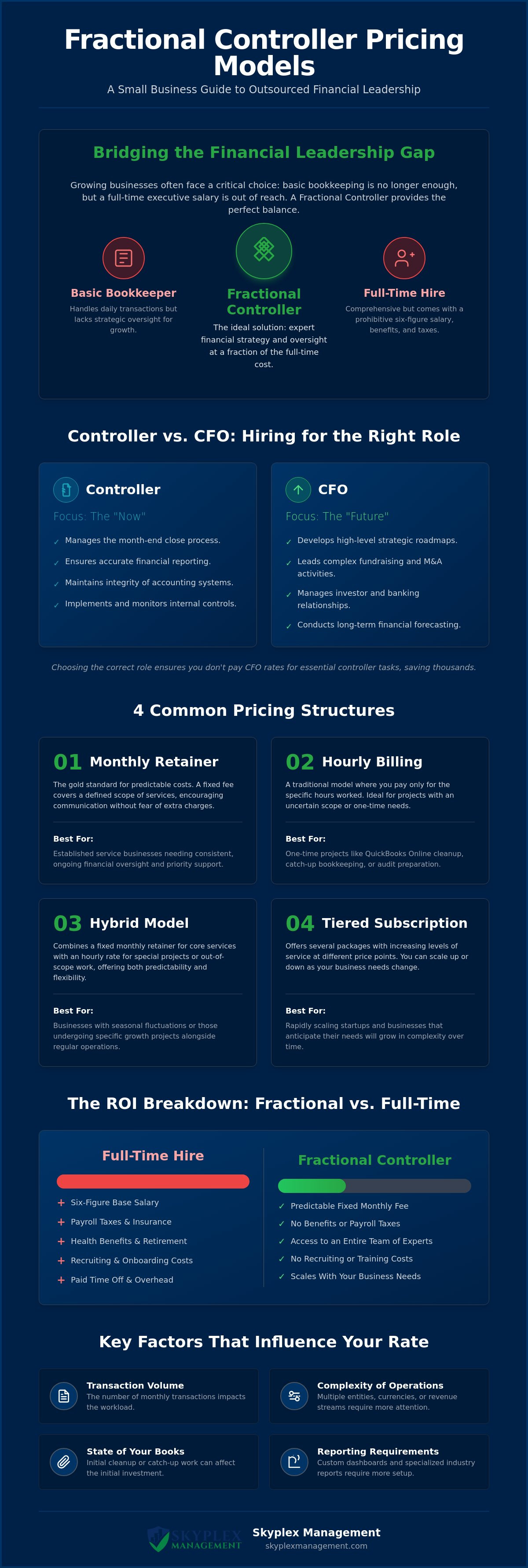
One common mistake that leads to overpaying is hiring for the wrong role. It's vital to understand the difference because it directly impacts your quote. Controllers focus on the "now." They handle the month-end close, financial reporting, and the integrity of your accounting systems. CFOs focus on the "future," dealing with complex fundraising, mergers, or high-level strategic roadmaps. If you need clean books and reliable reports to run your shop in Medina or Strongsville, a fractional controller is the right fit. Choosing the correct level of service ensures you aren't paying CFO rates for essential controller-level tasks, which can save your business thousands of dollars annually.
The 2026 Landscape for Outsourced Financial Oversight
Technology is rapidly changing the cost and efficiency of these services. AI and automation now handle many routine data entry tasks, which allows fractional controllers to spend less time on manual entry and more time on high-value analysis. This efficiency often lowers the entry-level cost for small businesses in communities like Cuyahoga Falls and Hudson. However, we've seen a rising demand for proactive QuickBooks Online cleanup before these services can even begin. Starting with clean data is essential for accurate reporting. If you're looking for more than just basic numbers, exploring Specialized Business Advisory Services can help you turn your financial data into a genuine growth roadmap for your business.
The 4 Most Common Pricing Structures for Outsourced Controllers
Choosing the right way to pay for financial oversight is just as important as the oversight itself. Many business owners in Cleveland and Akron fall into the billable hour trap, where they hesitate to call their advisor because they fear the clock is always running. At Skyplex Management, we believe your pricing model should encourage communication rather than punish it. When you understand the different fractional controller pricing models available in 2026, you can select a partnership that provides the peace of mind you need to focus on your operations in Medina or Strongsville.
| Pricing Model | Best For... | Primary Advantage |
|---|---|---|
| Monthly Retainer | Established service businesses | Total budget predictability and priority support |
| Hourly Billing | QuickBooks cleanup or catch-up | Pay only for the specific work performed |
| Hybrid Model | Businesses with seasonal projects | Combines steady oversight with project flexibility |
| Tiered Subscription | Rapidly scaling startups | Services and costs grow alongside your revenue |
Monthly Retainers (Fixed Fee)
Fixed-fee retainers are the gold standard for businesses seeking predictable monthly accounting costs. This model aligns our firm's efficiency with your company goals because the focus shifts from how long it takes to the quality of the result. A typical retainer covers the essential monthly close, financial statement preparation, and regular advisory sessions. This structure is particularly beneficial for construction accounting, where accurate job costing and WIP reports are vital for maintaining profitability. You get a set price every month, which makes it much easier to manage your cash flow.
Hourly Billing and Project-Based Fees
While we generally prefer fixed fees for ongoing support, hourly or project-based billing serves a specific purpose. This model is often the best fit for Fixing Messy QuickBooks Records or handling one-time catch-up work. Before you can transition to a steady monthly model, you may need to calculate your business costs and clean up historical data. The main risk here is scope creep, where a project takes longer than expected due to unforeseen complexities in the books. We use these arrangements to get your records back on track so we can move toward a more stable, long-term partnership.
Hybrid and Value-Based Models
Some growing companies in Brecksville or Richfield prefer a hybrid approach. This might involve a core monthly retainer for standard oversight combined with project-specific fees for things like annual budget creation or specialized reporting. Value-based pricing aligns the cost of service with the specific financial risks mitigated and the strategic integrity maintained within your organization. This approach ensures that the cost of the service is always proportionate to the complexity and transaction volume of your business. If you're unsure which structure fits your current needs, you can always reach out for a professional assessment of your financial systems.
Tiered Subscription Models
Tiered pricing is common for service-based businesses that need to scale their support as they grow. You might start at a lower tier that focuses on basic financial reporting and oversight, then move to a higher tier as your revenue increases or your payroll becomes more complex. This flexibility is perfect for businesses in Cuyahoga Falls or Hudson that are in a rapid growth phase. It allows you to buy exactly the level of expertise you need today while knowing that more robust support is available when you're ready for it.
Fractional Controller Cost vs. Full-Time Hire: The ROI Breakdown
Choosing between a local employee and an outsourced firm is a pivotal decision for your overhead. While we explored specific fractional controller pricing models in the previous section, the real value lies in comparing these costs to a traditional salary. For a business in North Royalton or Brunswick, the flexibility of an outsourced partner often provides a much higher return than committing to a permanent executive position. You gain the same level of oversight without the long-term liability of a high-salary contract.
Redundancy is another factor local owners often overlook. When you hire an individual, your financial integrity depends on that single person's health and schedule. Partnering with a firm like Skyplex Management means you have a team behind you. If one professional is away, another is ready to step in. This continuity ensures your reports are never delayed and your vendors are always paid on time. You're buying a system of financial integrity rather than just a person's time.
The True Cost of a Full-Time Executive in 2026
In the Cleveland-Akron market, a controller's base salary is just the starting point. You must also factor in employer-paid taxes, health insurance premiums, and 401k matching. These benefits typically add 20% to 30% to your total labor cost. Recruitment fees and onboarding time also create a significant lag in productivity. Fractional services act as a plug-and-play solution. You skip the hiring headache and start seeing results from day one. It's a cleaner, more efficient way to bring executive expertise into your organization.
Measuring the ROI of Financial Oversight
The return on this investment shows up clearly in your cash flow. A controller identifies margin leaks and ensures your accounts receivable don't age past the point of recovery. If you're seeking a line of credit from a bank in Stow or Wooster, having professional financials is a requirement. Accurate Profit and Loss reports allow you to spot trends before they become problems. This proactive approach helps you scale efficiently rather than just reacting to your bank balance.
Key Factors That Influence Your Monthly Outsourced Controller Rates
Every business has a unique financial footprint, which means a standard "off the shelf" price rarely provides the best value. When you evaluate different fractional controller pricing models, you'll find that the complexity of your operations is the primary driver of the final quote. A professional service firm in Cleveland with five employees has very different needs than a multi-state construction company based in Akron. Understanding how these variables impact fractional controller pricing models helps you prepare for a consultation and ensures you aren't paying for features your business doesn't yet require.
Your current transaction volume and annual revenue are the baseline indicators for the level of support you need. More transactions typically mean more reconciliations, more vendor management, and a higher demand for internal controls. Additionally, the state of your current books plays a massive role in your initial costs. If your QuickBooks Online file hasn't been reconciled in several months, a proactive cleanup is almost always a prerequisite. Starting with accurate historical data is the only way to ensure your future financial reporting is reliable enough for decision-making.
Industry-Specific Complexity: Construction and Auto Repair
Certain industries require a level of specialized knowledge that naturally influences the cost of oversight. For instance, construction firms in Medina or Strongsville deal with AIA billing, lien waivers, and complex job costing that standard accounting doesn't cover. If these aren't managed correctly, you risk losing profitability on individual projects or facing issues with the Ohio Department of Taxation. Similarly, auto repair shops face unique challenges with inventory management and parts tracking. Having a controller who understands these industry nuances prevents costly audit triggers and ensures your margins are protected at every stage of the job.
Software and Integration Requirements
The tech stack you use to run your business also dictates the scope of a controller's work. A simple setup might only involve QuickBooks Online, but many growing businesses in Northeast Ohio use a variety of third-party apps for things like CRM, time tracking, and field service management. Ensuring these systems talk to each other correctly requires technical oversight to prevent data silos. Managing your Payroll Services for Small Business is another critical integration point where accuracy is non-negotiable. The more complex your integrations, the more time your controller will spend on system maintenance and data integrity checks.
Reporting frequency is the final lever that impacts your monthly rate. While some owners are satisfied with a monthly deep dive, others require real-time dashboards or bi-weekly check-ins to manage tight cash flow. High-frequency reporting requires more hands-on management and sophisticated data automation, which will be reflected in your service agreement. By identifying your reporting needs early, you can choose a model that provides the right amount of visibility without overcomplicating your budget.
Finding the Right Financial Partner in Northeast Ohio
While understanding different fractional controller pricing models is a vital part of your search, the success of the partnership depends on finding an expert who understands your specific market. A partner should do more than just balance the books; they should act as a supportive fixture in your business community. Choosing a local firm ensures that your financial leadership is grounded in the same economic reality you face every day in the Cleveland-Akron area. This proximity allows for a level of personalized service that national firms simply cannot replicate.
Before you sign an engagement letter, it's helpful to ask potential partners about their experience with businesses of your size and industry. You should ask how they handle communication and whether their pricing scales as your transaction volume grows. A transparent firm will be happy to explain how their fractional controller pricing models align with your long-term goals. They should also be able to demonstrate a clear path from your current financial state to a future of total clarity and professional oversight.
The Advantage of a Local Cleveland-Akron Partnership
Local expertise is non-negotiable when it's time to deal with state and municipal regulations. Understanding Ohio’s Commercial Activity Tax (CAT) and the specific municipal filings required by communities like Hudson or Medina ensures you remain in good standing with the state without overpaying. We're familiar with the local business climate and the specific challenges faced by service-based companies throughout Northeast Ohio. Whether you need an occasional on-site meeting in Canton or a deep dive into your RITA filings, having a partner nearby provides a level of accessibility and peace of mind that a remote-only service can't offer.
The Skyplex Process: From Cleanup to Controller
We follow a methodical, three-step path to ensure your financial systems are robust and reliable. This structured approach removes the common professional burdens that keep business owners up at night. Our process includes:
- Step 1: The Initial Assessment and QuickBooks Cleanup. We start by identifying gaps in your current records and performing a thorough cleanup to ensure your historical data is accurate.
- Step 2: Establishing Accurate Monthly Bookkeeping and Payroll. Once the books are clean, we implement streamlined monthly bookkeeping and payroll processes to maintain data integrity.
- Step 3: High-Level Controller Oversight. With a solid foundation in place, we provide the strategic reporting and professional oversight you need to make confident scaling decisions.
Skyplex Management provides a comprehensive financial foundation that allows you to stop worrying about the background details and start focusing on your business’s future.
If you're ready to move away from unpredictable billing and toward a more structured financial future, the first step is a conversation. We can help you determine which of our fractional controller pricing models fits your current needs and growth trajectory. We invite you to reach out today to begin your journey toward professional financial oversight and lasting peace of mind.
Take the Next Step Toward Financial Clarity
Moving from basic bookkeeping to professional financial leadership is a major milestone for your business. By exploring the different fractional controller pricing models, you've already started the process of replacing unpredictable billing with a structure that supports your long-term growth. The right partnership ensures that your financial data is accurate and your internal controls are strong, which allows you to make scaling decisions with total confidence.
Our team specializes in providing expert QuickBooks Online cleanup and specialized accounting for construction and service-based industries throughout Northeast Ohio. We handle the background complexities so you can reclaim your time and focus on your core strengths. Whether you're in Cleveland, Akron, or Medina, we're ready to help you gain the peace of mind that comes from professional financial oversight.
We look forward to hearing about your business goals and helping you build a solid financial foundation for the years ahead.
Frequently Asked Questions
What is the average monthly cost of a fractional controller for a small business?
The cost of professional oversight is determined by your company's revenue size, transaction volume, and the complexity of your financial systems. Most fractional controller pricing models are structured as fixed monthly retainers to ensure your costs remain predictable. This approach allows you to budget effectively while receiving a level of expertise that scales with your business's specific needs.
Does a fractional controller include basic bookkeeping and payroll services?
A fractional controller primarily focuses on high-level oversight and the integrity of your financial reporting rather than daily data entry. However, many businesses in Northeast Ohio find it most efficient to bundle this oversight with monthly bookkeeping and payroll services. This creates a cohesive financial department where the controller manages the staff or outsourced team to ensure every record is accurate and audit-ready.
How many hours a month does a fractional controller typically work for my business?
Engagement lengths vary based on your reporting requirements and the current state of your books. Some businesses in Cleveland or Akron only need a few hours a week for high-level review and month-end closing, while others require more intensive support during growth phases. The fractional model is designed to be flexible, allowing you to increase or decrease professional support as your operational complexity changes.
Can a fractional controller help me get a bank loan or SBA funding?
Yes, having a professional controller is a significant advantage when applying for SBA loans or traditional bank financing. They prepare the "investor-ready" financial statements that lenders require, including accurate balance sheets and cash flow projections. This professional oversight gives banks confidence in your numbers, which can lead to a smoother application process and better terms for your business.
What is the difference between a fractional controller and a fractional CFO?
The distinction lies in their tactical versus strategic focus. A controller manages the "now" by ensuring your historical data is accurate, maintaining internal controls, and closing the books each month. A CFO handles the "future," focusing on fundraising, mergers, and long-term capital strategy. Most small businesses in Medina or Strongsville find that a controller provides the essential tactical leadership they need for daily success.
Is there a long-term contract requirement for outsourced controller services?
Most professional firms offer flexible service agreements that prioritize a long-term partnership over a rigid contract. While some arrangements are month-to-month, others might be annual with periodic reviews to adjust the scope of work. The goal is to provide stability for your financial department while allowing the partnership to evolve as your business reaches new revenue milestones.
How do I know if my business is ready for a fractional controller?
You're likely ready if you have a bookkeeper but still lack the financial clarity needed to make confident scaling decisions. Other signs include growing industry complexity, such as needing detailed job costing in construction, or simply outgrowing your current accounting software. If you feel you're "flying blind" despite having basic records, it's time for the professional oversight a controller provides.
Will an outsourced controller work with my existing tax CPA?
Yes, a fractional controller acts as a vital bridge between your daily operations and your year-end tax professional. They ensure your books are clean and reconciled before they reach your CPA, which often reduces the time and cost involved in filing your returns. This collaboration ensures that your internal management reports align perfectly with your tax and regulatory filings.
Disclaimer
The information provided in this article is for general educational purposes only and should not be considered accounting, tax, or legal advice. Every business is unique. Consult a qualified accounting professional before making financial or tax decisions. Contact Skyplex Management for guidance specific to your business.


