

What if the most expensive part of your accounting isn't the salary you pay, but the overhead you don't see? Many business owners across Northeast Ohio feel stuck between the high cost of employee benefits and the anxiety of messy QuickBooks records that could trigger an IRS audit. You've likely realized that a "simple" internal hire often comes with hidden baggage like payroll taxes, software subscriptions, and the constant need for oversight. This in-house vs outsourced accounting cost analysis explores the true financial impact of these two paths in 2026, helping you decide which model actually protects your bottom line.
It's a common struggle for growing firms in communities like Medina and Strongsville to balance technical accuracy with limited resources. We'll examine current salary data for the Cleveland area, the impact of recent 2026 QuickBooks price hikes, and the strategic advantages of fractional controller services. By the end of this guide, you'll understand how to reduce overhead costs while gaining the expert financial reporting you need to focus on your core business goals with total peace of mind.
Key Takeaways
- Identify the "fully loaded" cost of an internal hire, including the hidden 20-30% premium on top of base salaries for benefits, payroll taxes, and office space.
- Review our 2026 in-house vs outsourced accounting cost analysis specifically tailored for the Cleveland-Akron-Canton market to see how local salary trends impact your budget.
- Uncover the infrastructure savings found in professional firm partnerships, from managed QuickBooks Online subscriptions to secure cloud data storage and security.
- Learn how specialized fractional controller services provide the job costing and WIP reporting essential for Northeast Ohio construction and service businesses.
- Determine the exact point at which outsourcing becomes the more profitable choice for your growth, allowing you to reclaim your time while ensuring technical accuracy.
The 'True Cost' of In-House Accounting: Beyond the Salary
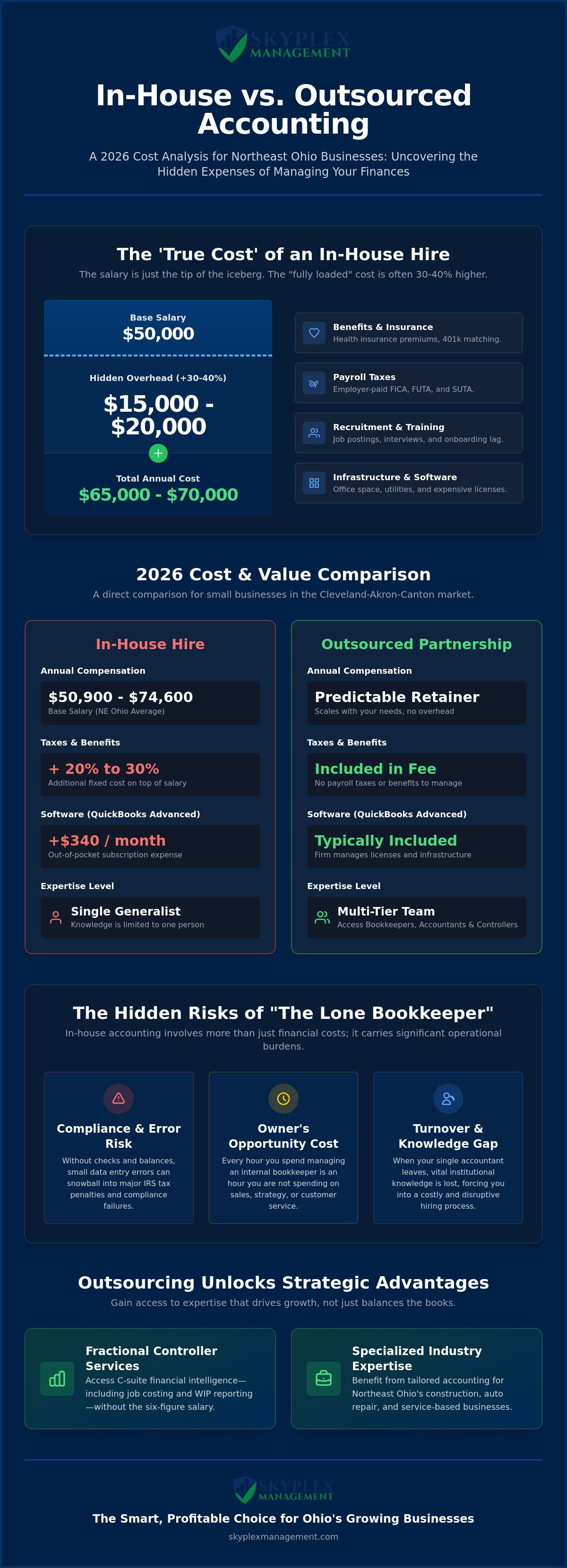
When you review a job offer for a new bookkeeper, the number on the paper is just the starting point. Many business owners in Northeast Ohio mistakenly assume that a $50,000 salary is the extent of their financial commitment. In reality, the "fully loaded cost" of an employee includes employer-paid taxes, health insurance, retirement contributions, and even the physical space they occupy. By the time you add these up, that $50,000 hire usually costs your business between $65,000 and $70,000 annually. Conducting a thorough in-house vs outsourced accounting cost analysis reveals that this 30% to 40% premium is a heavy burden for a small company in Cleveland or Akron trying to maintain healthy cash flow.
Beyond the raw dollars, there's a hidden operational risk we often call "The Lone Bookkeeper" syndrome. When one person manages your records in a vacuum, who ensures they're following standard accounting principles? Without a system of checks and balances, small errors in data entry can snowball into massive compliance issues or IRS tax penalties. You also have to consider your own time as a business owner. Every hour you spend managing an internal staff member or reviewing their work is an hour you aren't spending on sales, customer service, or strategic growth. This opportunity cost is often the most expensive part of the internal model.
The Burden of Payroll Taxes and Benefits
Ohio employers face a specific set of obligations that go far beyond a simple paycheck. You're responsible for the employer portion of FICA (Social Security and Medicare), along with federal (FUTA) and state (SUTA) unemployment taxes. In 2026, the administrative cost of managing a payroll department has only increased as regulations evolve. When you factor in the rising costs of health insurance premiums and the 401k matching programs necessary to stay competitive in the Medina and Strongsville markets, the financial weight becomes clear. These are fixed costs you must pay regardless of your monthly revenue.
Recruitment, Training, and Turnover
Hiring isn't free. Between job postings, background checks, and the dozens of hours spent interviewing, the initial investment is steep. There's also an "onboarding lag" to consider. It often takes three to six months before a new hire is fully proficient and profitable for your firm. In a tight Northeast Ohio labor market, turnover can be devastating. If your accountant leaves for a slightly higher offer in Canton or Cuyahoga Falls, you're left with a massive knowledge gap and the high cost of starting the recruitment process all over again. Outsourcing eliminates this cycle, providing a stable partnership that doesn't disappear when a single employee decides to move on.
Comparing 2026 Accounting Costs for Ohio Small Businesses
Choosing between a part-time employee and a professional firm requires a clear look at the local job market. In the Cleveland-Akron-Canton MSA, the majority of accountant salaries in 2026 range from $50,900 to $74,600. When you hire an internal senior accountant, you're responsible for that full salary plus the fully loaded costs of benefits and taxes discussed previously. This in-house vs outsourced accounting cost analysis shows that for many small businesses, the total cost of a full-service firm is significantly lower than the total expense of a single mid-level employee.
| Expense Category | In-House Hire (Canton/Akron) | Outsourced Partnership |
|---|---|---|
| Annual Compensation | $50,900 – $74,600 (Base Salary) | Predictable Monthly Retainer |
| Taxes & Benefits | Additional 20% – 30% Premium | Included in Fee |
| Software (QBO Advanced) | $340 / month (Out-of-Pocket) | Typically Included |
| Expertise Level | Single Generalist | Multi-Tier Team (Bookkeeper to Controller) |
Software expenses are another factor that often gets overlooked. Effective August 1, 2026, QuickBooks Online Plus has risen to $140 per month, and the Advanced tier is now $340. For an in-house department, these are additional line items that add to your overhead. Most outsourced firms include these licenses and the necessary infrastructure within their flat monthly fee. The 'True Cost' of In-House Accounting involves these recurring subscriptions that can quietly erode your profit margins if they aren't managed correctly.
The "Multiplier Effect" provides a significant financial advantage. Instead of paying one person to handle everything from basic data entry to complex tax strategy, your fee covers multiple levels of expertise. You gain access to a bookkeeping specialist, a payroll expert, and a fractional controller without paying three separate salaries. You're essentially buying a complete department for the price of a single role.
Salary Benchmarks in Northeast Ohio
Business owners in communities like Hudson and Stow face stiff competition for skilled labor. If you want a QuickBooks Online Certified ProAdvisor on your payroll, you'll pay a premium for that expertise. Localized knowledge of the Ohio Department of Taxation rules is essential for compliance, and finding an employee who possesses both technical accounting skills and local tax mastery is a challenge. Hiring locally often means paying a premium to keep that talent from moving to larger firms in Cleveland.
The Outsourced Monthly Retainer Model
A flat-fee retainer provides the budget predictability that small businesses need to grow. This model typically includes small business bookkeeping services, payroll management, and monthly financial reporting. You won't be surprised by unexpected costs or hourly billing spikes. If you aren't sure how these numbers apply to your specific situation, it's a good idea to request a personalized assessment of your current financial workflow and see where you can save.
Technology and Infrastructure: The Hidden Savings of Outsourcing
Many business owners focus on the person, but they often forget the platform. A thorough in-house vs outsourced accounting cost analysis should always account for the digital environment required to run modern books. Maintaining a secure, cloud-based infrastructure isn't just about paying a subscription fee. It involves ensuring data encryption, managing user permissions, and handling constant IT troubleshooting. When you outsource, these technical burdens shift to your partner. They already have the systems and security protocols in place to protect your sensitive financial data.
Professional oversight also reduces the risk of internal fraud or devastating data breaches. A firm provides a layer of separation and internal control that a single internal hire simply cannot match. Modern firms use automated bank feeds and AI-driven reconciliation to reduce manual entry errors and cut down on billable hours. This technology isn't just faster; it's more accurate. By letting a professional firm manage the tech stack, you eliminate the need for internal IT support for your financial software while gaining peace of mind that your records are secure.
The Value of a Clean QuickBooks Setup
A "messy" file is a financial liability that can cost you thousands in the long run. We often find that to Explore our QuickBooks Online Support & Cleanup is the single most effective way to lower long-term accounting costs. When your historical data is accurate, you avoid expensive year-end corrections and tax filing delays. Making the Choice to invest in a professional setup ensures your software integrates perfectly with your other business tools. This creates a streamlined workflow that saves hours every month for businesses in Cleveland and Akron.
Access to High-Level Tools without the Price Tag
Outsourced firms utilize enterprise-grade reporting and forecasting tools that are often too expensive for a single small business to license. Through a partnership, you get "fractional" access to these specialized platforms. This means you receive high-level financial intelligence without the high-level price tag. This fractional approach is a key component of a modern in-house vs outsourced accounting cost analysis. You aren't just saving on a salary; you're leveraging a tech stack that would cost thousands of dollars to build and maintain on your own. It's about getting the same insights as a large corporation while keeping your overhead manageable.
Strategic Gains: Controller-Level Intelligence for Growing Firms
Moving beyond basic data entry is where real business growth begins. While a standard bookkeeper records what happened in the past, a financial controller looks at what should happen next. This distinction is a vital part of your in-house vs outsourced accounting cost analysis. For a growing firm in Medina or Brecksville, the ability to interpret monthly financial reports means the difference between guessing at your cash flow and knowing exactly when to invest in new equipment. You need a partner who acts as a sounding board, helping you navigate the complexities of expansion without the overhead of a full-time executive.
Professional oversight transforms your financial data from a tax obligation into a management tool. By using monthly reports to drive cash flow decisions, you can proactively manage your debt and reinvestment strategies. This "Empowering Expert" role is about more than just numbers; it's about providing the peace of mind that comes from having a seasoned professional handle the background complexities so you can focus on your own strengths as a business owner. While we focus on the Northeast Ohio market, firms like The Bucket List Accountant demonstrate how this philosophy of aligning financial success with personal goals is a universal benefit of specialized advisory.
Specialized Industry Knowledge
Construction firms in Northeast Ohio face unique hurdles like job costing and Work in Progress (WIP) reporting. If your accounting doesn't track these metrics accurately, you could be losing money on a project before you even realize it. Similarly, auto repair shops and service-based businesses in communities like Richfield need to manage labor hours and inventory with precision. Specialized industry knowledge ensures you aren't just compliant with the Ohio Department of Taxation but also optimized for maximum profitability. Managing complex payroll and prevailing wage requirements requires a level of mastery that most generalist bookkeepers simply don't possess.
Scaling with Fractional Controller Services
Scaling your business shouldn't require adding a $150,000 salary to your books. Fractional controller services provide executive-level oversight at a price point that makes sense for small and medium-sized enterprises. You gain the professional-grade records necessary to secure bank financing or prepare for a future sale. See how our business advisory services help you scale and provide the strategic clarity you've been missing. This approach allows you to leverage expert guidance while keeping your overhead lean and your focus on the field.
Making the Choice: Is Skyplex Management the Right Partner?
Deciding between an internal hire and an external partner shouldn't be a source of stress. Your in-house vs outsourced accounting cost analysis has likely revealed that while a part-time bookkeeper might seem affordable on the surface, the hidden burdens of payroll taxes, turnover, and software subscriptions often tip the scales. Choosing to outsource isn't just a move to save money. It's a strategic decision to gain professional oversight that allows you to step away from the spreadsheets and back into your role as a leader. We focus on handling the background complexities so you can focus on your own strengths.
At Skyplex Management, our approach is characterized by a calm, supportive style that emphasizes reliability. We don't believe in high-pressure tactics or rushed setups. Instead, our process is unhurried and methodical. We specialize in transitioning businesses from the anxiety of "messy records" to the peace of mind that comes with a clean financial foundation. We take the time to perform a thorough QuickBooks cleanup, ensuring that your historical data is accurate before we ever begin the monthly reporting cycle. This stability is the bridge between complex financial regulations and your practical business needs.
The Local Advantage in Northeast Ohio
Having a partner who understands the specific business climate in Akron, Canton, or Cleveland matters for your compliance and growth. We aren't a faceless national provider; we're a dependable fixture within the Northeast Ohio community. Whether you're navigating the Ohio Commercial Activity Tax (CAT) or managing specialized payroll for a service business in Medina, we provide localized expertise that a generalist internal hire often lacks. Our commitment is to be a supportive partner who is both technically proficient and easy to talk to, ensuring you never feel like just another account number.
Your Next Steps to Financial Clarity
If you're still weighing your options, we recommend conducting a simple "Time Audit" of your current bookkeeping process. This exercise often reveals the true cost of staying in-house. Consider these factors during your audit:
- Track the actual hours you or your staff spend on manual data entry and bank reconciliations each month.
- Calculate the time lost to researching payroll tax compliance or fixing software errors.
- Assign a dollar value to your own time as a business owner to see what those administrative tasks are truly costing your company.
- Factor in the cost of oversight and the risk of having only one person managing your entire financial history.
For a deeper look at what to expect from a professional partnership, check our guide on outsourced bookkeeping pricing in 2026 to see how these services are structured. When you're ready for a more personalized perspective, we're here to help. You can contact us today for a financial health assessment. We'll walk through your current workflow with a "can-do" attitude and help you determine the most cost-effective path forward for your specific business goals.
Secure Your Financial Future with Strategic Partnership
Choosing the right path for your bookkeeping depends on your long-term vision. You've seen how the true cost of an internal hire extends far beyond a base paycheck when you factor in benefits, taxes, and the rising software rates of 2026. This in-house vs outsourced accounting cost analysis confirms that for most growing firms, the strategic value of professional oversight far outweighs the expense of managing a solo employee. By moving toward a partnership model, you gain access to high-level tech and fractional controller intelligence that would otherwise be cost-prohibitive.
Skyplex Management has served Northeast Ohio small businesses for nearly a decade, providing the specialized accounting expertise that construction and service industries require. As QuickBooks Online Certified ProAdvisors, we focus on streamlining your records to ensure every financial report is accurate and actionable. You can stop worrying about messy books and start focusing on the communities you serve in Cleveland, Akron, and beyond.
You deserve the peace of mind that comes from a dependable partnership. Let's build a financial foundation that empowers your business to reach its full potential.
Frequently Asked Questions
Is it cheaper to hire a virtual bookkeeper or a local firm in Ohio?
A local firm is typically more cost-effective when you consider the value of regional tax expertise. Ohio has specific requirements like the Commercial Activity Tax (CAT) and various municipal income taxes through RITA or CCA. A virtual bookkeeper in another state might miss these local details. This leads to expensive penalties that far outweigh any initial savings on a monthly rate for businesses in Cleveland or Akron.
What are the common mistakes small businesses make when hiring in-house?
The biggest mistake is failing to calculate the "fully loaded" cost of an employee, which includes payroll taxes, benefits, and office space. Business owners also often hire for basic data entry when they actually need strategic financial reporting. This results in a "lone bookkeeper" scenario where no one is auditing the work for accuracy. It leaves your business vulnerable to errors and compliance risks.
How much does outsourced accounting typically cost for a small business in 2026?
Costs are typically structured as a predictable monthly retainer based on your transaction volume and the complexity of your financial needs. This model is designed to be more affordable than a full-time salary. A proper in-house vs outsourced accounting cost analysis usually shows that businesses save money by eliminating the overhead of benefits and internal management time while gaining a higher level of expertise.
Can an outsourced firm handle my payroll and Ohio state tax filings?
Yes, a full-service firm can manage your entire payroll cycle along with state and local tax filings. This includes handling Ohio Department of Taxation requirements and ensuring you're compliant with local municipal taxes in communities like Hudson or Stow. Entrusting these tasks to experts reduces the risk of late filing fees. It ensures your employees are paid accurately and on time every single cycle.
What is the difference between a bookkeeper and an outsourced controller?
A bookkeeper focuses on recording daily transactions and reconciling bank accounts to keep your records current. An outsourced controller provides higher-level oversight, focusing on financial strategy, job costing for construction, and cash flow forecasting. While a bookkeeper tells you where your money went, a controller helps you decide where it should go next. They help maximize your profit margins and prepare you for growth.
How do I know if my QuickBooks Online records need a professional cleanup?
You likely need a professional cleanup if your bank balances don't match your QuickBooks dashboard or if you have a large "Uncategorized Expenses" account. Other red flags include unreconciled transactions from previous years or a balance sheet that shows negative liability accounts. Starting with a cleanup ensures your in-house vs outsourced accounting cost analysis begins with a reliable baseline of financial data for your business.
Will I lose control of my business finances if I outsource?
You actually gain more control because you'll have better visibility into your financial health through accurate, timely reporting. You remain the final decision-maker on all payments and strategic moves. Our role is to provide the data and professional oversight you need to make those choices confidently. We act as a supportive partner who handles the background complexities so you can focus on your strengths.
Do I still need an internal person if I use an outsourced accounting service?
In most cases, you don't need a dedicated internal accounting person once you outsource. Your firm handles the heavy lifting of bookkeeping, payroll, and reporting. Some businesses keep a local office manager to handle physical mail or basic administrative tasks in Medina or Strongsville. However, the specialized financial work is completely managed by your external partner to reduce your overall overhead and management burden.
Disclaimer
The information provided in this article is for general educational purposes only and should not be considered accounting, tax, or legal advice. Every business is unique. Consult a qualified accounting professional before making financial or tax decisions. Contact Skyplex Management for guidance specific to your business.