

Have you ever hesitated to process a customer's payment because you were worried about how it would impact your next bookkeeping bill? For many small business owners in Cleveland and Akron, the fear of unpredictable hourly invoices turns every new sale into a source of financial stress. You've likely found yourself wondering what the actual bookkeeping cost per transaction is and why your monthly fee seems to fluctuate so much as your business grows. It's frustrating to feel like your success is being penalized by a pricing model that doesn't respect your bottom line.
We agree that you deserve a financial partner who provides clarity rather than confusion. This guide will show you exactly how transaction volume drives your accounting fees and how to choose a pricing model that scales alongside your business. We'll define what a "transaction" actually means in QuickBooks Online and help you find a local partner who understands the nuances of our regional tax landscape. By the end, you'll have a clear path toward predictable monthly costs and the professional oversight your business deserves. This clarity allows you to stop worrying about the paperwork and start focusing on your next big project.
Key Takeaways
- Learn how to calculate your actual bookkeeping cost per transaction to determine if your current pricing model truly supports your business growth.
- Understand why flat-fee, volume-based pricing is replacing unpredictable hourly billing to provide small business owners with much-needed budget stability.
- Discover the "complexity multiplier" and how utilizing QuickBooks Online integrations can help streamline data entry and lower your overall processing costs.
- Identify the specific transaction volume tiers that indicate when your business has reached the "sweet spot" for outsourcing to a professional firm.
- Gain peace of mind by choosing a local Northeast Ohio partner who offers a "no-surprises" approach to monthly fees and expert tax oversight.
What is the True Bookkeeping Cost Per Transaction in 2026?
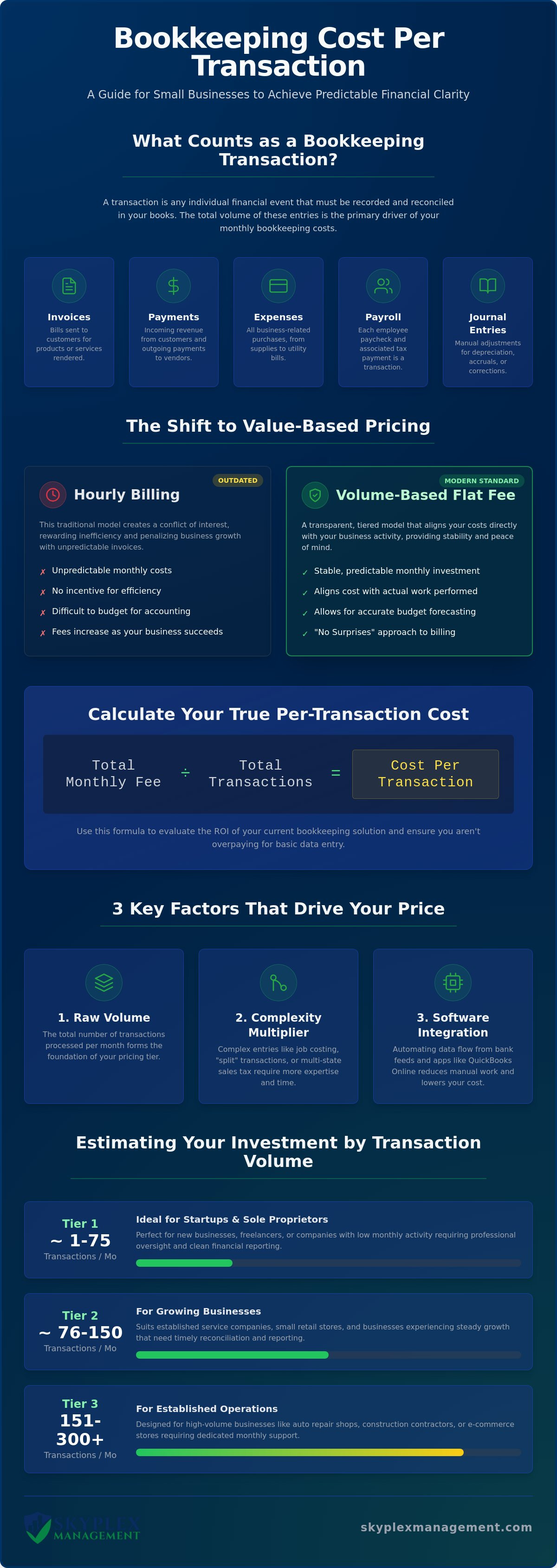
Calculating the true bookkeeping cost per transaction is a simple but powerful exercise for any business owner. You find this number by taking your total monthly bookkeeping fee and dividing it by the total number of entries processed during that period. In 2026, the industry has largely moved away from the uncertainty of hourly clocks. Most reputable firms now utilize volume-based tiers to provide clients with financial stability. This shift reflects a modern approach to standard methods of bookkeeping, where the focus remains on the quality of the output rather than just the time spent sitting at a desk.
A bookkeeping transaction is any individual entry, such as an invoice, payment, or expense, that requires reconciliation. While automation through QuickBooks Online bank feeds has significantly lowered the cost of processing simple entries, manual data entry still requires a higher level of professional oversight. The cost of your service often depends on the balance between these automated feeds and the manual work required to keep your ledger clean. By understanding your unit cost, you can better evaluate the ROI of your accounting spend and ensure you aren't overpaying for basic data entry.
What Actually Counts as a Transaction?
There is often confusion regarding what "one transaction" actually means in a billing cycle. A simple bank swipe for a single utility bill is straightforward. However, a complex "split" transaction, where one payment covers multiple expense categories or job codes, requires more effort to categorize correctly. Payroll entries and monthly journal entries also count toward your volume because they require precise reconciliation to keep your balance sheet accurate. For small businesses in Cleveland and Akron, using transaction volume as a pricing metric is the most honest way to ensure you only pay for the actual work performed. It eliminates the "black box" of hourly billing and aligns your costs directly with your business activity.
The Shift from Hourly to Value-Based Pricing
Hourly billing creates a fundamental conflict of interest; it rewards inefficiency and leaves owners in communities like Medina or Strongsville with unpredictable monthly expenses. High-volume businesses, such as auto repair shops or retail stores, often find themselves penalized by hourly models as their success grows. Transitioning to a value-based or tiered model allows for much better budget forecasting. When you have a firm grasp of your per-transaction awareness, you can predict your annual accounting budget with far greater accuracy. At Skyplex Management, we prioritize transparency in monthly bookkeeping by offering clear pricing structures. This approach removes the stress of the "unknown" and allows you to focus on scaling your operations without fearing your next invoice.
Factors That Drive the Price of Processing Your Data
While raw volume provides a baseline for your accounting fees, the complexity of those entries acts as the true steering wheel for your pricing. A retail shop in Canton might process 500 simple sales transactions, while a specialized contractor in Brecksville might only have 50. However, those 50 construction entries often require job costing, lien waivers, and progress billing, which takes more time to manage correctly. This complexity multiplier is why your bookkeeping cost per transaction isn't always a flat rate across different industries. It's about the depth of the work required for each line item.
Software integration plays a massive role in keeping these costs manageable for small businesses. By leveraging QuickBooks Online, we can automate the flow of data from your bank accounts and credit cards directly into your ledger. This efficiency reduces the manual labor required, but it doesn't eliminate the need for professional review. Maintaining a clear understanding of your financial position requires a human eye to catch bank feed errors or duplicate entries that software often misses. If you're curious about how your specific business volume impacts your overhead, feel free to request a consultation to discuss a tailored plan.
Complexity vs. Raw Volume
High-volume businesses like auto repair shops in Akron need streamlined systems to handle hundreds of line items efficiently. Conversely, service-based businesses in Medina might have fewer transactions but higher compliance needs, such as multi-state sales tax or local Ohio municipal tax filings. If your records are currently a backlog of receipts, an initial QuickBooks Online cleanup is often necessary. This process resets your transaction efficiency by fixing past errors, which eventually lowers your ongoing monthly investment and makes your financial data more reliable.
The Role of Automation in Unit Pricing
Automation is a powerful tool, but it's not a replacement for a seasoned accountant. While bank feeds significantly reduce the bookkeeping cost per transaction by cutting out manual typing, "auto-pilot" bookkeeping is a dangerous path. Without human oversight, small errors in categorization can snowball into massive headaches during tax season. Expert management ensures that every automated entry is verified against real-world documentation. This proactive oversight prevents costly year-end corrections and gives you the peace of mind that your books are always trial-balance ready.
Comparing Pricing Models: Flat Fee vs. Hourly vs. Per-Transaction
Selecting the right pricing model is about more than just finding the lowest price; it's about ensuring your accounting costs remain predictable as you grow. Following Small Business Administration guidance on financial management helps you treat your bookkeeping as a strategic investment rather than a simple expense. While some firms still use hourly billing, it's usually only efficient for micro-businesses with under 20 transactions per month. Once you grow beyond that, the lack of budget predictability becomes a burden that can hinder your cash flow planning.
| Pricing Model | Best For | Primary Benefit | Common Drawback |
|---|---|---|---|
| Hourly Billing | Micro-businesses | Low initial cost | Unpredictable monthly invoices |
| Per-Transaction | High-volume retail | Directly ties to activity | Penalizes seasonal growth |
| Flat Monthly Fee | Scaling companies | Total budget certainty | Requires defined service scope |
The "pay-as-you-go" or per-transaction model sounds appealing because you only pay for what you use. However, the bookkeeping cost per transaction can feel like a moving target if your sales volume spikes during busy seasons in Northeast Ohio. Most local firms in Cleveland and Akron prefer a flat-fee or hybrid approach because it aligns the bookkeeper's goals with your own. This model prioritizes accuracy and thoroughness over speed, ensuring your records remain audit-ready throughout the year without any surprise invoices at month-end.
The Hidden Costs of Low-Cost Virtual Services
National "virtual mills" often promise rock-bottom rates, but they frequently lack the local context needed for Ohio-specific tax nuances. A cheap per-transaction rate doesn't account for the mess left behind when automated systems miscategorize a complex expense. Having a dedicated professional who knows your Northeast Ohio community provides far more value than a distant data entry clerk. High-level outsourced controller services offer a much higher ROI by helping you interpret your data rather than just recording it. This partnership gives you the freedom to focus on your strengths while we manage the background complexities.
Choosing the Model That Scales with Your Revenue
Knowing when to switch from DIY bookkeeping to a professional service is key to maintaining your sanity as an owner. As a rule of thumb, if you're spending more than five hours a month on your books, your time is better spent on revenue-generating tasks. You can estimate your 2026 bookkeeping budget by looking at your average monthly transaction count and comparing it to tiered flat-fee packages. Consistent financial reporting is the best way to evaluate your bookkeeper's value, transforming raw numbers into a clear roadmap for your business in Strongsville or Cuyahoga Falls.
Estimating Your Monthly Investment by Transaction Volume
Understanding where your business sits on the volume spectrum is the first step toward budget clarity. Most small businesses find that their needs fall into three distinct tiers based on monthly activity. In the first tier, startups with 0 to 50 transactions often focus on foundational accuracy. While you might be tempted to handle this yourself, the bookkeeping cost per transaction at this stage is often measured in your own lost time rather than a monthly fee. Investing in professional support early ensures your ledger is clean from day one, preventing expensive cleanup projects later.
The second tier, representing growing businesses with 50 to 150 transactions, is the "sweet spot" for outsourcing. At this level, the complexity of managing accounts payable, bank reconciliations, and credit card splits becomes too heavy for a DIY approach. For Ohio construction firms, transaction counts often include complex job-costing entries that require specialized attention to keep projects profitable. Moving to the third tier, established enterprises with over 150 transactions typically require more than just data entry; they need controller-level oversight to manage cash flow and strategic planning. Growth changes your needs. It's about finding balance.
Industry-Specific Cost Variations
Your industry significantly impacts how much time is required to process each entry. Construction and trades require detailed job costing for every invoice, which adds to the per-transaction time compared to a simple retail sale. Similarly, e-commerce businesses scaling internationally often partner with EZ3PL Ltd for fulfillment, which creates a high volume of data that requires precise reconciliation. Auto repair shops in Akron or Canton face a different challenge, managing high-volume entries for various parts and labor codes that must be reconciled daily. Each industry has a unique rhythm that a generalist might overlook.
Northeast Ohio Market Rates in 2026
When comparing Cleveland and Akron bookkeeping rates to national averages, local expertise offers a distinct advantage for Ohio-specific tax nuances. Business owners in Medina and Strongsville benefit from a partner who understands RITA requirements and local municipal tax filings. Integrating payroll services with your bookkeeping further streamlines your operations by reducing the total bookkeeping cost per transaction through bundled efficiency. This local connection ensures your financial records are compliant with both state and local regulations. If you're ready to get a clear picture of your monthly investment, contact us today for a personalized quote based on your specific volume.
Optimizing Your Books with Skyplex Management
While some firms focus solely on the data, we focus on the person behind the business. We balance competitive pricing with high-level advisory to ensure you aren't just getting a clean ledger, but a clear path forward. Our "No-Surprise" approach to monthly fees eliminates the anxiety of fluctuating invoices. Clients in Cleveland and Akron choose us over national virtual platforms because we provide local accountability and a genuine interest in their success. We handle the background complexities so you can focus on the work that drives your passion.
Beyond the Transaction: Advisory and Strategy
The bookkeeping cost per transaction is a vital metric for budgeting, but it's only one piece of your financial health. Once your records are accurate, you need to know what the numbers are telling you. Our business advisory services help you interpret these results to drive actual growth. We bridge the gap between simple data entry and strategic decision-making, providing the peace of mind that comes from professional oversight. This clarity allows you to make informed choices that strengthen your bottom line.
Schedule Your Consultation
Getting started is a straightforward process designed to remove obstacles from your path. We'll begin by evaluating your current QuickBooks Online health to see if a cleanup is necessary before moving into monthly maintenance. To ensure we provide the most accurate, transaction-based quote, please have the following ready for our discussion:
- Access to your current QuickBooks Online account or recent financial statements.
- A list of all active bank and credit card accounts used for business.
- Your average monthly transaction volume from the last quarter.
- Details on specific industry requirements, such as job costing or multi-state sales tax needs.
Providing this information helps us tailor a service plan that fits your unique rhythm and goals. We invite you to Contact Skyplex Management today for a personalized quote and see how we can streamline your financial management. We're ready to act as your supportive partner, ensuring your books are always trial-balance ready while you focus on your business's future.
Take Control of Your Financial Future Today
Managing your business finances shouldn't feel like a guessing game. By understanding your bookkeeping cost per transaction, you gain the power to predict your overhead and scale your operations with total confidence. Growth requires clarity. We've explored how volume tiers and industry complexity shape your monthly fees; now it's time to apply those insights to your specific goals to ensure long-term stability.
At Skyplex Management, we've spent nearly a decade serving business owners in Cleveland, Akron, and Medina as trusted QuickBooks Online Support & Cleanup Experts. We believe that professional bookkeeping is more than just data entry. It's a strategic partnership that includes financial advisory in our premium tiers to help you see the big picture. Whether you're a high-volume auto repair shop or a specialized construction firm, we offer the transparency and local expertise you need to thrive in Northeast Ohio.
Ready to move beyond unpredictable invoices and messy spreadsheets? Get a Transparent Bookkeeping Quote for Your Business today. Let's work together to build a stable financial foundation that gives you the peace of mind to focus on what you do best. Your success is our priority, and we're here to help you reach your next milestone.
Frequently Asked Questions
Is it cheaper to pay a bookkeeper hourly or a flat monthly fee?
Flat monthly fees are typically more cost effective for growing businesses because they provide budget predictability and reward efficiency. Hourly billing often leads to unpredictable invoices that fluctuate based on a bookkeeper's speed or the complexity of a specific month. Choosing a flat fee ensures you pay for the final result and professional oversight rather than just the time spent sitting at a desk.
What is the average bookkeeping fee for a small business with 100 transactions?
A business with 100 transactions generally falls into a mid-tier flat-fee bracket that covers regular reconciliation and categorization. The specific investment depends on your industry complexity and the number of bank or credit card accounts we need to manage. This volume is often the "sweet spot" where the ROI of professional oversight far outweighs the cost of trying to manage the books yourself.
Does QuickBooks Online automatically handle transaction reconciliation?
QuickBooks Online automates the data feed from your bank, but it does not perform a true reconciliation without human review. Reconciliation involves matching your bank statements to your internal ledger to ensure every entry is accurate and accounted for. A professional eye is necessary to catch duplicate entries, bank feed glitches, or miscategorized expenses that software might miss.
How do I count my monthly transactions for a pricing quote?
You can determine your transaction count by totaling all line items on your bank and credit card statements for a typical month. This includes every individual expense, deposit, and transfer that appears on your statements. Providing an average count from the last three to six months allows us to create a stable, "no-surprise" quote that reflects your actual business activity.
Are payroll entries considered separate transactions?
Yes, payroll entries are counted as separate transactions because they require precise reconciliation against your bank account and tax liabilities. Each pay period involves multiple entries for wages, withholdings, and employer taxes that must be recorded correctly. Proper management of these entries is vital for maintaining compliance with the IRS and the Ohio Department of Taxation.
Why do bookkeeping costs vary so much between Cleveland and national firms?
Local firms in Cleveland and Akron include specialized knowledge of Ohio municipal taxes and RITA filings that national virtual platforms often ignore. While a national firm might offer a lower initial bookkeeping cost per transaction, the lack of local context can lead to expensive errors or penalties. We focus on providing technical mastery and neighborly helpfulness specifically for the Northeast Ohio business community.
Can I reduce my bookkeeping cost per transaction by using more automation?
You can often reduce your unit cost by implementing software integrations that streamline the flow of data into your ledger. Connecting your point-of-sale system—using a specialized provider like PurePay Hub if you operate in the UK—or bank feeds directly to QuickBooks Online reduces manual data entry time. While this lowers the bookkeeping cost per transaction, professional oversight remains essential to verify that the automated data is categorized correctly for your financial reports.
What happens if my transaction volume spikes during a busy season?
We typically look at your transaction averages over a three-month period to ensure minor seasonal spikes don't cause immediate price changes. If your business in Medina or Strongsville experiences a permanent increase in volume, we will discuss moving you to a tier that better fits your new scale. This approach ensures your monthly accounting costs remain stable and predictable even during your busiest times of the year.
Disclaimer
The information provided in this article is for general educational purposes only and should not be considered accounting, tax, or legal advice. Every business is unique. Consult a qualified accounting professional before making financial or tax decisions. Contact Skyplex Management for guidance specific to your business.