
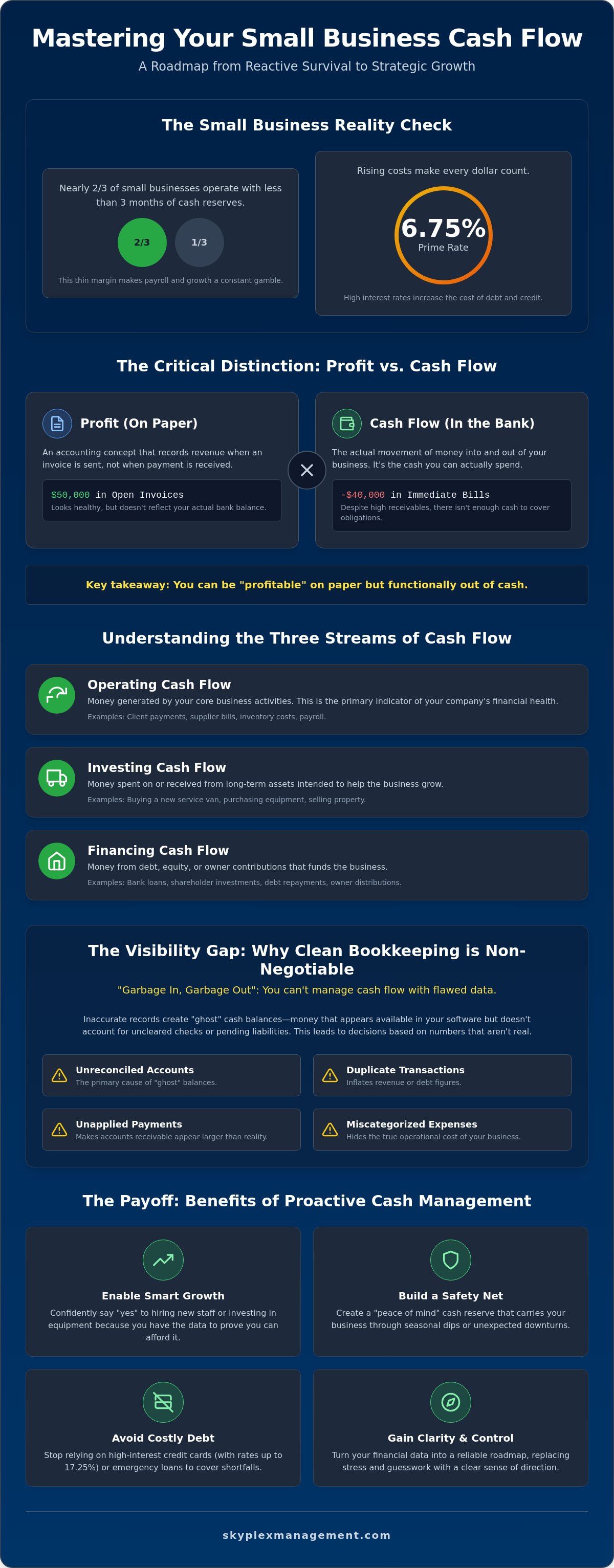
Did you know that nearly two-thirds of small businesses currently operate with less than three months of cash reserves? In a year where the prime rate sits at 6.75% and operating costs continue to climb, that thin margin can make payroll weeks feel like a high-stakes gamble. Whether you are running an auto repair shop in Akron or managing a construction crew in Cleveland, you shouldn't have to check your bank balance with a sense of dread. We understand that unpredictable financial cycles are more than just a numbers problem; they are a direct barrier to your peace of mind and your ability to hire or scale.
The good news is that you can move from reactive survival to strategic growth when you learn to manage small business cash flow with a proactive system. This article will help you master your financial cycles by turning raw data into a clear roadmap for the future. We will explore how to leverage the permanent 20% QBI deduction and restored 100% bonus depreciation to your advantage. You will also discover how professional QuickBooks Online support and fractional controller services provide the oversight you need to make confident decisions for long-term stability in 2026.
Key Takeaways
- Learn why clean bookkeeping and QuickBooks cleanup are the essential first steps to financial visibility, helping you avoid "ghost" balances and unreconciled errors.
- Discover a proactive five-step system to manage small business cash flow that turns historical data into a reliable roadmap for hiring and equipment purchases.
- Master the art of optimizing your cash cycles by accelerating receivables and timing payables to maintain maximum liquidity for your Northeast Ohio business.
- Understand how outsourced controller services bridge the gap between monthly bookkeeping and strategic financial advisory to support your long-term stability.
What is Small Business Cash Flow Management?
Every business owner in Northeast Ohio, from the busy auto repair shops in Akron to the growing construction firms in Strongsville, knows that revenue is only half the story. To truly understand the health of your company, you must look at the timing and movement of your money. At its core, What is cash flow management? It's the disciplined process of monitoring, analyzing, and optimizing the net amount of cash receipts minus your cash expenses. Learning how to manage small business cash flow isn't just about record-keeping; it's about ensuring you have enough liquidity to meet your obligations exactly when they fall due.
Cash flow is typically categorized into three distinct streams. Operating cash flow includes the money generated by your core business activities, such as client payments and inventory costs. Investing cash flow tracks money spent on or received from long-term assets, like a new service van for a Hudson-based plumbing company. Finally, financing cash flow accounts for debt repayments, loans, or owner distributions. Many owners feel a sense of persistent anxiety about these numbers, but it's helpful to remember that cash flow struggles are usually a systemic issue rather than a personal failure. With the right oversight and a proactive system, these cycles become predictable and manageable.
Cash Flow vs. Profit: The Critical Distinction
It's a common and frustrating scenario: your accountant tells you the business was profitable last month, yet you're struggling to cover the next payroll run in Cuyahoga Falls. This happens because profit is an accounting concept that records a sale when the invoice is sent, while cash flow only cares about when the money actually hits your bank account. If you have $50,000 in open accounts receivable but $40,000 in immediate bills, you're "profitable" on paper but functionally broke. Understanding your burn rate is essential for navigating these gaps. Burn rate is the specific speed at which your business spends its available cash reserves before it begins generating positive cash flow from its daily operations.
The Benefits of Proactive Cash Management
When you shift from reactive checking to proactive planning, the entire atmosphere of your business changes. You no longer have to rely on high-interest credit cards or emergency bank loans that carry rates as high as 17.25% in 2026. Instead, you build a "peace of mind" reserve that carries your team through seasonal dips in Medina or Brecksville. This level of professional oversight empowers you to say "yes" to growth opportunities, such as hiring a new lead technician or investing in advanced diagnostic equipment, because you have the data to prove you can afford it. Strategic management turns your financial data into a reliable roadmap, replacing stress with a clear sense of direction.
The Visibility Gap: Why Clean Bookkeeping is the Foundation
Most financial guides assume your records are already perfect, but we know that isn't always the case for busy owners in Cleveland or Medina. You cannot effectively manage small business cash flow if your underlying data is riddled with errors. This is the "Garbage In, Garbage Out" principle in action. If your ledger is messy, your financial reports are essentially fiction, making it impossible to plan for the next payroll cycle or a major equipment purchase. Accurate bookkeeping isn't just about tax compliance; it's the only way to see the true movement of your money.
Unreconciled accounts are the primary cause of "ghost" cash balances. These occur when your software shows a specific amount of money available, but it doesn't account for uncleared checks, pending electronic transfers, or upcoming tax liabilities. Without professional ledger management, you're making decisions based on a number that doesn't exist. This is why this U.S. Small Business Administration guide emphasizes that maintaining accurate financial records is the absolute bedrock of a stable company. It's the difference between guessing your next move and knowing you have the funds to make it.
Common Bookkeeping Errors That Distort Cash Flow
In our work with auto repair shops in Akron and construction firms in Strongsville, we often find a few recurring issues that skew the numbers. Duplicate transactions and unapplied payments in QuickBooks Online can make your revenue look inflated or your debts look larger than they are. Miscategorized expenses are another frequent problem, as they hide the true operational costs of your business. Perhaps most dangerously, mixing personal and business finances creates a tangled web that obscures your actual performance and makes it difficult to see if the company is truly sustaining itself.
Restoring Data Integrity with Professional Cleanup
Restoring financial truth begins with a deep dive into account reconciliation and historical correction. Our team specializes in QuickBooks Online Support & Cleanup to provide you with a clean slate, fixing past mistakes so you can move forward with confidence. Once we've cleared the backlog, transitioning to consistent Monthly Bookkeeping ensures you never lose that visibility again. If your records feel overwhelming, a professional QuickBooks cleanup is the first step toward the peace of mind you deserve. This ongoing oversight transforms your books from a source of stress into a strategic tool for growth in Cuyahoga Falls and beyond.
How to Build a Proactive Cash Flow Forecast in 5 Steps
Once your QuickBooks Online cleanup is complete, you have the reliable foundation needed to look ahead. A forecast isn't a complex math equation; it's a living tool that helps you manage small business cash flow by predicting the future based on current reality. By following these five steps, you can move from reactive stress to proactive control.
- Establish your baseline: Use your reconciled historical data to identify your average monthly spending and recurring costs.
- Estimate future inflows: Look at your current accounts receivable and project pipeline. If you're a construction firm in Cuyahoga Falls, factor in your typical 30-day or 60-day payment cycles rather than assuming money arrives the day you invoice.
- Project all outflows: Include fixed costs like rent and payroll, alongside variable costs like seasonal inventory or materials.
- Identify the gaps: Pinpoint specific weeks where your expenses might exceed your incoming cash. Seeing these "danger zones" in advance allows you to adjust your spending or follow up on late invoices early.
- Adjust and iterate: Update your forecast every week to reflect actual bank balances and new sales.
The 13-Week Rolling Forecast Explained
We recommend a 13-week rolling forecast because one quarter is the "sweet spot" for small business planning. It's long enough to see upcoming trends but short enough to remain highly accurate. You can use this timeframe for scenario planning, comparing a "best-case" scenario where all clients pay on time against a "worst-case" where a major project in Medina is delayed. To find recurring hidden expenses, start by reviewing your annual insurance renewals, quarterly tax payments, and those small software subscriptions that often slip through the cracks. Identifying these early prevents them from becoming "surprise" drains on your liquidity during a busy month.
Tools to Simplify the Forecasting Process
QuickBooks Online offers helpful reporting features that can automate part of this process, but software has its limits. A computer can tell you what happened in the past, but it can't interpret the "why" or help you pivot your strategy when market conditions change in Northeast Ohio. This is why human analysis is essential. For many growing businesses, our Outsourced Accounting & Controller Services provide the high-level oversight needed to turn these reports into actionable growth plans. If you're ready to move beyond basic data entry and start using your numbers to scale, check out The Ultimate Guide to Small Business Bookkeeping Services to see how professional support changes your financial outlook.
Strategic Tactics to Optimize Your Business Cash Cycles
While many national banks suggest securing a line of credit as the primary solution for cash gaps, borrowing money is often a temporary fix for a systemic process issue. In 2026, with bank lines of credit carrying interest rates between 8% and 14%, relying on debt to manage small business cash flow can become an expensive habit. Instead, focusing on internal process improvements allows you to keep more of your hard-earned money. By refining how cash moves through your business in Northeast Ohio, you create a self-sustaining cycle that supports long-term stability without the burden of additional interest payments.
Inflow Strategies: Getting Cash in the Door
Speeding up your accounts receivable is the most effective way to improve liquidity without increasing sales volume. If you run a service-based business in Stow or Cuyahoga Falls, implementing a deposit requirement for large projects ensures you aren't financing the client's work out of your own pocket. You should also leverage QuickBooks Online to automate invoice reminders and offer multiple online payment options. These small shifts reduce the "friction" of getting paid. While some owners hesitate to charge late fees, offering a small early payment discount is often a friendlier way to encourage clients to move your invoice to the top of their pile.
Outflow Strategies: Keeping Cash in the Bank
Managing your payables is just as critical as collecting your receivables. When considering major equipment for an auto repair shop in Canton or a construction crew in Akron, the "lease vs. buy" debate is a central part of cash preservation. Leasing often allows for smaller, predictable monthly payments, preventing a massive cash drain that could otherwise be used for payroll or marketing. You should also perform a monthly audit of your ledger to identify "leakage" from recurring subscriptions you no longer use. Scheduling your bill payments to align with your highest inflow weeks prevents your balance from dipping into the "danger zone" during slower periods.
Efficiency in your Payroll Service and inventory management also plays a vital role. For service-based businesses, keeping too much capital tied up in unsold parts or materials is essentially "trapping" your cash on a shelf. Furthermore, using a professional service for payroll ensures you avoid the steep penalties associated with timing errors or tax filing mistakes, which can derail even the best cash flow plan. If you're ready to stop reacting to bank balances and start leading with a strategy, our team is here to help. Contact Skyplex Management today to learn how our fractional controller services can optimize your financial operations.
Scaling with Confidence: The Role of Outsourced Controller Services
There comes a point for every successful business in Northeast Ohio where simply recording transactions isn't enough to sustain momentum. While bookkeeping focuses on the accuracy of past data, controller services focus on what those numbers mean for your future. Moving from "counting beans" to "strategic advisory" is a vital shift for owners who want to manage small business cash flow with a higher level of sophistication. A controller acts as your financial navigator, taking the clean data from your Monthly Bookkeeping and turning it into a high-level strategy that drives operational efficiency.
Outsourced controller services provide the "big picture" perspective that is often missing when you're buried in daily operations in Cleveland or Strongsville. Instead of just seeing a bank balance, you receive detailed financial reporting that highlights trends, identifies waste, and pinpoints your most profitable service lines. At Skyplex Management, we act as the strategic partner that handles the complex "how" of your financial structure. This allows you to stay focused on the "why" behind your business, whether that is serving more customers in Medina or expanding your crew in Cuyahoga Falls.
When to Move Beyond Basic Bookkeeping
If you've noticed that your revenue is climbing but your bank balance remains stagnant, it's a clear sign you need higher-level oversight. Rapid growth often brings complexity that basic bookkeeping can't address, such as intricate Payroll Service requirements or the need for advanced fraud prevention. Stalled profits or a lack of clarity on where your money is going are also major indicators. Hiring a full-time, in-house financial executive in a city like Akron can be a significant expense. Our Outsourced Accounting & Controller Services provide that same level of expertise and financial oversight at a fraction of the cost, giving you the benefit of a seasoned professional without the executive price tag.
Your Roadmap to Financial Peace of Mind
True financial stability is built on a simple, three-part foundation: clean books, proactive forecasting, and strategic advisory. When these elements work together, the stress of "payroll weeks" disappears and is replaced by a sense of calm authority. You no longer have to guess if you can afford that new piece of equipment for your shop in Canton or if you should hire more staff in Hudson. You have the data, the forecast, and the expert guidance to make those decisions with total confidence.
Your journey toward this level of clarity doesn't have to be overwhelming. It can start with a simple QuickBooks Online Support & Cleanup to fix historical errors or a comprehensive financial health assessment to see where you stand today. We invite you to take that first step toward a more predictable financial future. Schedule a consultation with Skyplex Management to reclaim your financial clarity.
Take Control of Your Financial Future Today
Mastering your financial cycles is the most effective way to replace bank balance anxiety with long-term stability. Clean data changes everything. The ability to manage small business cash flow effectively begins with the integrity of your records. When your books are clean and your forecasts are proactive, you gain the clarity needed to make bold decisions. Whether you're planning a new hire in Strongsville or an equipment purchase in Akron, professional oversight ensures you're leading with strategy rather than reacting to shortages.
Skyplex Management provides the expert QuickBooks Online cleanup and dedicated small business advisory you need to scale with confidence. Our strategic outsourced controller services handle the background complexities so you can focus on your core strengths. You don't have to let messy ledgers or unpredictable cycles stall your growth. You deserve a partner who is as committed to your success as you are.
Ready to move from financial uncertainty to a clear roadmap for growth? Get a Professional QuickBooks Cleanup and Reclaim Your Peace of Mind. We're here to help you build the stable, thriving business you've always envisioned.
Frequently Asked Questions
How is cash flow different from profit?
Profit is an accounting calculation showing what remains after expenses are subtracted from revenue, while cash flow is the actual movement of liquid money into and out of your bank account. It is possible to be profitable on paper but still lack the funds to cover a payroll run in Cuyahoga Falls if your money is tied up in unpaid invoices. Understanding this distinction is the first step to manage small business cash flow with confidence.
What is a "good" cash reserve for a small business?
A healthy cash reserve should typically cover three to six months of your essential operating expenses. Data from early 2026 indicates that nearly two-thirds of small businesses currently operate with less than three months of cash on hand. Building this cushion provides a vital safety net for your Strongsville or Medina business during seasonal dips or unexpected market shifts.
Can QuickBooks Online manage my cash flow automatically?
QuickBooks Online provides excellent tracking tools, but it cannot manage your cash flow automatically without professional human analysis. While the software records what has already happened, it lacks the context to predict your specific sales pipeline or upcoming project delays in Cleveland. Professional QuickBooks Support ensures your software data is translated into a reliable roadmap for the future.
How often should I update my cash flow forecast?
You should update your cash flow forecast at least once a week to maintain accuracy. A 13-week rolling forecast is most effective when you reconcile your actual bank balances and new invoices every Friday afternoon. This consistent habit allows you to spot potential "danger zones" in your Akron business well before they become financial emergencies.
What are the quickest ways to improve cash flow today?
The fastest ways to boost your cash position include sending invoices immediately upon job completion and offering online payment options to reduce friction. You should also follow up on any accounts receivable that are past their due date. For service-based businesses in Stow, requiring a deposit before beginning work is another effective way to get cash in the door sooner.
How does outsourced bookkeeping help with cash flow?
Outsourced bookkeeping provides the clean, reconciled data that is necessary for any accurate financial planning. When your records are messy, you're making decisions based on "ghost" balances that don't actually exist. Professional QuickBooks Online Support & Cleanup restores financial truth to your ledger, giving you the visibility needed to plan for long-term stability.
What is the difference between a bookkeeper and a controller?
A bookkeeper focuses on the accurate recording of your daily financial transactions, while a controller provides high-level strategy and financial oversight. Think of a bookkeeper as the person maintaining your vehicle and a controller as the navigator helping you reach your destination. Our Outsourced Accounting & Controller Services provide the strategic advisory that growing Northeast Ohio firms need to scale.
Is it better to lease or buy equipment for cash flow purposes?
Leasing is often better for cash flow because it preserves your liquid reserves for daily operations and payroll. However, with 2026 tax laws restoring 100% bonus depreciation, buying equipment might offer significant tax advantages for your business in Hudson or Canton. We recommend analyzing your current liquidity against your year-end tax goals before making a final decision.
Disclaimer
The information provided in this article is for general educational purposes only and should not be considered accounting, tax, or legal advice. Every business is unique. Consult a qualified accounting professional before making financial or tax decisions. Contact Skyplex Management for guidance specific to your business.