

Did you know that 40% of small businesses face IRS fines every year because of simple payroll errors? When you're trying to calculate the full service payroll cost for small business in 2026, it's easy to focus only on the monthly software fee while ignoring the much larger cost of a single compliance mistake. You likely started your company to build something meaningful, not to spend your Friday nights wrestling with RITA filings or calculating Ohio SUTA rates. It's frustrating when manual data entry eats up hours that should be spent serving your clients in Cleveland or growing your team in Akron.
We understand that you need predictable expenses and the peace of mind that comes from knowing your taxes are handled correctly. This guide provides a transparent look at what you can expect to pay for professional payroll management this year, including the hidden fees that often catch local owners off guard. We'll break down the latest 2026 tax rates, compare various service tiers, and explain how expert oversight helps you reclaim your time while ensuring you never pay a penny in unnecessary penalties.
Key Takeaways
- Understand the standard 2026 pricing model of base monthly fees and per-employee charges to accurately project your annual expenses.
- Learn how to calculate the true full service payroll cost for small business by accounting for complex Ohio municipal tax filings like RITA and CCA.
- Identify the hidden risks of using software alone, which often leads to expensive IRS penalties that professional management can help you avoid.
- Discover how local businesses in communities like Strongsville and Brecksville save valuable hours each month by integrating payroll with their monthly bookkeeping.
- Evaluate the long-term ROI of a dedicated account manager versus the frustration of waiting for a support ticket from a national software provider.
Understanding the Components of Full Service Payroll Pricing
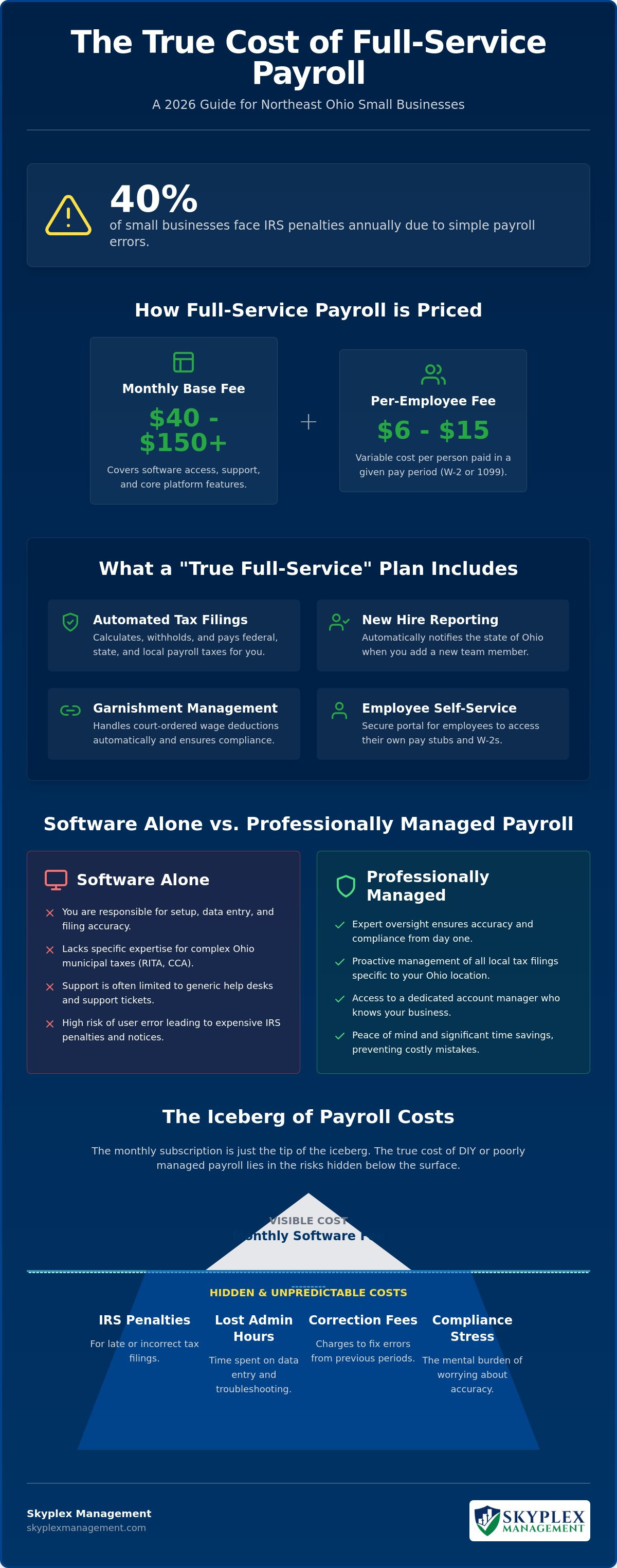
Budgeting for your team's compensation involves more than just calculating hourly wages or salaries. To get a clear picture of the full service payroll cost for small business, you have to look at the two-tiered pricing model that dominates the industry in 2026. Most providers use a "Base + Per Head" structure. The base fee is your monthly subscription for the software and support, while the per-head fee is a variable cost that changes as you hire new staff or seasonal help in communities like Medina or Hudson.
Industry data for 2026 shows that most small businesses pay between $70 and $250 per month for payroll software. If you're looking for a foundational understanding of what is payroll and the logistics behind these numbers, it's helpful to view the base fee as your access to the platform's infrastructure and the per-employee fee as the cost of processing individual data and tax forms.
Base Fees vs. Per-Employee Charges
The base fee for a mid-tier service typically ranges from $40 to $80 per month. If you require more advanced features like integrated HR tools or specialized reporting, that base can jump to $150 or more. On top of that, you'll pay a per-employee fee, which usually falls between $6 and $15 per person.
It's important to differentiate between W-2 employees and 1099 contractors. Some providers charge the same rate for both, while others offer a lower per-head cost for contractors because they don't require tax withholdings. You should also verify if your provider charges per pay run. While many modern systems allow for unlimited runs, some still bill you every time you process checks, which can significantly increase costs for businesses that pay weekly rather than bi-weekly.
What "Full Service" Actually Includes
When you opt for a payroll service that is truly "full service," you're paying for the provider to take legal and administrative responsibility for your tax filings. This isn't just about printing checks. It's a comprehensive management system that handles federal, state, and local tax impounding and filing. A genuine full-service plan includes:
- Automated Tax Filings: The system calculates, withholds, and pays your payroll taxes to the IRS and the Ohio Department of Taxation.
- Employee Self-Service: Portals where your team can download their own pay stubs and W-2s, saving you from constant administrative requests.
- New Hire Reporting: Automatic notification to the state of Ohio whenever you add a new member to your team.
- Garnishment Management: The software handles court-ordered deductions automatically, ensuring you stay compliant with legal requirements.
Beyond the monthly cycle, remember to account for year-end filing fees. Most providers charge a flat fee plus a per-form rate to generate and file W-2s and 1099s. There may also be a one-time implementation fee. While this setup cost might feel like an extra burden, it's an investment in accuracy. Proper setup ensures your historical data is imported correctly, which prevents expensive tax notices and penalties down the road.
Key Factors Influencing Payroll Fees for Northeast Ohio Businesses
Calculating the full service payroll cost for small business requires looking beyond the sticker price of a software subscription. While a national provider might offer a low introductory rate, that price often swells once you add the specific filing requirements necessary for our region. Northeast Ohio presents a unique regulatory environment that can turn a simple payroll run into a complex administrative project. If your business operates in multiple states or even multiple Ohio cities, your costs will reflect the additional filing volume and oversight required to keep you in good standing. For companies leveraging enterprise automation to handle these multi-state complexities, PS WebSolution provides specialized expertise in navigating regional tax nuances, such as those in neighboring Pennsylvania.
The frequency of your pay runs also plays a role. While many modern platforms include unlimited runs in their base fee, others charge per-cycle. If you're a contractor in Akron paying your crew weekly, or a restaurant owner in Cleveland issuing off-cycle checks for tipped employees, those transaction fees add up quickly. Understanding these variables is the first step in a step-by-step payroll guide toward a more predictable budget.
The Ohio Municipal Tax Challenge
Business owners in Cleveland, Akron, and Canton face a tax landscape that most national software companies don't fully grasp. Ohio is one of the few states with a robust municipal income tax system, often managed through the Regional Income Tax Agency (RITA) or the Central Collection Agency (CCA). Each district has its own rates, reciprocity rules, and filing deadlines. If your employees live in one RITA municipality but work in another, the withholding calculations become significantly more difficult.
Most full service payroll cost for small business estimates include federal and state filings, but local municipal compliance is often treated as an "add-on" or left for the owner to handle. Local tax errors are the most common source of Ohio penalties because of the sheer volume of overlapping jurisdictions and varying rate requirements. If you find yourself buried in RITA notices, it may be time to schedule a brief consultation to ensure your local withholdings are accurate.
Industry-Specific Payroll Complexity
Your specific industry dictates how much "heavy lifting" your payroll provider must do. For construction firms in Medina or Strongsville, payroll isn't just about cutting checks; it's about job costing and prevailing wage reporting. If you're working on government-funded projects, your payroll system must generate certified payroll reports that meet strict state and federal standards. This level of detail usually moves you into a higher service tier.
Service-based businesses and auto repair shops also have specialized needs. Managing varied shifts, overtime calculations, and tip credits requires a system that integrates deeply with your time-tracking software. Additionally, in Ohio, your Workers' Compensation (BWC) premiums are tied directly to your payroll data. A professional management strategy ensures your BWC true-up reports are accurate, preventing you from overpaying on premiums or facing audit-related fines at year-end.
Automated Software vs. Professional Managed Payroll: A Value Analysis
Choosing between a self-service app and a managed service is a critical decision for your bottom line. While automated software often looks like the most affordable path, the true full service payroll cost for small business is frequently hidden in the hours you spend troubleshooting software glitches. National software platforms are built for the average user. They often struggle with the hyper-local tax requirements found in Northeast Ohio. When a system incorrectly flags a RITA withholding or misses a local rate change, you're the one left on hold with customer support for hours trying to fix a problem you didn't create.
Industry data on payroll service costs suggests that businesses can spend significantly more on internal administrative time than they would on a professional service fee. This discrepancy creates a "DIY tax" where you pay with your own productivity. By delegating these technical tasks to a dedicated professional, you ensure that your payroll is processed accurately every single time, which ultimately protects your business from the 40% of IRS penalties that stem from simple filing errors.
The Hidden Cost of "Cheap" Software
Many owners in Hudson and Stow start with basic automation only to realize their QuickBooks Online file has become a mess of unreconciled payroll liabilities. If your payroll data doesn't sync perfectly with your general ledger, your financial reports become unreliable. This lack of clarity makes it impossible to understand your true labor costs or profitability. You then have to invest in Skyplex Management’s QuickBooks Online support to clean up backdated entries and fix tax mapping errors. A professionally managed service ensures data integrity from the start, so you can trust your financial statements without second-guessing the math.
Professional Oversight and Advisory
Managed payroll provides more than just a processed check; it offers a level of professional oversight that software cannot replicate. Instead of submitting a support ticket and waiting days for a response, you have a direct line to an expert who understands the nuances of construction accounting or service-based business models. This relationship often functions like a fractional controller. We monitor your labor trends and help with proactive tax planning throughout the year. For a growing company, this transition from reactive filing to strategic management is what allows you to scale smoothly without being dragged down by background complexities.
Calculating the True Cost: Hidden Fees, Penalties, and Time Loss
When evaluating the full service payroll cost for small business, the monthly subscription is only one line item in a much larger equation. The real expense often surfaces through the "cost of correction." If you use a basic software tool that doesn't account for the $184,500 Social Security wage base or the additional 0.9% Medicare tax for high earners in 2026, you'll eventually face an audit. These technical oversights lead to messy records that require professional intervention to resolve. We often see owners pay twice: once for the software that failed them and again for a specialized cleanup to fix the resulting errors.
Beyond tax mistakes, poorly timed payroll runs can trigger expensive bank fees and NSF charges. If your software initiates a direct deposit pull before your cash flow is ready, you're hit with penalties from both your bank and your employees. A professional payroll service provides the oversight needed to sync your payroll cycle with your actual bank balance, preventing these avoidable financial drains.
The High Price of Non-Compliance
The IRS and the Ohio Department of Taxation are increasingly automated in their penalty assessments. Since 40% of small businesses are fined annually by the IRS for payroll errors, the risk of a "DIY" approach is statistically high. Penalties for late deposits can start at 2% and quickly climb to 10% of the tax amount due. In Ohio, the state also applies interest to unpaid withholding taxes, which compounds the financial burden. To stay off the radar of auditors, you should focus on these common triggers:
- Late Tax Deposits: Missing a federal or state deposit deadline by even one day.
- Inaccurate SUTA Reporting: Using the wrong Ohio SUTA rate, which for new employers is 2.85% in 2026.
- Misclassified Workers: Treating employees as 1099 contractors to avoid FICA taxes.
- Incomplete Local Filings: Neglecting specific municipal requirements for RITA or CCA districts.
Opportunity Cost for the Business Owner
Every hour you spend reconciling payroll entries is an hour you aren't generating revenue. For a business owner in Cleveland or Akron, your time has a high market value. If you spend five hours a month on payroll administration, you're essentially paying yourself a premium to do data entry. When you compare your hourly billing rate or sales potential to a professional management fee, the math almost always favors outsourcing. Administrative burnout is a real threat to growth; it occurs when an owner becomes so entangled in background accounting tasks that they lose the energy to lead their team. If you're ready to reclaim your Friday nights and eliminate tax anxiety, contact us today for a professional payroll review.
Optimizing Your Payroll Strategy with Skyplex Management
Managing a company in Northeast Ohio requires a delicate balance of local focus and technical precision. While national software companies offer a one-size-fits-all approach, Skyplex Management provides a personalized strategy that accounts for the specific needs of your community. Whether you're operating a service-based business in Strongsville or a construction firm in Brecksville, your payroll should be a silent, efficient engine that supports your growth rather than a source of constant stress. By choosing a partner who understands the local landscape, you ensure that the full service payroll cost for small business remains a predictable investment in your company's stability.
One of the most significant advantages of our approach is the seamless integration between your payroll and your broader financial picture. When your payroll data is disconnected from your monthly bookkeeping, you're forced to spend hours on manual reconciliations. We eliminate this burden by ensuring your labor costs, tax liabilities, and employee benefits flow directly into your financial reports. This level of synchronization gives you a real-time view of your cash flow, allowing you to make informed decisions about hiring or expansion without waiting for year-end reports.
The Skyplex Advantage in Northeast Ohio
We've spent nearly a decade serving business owners in Cuyahoga Falls, Fairlawn, and across the region. This local presence means we don't just process checks; we act as a supportive partner who handles the background complexities of the Ohio Department of Taxation and local RITA requirements. Our team provides the professional oversight necessary to prevent the common filing errors that lead to expensive IRS notices. When you work with Skyplex Management’s Payroll Services, you're gaining an empowering expert who prioritizes your peace of mind over simple data entry.
Next Steps: From Consultation to Compliance
Moving from a messy, manual system to a streamlined professional platform doesn't have to be overwhelming. Our customized onboarding process is designed to be methodical and unhurried, ensuring every piece of historical data is imported correctly. We specialize in "cleanup" for businesses that have struggled with automated software in the past, fixing tax mapping errors and unreconciled liabilities before they become audit triggers. This proactive transition sets the foundation for a long-term partnership built on reliability and technical mastery.
Every business has a unique footprint, which is why we offer personalized quotes rather than generic pricing tiers. We take the time to understand your industry, employee count, and filing requirements to create a strategy that fits your budget and goals. If you're ready to stop wasting time on data entry and start focusing on your business growth, schedule a consultation to streamline your payroll today.
Building a More Profitable and Compliant Future
Managing your workforce in 2026 requires more than just a software subscription; it demands a strategy that accounts for the unique regulatory landscape of Northeast Ohio. As you evaluate the full service payroll cost for small business, remember that the lowest monthly fee often leads to the highest long-term expense through RITA penalties or administrative burnout. By integrating your payroll with expert QuickBooks Online support and professional oversight, you transform a complex burden into a streamlined asset that fuels your growth.
Skyplex Management has served communities from Cleveland to Medina for nearly a decade, providing the deep expertise in Ohio Department of Taxation requirements that national software companies simply can't match. We handle the technical details of local withholdings and tax compliance so you can focus on leading your team and serving your customers. If you're tired of wrestling with data entry and the fear of tax notices, it's time to choose a local partner who prioritizes your success. Ready to offload your payroll stress? Contact Skyplex Management for a custom quote. We look forward to helping you reclaim your time and achieve total peace of mind.
Frequently Asked Questions
How much does full service payroll cost for a small business with 5 employees?
Most 5-employee firms spend between $70 and $155 per month on software fees alone. This total includes a base monthly subscription and a per-head charge for each team member. While these figures represent the baseline full service payroll cost for small business, professional management adds significant value by preventing the expensive filing errors that automated software often misses.
Is it cheaper to use a payroll service or do it myself with software?
Software looks cheaper on a monthly statement, but it often costs more in the long run because of administrative time and IRS penalties. Since 40% of small businesses face fines annually, the perceived savings from DIY software quickly vanish when a single filing error occurs. Managed services provide the professional oversight needed to protect your profit margins and reclaim your valuable time.
What are the most common payroll tax penalties for Ohio businesses?
The most frequent penalties stem from late tax deposits and incorrect SUTA reporting. In 2026, the Ohio SUTA rate for new employers is 2.85%, and failing to calculate this correctly can trigger interest charges from the state. Additionally, neglecting municipal filings for RITA or CCA districts often results in automated notices and compounding fines that are difficult to resolve without professional assistance.
Does full service payroll include 1099 filings for contractors?
Yes, most comprehensive payroll plans include the processing and filing of 1099-NEC forms for your independent contractors. While there is typically a small year-end fee per form, having these documents integrated with your regular payroll ensures that your annual reporting is consistent. This streamlined approach guarantees that all filings are submitted on time to both the IRS and the state of Ohio.
How long does it take to switch to a professional payroll provider?
A smooth transition typically takes one to two weeks, depending on the complexity and accuracy of your current records. If you're moving from a manual system or a software that wasn't set up correctly, we focus on a methodical onboarding process to import your historical data. This ensures your year-to-date totals are perfectly accurate before your first pay run on our platform.
What local Ohio taxes do I need to worry about for my employees?
You must manage municipal income taxes through agencies like RITA or CCA, which vary based on where your employees work and live. Ohio's local tax system is unique because of its overlapping jurisdictions and specific reciprocity rules. Failing to withhold the correct city tax for a Cleveland or Akron resident can lead to significant compliance headaches for both you and your staff.
Can Skyplex Management help if my current payroll records are a mess?
We specialize in QuickBooks Online Support & Cleanup and payroll reconstruction for businesses with disorganized records. If your previous software mapping was incorrect or you've fallen behind on tax reconciliations, we can step in to stabilize your system. Our goal is to move you from administrative chaos to a streamlined process that provides clear financial reporting every month.
Are payroll service fees tax-deductible for my small business?
Yes, the fees you pay for professional payroll management are considered an ordinary and necessary business expense by the IRS. This means the full service payroll cost for small business is fully tax-deductible on your annual return. Beyond the deduction, the real ROI comes from the time you save and the total elimination of expensive tax penalties and interest charges.
Disclaimer
The information provided in this article is for general educational purposes only and should not be considered accounting, tax, or legal advice. Every business is unique. Consult a qualified accounting professional before making financial or tax decisions. Contact Skyplex Management for guidance specific to your business.