

How many Saturdays have you traded for a stack of receipts and a nagging sense of dread about your bank balance? For many business owners in Northeast Ohio, from Cleveland to Canton, the DIY approach eventually leads to a breaking point where messy records and the fear of an IRS audit become too heavy to carry. You started your business to build something meaningful, not to lose sleep over bank reconciliations or uncertain monthly cash flow. Understanding how to choose a bookkeeping service for small business is the first step toward reclaiming your focus and ensuring your financials are always tax-ready.
It's natural to feel uncertain about the investment, but the right partner provides a lifestyle benefit that far outweighs the monthly fee. In this 2026 buying guide, you'll learn how to evaluate bookkeeping costs, compare various pricing models, and identify the specific qualities that make a firm a true strategic partner. We will break down what to expect from modern financial services so you can move forward with predictable pricing and the clarity needed to scale your business with confidence.
Key Takeaways
- Discover why transaction volume and account complexity, rather than just annual revenue, are the primary factors that determine your monthly bookkeeping fees.
- Compare the pros and cons of hourly billing versus fixed monthly rates to find a pricing model that ensures your business budget remains predictable.
- Learn how to choose a bookkeeping service for small business by using a professional checklist to evaluate transparency, response times, and industry expertise.
- Identify common red flags that indicate a bookkeeper may be falling behind, helping you avoid the stress of year-end cleanups or IRS audit fears.
- Understand how local strategic partners in Northeast Ohio bridge the gap between simple data entry and high-level financial advisory to help your business scale.
Understanding the Average Cost of Bookkeeping for Small Business
When you begin researching how to choose a bookkeeping service for small business, the initial question usually revolves around the price tag. However, looking for a single "average" cost can be a trap because financial needs vary wildly between a solo consultant in Medina and a high-volume auto repair shop in Cleveland. To find the right fit, you must first understand the hierarchy of financial support. What is bookkeeping? At its core, it's the daily recording of transactions, while accounting involves interpreting that data for tax strategy. A fractional controller goes even further, providing the high-level oversight needed for complex cash flow management.
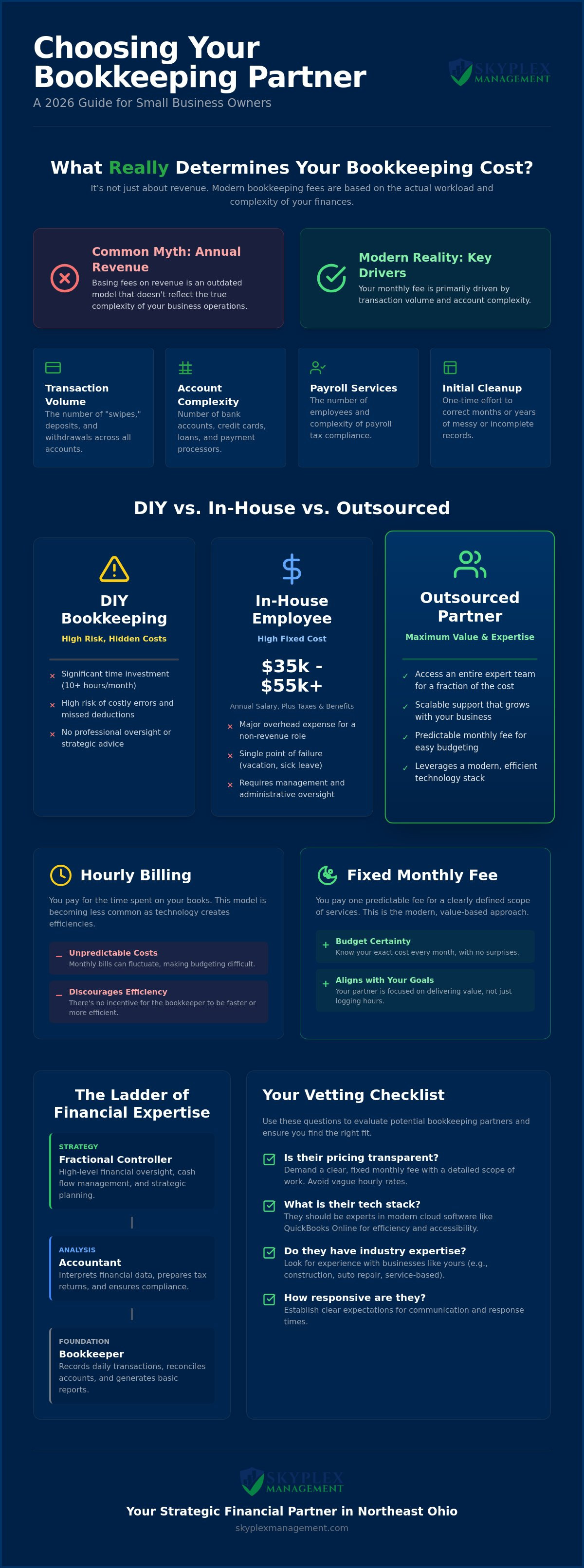
In 2026, the industry has shifted away from simple hourly billing toward value-based pricing. This change is driven by automation and advanced QuickBooks Online tech stacks that allow professionals to focus on accuracy and insights rather than manual data entry. Total revenue is rarely the best way to predict your fee. Instead, most firms look at your transaction volume; the actual number of "swipes" and bank lines that need reconciling each month. Professional bookkeeping is a strategic risk-management investment that protects your business from financial blind spots and regulatory penalties.
The Hidden Costs of DIY Bookkeeping
Many owners in Northeast Ohio attempt to save money by handling their own books, but this often leads to an expensive "opportunity cost." If you spend ten hours a month wrestling with bank feeds, those are ten hours you aren't selling services or managing your team. Beyond lost time, the price of errors is steep. Missing out on the restored 100% bonus depreciation for qualifying equipment in 2026 or failing to track the 72.5 cents per mile IRS standard mileage rate can cost you thousands in overpaid taxes. Software subscriptions are helpful tools, but they don't replace the professional oversight required for 2026 compliance.
In-House vs. Outsourced Bookkeeping Models
Hiring an in-house bookkeeper often means committing to a salary between $35,000 and $55,000 per year, and that's before adding payroll taxes, health insurance, and office overhead. For most small to medium-sized businesses, this is an unnecessary burden on the bottom line. Outsourcing to a specialized firm provides access to a full team of experts for a fraction of that cost. By utilizing small business accounting services, you gain the efficiency of a modern tech stack without the administrative headache of managing an employee. This model allows you to scale your support as your business grows from a local startup into a regional fixture.
Key Factors That Influence Monthly Bookkeeping Fees
Determining how to choose a bookkeeping service for small business requires looking past a flat monthly rate and examining the moving parts of your specific operation. While many national services try to bucket businesses by annual revenue, a local firm understands that a high-revenue consultant has much simpler needs than a mid-sized auto repair shop in Akron. The number of monthly transactions, often referred to as "swipes" or bank lines, is the primary driver of labor hours. Every time you use a business credit card or receive a client payment, that data must be categorized and reconciled to ensure your records remain tax-ready.
To manage these ongoing needs, McConnell Bookkeeping provides the monthly bank reconciliations and accurate financial statements required to keep your business's ledger precise and up to date.
Account complexity also plays a major role in your monthly fee. Managing three different bank accounts, two credit cards, and a long-term equipment loan requires more oversight than a single checking account. If you're a contractor in Strongsville or Medina, you likely have specialized needs like job costing or tracking sub-contractor payments. These factors influence the depth of the work performed each month. It's also vital to consider the state of your current books. If you have months or even years of messy records, a one-time cleanup fee is often necessary to establish a clean slate before moving into a regular monthly rhythm. Addressing these historical errors now prevents them from snowballing into a major headache during tax season.
Transaction Volume and Data Integration
Automated bank feeds in 2026 have significantly reduced the manual data entry that once defined this industry. However, high-volume businesses like e-commerce or local retail shops still require frequent, sometimes daily, reconciliation to maintain an accurate picture of cash flow. Integrating your payroll service also adds a layer of complexity. While it might increase the monthly fee slightly, it drastically reduces your compliance risk by ensuring tax withholdings and employee payments are recorded correctly. You can manage your finances more effectively when your bookkeeping system talks directly to your payroll and bank accounts, providing a real-time view of your available capital.
Industry-Specific Reporting Requirements
Certain industries demand more than just basic record-keeping. For construction firms in Cleveland or Cuyahoga Falls, job costing is essential to understand which projects are actually profitable and which are draining resources. Service-based businesses often need to track billable hours against specific clients to ensure they aren't losing money on low-margin work. Choosing a partner that offers specialized bookkeeping services ensures your reports provide the specific insights your industry requires. If you're unsure how these variables apply to your current situation, you can always reach out for a professional review of your account structure and transaction volume.
Comparing Bookkeeping Pricing Models: Hourly vs. Fixed Monthly
When deciding how to choose a bookkeeping service for small business, the pricing structure you select is just as important as the person you hire. The traditional hourly model was once the industry standard, but it often leads to "bill shock" at the end of a busy month. Hourly billing can inadvertently penalize efficient professionals who use modern technology to streamline tasks. For Ohio business owners, this unpredictability makes it difficult to manage a consistent monthly budget. Understanding these differences helps you determine how to choose a bookkeeping service for small business that aligns with your operational goals.
Value-based pricing, or a fixed monthly model, has become the preferred choice for growing firms in Northeast Ohio. This approach focuses on the complexity and insights delivered rather than just the number of hours logged. Internationally, this trend is also visible; for example, Radius Regnskab utilizes a subscription model with fixed prices to help businesses maintain financial clarity without surprise costs. Fixed-fee models encourage proactive communication between the owner and bookkeeper because you don't have to worry about the clock ticking every time you ask a question. This partnership allows you to treat your bookkeeper as a dependable fixture of your team who is invested in your long-term stability.
What a Basic Monthly Package Typically Includes
A standard bookkeeping package focuses on the essential record-keeping tasks that keep your business compliant and organized. This usually includes bank and credit card reconciliations, where every transaction is matched to your financial statements. You should also expect a monthly Profit and Loss (P&L) statement and a Balance Sheet to help you track your true cash flow. Maintaining organized records is a legal necessity, and the IRS provides detailed guidance in their publication on Starting a Business and Keeping Records. Beyond basic data entry, these packages often manage 1099 filings for independent contractors and basic sales tax reporting to ensure you stay ahead of deadlines.
Premium and Advisory Service Tiers
As your business in Cleveland or Akron scales, your needs will likely shift from simple record-keeping to strategic financial management. Premium tiers often include outsourced controller services, providing a higher level of oversight and strategic growth planning. These services move beyond the "what happened" of your finances into the "what's next," offering custom financial reporting and monthly advisory meetings. These sessions are designed to drive profitability by identifying cost-saving opportunities and optimizing your cash reserves. To see how these services scale with your growth, review the outsourced bookkeeping pricing in 2026 guide for detailed support tiers.
How to Choose a Bookkeeping Service for Small Business
Deciding how to choose a bookkeeping service for small business involves looking for a partner who understands both your ledger and your local environment. Certification in QuickBooks Online is a non-negotiable standard in 2026. It ensures your bookkeeper has mastered the tools necessary to keep your records accurate and accessible. However, technical skill must be paired with clear communication. A major red flag is a firm that takes days to answer a simple email or hides behind vague, "black box" pricing. You need a partner who provides a clear window into your financial health, not one who keeps you in the dark about your own numbers.
Local expertise is particularly vital for businesses operating in Northeast Ohio. National "cloud-only" firms often struggle with the nuances of Ohio's complex municipal tax system, such as RITA filings, or the specific requirements of the Commercial Activity Tax (CAT). A firm based in Cleveland or Akron understands these local burdens. This regional knowledge ensures you don't face unexpected penalties from the Ohio Department of Taxation or local municipalities. When you prioritize a partner who understands the specific landscape of Strongsville or Medina, you gain a level of security that a generic service simply can't provide.
Essential Questions for Your Initial Consultation
When you meet with a potential partner, move beyond basic fee discussions to gauge their actual expertise. Ask specifically how they handle historical cleanup for messy QuickBooks records. Messy data from previous years can skew your current reports, so a clear cleanup strategy is essential for a fresh start. Inquire about their communication cadence. Will you receive a monthly summary of your cash flow and profitability, or just a pile of reports you have to interpret yourself? Finally, confirm their experience with Ohio-specific filings like RITA or CAT. A bookkeeper who is unfamiliar with these local burdens can leave your business vulnerable to costly compliance errors.
The Onboarding Process: What to Expect
A professional onboarding process should feel organized and intentional rather than rushed. It typically begins with setting up secure document portals and establishing software access for seamless, paperless collaboration. For businesses upgrading their accounting platform during this stage, Switch My Books can facilitate a professional data migration to ensure your financial history is preserved. This protects your sensitive data while allowing for real-time updates to your books. The timeline usually involves an intensive initial "Cleanup" phase to resolve historical errors before transitioning into a steady rhythm of ongoing monthly maintenance. This transition is the perfect time to explore business advisory services to turn your clean data into a roadmap for future growth. If you're ready to move past the stress of unorganized records, you can schedule a consultation with our Northeast Ohio team to discuss a tailored plan for your business.
Strategic Financial Management for Northeast Ohio Businesses
Skyplex Management acts as a vital bridge between basic data entry and the high-level financial leadership your business needs to thrive. When you are evaluating how to choose a bookkeeping service for small business, the local factor is often the deciding element in your long-term success. We provide tailored solutions specifically designed for owners in Cleveland, Akron, Medina, and Strongsville, ensuring your financials reflect the reality of our regional economy. Our team doesn't just manage your ledger; we act as a supportive partner who handles background complexities so you can focus on your own strengths.
Our commitment to QuickBooks Online excellence means we don't just record what happened yesterday. We help you build a foundation for what's coming tomorrow. By choosing a partner who understands the Northeast Ohio business climate, you gain more than just tax-ready financials. You gain the peace of mind that comes from knowing every transaction is accounted for by a professional who knows your community. This local connection is what transforms a standard service provider into a dependable fixture of your business operations.
From Messy Records to Financial Clarity
Many of our clients come to us with months of unorganized data and a nagging fear of what those records might reveal. Our specialized approach to QuickBooks Online cleanup and catch-up services is designed to turn that chaos into a clear financial roadmap. For service-based businesses in Hudson, accurate reporting is the difference between guessing at margins and knowing exactly where your profit lies. Consider the scenario of a local contractor in Cuyahoga Falls who used to spend every Sunday night wrestling with bank reconciliations. By reclaiming that time, they were able to focus on high-value bidding and project management while we ensured their books remained pristine and compliant.
Your Local Partner for Payroll and Controller Services
Scaling an operation in Stow or Canton requires a streamlined approach to payroll and compliance that a national software-only solution simply can't provide. Our payroll service takes the guesswork out of complex withholdings and local municipal filings, protecting you from common administrative errors. As your business matures, the role of a fractional controller becomes essential for navigating strategic growth. This level of oversight provides the technical mastery needed to manage cash flow and equipment investments without the cost of a full-time executive hire. If you're ready to move from uncertainty to total financial clarity, contact Skyplex Management today to fix your books and secure your business's future.
Take the Next Step Toward Financial Clarity
Navigating your company's finances shouldn't feel like a second full-time job. The key to finding the right support lies in understanding your transaction volume and identifying a pricing model that keeps your monthly budget predictable. When you prioritize local expertise and technological proficiency, you aren't just buying data entry; you're investing in the strategic oversight needed to scale. Mastering how to choose a bookkeeping service for small business ensures your records remain tax-ready while you focus on the work that actually grows your bottom line.
At Skyplex Management, we've spent nearly a decade serving business owners throughout Cleveland, Akron, and the surrounding Northeast Ohio communities. Our team of QuickBooks Online Certified ProAdvisors brings specialized expertise in construction and service-based accounting to help you streamline your operations and manage cash flow with confidence. Whether you need a complete historical cleanup or ongoing monthly support, we're here to act as your dependable financial partner. Schedule a consultation with Skyplex Management to get a custom quote for your bookkeeping needs. We look forward to helping you achieve the peace of mind you deserve.
Frequently Asked Questions
How much should a small business pay for bookkeeping each month in 2026?
Most small businesses with under $5 million in revenue pay between $300 and $1,500 per month for professional bookkeeping in 2026. A typical operation often falls within the $400 to $800 range for standard monthly support. Your specific investment depends more on your transaction volume and account complexity than on your total annual revenue. Firms in Northeast Ohio generally offer tiered packages that allow you to scale your services as your business expands.
Is it cheaper to hire an in-house bookkeeper or outsource in Ohio?
Outsourcing is almost always more cost-effective for small businesses in Ohio because it eliminates the overhead of a full-time salary. An in-house bookkeeper's salary currently averages between $35,000 and $55,000 before you factor in payroll taxes, health insurance, and benefits. By choosing an outsourced firm, you gain access to a team of experts for a fraction of that cost, which frees up capital to grow your Cleveland or Akron based company.
What is the average hourly rate for a freelance bookkeeper in 2026?
Freelance bookkeepers in 2026 typically charge between $20 and $50 per hour for basic data entry tasks. Professionals with more experience or specialized industry knowledge often command rates between $40 and $75 per hour. While hourly rates might seem simple, many owners find that fixed monthly models provide better budget stability. This approach also encourages more frequent communication without the worry of an unpredictable bill at the end of the month.
Do I need a CPA or a bookkeeper for my small business records?
You generally need a bookkeeper for your daily transaction management and a CPA for high-level tax strategy or audits. A bookkeeper ensures your records are accurate and tax-ready every single month, which significantly reduces the hours your CPA needs to bill for year-end filings. Understanding how to choose a bookkeeping service for small business helps you build a solid financial foundation that keeps your business compliant and your CPA's fees manageable.
How much does a QuickBooks Online cleanup service typically cost?
A one-time QuickBooks Online cleanup for a business that is one to two years behind generally costs between $1,500 and $8,000 as a fixed fee. This investment covers the intensive labor required to fix miscategorized transactions, reconcile old bank statements, and correct Balance Sheet errors. Starting with clean books is vital for accuracy and prevents historical mistakes from causing issues with the IRS or the Ohio Department of Taxation during tax season.
Can AI replace the need for a professional bookkeeper for small businesses?
AI cannot fully replace a professional bookkeeper because it lacks the critical thinking needed to handle complex industry regulations or local tax nuances. While 75% of business owners use at least one AI tool in 2026, these systems often miscategorize transactions without expert human oversight. A professional partner provides the strategic analysis that AI can't, helping you navigate specific regional burdens like RITA or CAT filings in Northeast Ohio.
What factors increase the cost of small business payroll services?
Payroll costs are primarily influenced by your number of employees, pay frequency, and the number of local tax jurisdictions where you operate. For businesses in communities like Strongsville, Medina, or Canton, filing across multiple municipalities adds administrative complexity that impacts the fee. Integrating your payroll with your monthly bookkeeping often reduces your overall compliance risk and ensures your financial reports accurately reflect your total labor burden.
How often should I receive financial reports from my bookkeeping service?
You should receive financial reports at least once a month to ensure you're making decisions based on current data. A standard reporting package includes a Profit and Loss statement and a Balance Sheet, typically delivered within a few weeks of the month-end close. Regular reporting is a cornerstone of how to choose a bookkeeping service for small business because it provides the visibility needed to manage cash flow and plan for future growth.
Disclaimer
The information provided in this article is for general educational purposes only and should not be considered accounting, tax, or legal advice. Every business is unique. Consult a qualified accounting professional before making financial or tax decisions. Contact Skyplex Management for guidance specific to your business.