

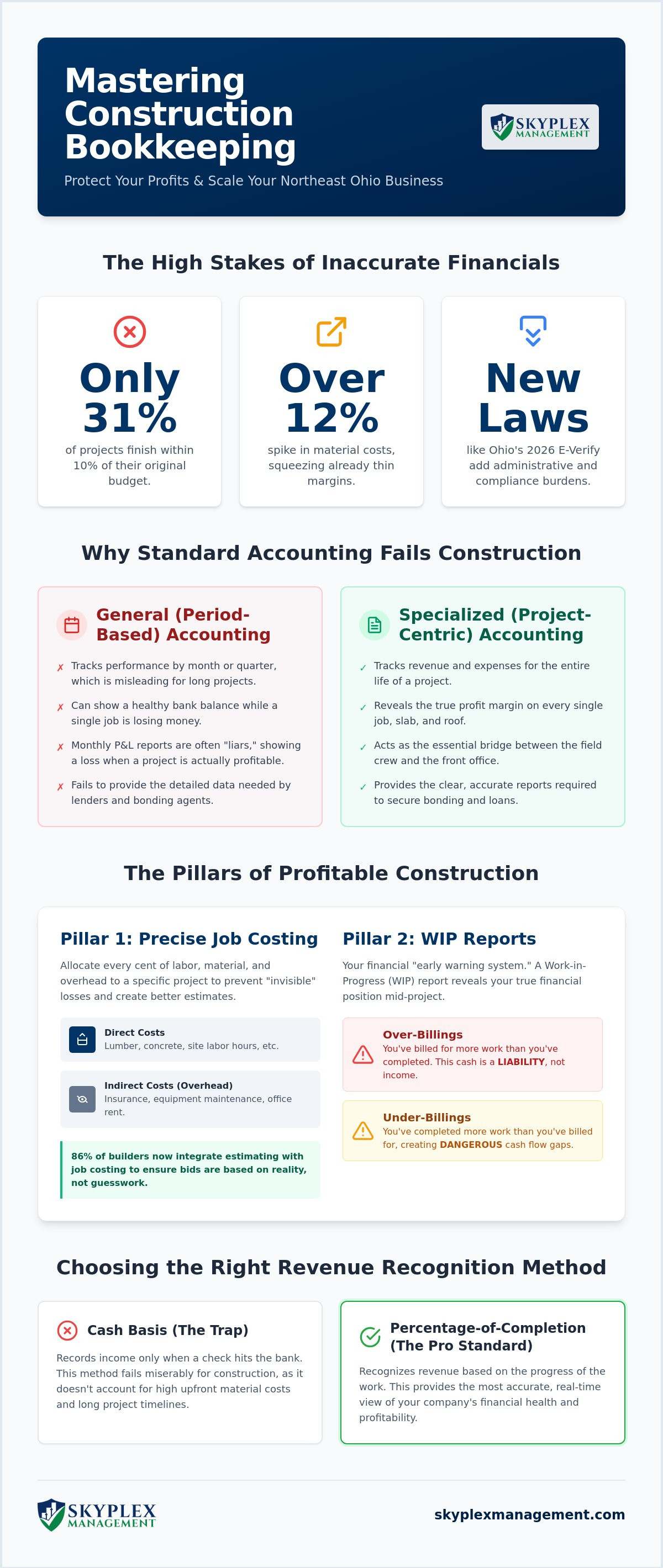
Only 31% of construction projects finish within 10% of their original budget. For contractors across Northeast Ohio, from Cleveland to Akron, that slim margin for error is getting even tighter as material costs spike by over 12% and new regulations like the 2026 Ohio E-Verify Law add to your administrative load. Effective bookkeeping for construction companies is no longer just about tracking receipts. It is the essential foundation for protecting your hard earned profit from being swallowed by labor fluctuations or sudden material price hikes.
It is stressful to see a 5% margin disappear because of a single entry error or a delay in retainage collection. We understand that you would rather be on the job site than buried in complex spreadsheets. This guide will show you how to master specialized accounting techniques to protect your bottom line and scale your contracting business with confidence. We will walk through precise job costing, managing cash flow gaps, and preparing the clear financial reports you need to secure bonding or loans.
Key Takeaways
- Learn why project-centric accounting is the only way to reveal hidden job losses that a standard general ledger might miss.
- Implement Job Costing and Work-in-Progress (WIP) reporting to act as an early warning system against budget overruns.
- Stay ahead of 2026 regulatory changes, including the Ohio E-Verify Law and shifting retainage caps, to protect your cash flow.
- Discover how to leverage QuickBooks Online for specialized bookkeeping for construction companies to clean up years of messy data.
- Identify the strategic benefits of outsourced controller services to move beyond simple data entry and start scaling your business with confidence.
Why Construction Bookkeeping is a Specialized Discipline (Not Just General Accounting)
General accounting tracks how much money you have. Specialized bookkeeping for construction companies tracks how much money you are making on a specific slab or roof. Most businesses operate on a monthly cycle; they pay rent, buy inventory, and sell products within 30 days. Construction projects often span months or even fiscal years. If you rely on a standard general ledger, your books might show a healthy bank balance while a single mismanaged project quietly erodes your equity.
This "Project-Centric" shift is what separates successful contractors from those who struggle to stay afloat. Specialized records act as the bridge between your field crew and your front office. When your foreman reports labor hours in Medina, those costs must be tied directly to that specific job's budget. This level of detail is exactly what lenders and bonding agents in Cleveland or Akron look for when they evaluate your firm's stability and risk profile.
Project-Based vs. Period-Based Accounting
A standard Profit and Loss statement tells you how the company performed last month. However, for a contractor, a monthly P&L is often a "liar." You might have paid for all the materials for a Brecksville project in June, making it look like a loss, even though the job is highly profitable. Project-Based Accounting is the mandatory standard for 2026 contractors because it tracks expenses and revenue for the life of the project, regardless of when the calendar flips. This ensures you always know your true margins. You can find a deeper Construction accounting overview to see how these methods differ from retail or service models.
The Complexity of Construction Revenue Recognition
Many small contractors fall into the "Cash Basis" trap, where they only record income when the check hits the bank. This fails miserably when material costs are high. Instead, you need to choose between the Percentage-of-Completion or Completed Contract methods. Most growing firms find that Percentage-of-Completion provides the most accurate view of their financial health, as it recognizes revenue based on the progress of the work. If you are unsure which method fits your current operations, our team at Skyplex Management provides specialized Small Business Accounting Services to help you make that strategic choice. Using the right recognition method is a core part of effective bookkeeping for construction companies.
The Pillars of Profitable Construction: Job Costing and WIP
Revenue is vanity; profit is sanity. In the contracting world, you can have a million dollar contract and still lose money if your expenses aren't tracked with surgical precision. Robust bookkeeping for construction companies relies on job costing to prevent these "invisible" losses. It is the process of allocating every cent of labor, material, and overhead to a specific project. This level of detail allows you to see which crews are efficient and which material suppliers in Cleveland or Akron are eating your margins.
With construction wages increasing by over 4% year-over-year, labor burden is more volatile than ever. You must link payroll data directly to cost codes to gain real-time visibility. This tells you immediately if a job in Cuyahoga Falls is staying on budget or if overtime is killing the profit before the project is even halfway finished.
Mastering Job Costing for Better Estimates
Effective job costing starts with distinguishing direct costs, like lumber and site labor, from indirect costs such as insurance and equipment maintenance. We recommend setting up specific "Cost Codes" in QuickBooks Online to categorize these expenses automatically. Research shows that 86% of builders now integrate estimating directly into job costing to ensure their bids are based on historical reality rather than guesswork. Following construction accounting best practices helps you avoid the common pitfalls of missed overhead and underbidding.
Understanding WIP (Work-in-Progress) Reports
A Work-in-Progress (WIP) report is your early warning system. It reveals "over-billings" and "under-billings" before they impact your bank account. If you've billed $50,000 but only completed $30,000 of work, you are over-billed; that extra cash is a liability, not income. Conversely, under-billing means you are essentially financing the project for the owner, which creates dangerous cash flow gaps. A WIP report is the most important document for your 2026 growth strategy because it reveals your true financial position mid-project. It allows you to calculate "Earned Revenue" so you know exactly where you stand.
If your current reports don't show you these numbers clearly, it might be time to discuss a more robust reporting setup that gives you the clarity you need to scale safely. Accurate data is the only way to protect your 5-7% margins from being wiped out by a single estimating error.
Navigating 2026 Challenges: Labor Costs, Retainage, and Ohio Compliance
The 2026 building season is defined by volatility. Annualized material price spikes are running at 12.6%, with specific categories like copper wire jumping up to 36% and aluminum products increasing by 33%. Even your HVAC estimates are facing pressure, as the mandatory transition to A2L refrigerants has pushed equipment costs up by nearly 18%. In an environment where a 5% margin is considered standard, real-time data is your only shield. Accurate bookkeeping for construction companies ensures that these price hikes are captured immediately, allowing you to adjust your change orders before the project's profitability is compromised.
Labor management is equally demanding. The industry needs to fill roughly 499,000 new positions this year alone to keep up with demand. With wages growing at over 4%, the true cost of your crew isn't just their hourly rate. It includes specialized trade premiums and the administrative burden of tracking overtime. When you manage these costs effectively, you protect your cash flow from the "silent" drain of unallocated labor hours.
Ohio-Specific Compliance: Prevailing Wage and Local Taxes
Compliance in Northeast Ohio requires a methodical approach. Effective March 19, 2026, the Ohio E-Verify Workforce Integrity Act requires all nonresidential contractors to use the federal E-Verify program for every new hire. Failing to document this correctly can lead to penalties starting at $250 and scaling to $25,000. Specialized bookkeeping for construction companies also handles the headache of municipal tax filings. If your crew moves between Cleveland, Akron, and Strongsville, you're dealing with multiple RITA or CCA filings. By automating these local tax distributions, you spend less time on paperwork and more time managing your crew on-site.
Retainage and Cash Flow Management
Retainage is often the difference between a profitable year and a cash flow crisis. Most owners hold back 5% to 10% of your payment until the final punch list is complete. This money belongs to you, but it shouldn't be recorded as standard income until it's actually earned. Recording retainage correctly on your balance sheet prevents you from paying taxes on money you haven't received yet. To bridge the gap between these milestones, we recommend proactive planning through Skyplex Business Advisory Services. Understanding your "retainage gap" allows you to negotiate better terms with suppliers and keep your projects moving forward without draining your reserves.
QuickBooks Online for Construction: Support, Cleanup, and Catch-Up
Many contractors treat their accounting software like a digital shoebox, but QuickBooks Online (QBO) is a powerhouse tool when configured correctly. As of August 1, 2026, QBO pricing has shifted, with the "Plus" plan at $140 per month and the "Advanced" plan at $340 per month. These plans are the gold standard because they provide the job costing features essential for modern bookkeeping for construction companies. However, a software subscription alone doesn't fix a broken process. You need a partner who understands how to map your field operations to your financial reports.
Integrating field apps and time-tracking tools directly with QBO eliminates the "double entry" headache that leads to human error. When your crew in Akron logs hours on a mobile app, those costs should flow seamlessly into your project budget. This real-time visibility prevents the shock of discovering a project is over-budget weeks after the work is finished. It allows you to catch labor leaks before they drain your bank account.
Signs You Need a QuickBooks Cleanup
If your "Uncategorized Expenses" account is growing or your bank balance doesn't match your project cost reports, your data is likely compromised. Common errors include duplicate income from improperly recorded deposits and expenses that aren't tied to a specific customer or job. These mistakes make your Profit and Loss statements useless for securing loans or bonding from local banks in Medina or Cleveland. Our specialized QuickBooks Online Support & Cleanup service targets these specific issues, reconciling every transaction to ensure your books are audit-ready and accurate.
Maximizing QBO for Construction Projects
A generic Chart of Accounts won't work for a builder. You need a structure that tracks labor burden, material costs, and subcontractor retainage separately. Professional cleanup restores your ability to make data-driven decisions. Once your accounts are organized, you can automate progress invoicing and project-specific reports. This level of oversight gives you the peace of mind to focus on your crews in Strongsville or Stow while knowing your financial foundation is solid.
Scaling Your Firm with Skyplex: From Bookkeeping to Controller Services
Basic data entry keeps you compliant, but strategic oversight keeps you profitable. As your contracting business grows, the complexity of your financial needs often outpaces standard ledger entries. Moving beyond simple bookkeeping for construction companies means looking toward the future of your firm. You need a partner who doesn't just tell you what happened last month, but helps you plan for the next three years. This is where the transition from clerical support to high level advisory becomes the engine for your growth.
Our team at Skyplex Management provides the specialized oversight that Cleveland and Akron contractors need to compete in a tightening market. By handling the background complexities of payroll and multi-city tax filings, we free you to focus on your core strengths. Whether you are managing a crew in Cuyahoga Falls or bidding on a major development in Canton, having a professional financial foundation gives you the confidence to take calculated risks.
The Role of an Outsourced Controller
An outsourced controller acts as your strategic partner. While bookkeeping for construction companies tracks the cents, a controller analyzes the trends. This includes strategic budgeting and forecasting for your next large scale project, ensuring you have the capital to mobilize without overextending your reserves. We also focus on precise overhead allocation. If your indirect costs like equipment maintenance or insurance aren't being distributed correctly across your jobs, your "profitable" projects might actually be subsidizing your losses. You can explore how we bridge this gap through our Skyplex Outsourced Accounting & Controller Services.
Your Local Partner in Northeast Ohio
Proximity matters when it comes to specialized industry accounting. We understand the specific regulatory environment of Northeast Ohio, from the nuances of RITA filings to the 2026 Ohio E-Verify requirements. We serve construction companies throughout the region, including Medina, Hudson, and Strongsville. A local partner provides a level of accountability that national software firms simply cannot match. We are a dependable fixture in your community, dedicated to helping your business become a permanent fixture as well.
Protect your margins and gain the peace of mind that comes with professional financial management. Schedule your consultation with Skyplex Management today to see how we can streamline your operations and support your scaling goals.
Building a More Profitable Future for Your Contracting Business
Building a profitable contracting business in 2026 requires more than just hard work on the job site. It demands a financial foundation that can withstand material price hikes and shifting labor costs. By prioritizing job costing and Work-in-Progress reporting, you gain the clarity needed to bid with confidence. These systems act as your early warning system, ensuring that a single project error doesn't wipe out your hard earned equity.
Specialized bookkeeping for construction companies is a strategic investment in your firm's longevity. At Skyplex Management, we've spent nearly a decade helping Northeast Ohio business owners in Cleveland, Akron, and Medina master their numbers. Whether you're dealing with messy QuickBooks records or need a fractional controller to guide your next phase of growth, we're here to provide the expert oversight you deserve.
You've worked hard to build your firm's reputation in the community. We're here to help you build its financial strength for the years to come.
Frequently Asked Questions
How much does bookkeeping for a construction company cost in 2026?
Professional fees typically depend on your project volume, the number of employees, and the level of reporting you require. In 2026, specialized bookkeeping for construction companies is often priced as a monthly service that scales with your business activity. Investing in professional oversight is almost always more cost effective than the high price of correcting tax errors or missing out on earned retainage payments later.
Is QuickBooks Online good enough for a construction company?
QuickBooks Online is an excellent tool for contractors when you utilize the "Plus" or "Advanced" plans. These specific versions provide the robust job costing and project tracking features you need to stay profitable. While it is not a dedicated construction suite, its ability to integrate with modern field apps makes it the most flexible and accessible choice for firms in Northeast Ohio.
What is the best revenue recognition method for small contractors?
The Percentage of Completion method is generally the superior choice for contractors who want an accurate view of their financial health. It recognizes revenue based on the progress of work, which prevents the misleading "spikes" in income that happen with the Completed Contract method. This approach provides the steady financial reporting that banks and bonding agents in Cleveland and Akron prefer to see.
How do I handle retainage in my bookkeeping?
You should record retainage as a separate "Retainage Receivable" account on your balance sheet. This allows you to track the 5% to 10% of your contract value that is being held back without treating it as immediate taxable income. Managing this correctly ensures you don't pay taxes on money you haven't received yet while keeping your total project value visible in your records.
What is the difference between construction accounting and regular accounting?
Construction accounting is project centric, while regular accounting is period centric. Most businesses focus on how much they made in a specific month, but contractors must track costs and revenue over the entire life of a job. This requires specialized knowledge of job costing, Work in Progress (WIP) reports, and labor burden that goes far beyond what a general bookkeeper typically provides.
Can Skyplex help me fix messy QuickBooks records from previous years?
We specialize in QuickBooks Online support and cleanup for contractors with neglected or disorganized books. Our team can untangle years of miscategorized materials, unreconciled bank statements, and duplicate income entries. We restore the integrity of your financial data so you can move forward with a clean slate and make better decisions for your firm's future growth.
Do you handle payroll for construction crews in Ohio?
Yes, we provide comprehensive payroll services tailored to the needs of Ohio contractors. We manage everything from the 2026 Ohio E-Verify requirements to complex municipal tax filings in cities like Cleveland, Akron, and Strongsville. Our team ensures your crew is paid accurately while you stay compliant with state labor laws and local tax regulations without the administrative headache.
Why is job costing so difficult to get right?
Job costing is challenging because it requires every labor hour and material purchase to be coded to a specific project in real time. If your data entry lags or expenses aren't tied to a customer, your margins become invisible. It also requires a deep understanding of indirect overhead and labor burden to ensure every bid covers the true cost of doing business.
Disclaimer
The information provided in this article is for general educational purposes only and should not be considered accounting, tax, or legal advice. Every business is unique. Consult a qualified accounting professional before making financial or tax decisions. Contact Skyplex Management for guidance specific to your business.