

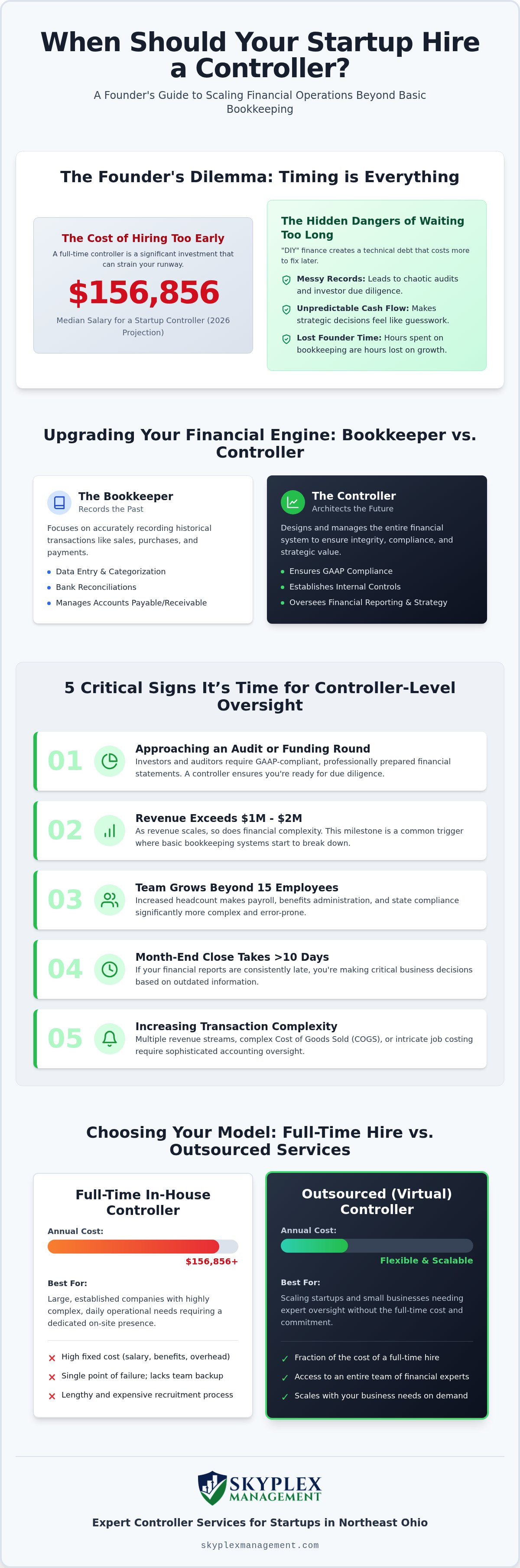
With the median salary for a startup controller reaching $156,856 in 2026, hiring for this role too early can drain your runway faster than a bad product launch. It's a delicate balance that every founder faces as they scale. You want the high level oversight that protects your business, but you don't want to overspend on overhead before your revenue supports it. Understanding when to hire a controller for a startup is often the difference between a smooth audit and a chaotic scramble during investor due diligence.
You've likely noticed that your monthly financial reports are arriving later each month, or perhaps your QuickBooks records have become a messy hurdle that makes cash flow unpredictable. We understand how stressful it feels when you're unsure if your books would pass a professional review from a lender or a VC firm. This guide provides a clear framework to help you identify the specific triggers that signal you've outgrown basic bookkeeping. You'll discover how to transition toward strategic controller oversight, whether through a full time hire or a flexible virtual model, so you can keep your focus on growth while we handle the technical complexities.
Key Takeaways
- Learn the fundamental difference between recording transactions and managing financial systems so you can ensure GAAP compliance and data integrity.
- Identify the specific revenue and headcount milestones that signal when to hire a controller for a startup to avoid late reports and unpredictable cash flow.
- Compare the high costs of a full time hire against virtual controller services to find a scalable solution that fits your current funding stage.
- Discover why a comprehensive QuickBooks Online cleanup is the essential first step toward investor-ready financial statements and smooth audit preparation.
- Understand how strategic financial oversight helps Cleveland and Akron startups transition from messy records to clear, actionable growth insights.
Defining the Controller’s Role in a Startup’s Lifecycle
Many founders think they're covered because they have a bookkeeper for data entry or a tax CPA for annual filings. However, a controller fills a critical gap that neither of those roles addresses. While a bookkeeper focuses on recording historical transactions, a controller manages the integrity of the entire financial process. They ensure your systems are compliant with Generally Accepted Accounting Principles (GAAP), which is vital for any business in Northeast Ohio looking to secure bank financing or attract sophisticated investors. Deciding when to hire a controller for a startup often happens when your business model becomes too complex for simple spreadsheets to handle.
A common mistake is assuming your tax professional can handle this level of oversight. Tax CPAs are focused on your relationship with the IRS and the Ohio Department of Taxation; they look at your numbers once a year to minimize liability. In contrast, the Financial Controller’s Role is that of an internal architect. For a construction startup, this means designing systems for accurate job costing and Work in Progress (WIP) reporting. For an auto repair shop, it involves managing parts inventory and labor efficiency. A controller transitions your business from simple cash-basis accounting to accrual-basis reporting, matching revenue to expenses so you can see your true profitability.
The Bridge Between Bookkeeping and CFO Strategy
The controller serves as the essential middle layer in your organization. They supervise the day to day small business bookkeeping function to ensure every invoice and receipt is categorized correctly from the start. This oversight creates a reliable data set that high level advisors can use to build strategic growth models. Without this layer of management, your decisions are based on "noisy" data that can lead to expensive cash flow mistakes.
Beyond data integrity, a controller establishes internal controls. In a fast paced service business, it's easy for errors or even fraud to go unnoticed. By implementing clear approval workflows and reconciling accounts with precision, a controller protects your hard earned assets. They translate raw ledger data into the clear, professional insights that prove your business is a well managed operation ready for the next level.
Why "DIY" Finance Fails at the Scaling Stage
Founders often try to wear the "finance hat" for too long to save money. This leads to a hidden cost: your time. Every hour you spend troubleshooting a payroll discrepancy or fixing a QuickBooks error is an hour you aren't spending on business development or customer service. For a scaling business in Cleveland or Akron, these distractions can stall your momentum during a critical growth phase.
Messy records also create a financial debt that eventually comes due. If you wait until an audit or a loan application to fix your books, the cleanup fees will often exceed the cost of proactive management. The Controller is the architect of a startup’s financial reliability. By bringing in professional oversight early, you avoid the "scramble" and maintain a state of constant readiness for any growth opportunity that comes your way.
5 Critical Signs It’s Time to Hire Startup Controller Services
Scaling a business is exciting, but it often breaks the very systems that got you started. As your operations in Northeast Ohio expand, you'll reach a tipping point where traditional bookkeeping isn't enough to support your ambitions. Identifying when to hire a controller for a startup requires looking at five specific red flags:
- You are preparing for your first external audit or a significant funding round like Series A or B.
- Annual revenue has exceeded the $1 million to $2 million mark.
- You have grown to more than 15 employees, which makes payroll management and benefit allocations significantly more complex.
- Your month-end closing process consistently takes longer than 10 days, meaning you're making decisions based on stale data.
- You have multiple revenue streams or intricate Cost of Goods Sold (COGS) that your current staff cannot categorize accurately.
Milestone-Based Triggers: Funding and Compliance
When you step into a room with investors, they expect a level of financial maturity that goes beyond a simple profit and loss statement. A controller is your best ally during due diligence. They can confidently explain your accruals, revenue recognition policies, and cash burn. In 2026, managing R&D tax credits has become more nuanced; a professional ensures you aren't leaving money on the table while staying compliant with updated IRS guidelines.
For businesses in communities like Akron or Canton, scaling also means hitting thresholds for the Ohio Commercial Activity Tax (CAT). A controller monitors these local and state obligations so you never face surprise penalties. If you're feeling overwhelmed by these requirements, you might want to speak with an expert about how to bridge the gap.
Operational Triggers: When the Data Stops Making Sense
We often see founders experience the "Gut Feeling" Gap. This happens when your bank balance is high, but your financial statements suggest you're barely breaking even, or vice versa. This discrepancy usually stems from poor timing in how transactions are recorded. A controller provides professional ledger management that aligns your books with economic reality. Knowing when to hire a controller for a startup is also about recognizing when your board members start asking for specialized reports that your bookkeeper simply cannot generate.
As you grow, you also need to move away from managing one "big bucket" of cash. A controller helps you implement departmental budgeting. Instead of seeing a single line for "Marketing," you'll see granular spending across digital ads, events, and personnel. This clarity allows you to hold team leaders accountable and reinvest capital where it actually generates a return. It's about moving from reactive recording to proactive management.
Full-Time vs. Virtual Controller Services: A 2026 Buying Guide
Deciding between a traditional hire and a flexible service provider is the most critical choice you'll make after identifying when to hire a controller for a startup. In 2026, the financial weight of a full-time employee is significant. Beyond the median base salary of $156,856, you're looking at a total compensation package that includes health insurance, 401(k) matching, and often a 0.1% equity stake. For a Series A startup in Strongsville or Brecksville, this executive-level overhead can drain your runway before you've reached your next valuation milestone.
Virtual controller services offer a scalable alternative. You gain access to a seasoned professional who manages your financial systems for a fraction of the cost. This model is particularly effective for businesses in the Cleveland and Akron corridor that need high-level oversight but don't yet have 40 hours of controller-level work each week. It allows you to reinvest those saved funds back into your product or sales team.
| Feature | Full-Time Controller | Virtual Controller Services |
|---|---|---|
| Annual Cost | $156k+ median salary plus benefits | 20-30% of full-time cost |
| Onboarding | 3-6 months for full integration | Immediate with standardized systems |
| Scalability | Fixed overhead regardless of need | Hours flex up or down with growth |
| Expertise | Single point of knowledge | Access to a team of specialists |
The Pros and Cons of In-House Hires
An in-house hire offers immediate physical proximity and deep cultural integration. This is helpful if your operations require constant, face-to-face supervision. However, the cons are often overlooked in the early stages. Recruiting top-tier talent in 2026 remains difficult and time-consuming. There's also a risk that your business needs will evolve, leaving you with an employee whose skills no longer match your complexity. In many seed-stage companies, a full-time hire sits idle for a portion of the week, resulting in expensive inefficiency that your board may question.
The Virtual Controller Advantage for Startups
Choosing a virtual model provides you with a team of experts rather than a single point of failure. These professionals bring their own optimized QuickBooks workflows, ensuring your business is "exit-ready" from day one. This approach also allows for natural integration with outsourced controller vs CFO strategic planning. By utilizing fractional hours in communities like Hudson or Medina, you ensure that your ledger is managed with professional rigor while maintaining the agility a startup needs to pivot and grow.
Preparing Your Financial Infrastructure for High-Level Oversight
Before a controller can provide the strategic guidance your business needs, your financial foundation must be solid. Many founders realize when to hire a controller for a startup precisely because their current infrastructure is crumbling under the weight of new transactions. A controller doesn't just manage data; they design the systems that capture it. This begins with standardizing your Chart of Accounts (COA) to reflect your specific business model, whether you're a SaaS firm in Cleveland or a service-based business in Akron. A well-organized COA ensures that every dollar spent or earned is tracked in a way that makes sense to investors and lenders.
Modern startups in 2026 require seamless data flows between payroll platforms, point-of-sale systems, and accounting software. A controller automates these connections to reduce manual entry errors and save time. They also establish a rigorous "Audit Trail" by ensuring every transaction has digital supporting documentation attached. This level of preparation is what separates a "hobbyist" set of books from a professional, investment-ready financial system.
QuickBooks Online: The Startup Standard
For most scaling companies in Northeast Ohio, QuickBooks Online support and cleanup is the essential first step toward controller-level oversight. You can't build a reliable forecast on top of messy records. In 2026, the best practice involves integrating third-party apps that handle complex revenue recognition or inventory tracking. If your books are currently a tangle of uncategorized expenses and old reconciliations, transitioning to professional management will be difficult and costly. Starting with a professional cleanup ensures your controller can focus on growth rather than fixing old mistakes.
Establishing Monthly Reporting Cadence
Transitioning to high-level oversight means moving away from "tax-time" accounting. Instead of looking at your numbers once a year, you need a monthly management report cycle. This cadence allows you to analyze financial statements in real time, identifying cash leaks or overspending before they become crises. In cities like Cuyahoga Falls or Stow, local tax obligations and the Ohio Commercial Activity Tax (CAT) require this level of monthly precision. A clean ledger acts as a truth-teller for startup founders, stripping away assumptions to reveal the actual health of the business.
Scaling Your Startup with Skyplex Management’s Controller Services
Skyplex Management acts as the "Empowering Expert" for startups throughout the Cleveland and Akron corridor. We understand that you didn't start your company to spend your weekends reconciling bank statements or worrying about regional tax deadlines. Our approach is methodical and supportive. We begin by stabilizing your foundation through a thorough cleanup and then transition into strategic business advisory services that help you scale with confidence. This partnership provides the stability you need to move from a survival mindset to one of long term growth.
Local expertise is a significant advantage when you're navigating the specific regulatory landscape of Northeast Ohio. Communities like Medina, Strongsville, and Hudson have their own local tax nuances, and the Ohio Commercial Activity Tax (CAT) requires precise reporting as your gross receipts grow. We provide the professional oversight needed to ensure you remain in good standing with the Ohio Department of Taxation while you focus on building your product and leading your team. The Skyplex promise is simple: we provide peace of mind regarding your compliance and data integrity so you can focus on your core strengths.
Customized Fractional Oversight
We don't believe in a one-size-fits-all approach. Whether you're in the Seed stage, a Bridge round, or preparing for Series A, we tailor our involvement to your specific growth milestones. This ensures you aren't paying for more than you need, but you're never left without the high-level financial reporting that local Ohio investors expect to see. You'll have direct access to Kevin and our seasoned team for proactive problem-solving. This gives you a partner who is as invested in your individual success as you are, handling background complexities before they become obstacles.
Your Next Steps Toward Financial Clarity
If you're still questioning when to hire a controller for a startup, our "Health Check" process is designed to give you an objective answer. We evaluate the current state of your bookkeeping and identify any gaps that could hinder your future fundraising or operational efficiency. This diagnostic phase removes the guesswork and provides a clear roadmap for your financial infrastructure. Understanding when to hire a controller for a startup is easier when you have a professional assessment of your current risks and opportunities.
Now is the time to bridge the gap between where your finances are today and where they need to be for your next stage of growth. We invite you to reach out and see how our team can streamline your accounting systems and provide the strategic clarity you deserve.
Mastering Your Startup's Financial Future
Transitioning from basic data entry to professional financial management is a significant step in your company's journey. You've learned that the decision of when to hire a controller for a startup depends on reaching specific revenue triggers, complex payroll needs, or the pressure of upcoming funding rounds. By choosing a fractional model, you gain the strategic oversight necessary to ensure GAAP compliance and investor readiness without the heavy burden of a six-figure executive salary.
At Skyplex Management, we've spent nearly a decade helping Northeast Ohio startups navigate these transitions. As QuickBooks Online Certified ProAdvisors, we specialize in cleaning up messy records and establishing the rigorous internal controls that VCs look for during due diligence. We also handle the complexities of the Ohio Commercial Activity Tax (CAT) so you don't have to worry about surprise penalties from the state. Our goal is to provide the clarity you need to lead with confidence.
You've built something incredible. Now it's time to give it the financial foundation it deserves so you can focus on the vision that started it all. We look forward to helping you reach your next milestone.
Frequently Asked Questions
What is the average cost of virtual controller services for a startup in 2026?
The cost of virtual controller services is typically based on the complexity of your financial systems and the frequency of reporting you require. While a full time hire in the Cleveland or Akron area often commands a salary exceeding $150,000, virtual services allow you to pay for a fraction of that time. Most startups find that an outsourced model provides 100% of the necessary expertise at a much more manageable monthly investment.
Does my startup need a controller if I already have a tax CPA?
Yes, because these professionals handle different parts of your business. A tax CPA focuses on your relationship with the IRS and the Ohio Department of Taxation once a year. A controller manages your internal financial infrastructure every day, ensuring your data is accurate, your systems are efficient, and your monthly reports are ready for strategic decision-making.
What is the difference between a controller and a fractional CFO?
A controller is the architect of your financial data, focusing on "the how" of your accounting systems and data integrity. They ensure your books are GAAP-compliant and your internal controls are strong. A fractional CFO uses the reports generated by the controller to focus on "the where," dealing with high level strategy, capital raises, and long term financial roadmaps.
Can a controller help my startup prepare for a Series A funding round?
A controller is your most valuable asset during a Series A round because they ensure your books can withstand intense investor due diligence. Knowing when to hire a controller for a startup is often tied to this specific milestone. They standardize your reporting and act as the technical lead when investors ask detailed questions about your revenue recognition or burn rate.
How many hours a month does a virtual controller typically work for a small business?
Most startups utilize a virtual controller for 5 to 20 hours per month depending on their transaction volume and reporting needs. This time is spent overseeing the bookkeeping staff, reconciling complex accounts, and providing a final review of monthly financial statements. It's a scalable model that allows the level of oversight to grow alongside your revenue in cities like Medina or Hudson.
What specific QuickBooks cleanup tasks does a controller perform?
A controller goes beyond simple entry to fix structural issues within your file. They reconcile old, neglected accounts, standardize a messy Chart of Accounts, and correct miscategorized transactions from previous years. They also implement automated data flows between your payroll and point of sale systems to ensure your QuickBooks Online ledger remains a reliable source of truth.
Is a controller responsible for filing my startup’s business taxes?
Typically, a controller manages the data preparation rather than the final filing. They ensure your ledger is "tax-ready" by the end of the year, which significantly reduces the time and fees your tax CPA charges. This partnership ensures that your filings are based on accurate, well-documented data while keeping you compliant with local Ohio tax requirements.
How do I know if my bookkeeper is qualified to be promoted to controller?
A bookkeeper is ready for a promotion if they can move beyond recording history to managing financial processes. They must demonstrate a deep understanding of accrual-basis accounting and the ability to design internal controls that prevent errors. If they can interpret financial statements to identify cash leaks and suggest system improvements, they are likely transitioning into a controller mindset.
Disclaimer
The information provided in this article is for general educational purposes only and should not be considered accounting, tax, or legal advice. Every business is unique. Consult a qualified accounting professional before making financial or tax decisions. Contact Skyplex Management for guidance specific to your business.


