
What if the biggest obstacle to your growth isn't your sales pipeline, but the way you're managing the money already coming in? Many business owners in Northeast Ohio find themselves drowning in daily data entry or panicking over messy QuickBooks records because they don't yet know the fundamental difference between bookkeeper accountant and controller roles. It's completely normal to feel a sense of anxiety when you're staring at a ledger instead of focusing on your customers in Medina or Strongsville. You want the peace of mind that comes with an accurate ledger and the confidence that you're prepared for any IRS or Ohio Department of Taxation inquiry.
This guide will help you move past the confusion and learn exactly which level of financial support your business needs to scale safely in 2026. We'll examine the specific responsibilities of each professional, from daily transaction entry to high-level strategic oversight. By the end, you'll have a clear plan for building a financial department that supports your long-term success in Akron, Cleveland, or wherever you call home.
Key Takeaways
- Understand the specific "time-horizon" of each role: bookkeepers focus on past records, accountants interpret current data, and controllers plan for future growth.
- Identify the difference between bookkeeper accountant and controller so you can match your financial support to your business's current size and complexity.
- Recognize common red flags, such as messy QuickBooks Online records or missed filing deadlines, that signal a need for professional cleanup or oversight.
- Gain peace of mind by learning how integrated financial reporting protects your business from IRS audits and local tax compliance errors in Northeast Ohio.
- Discover a clear roadmap for scaling your financial department from basic data entry to strategic advisory as your company expands.
Defining the Roles: From Data Entry to Strategic Oversight
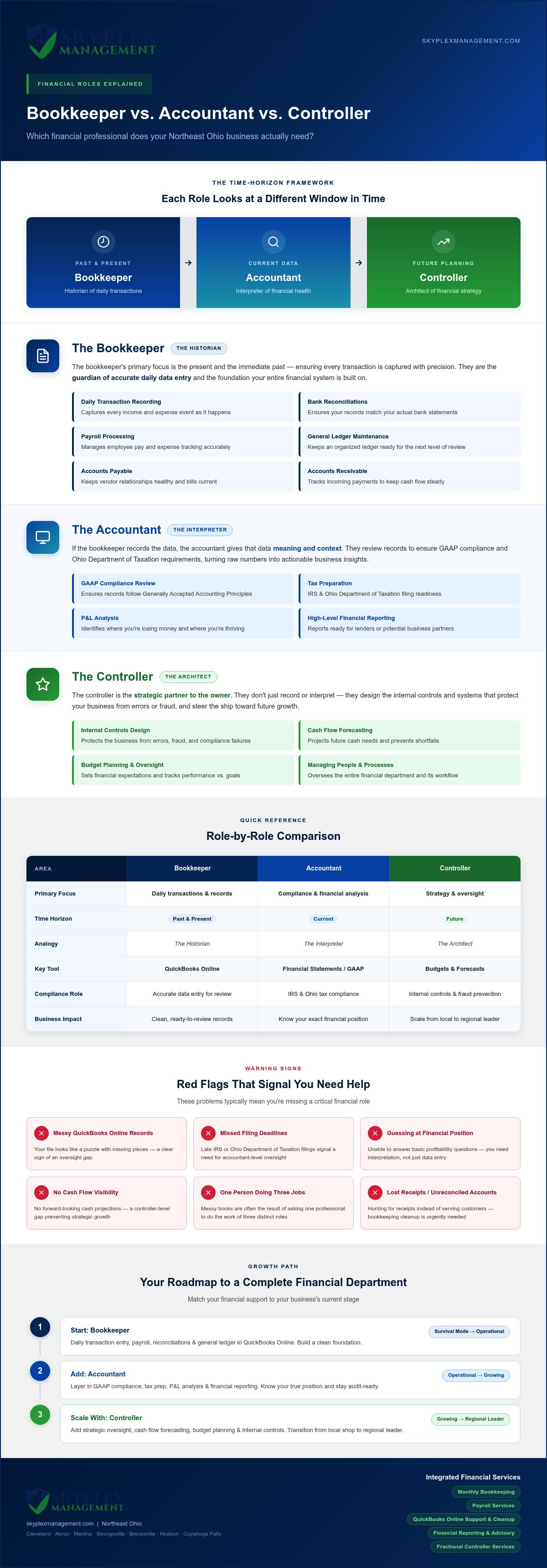
Small business owners in communities like Akron and Medina often start by handling every task themselves. This "many hats" approach is a badge of honor, but it frequently leads to confusion regarding financial management. You might think you just need someone to "do the books," yet the actual difference between bookkeeper accountant and controller roles determines how effectively you can scale. Understanding these distinctions is the first step toward moving from survival mode to strategic growth. Each role serves a specific purpose in your company's lifecycle, acting as the historian, the interpreter, or the architect of your financial health.
The Bookkeeper: Managing the Daily Details
The bookkeeper acts as your business's historian. Their primary focus is the present and the immediate past, ensuring every transaction is captured with precision. They manage the bookkeeping fundamentals that keep your operations running smoothly. This includes processing payroll, managing accounts payable to keep vendors happy, and tracking accounts receivable so your cash flow remains steady. When you have a dedicated professional handling these tasks in QuickBooks Online, you gain the freedom to focus on your customers in Strongsville or Cleveland instead of hunting for lost receipts. A bookkeeper is the guardian of accurate daily data entry.
- Recording daily financial transactions and bank reconciliations.
- Maintaining an organized general ledger for easy review.
- Processing employee payroll and managing expense tracking.
The Accountant: Ensuring Compliance and Accuracy
If the bookkeeper records the data, the accountant is the interpreter who gives that data meaning. They review your financial records to ensure they follow Generally Accepted Accounting Principles (GAAP) and remain compliant with the Ohio Department of Taxation. This role is vital for tax preparation and high-level reporting. They analyze your profit and loss statements to identify where you're losing money and where you're thriving. By bridging the gap between raw numbers and actionable insights, they help you understand the "why" behind your financial performance. Utilizing professional small business accounting services ensures your reports are ready for lenders or potential partners whenever you're ready to expand.
Finally, the controller serves as the architect of your entire financial system. They don't just look at what happened; they design the internal controls that protect your business from errors or fraud. A controller provides strategic oversight, managing cash flow projections and budget expectations for the coming year. While the bookkeeper and accountant keep the engine running, the controller makes sure the ship is heading in the right direction. This level of expertise is what allows a business in Hudson or Cuyahoga Falls to transition from a small local shop to a regional leader with confidence.
Core Responsibilities: Who Handles What in Your Ledger?
Messy books are often the result of asking one professional to do the work of three. If your QuickBooks Online file looks like a puzzle with missing pieces, you're likely experiencing a gap in oversight. The difference between bookkeeper accountant and controller roles becomes clear when you look at the daily ledger. A bookkeeper focuses on the "in and out," ensuring that Skyplex Management Bookkeeping Services capture every transaction from your local vendors in Strongsville or Brecksville. They handle the heavy lifting of payroll processing and bank reconciliations, making sure your records are ready for the next level of review.
Accountants take that raw data and turn it into a story about your business's health. While the bookkeeper records the fact that you paid a bill, the accountant analyzes how that expense impacts your profit margins. They ensure your reporting remains compliant with the Ohio Department of Taxation and the IRS. For a growing service business in Cleveland or a construction firm in Akron, this analysis is the difference between guessing at your success and knowing your exact financial position. They bridge the gap between simple data entry and the high-level strategy required to scale.
The Controller: High-Level Financial Management
A controller acts as the architect of your entire financial department. Instead of just recording or interpreting data, they manage the people and processes behind it. They are the strategic partner to the owner, focusing on the future through detailed budgeting and cash flow forecasting. By establishing strict internal controls, a controller protects your business from fraud and costly accounting errors. They ensure that the financial infrastructure in your Medina or Hudson office is robust enough to support rapid expansion without the risk of a messy cleanup later.
Where the Roles Overlap
The primary overlap lies in the shared goal of accurate financial reporting. It's a chain of accountability where each role relies on the precision of the one before it. The bookkeeper provides the foundation, the accountant verifies the integrity of the data, and the controller uses that information to steer the company. If you're wondering how this fits into a larger leadership structure, you might also want to compare an Outsourced Controller vs. CFO: Which Does Your Ohio Business Need? to see where strategic planning truly begins.
When these roles work in harmony, you stop worrying about technical errors and start focusing on your vision. If your current setup feels disjointed or your records remain confusing, it might be time to reach out for a professional review to see where your gaps are.
Comparing Bookkeepers, Accountants, and Controllers
To effectively manage your growth, you must understand how these roles differ in focus and frequency. One helpful way to visualize the difference between bookkeeper accountant and controller roles is the "Yesterday, Today, Tomorrow" framework. Bookkeepers look at yesterday, ensuring every transaction is coded and recorded correctly. Accountants look at today, interpreting those records for tax compliance and accurate monthly reporting. Controllers look at tomorrow, building the budgets and financial roadmaps that guide your next big business move. This chain of accountability ensures that your financial data is not just accurate, but also useful for making decisions.
Task Comparison Matrix
Each professional brings a different level of education and technical focus to your business. While a bookkeeper often holds a certification like a QuickBooks Online ProAdvisor designation, an accountant typically possesses a bachelor's degree in accounting or a CPA license. A controller usually has advanced experience and is responsible for the integrity of the entire financial system. The following table highlights how these responsibilities break down by frequency and function.
| Feature | Bookkeeper | Accountant | Controller |
|---|---|---|---|
| Focus | Daily Transactions | Monthly Compliance | Strategic Growth |
| Primary Goal | Accuracy | Interpretation | Oversight |
| Frequency | Daily/Weekly | Monthly/Quarterly | Monthly/Strategic |
| QuickBooks Role | Data Entry | Reporting | System Design |
When your records become unorganized, it's often because these roles have been neglected or blurred. If you find yourself in this position, you may need professional help to learn how to fix messy QuickBooks records. A thorough reconciliation ensures that your accountant has a clean foundation for tax filings and financial analysis.
The Strategic Value of Fractional Services
Many business owners in Cleveland and Akron assume they need a full-time hire to fill these gaps. However, the cost-to-value ratio of a fractional or outsourced model is often far superior for small and medium-sized companies. You don't necessarily need a controller on the payroll 40 hours a week; you might only need their expertise for ten hours a month to review your cash flow and internal controls. This "second set of eyes" provides essential peace of mind, ensuring that errors are caught before they become expensive problems with the IRS or the Ohio Department of Taxation.
By utilizing outsourced services, you gain access to a team of specialists who understand the unique needs of Northeast Ohio businesses. Whether you're a construction firm in Medina or a service shop in Strongsville, this model allows you to scale your financial support as your revenue grows. You get the professional oversight you need to sleep better at night without the overhead of a full-time executive salary. For businesses seeking a strategic partner to implement this approach, JKB Services offers the high-level guidance needed to align financial records with long-term growth objectives.
Identifying the right level of support isn't just about your budget; it's about the specific risks your business faces today. If you're still weighing the difference between bookkeeper accountant and controller, start by evaluating your current workload. You might be a growing contractor in Akron or a shop owner in Medina who has hit a "financial ceiling" where your own efforts are no longer enough to keep the records clean. To find your path forward, follow these four steps to assess your internal needs.
- Step 1: Assess Transaction Volume. If you're processing hundreds of transactions monthly, manual entry is likely leading to errors that will haunt you during tax season.
- Step 2: Check Compliance Deadlines. Are you consistently on time with the Ohio Department of Taxation? Missing sales tax filings or Commercial Activity Tax (CAT) deadlines is a clear sign you've outgrown your current process.
- Step 3: Evaluate Cash Flow Clarity. If you can't predict your bank balance three months from now, you lack the strategic oversight a higher-level professional provides.
- Step 4: Inspect Your QuickBooks Online File. Open your reconciliation screen. If you see a long list of "uncategorized" transactions or months of unreviewed bank feeds, your foundation is unstable.
Signs You Need a Bookkeeper
You need a bookkeeper when the "administrative drag" of running your business starts to hinder your actual work. If you're spending your Sundays in Strongsville or Brecksville trying to match receipts to bank statements, you're losing valuable time. A bookkeeper ensures invoices go out the moment a job is finished so your cash flow doesn't stall. They also take the stress out of payday by managing Small Business Payroll Services, ensuring your team is paid accurately and on time without you lifting a finger.
Signs You Need a Controller
The need for a controller usually arises during a period of significant transition. If you're planning to scale your operations, add multiple locations across Northeast Ohio, or apply for a substantial business loan, a controller is essential. They move beyond simple recording to provide Business Advisory Services that protect your profit margins. A controller is the right choice if you have complex inventory to track in a warehouse in Canton or if you need to manage different departmental budgets to ensure every dollar is working toward your growth goals.
Skyplex Management: Integrated Financial Support for Northeast Ohio
Most small business owners in Northeast Ohio don't have the resources or the desire to hire three separate employees to handle their finances. At Skyplex Management, we bridge this gap by offering a comprehensive suite of services that scales with your company. We understand that the real difference between bookkeeper accountant and controller roles lies in how they work together to protect your profit. Our team provides the daily precision of a bookkeeper, the compliance expertise of an accountant, and the strategic oversight of a controller, all within a single partnership. This integrated model ensures that your financial data flows seamlessly from a simple receipt to a high-level growth strategy.
Working with a local partner in communities like Medina, Strongsville, or Hudson provides a level of accessibility that national firms simply cannot match. We aren't just a voice on a headset; we're a dependable fixture in your geographic community. Our team understands the specific nuances of the Ohio Department of Taxation and the local compliance needs of Cuyahoga and Summit counties. By handling these background complexities, we empower you to reclaim your time and focus on your core operations. You can lead your business with confidence, knowing that a seasoned professional is managing the meticulous details of your ledger.
Our Approach to QuickBooks Online Cleanup and Support
If your current records feel like a burden rather than a tool, our cleanup services are designed to restore order. We dive deep into your existing QuickBooks Online file to resolve discrepancies, categorize historical transactions, and reconcile old bank statements. This process transforms messy records into a clear financial roadmap that you can actually use to make decisions. Once your foundation is clean, we provide ongoing support to keep your bookkeeping and accounting functions perfectly aligned. We invite you to experience a stress-free financial future where your records are always accurate and audit-ready.
Schedule Your Northeast Ohio Consultation
Taking the next step toward professional financial oversight shouldn't be a source of stress. We offer discovery calls to help you identify exactly which level of support your business needs to reach its 2026 goals. Whether you need monthly bookkeeping to stay organized or fractional controller services to manage a complex expansion in Akron or Cleveland, we're here to help. Our goal is to provide the professional reliability and peace of mind you need to sleep better at night. Let us handle the complexities of your financial department so you can focus on building your legacy.
Build a Scalable Financial Foundation for 2026
Scaling a business in Northeast Ohio requires more than just hard work; it demands a clear understanding of the difference between bookkeeper accountant and controller functions. By aligning your daily data entry with strategic oversight, you move from reactive bookkeeping to proactive financial management. You don't have to navigate these complexities alone. Whether you're managing a construction firm in Akron or a service shop in Cleveland, having the right level of support ensures your records are audit-ready and your cash flow is predictable.
As QuickBooks Online Certified ProAdvisors, the team at Skyplex Management provides the comprehensive financial reporting and advisory services you need to grow safely. We offer expert support tailored specifically to the needs of small businesses in Medina, Strongsville, and the surrounding communities. You deserve the peace of mind that comes with knowing your ledger is accurate and your business is fully compliant with Ohio tax regulations.
Take the first step toward a more organized and profitable future. We look forward to helping you reach your goals with confidence and professional reliability.
Frequently Asked Questions
Can one person be my bookkeeper, accountant, and controller?
While one person might have the skills to perform these tasks, it's rarely efficient or safe for a single individual to handle all three roles. Small businesses in Cleveland or Akron benefit from a team approach that ensures proper internal controls and a second set of eyes on the ledger. Skyplex Management provides this integrated support, allowing different experts to manage daily data while others provide high-level strategic oversight.
How much does it cost to hire an outsourced controller in Ohio?
The cost of an outsourced controller varies based on your business complexity and the frequency of oversight required. Instead of paying a full-time executive salary, you pay only for the specific expertise your company needs to scale safely. This model is highly efficient for companies in Medina or Strongsville that require strategic guidance without the overhead of a permanent hire. We recommend a consultation to determine a plan for your growth stage.
Do I need a CPA if I already have a great bookkeeper?
Yes, because the difference between bookkeeper accountant and controller roles involves different levels of technical interpretation. A bookkeeper focuses on accurate data entry and daily records, while an accountant or CPA interprets that data for tax compliance and complex reporting. For businesses in Hudson or Stow, having both ensures that your daily records are perfect and your year-end filings with the IRS remain technically sound.
What is the difference between a controller and a CFO?
A controller focuses on the integrity of financial reporting and internal controls, while a CFO handles high-level capital structure and long-term investment strategy. For most small to mid-sized businesses in Canton or Cuyahoga Falls, a controller provides the necessary oversight to manage cash flow and departmental budgets. A CFO is typically needed only when a company reaches a massive scale or requires complex debt and equity financing.
How often should a bookkeeper reconcile my QuickBooks Online accounts?
At a minimum, your bookkeeper should reconcile your accounts once a month. However, for high-volume service businesses in Brecksville or North Royalton, weekly reconciliations are often better for maintaining real-time cash flow visibility. Regular reconciliation ensures that every transaction is accounted for and helps identify bank errors or fraudulent activity early. This consistent habit prevents the messy books scenario that causes stress during tax season and local audits.
Can Skyplex Management help if my books are currently a mess?
Absolutely, we specialize in QuickBooks Online support and cleanup for businesses throughout Northeast Ohio. We've seen ledgers with years of unreconciled transactions and uncategorized expenses in places like Fairlawn and Wadsworth. Our team performs a deep-dive cleanup to fix historical errors and reconcile your accounts. This process provides a fresh start and a clear financial foundation so you can make informed decisions moving forward with total confidence.
What local Ohio taxes should my accountant be monitoring?
Your accountant should stay on top of the Ohio Commercial Activity Tax (CAT), state sales tax, and municipal income taxes through RITA or CCA. Businesses in communities like Solon or Broadview Heights must also manage local payroll tax withholdings correctly. Missing these deadlines can lead to significant penalties from the Ohio Department of Taxation. A professional accounting partner ensures you remain compliant while you focus on your daily operations and growth.
Is a fractional controller worth it for a service-based business?
A fractional controller is incredibly valuable for service-based businesses in Wooster or Macedonia that are ready to scale. They help you analyze project profitability, manage labor costs, and forecast cash flow for the coming months. This strategic oversight allows you to identify which services are most profitable and where you might be losing money. It's an investment in professional reliability that pays for itself through improved efficiency and informed planning.
Disclaimer
The information provided in this article is for general educational purposes only and should not be considered accounting, tax, or legal advice. Every business is unique. Consult a qualified accounting professional before making financial or tax decisions. Contact Skyplex Management for guidance specific to your business.


