
With new business applications in Ohio up 13.8 percent through early 2026, the local market from Cleveland to Akron is more crowded than ever. It's easy to feel overwhelmed by the sheer volume of receipts and transactions that pile up each month. You likely started your company to serve your customers, not to spend your weekends staring at spreadsheets and worrying about whether your records would pass an IRS audit. We understand that uncertainty. It's a common burden for owners in Medina and Cuyahoga Falls who just want to know if they're actually making a profit.
Securing accurate financial statements for business isn't just about surviving tax season; it's about gaining the clarity you need to scale. Whether you're preparing for a loan application at a local bank in Strongsville or simply want to sleep better at night, professional oversight makes all the difference. This guide will show you how to turn raw data into bank-ready reports that support smarter decisions. You'll learn exactly what's required for 2026 compliance, including the latest Ohio commercial activity tax updates, and how to build a foundation for long-term stability.
Key Takeaways
- Understand why moving beyond "bank balance accounting" is essential for long-term growth and 2026 tax compliance.
- Master the "Core Trio" of reports to gain a clear snapshot of your company’s current assets, liabilities, and profitability.
- Learn how to identify and fix "QuickBooks Chaos" to ensure you maintain accurate financial statements for business that are ready for bank loans.
- Implement a simple two-step self-audit process to catch uncategorized expenses and reconciliation errors before they become costly mistakes.
- Discover how professional oversight from an outsourced controller can streamline your monthly reporting and provide the strategic peace of mind needed to scale.
Why Accurate Financial Statements are the Foundation of Your Business Health
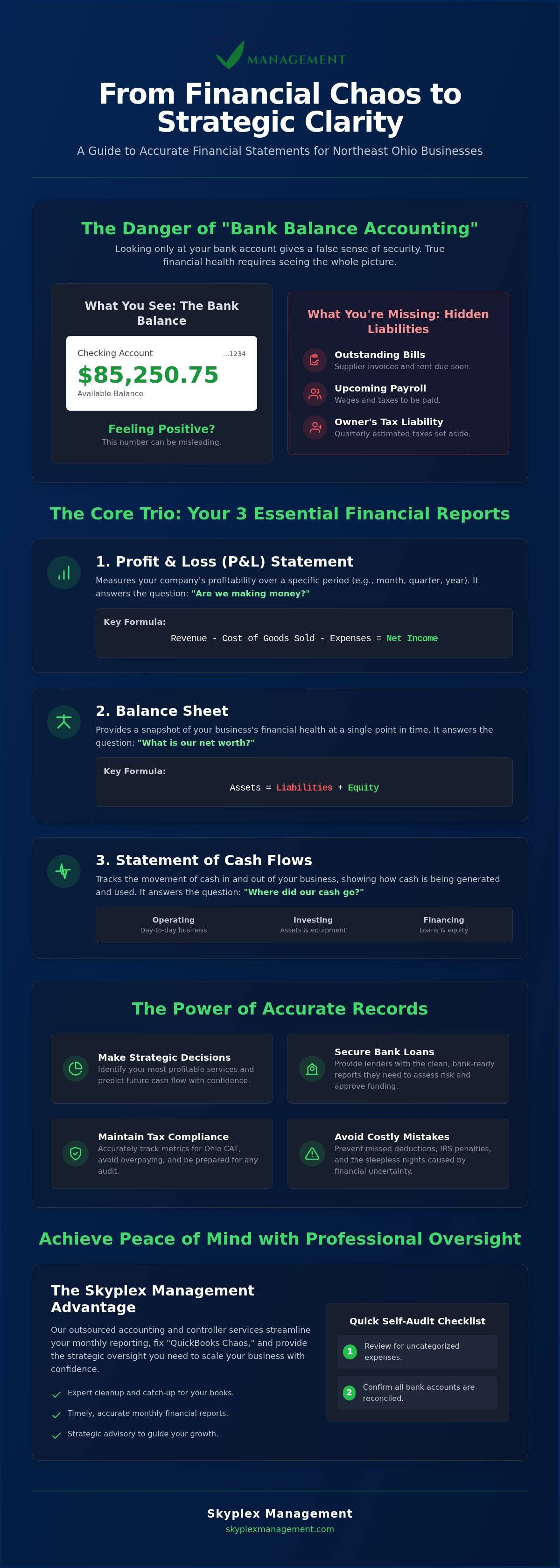
Many owners in communities like Medina and Hudson fall into the trap of "bank balance accounting." They look at their checking account and assume that if the number is positive, the business is healthy. This approach ignores outstanding bills, upcoming payroll, and uncollected revenue. True accuracy begins when every single transaction is categorized and reconciled against your bank statements. This process ensures that your Financial Statements reflect reality rather than a temporary snapshot of cash on hand. When you maintain accurate financial statements for business, you move from guessing to knowing.
Clean data builds a bridge of trust with local lenders. In 2025, the SBA approved over $1.4 billion in loans for Ohio businesses. Whether you're working with a bank in Cleveland or a credit union in Akron, those institutions require precise reports to assess your risk and debt-to-income ratio. Beyond lending, the Ohio Department of Taxation has specific expectations for 2026. For example, the Commercial Activity Tax (CAT) now features an annual exclusion threshold of $6 million. If your records are messy, you won't know if you've crossed that threshold or if you're accidentally overpaying on your gross receipts. Professional Monthly Bookkeeping ensures you're always prepared for these requirements.
Beyond Compliance: Using Reports for Strategy
Clean data allows you to look past the surface and understand which parts of your business are actually driving growth. You might find that a specific service you offer in Strongsville is high-revenue but low-profit once you factor in labor and materials. Refining these insights is a core part of a successful small business financial strategy. When your historical data is precise, you can predict future cash flow needs with confidence. This foresight allows you to hire new staff or invest in equipment without the constant fear of a sudden cash crunch.
The High Cost of Inaccurate Records
Poor record-keeping is more than a headache; it's a financial liability. Inaccurate books often lead to missed tax deductions that could have saved you thousands of dollars at year-end. Even worse, they increase your risk of IRS penalties and the grueling process of an audit defense. The emotional toll is just as significant. Local owners often face sleepless nights when they aren't sure if they can cover next month's expenses. Partnering with a professional for Small Business Accounting removes that weight, replacing uncertainty with a clear, documented path forward for your company.
The Core Trio: Understanding the Three Essential Financial Reports
While many owners focus solely on their bank balance, true financial health is found at the intersection of three specific reports. Maintaining accurate financial statements for business requires understanding how the Income Statement, Balance Sheet, and Statement of Cash Flows work together to tell your company's story. Relying on just one of these is like trying to navigate a ship with only a compass but no map; you might know your direction, but you won't see the obstacles ahead. When these three reports are reconciled correctly, they provide the 360-degree view necessary for confident leadership.
The Profit and Loss (P&L) Deep Dive
The Profit and Loss statement tracks your revenue against your expenses over a specific period, such as a month or a fiscal year. For service-based businesses in Northeast Ohio, it's vital to distinguish between your Gross Margin and your Net Income. Gross margin shows what you keep after the direct costs of a job, like materials for a construction project in Strongsville. Net income is what remains after all overhead, such as rent and insurance, is paid. The P&L is the primary tool for measuring monthly operational efficiency. A common mistake we see during QuickBooks Online cleanup is owners accidentally including personal expenses or owner draws as business costs, which distorts actual profitability.
The Balance Sheet: Your Business Net Worth
Your Balance Sheet provides a snapshot of your business net worth at a specific moment in time. It lists what you own (assets) and what you owe (liabilities). For construction firms or auto repair shops in Medina, this is where you track high-value equipment and long-term vehicle loans. The equation is simple: Assets must always equal Liabilities plus Equity. If it doesn't balance, it usually points to a data entry error or a missing transaction. You can learn more about Small Business Balance Sheet Analysis to understand how these figures impact your borrowing power at local banks.
| Report Name | Key Question Answered | Primary Focus |
|---|---|---|
| Income Statement (P&L) | Am I making a profit? | Operational efficiency over time |
| Balance Sheet | What is my business worth? | Financial position at a specific date |
| Statement of Cash Flows | Where did my cash go? | Movement of liquid funds |
The Statement of Cash Flows is often the most overlooked report, yet it's the most critical for survival. It shows the actual movement of cash in and out of your business. You might have a profitable P&L, but if your cash is tied up in unpaid invoices from a large project in Cleveland, you won't be able to meet payroll. Understanding how to read financial statements like the cash flow report helps you anticipate lean months before they happen. If you find yourself struggling to make sense of these numbers, you can reach out to our team for a professional review of your current reporting setup.
Common Barriers to Accuracy in Small Business Accounting
Modern accounting software makes it easier to track numbers, but it also creates a false sense of security. Many owners in Northeast Ohio believe that because their bank feed is connected to QuickBooks, their books are automatically correct. This is rarely the case. In reality, several common hurdles prevent owners from achieving accurate financial statements for business. Without addressing these technical gaps, your reports will likely contain significant errors that hide your true profitability.
One of the most frequent issues we see is the "QuickBooks Chaos" effect. This happens when the software's auto-categorization feature guesses where a transaction belongs and gets it wrong. For example, it might label a loan repayment as a simple utility expense or miscategorize a large equipment purchase. If you don't manually review and reconcile these entries, your Profit and Loss statement becomes a work of fiction. Unreconciled accounts also lead to duplicate entries, where a single expense is counted twice because the software didn't match a manual check to the bank download.
Technical accounting tasks like depreciation and amortization are also frequently ignored. If you own an auto repair shop in Akron or a construction firm in Cleveland, your heavy machinery loses value over time. Failing to record this monthly depreciation means your asset values are artificially high on your balance sheet. Similarly, there is often a significant gap between payroll processing and general ledger integration. If your Payroll Service data isn't mapped correctly to your accounting software, your labor costs will be inaccurate, making it impossible to see your true margins.
Software is a Tool, Not a Solution
Automation is helpful, but it cannot replace professional oversight. Automated feeds still require expert QuickBooks Online support to ensure that every transaction hits the right account. DIY data entry often falls into the "garbage in, garbage out" trap, where small mistakes snowball into massive cleanup projects. Professional cleanup services are designed to fix these historical errors, providing you with a clean slate and reliable data for future planning.
The Hidden Dangers of Messy Records
Messy records do more than just confuse you; they cost you money. When duplicate transactions inflate your expenses, you might think you're less profitable than you are, but if they inflate your income, you'll end up with a higher tax bill than necessary. It's incredibly difficult to scale a company in growing communities like Hudson or Stow when you're working with flawed data. You can't make a confident hire or sign a new lease if you don't trust your bottom line. If your books feel out of control, see our guide on how to fix messy QuickBooks records to start the journey back to clarity.
How to Audit Your Own Records for Data Integrity
Once you understand the common barriers to accuracy, you can begin the process of verifying your own data. Many owners in Brecksville and Richfield feel a sense of relief when they realize they don't have to be a CPA to spot major errors. Maintaining accurate financial statements for business requires a disciplined review process that moves beyond simply looking at your current cash balance. By following a structured audit path each month, you can catch mistakes before they impact your tax filings or loan applications.
Start by performing a month-end reconciliation for every single account, including credit cards and lines of credit. This isn't just about making sure the numbers look "close enough." You need to match your digital ledger to your bank statement to the penny. Next, dive into your "Uncategorized Expenses" or "Ask My Accountant" folders. These are often used as temporary holding pens for transactions that were confusing at the time. If these aren't cleared out monthly, your Profit and Loss statement won't reflect your true spending in categories like materials or labor.
Another powerful tool is the Year-over-Year (YoY) comparison. Run your P&L for the current month and compare it to the same month from last year. If your rent in Cuyahoga Falls is suddenly 20 percent higher without a new lease agreement, you likely have a miscategorized entry. Finally, verify that your payroll reports match your general ledger. Your total gross wages and employer taxes should align perfectly with the entries in your accounting software. Discrepancies here often signal that your payroll data isn't syncing correctly, which can lead to significant headaches during an IRS or Ohio Department of Taxation review.
The Reconciliation Checklist
- Match your bank statements to your digital ledger to the penny for every account.
- Identify "uncleared" checks or deposits that have been sitting for more than 30 days.
- Review your credit card statements to ensure all interest and fees are recorded.
A reconciled account is the only verified account.
Spotting Red Flags in Your Reporting
Negative balances in asset accounts are a major red flag. Unless you're truly overdrawn at the bank, a negative cash balance usually means you've missed a deposit entry or recorded an expense twice. You should also watch for sudden spikes in "Miscellaneous" expenses. This category often becomes a "catch-all" for operational waste or transactions that haven't been properly vetted. If you find that these red flags are becoming a recurring theme, it may be time to transition away from the DIY approach. Seeking professional accounting oversight ensures that your records remain clean and your strategy stays on track.
Partnering with Skyplex Management for Professional Financial Oversight
Managing a company in Northeast Ohio requires more than just keeping a tally of your income and expenses. As your business grows, the complexity of your records increases, often reaching a point where DIY software is no longer enough. Skyplex Management serves as your outsourced controller and strategic partner, moving you beyond basic data entry into high-level fiscal management. We provide the professional oversight needed to maintain accurate financial statements for business, ensuring that every financial decision you make is backed by verified data rather than gut instinct.
Our firm specializes in providing the deep insights that small and medium-sized business owners need to thrive. Whether you operate a construction firm in Medina or an auto repair shop in Akron, we customize our approach to fit your specific industry requirements. We don't just hand over a report at the end of the month; we act as a fractional controller to help you interpret those numbers. This level of business advisory services allows you to identify trends, manage your debt-to-equity ratio, and prepare for the 2026 tax season with total confidence.
A Local Team for Cleveland and Akron Businesses
Working with a local firm provides a distinct advantage because we understand the unique economic landscape of our region. From the municipal tax complexities in Cuyahoga Falls to the rising business applications in Canton, we are a dependable fixture in your community. Our "Neighborly Helpfulness" approach means we prioritize your peace of mind and long-term stability over high-pressure sales tactics. We see ourselves as a supportive partner that handles the background complexities so you can focus on your own strengths. The first step toward this partnership is often a comprehensive QuickBooks Online cleanup, where we reconcile your historical records and establish a clean foundation for future growth.
Your Path to Financial Clarity Starts Here
Accurate financial statements for business transform your operations from a state of "surviving" to a state of "scaling." When you have total clarity on your profitability and cash flow, you gain the freedom to invest in new equipment or expand your team without fear. Professional oversight removes the emotional weight of financial uncertainty, replacing it with a structured, intentional path toward success. We are here to assist you in streamlining your processes and assisting with the meticulous management of your payroll and reporting needs. Our goal is to provide the stability you need to build a lasting legacy in Northeast Ohio.
Securing Your Company's Fiscal Future
Transitioning from simple bank balance tracking to comprehensive oversight is the key to long-term stability. By implementing the self-audit steps we've discussed, you protect your company from audit risks and identify missed deductions before they impact your bottom line. Maintaining accurate financial statements for business is the foundation for scaling your operations with total confidence and clarity.
Skyplex Management has served the Cleveland and Akron business community for nearly a decade. Our QuickBooks Online Certified ProAdvisors bring specialized expertise to construction and service-based industries, ensuring your reports are bank-ready and tax-compliant. We focus on removing technical burdens so you can lead your company with a proactive, strategic mindset.
You don't have to manage these financial complexities alone. We're here to act as your strategic partner, helping you build a more profitable and sustainable future for your business.
Frequently Asked Questions
What makes a financial statement "accurate" for a small business?
Accuracy means every transaction is categorized correctly and reconciled to the penny against your bank and credit card statements. It also requires accounting for non-cash items like depreciation and amortized expenses. Without these steps, your reports are just estimates rather than verified records. True accuracy ensures that your balance sheet and income statement reflect the actual economic reality of your company.
How often should I review my profit and loss reports?
You should review your P&L reports at least once a month after your books are closed and reconciled. This frequency allows you to catch spending spikes or declining margins in real-time. Waiting until year-end prevents you from making the tactical adjustments needed to stay profitable. Monthly reviews help you spot trends in your Cleveland or Akron business before they become major problems.
Can QuickBooks Online ensure my financial statements are correct automatically?
No, software is a data management tool that still requires human oversight to ensure accurate financial statements for business. Automated bank feeds often miscategorize transactions or create duplicate entries that inflate your numbers. Professional review is necessary to verify that the software's automated "guesses" align with actual accounting principles and your specific business needs.
What is the difference between a bookkeeper and a controller for financial reporting?
A bookkeeper focuses on daily data entry and bank reconciliations, while a controller provides high-level analysis and strategic oversight. While a bookkeeper records what happened, a controller explains why it happened and how it impacts your future cash flow. Skyplex Management offers both services to ensure your reporting is both technically precise and strategically actionable for long-term growth.
Why does my bank balance never match my financial statements?
Your bank balance represents a snapshot of cleared cash, whereas financial statements include uncleared checks, pending deposits, and non-cash expenses. This timing difference is exactly why monthly reconciliation is vital for your peace of mind. If you only look at your bank balance, you risk spending money that is already "spoken for" by upcoming bills, payroll, or tax obligations.
How do accurate financial statements help with Ohio business taxes?
Precise reports ensure you only pay what you owe by capturing every valid deduction and correctly calculating your gross receipts. In 2026, Ohio businesses must navigate specific thresholds for the Commercial Activity Tax (CAT). Having accurate financial statements for business simplifies this process and provides a clear audit trail that protects you during a review by the Ohio Department of Taxation.
What should I do if I know my QuickBooks records are currently messy?
The best first step is to stop adding new data to a flawed system and schedule a professional account cleanup. Attempting to fix years of errors on your own often leads to more confusion and deeper technical mistakes. A specialized cleanup service reconciles historical data, removes duplicates, and sets up a clean foundation so you can move forward with confidence.
Disclaimer
The information provided in this article is for general educational purposes only and should not be considered accounting, tax, or legal advice. Every business is unique. Consult a qualified accounting professional before making financial or tax decisions. Contact Skyplex Management for guidance specific to your business.


