
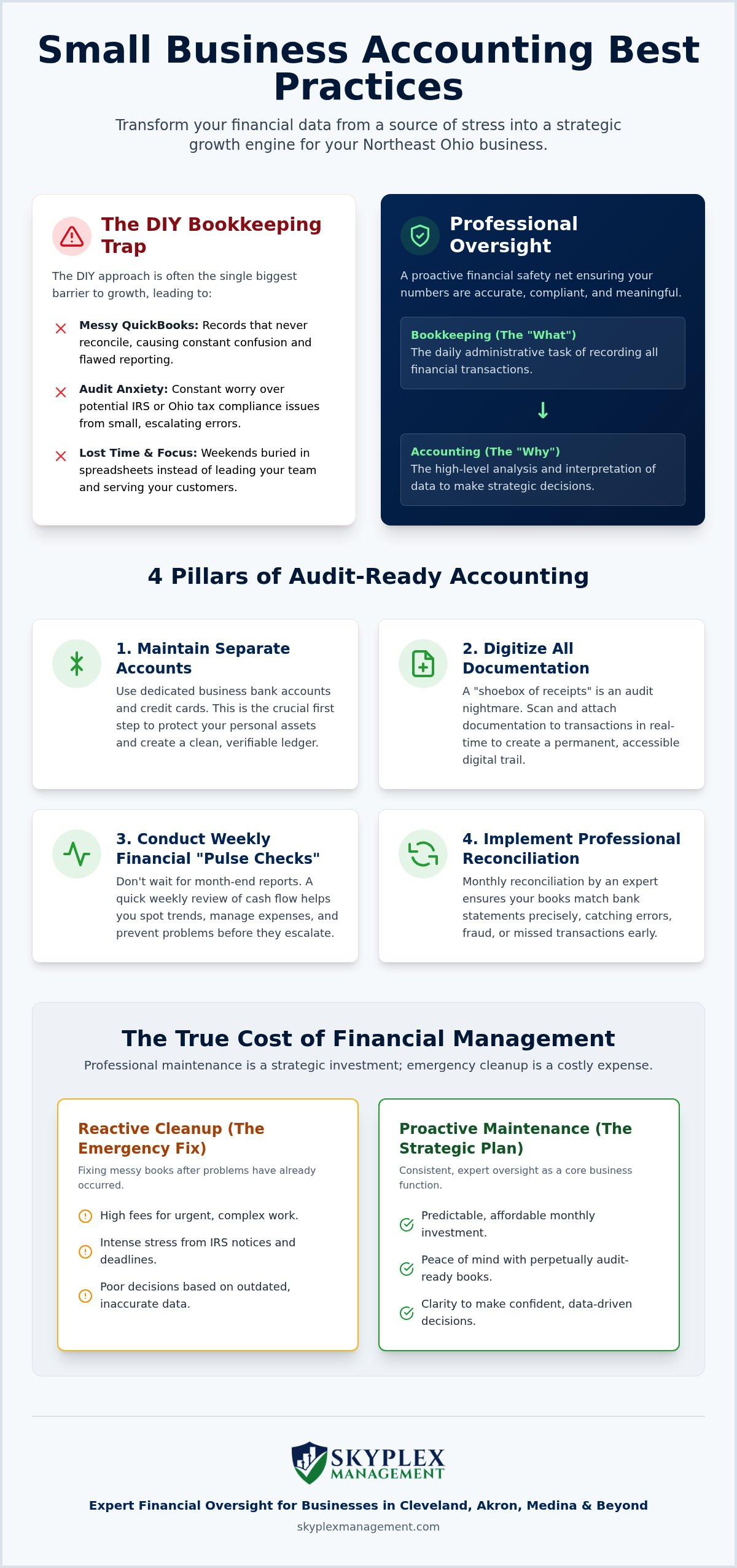
The DIY approach to bookkeeping is no longer a savvy cost-cutting measure; in 2026, it's often the single biggest barrier to your company's growth. It's easy to feel overwhelmed by messy QuickBooks records that never seem to reconcile or the constant anxiety of an IRS audit. If you're managing a business in Cleveland, Akron, or Medina, you likely started your company to serve your community, not to spend your weekends buried in payroll spreadsheets and Ohio tax compliance forms.
We understand that financial stress can cloud your vision for the future. By mastering small business accounting best practices, you can protect your cash flow and transform your financial data into a strategic growth engine. This shift provides the clarity needed to make confident decisions rather than educated guesses. When your ledger is managed with professional precision, you gain the freedom to lead your team without looking over your shoulder at the IRS.
In this guide, we'll break down the essential frameworks that move your books from a source of dread to a position of strength. You'll learn how professional oversight ensures your records are always audit-ready and how monthly reporting can finally give you the peace of mind you deserve.
Key Takeaways
- Professional oversight serves as a vital safety net, preventing small clerical errors from escalating into stressful IRS audits or Ohio tax compliance issues.
- Adopting small business accounting best practices, such as maintaining strictly separate bank accounts and a digital-first documentation strategy, is essential for protecting your legal and financial interests.
- Learn how to transform raw financial data into clear Profit and Loss statements that highlight hidden expenses and drive better operational efficiency.
- Professional maintenance is significantly more affordable than emergency cleanup, saving you the high costs associated with fixing "messy books" after the fact.
- Strategic partnerships with experts in Northeast Ohio allow you to transition from the daily burden of bookkeeping to the clarity of high-level financial leadership.
What is Professional Accounting Oversight for Small Businesses?
Professional accounting oversight is the active, expert review of your entire financial system. It isn't just about making sure numbers are typed into a software program; it's about ensuring those numbers are accurate, compliant, and meaningful. Following small business accounting best practices creates a financial safety net for your company. In the fast-paced business environment of 2026, where digital transactions move instantly, a small coding error can snowball into a major compliance issue. Professional oversight catches these discrepancies before they trigger a stressful letter from the IRS or the Ohio Department of Taxation.
Many business owners in Northeast Ohio are used to reactive bookkeeping. This means looking at what happened last month and trying to make sense of it after the fact. Oversight is different because it's proactive. It involves setting up systems that prevent errors and provide real-time visibility into your cash flow. This is where an outsourced controller becomes a vital partner. They don't just record history. They help you write your business's future by providing a high-level perspective on your financial health.
Bookkeeping vs. Accounting: Why the Distinction Matters
It's common to use these terms interchangeably, but they serve very different purposes. Bookkeeping is the daily administrative task of recording transactions, such as sales, purchases, and payments. It relies on fundamental bookkeeping principles to keep an organized record of every dollar. Accounting, however, is the process of analyzing and interpreting that data to make strategic decisions. Professional oversight bridges this gap by ensuring your bookkeeping is clean enough to support high-level accounting analysis.
The Role of Professional Oversight in Scaling Your Business
Growth requires more than just increased sales; it requires a solid financial infrastructure. Many businesses in Cleveland, Akron, and Medina hit a growth ceiling because their internal systems can't handle the complexity of more employees or multiple locations. Accurate data entry is essentially useless without professional reconciliation and a thorough review process. Oversight ensures that your financial reports actually reflect reality, allowing you to secure loans or invest in new equipment with confidence.
Implementing small business accounting best practices means moving beyond simple data entry. You need a system where every transaction is verified and every report is scrutinized by a professional who understands the local economic climate. For a deeper look at why this matters, read about Professional Ledger Management. By prioritizing small business accounting, you build a foundation that supports long-term stability and peace of mind.
Essential Accounting Best Practices to Protect Your Bottom Line
The foundation of any healthy business starts with a clear line between your personal life and your professional finances. Mixing these two is a common mistake that complicates tax filings and puts your personal assets at risk. Establishing small business accounting best practices begins with dedicated business bank accounts and credit cards. This separation ensures that every transaction is a clean, verifiable business expense. It's the first step in creating a ledger that can withstand professional scrutiny.
In 2026, a digital-first documentation strategy is no longer optional. Relying on a shoebox of faded paper receipts is a recipe for disaster during an audit. Modern tools allow you to scan and attach documentation directly to transactions in real time. The IRS frequently emphasizes the importance of good recordkeeping for tax compliance. By maintaining a digital trail, you protect your deductions and ensure your financial history is always audit-ready. Implementing a "Weekly Financial Pulse" check also helps you monitor cash flow, allowing you to spot trends before they become problems.
Establishing a Robust Chart of Accounts
Your Chart of Accounts is the organizational backbone of your financial system. While QuickBooks Online offers default templates, these are often too generic for specialized industries in Northeast Ohio. A construction firm in Hudson or an auto repair shop in Strongsville requires specific categories to track job costs and parts inventory accurately. A professional setup ensures your categories match your actual business operations, which simplifies tax preparation and provides a clearer picture of where your money is going. If you aren't sure if your categories are set up correctly, reaching out for a professional review can prevent significant headaches during tax season.
The Discipline of Monthly Bank Reconciliations
Reconciliation is the process of matching your bank and credit card statements to your internal ledger entries. It's a critical check that ensures your books actually reflect the money in your bank account. During this process, we often find hidden bank fees, missed deposits, or duplicate entries that would otherwise distort your financial health. Skipping even one month can lead to a backlog of errors that are difficult to untangle later. For businesses struggling with historical errors, utilizing professional QuickBooks reconciliation services is the fastest way to restore accuracy. Regular reconciliation provides the peace of mind that your data is reliable, allowing you to make growth decisions based on facts rather than guesses.
Beyond Data Entry: The Strategic Value of Financial Oversight
Recording transactions is merely the first step in a much larger journey. While basic data entry tells you what happened, professional oversight explains why it happened and what you should do next. By applying small business accounting best practices, you transition from simply tracking expenses to actively managing your company's future. This level of scrutiny allows you to identify hidden costs, such as underutilized subscriptions or inefficient vendor contracts, that often go unnoticed in the daily rush of operations. When your data is clean and interpreted correctly, it becomes a strategic asset that drives operational efficiency.
Financial oversight is also your strongest tool when seeking external funding. Whether you are applying for an SBA 7(a) loan or looking for private investors in Cleveland or Akron, lenders require more than just a glance at your bank balance. They want to see a history of professional oversight that proves your numbers are reliable. Accurate records demonstrate that you have a firm grip on your business, which significantly reduces the perceived risk for any financial institution. Additionally, staying proactive with your ledger ensures you remain in good standing with the Ohio Department of Taxation, preventing costly penalties that can arise from simple filing errors.
Leveraging Monthly Financial Reporting for Growth
To lead effectively, you must understand the "Big Three" financial reports: the Profit and Loss (P&L) statement, the Balance Sheet, and the Cash Flow Statement. These documents provide the infrastructure for every major business decision. For example, a service-based business in Medina or a construction firm in Cuyahoga Falls can use these reports to identify seasonal trends. If your data shows a recurring dip in cash flow every February, you can plan your equipment purchases or hiring cycles accordingly. For a deeper dive into making these numbers work for you, see our guide on How to Analyze Financial Statements for Small Business.
Preparing for Tax Season and Compliance Year-Round
The most successful business owners don't treat tax season as a frantic event in April. Instead, they view it as a year-round oversight process. When you maintain small business accounting best practices every month, tax preparation becomes a simple summary of a job already well done. This consistent approach allows you to maximize legal tax deductions as they occur, rather than trying to reconstruct your year from memory. Professional oversight also covers critical areas like payroll tax compliance, ensuring that withholdings and filings are handled accurately and on time. This ongoing vigilance protects your business from the legal and financial fallout of non-compliance, giving you the peace of mind to focus on your clients.
Avoiding Common Pitfalls: Why 'DIY' Accounting Often Costs More
Many business owners in Northeast Ohio believe that handling their own books is a savvy way to save money. However, this "DIY" approach often leads to "Messy Books" that require extensive, expensive cleanup later. Following small business accounting best practices is actually more cost-effective because consistent maintenance is always cheaper than a financial rescue mission. When you delay professional oversight, small errors in data entry or categorization compound over time, creating a tangled web that takes significant hours to unravel. In many cases, the cost to fix a year of neglected records is double or triple what a monthly service would have cost.
The Risks of Commingling Personal and Business Funds
Using a business credit card for a personal coffee run or a grocery trip might seem harmless, but it's a major red flag for auditors. This practice, known as commingling, makes it incredibly difficult to verify legitimate business expenses during tax season. More importantly, it can "pierce the corporate veil," potentially exposing your personal assets to business liabilities in a legal dispute. Whether you're in Cleveland or Akron, maintaining a strict "financial wall" between your personal life and your business is essential for protecting your liability status and simplifying your financial reporting. It ensures that every deduction you claim is backed by a clean, professional paper trail.
Dealing with QuickBooks Reconciliation Errors
One of the most catastrophic mistakes a business owner can make is "forcing" a reconciliation in QuickBooks. When the software doesn't match the bank statement, it's tempting to create a "balance adjustment" entry just to clear the screen. This often hides "ghost transactions" or duplicate entries that inflate your perceived cash position, leading you to spend money you don't actually have. Structural errors in your software setup can cause these discrepancies to recur every month. If your ledger feels out of control, seeking QuickBooks Online setup help is the best way to fix the root cause of the problem and restore your financial clarity.
Inaccurate payroll processing is another fast track to heavy IRS penalties. Missing a tax deadline or miscalculating withholdings can result in fines that far exceed the cost of a professional payroll service. Professional oversight ensures that your employees are paid accurately and your tax obligations are met on time, keeping your business in good standing with both federal and state authorities. By avoiding these common pitfalls, you protect your bottom line and gain the peace of mind needed to focus on your company's growth.
Implementing a Professional Oversight Framework with Skyplex Management
Skyplex Management serves as more than just a service provider; we act as a dedicated strategic partner for businesses throughout Cleveland and Akron. Many owners come to us feeling weighed down by the daily "Bookkeeping Burden," where hours are lost to reconciling accounts and chasing down missing receipts. Our goal is to guide you toward "Controller Clarity." By implementing small business accounting best practices, we transform your financial department from a source of stress into a streamlined engine for growth. This transition allows you to stop questioning your bank balance and start making high-level decisions with total confidence in your data.
We believe that an oversight plan should never be static. As your revenue scales, your financial complexity increases, requiring a more sophisticated approach to reporting and compliance. We customize our framework to match your current stage of growth while preparing you for the next one. Having a local expert who understands the Ohio business climate is a significant advantage. We are intimately familiar with the specific expectations of the Ohio Department of Taxation and the regional economic trends that affect Northeast Ohio. This local mastery ensures your business remains compliant and competitive in our unique market.
Tailored Bookkeeping for Northeast Ohio Industries
Generic accounting solutions often fail because they don't account for the nuances of specific industries. A construction firm in Hudson has vastly different reporting requirements than an auto repair shop in Strongsville or a service-based business in Medina. We provide specialized oversight that targets the metrics that matter most to your niche, such as job costing for contractors or inventory management for shops. Our team is proud to serve these local communities, ensuring that business owners from Brecksville to Cuyahoga Falls receive the personalized attention they deserve. If you're ready for a system that actually fits your workflow, we encourage you to schedule a consultation for specialized bookkeeping today.
Getting Started with a Professional Cleanup and Support Plan
The "Skyplex Method" begins with a thorough evaluation of your current financial state. If you're struggling with historical errors, our first priority is a comprehensive QuickBooks Online cleanup to restore the integrity of your ledger. We untangle "messy books" and reconcile past-due accounts to give you a fresh start. Once your foundation is solid, we move into a monthly rhythm of professional oversight. This includes regular reporting and advisory sessions where we interpret your Profit and Loss statements and cash flow trends together. By establishing this consistent cadence, you ensure your business stays audit-ready and profitable year-round. Empower your business with the professional oversight it deserves and finally experience the peace of mind that comes with expert financial management.
Transforming Your Financial Data into a Strategic Advantage
Transitioning from messy records to a clear, audit-ready ledger provides the peace of mind every business owner deserves. We have explored how separating finances and maintaining a robust chart of accounts prevents legal liabilities and simplifies your tax obligations. By embracing small business accounting best practices, you move beyond the daily stress of bookkeeping and start using your financial data to predict your next big move with confidence.
Skyplex Management has served the Northeast Ohio community for nearly a decade, helping businesses in Cleveland, Akron, and Medina achieve financial clarity. Our team brings specialized knowledge to the construction and service industries, ensuring your reports are accurate and industry-compliant. If your current system feels overwhelming, our expert QuickBooks Online cleanup services can restore order to your records and provide the fresh start you need to scale effectively.
You don't have to navigate complex tax regulations or software errors alone. We are here to act as your trusted advisor, providing the steady hand and professional oversight your business needs to thrive. Let's work together to build a more secure and profitable future for your company.
Frequently Asked Questions
What is the most important accounting practice for a new small business?
Separating personal and business finances is the single most critical practice for any new venture. This step protects your personal assets by maintaining the "corporate veil" and ensures that your business deductions are clear and defensible. It's the foundation of all small business accounting best practices, allowing you to track every dollar without the confusion of personal coffee runs or grocery trips clouding your ledger.
How often should a small business owner review their financial statements?
You should review your financial statements at least once every month. A monthly review of your Profit and Loss statement and Balance Sheet allows you to spot cash flow trends and operational inefficiencies while they are still manageable. This consistent rhythm ensures you aren't surprised by a shortage of funds or a large tax bill at the end of the year, giving you the clarity to lead with confidence.
Can I do my own small business bookkeeping using QuickBooks Online?
While you can manage your own books using QuickBooks Online, doing so often leads to structural errors that are expensive to fix later. The software is a powerful tool, but it requires a deep understanding of accounting principles to ensure transactions are categorized correctly. Many business owners find that the time spent troubleshooting software issues is better invested in serving their own clients or growing their revenue.
What are the risks of having messy financial records?
Messy records lead to missed tax deductions, increased audit risk, and a lack of clear insight into your profit margins. When your books don't reconcile, you might make major equipment purchases or hiring decisions based on "ghost" cash that doesn't actually exist. Inaccurate data can also result in heavy penalties from the IRS or the Ohio Department of Taxation if your filings don't match your true financial activity.
What is the difference between a bookkeeper and an outsourced controller?
A bookkeeper focuses on the daily administrative task of recording transactions, while an outsourced controller provides high-level financial strategy and oversight. Think of the bookkeeper as the person who records the history of your business and the controller as the partner who helps you plan its future. Both roles are essential, but the controller's analysis is what turns raw data into a roadmap for scaling your operations.
Why is professional accounting oversight better than just using software?
Professional oversight provides a human "sanity check" that software alone cannot replicate. Even the most advanced AI can miscategorize a transaction or fail to account for specific Ohio tax regulations. An expert reviewer identifies these discrepancies and ensures your records comply with small business accounting best practices. This partnership moves you beyond simple data entry and into a position of true financial leadership.
How does professional bookkeeping help during an IRS audit?
Professional bookkeeping creates a verifiable paper trail that justifies every deduction and income claim on your tax return. If the IRS selects your business for an audit, having clean, reconciled records significantly reduces the time and stress involved in the process. Auditors are much more likely to accept your filings when they see that a professional has maintained oversight of your ledger throughout the year.
Does Skyplex Management provide payroll services for Ohio businesses?
Yes, Skyplex Management provides full-service payroll solutions specifically designed for the unique tax landscape of Ohio. We handle everything from federal withholdings to local municipal tax filings for communities like Cleveland, Akron, and Medina. Our team ensures that your employees are paid accurately and your business remains in good standing with all regulatory bodies, removing the burden of complex payroll administration from your plate.
Disclaimer
The information provided in this article is for general educational purposes only and should not be considered accounting, tax, or legal advice. Every business is unique. Consult a qualified accounting professional before making financial or tax decisions. Contact Skyplex Management for guidance specific to your business.


