
Does a healthy bank balance on a Friday morning actually mean your business is thriving, or are you just one unexpected tax bill away from a cash flow crisis? Many owners across Northeast Ohio, from Akron to Cleveland, struggle with this same uncertainty every day. When your QuickBooks records feel messy and unreliable, it's nearly impossible to tell if you're truly profitable or just treading water. Performing a regular financial health assessment for business is the only way to replace that nagging gut feeling with the data-driven clarity you need to lead effectively.
We know the anxiety that comes with managing payroll while trying to stay compliant with 2026 regulations, like Ohio's 2.75% flat personal income tax rate. This article promises to show you how to evaluate your company's vital signs and identify clear growth opportunities with our comprehensive small business checklist. We'll preview the essential metrics you need to monitor, from liquidity ratios to the latest SBA loan trends, so you can finally enjoy the peace of mind that comes with professional financial oversight.
Key Takeaways
- Discover why a bank balance is a deceptive lagging indicator and how a regular financial health assessment for business provides the true story of your stability.
- Learn to track vital KPIs like Gross Profit Margin and Current Ratio to ensure your core operations are actually efficient and sustainable.
- Understand the "Garbage In, Garbage Out" risk and why professional QuickBooks reconciliation is the foundation of reliable decision-making.
- Follow our 2026 checklist to reconcile accounts and review aging reports, turning messy data into a clear roadmap for growth.
- Use your assessment results to transition from survival mode to strategic scaling, positioning your Ohio business for better funding opportunities.
What is a Financial Health Assessment for Business?
A financial health assessment for business is a systematic review of your company's financial statements to determine its overall stability and future growth potential. Think of it as a comprehensive physical for your organization. Instead of just checking a single metric, we examine the balance sheet, income statement, and cash flow statement to see how every part of your operation works together. This process moves beyond "bank balance accounting," which is a trap many owners in Cleveland and Akron fall into. Your bank balance is a lagging indicator; it only tells you what happened in the past, not what liabilities are looming on the horizon.
Understanding the difference between being profitable and having positive cash flow is a cornerstone of this assessment. You might see a healthy net income on your profit and loss statement, but if your cash is tied up in unpaid invoices or excessive inventory, you can't pay your team or your vendors. By conducting regular reviews, you can identify these gaps before they become crises. This proactive approach helps you avoid common mistakes like overextending your credit or failing to set aside enough for the Ohio Commercial Activity Tax (CAT). For many of our clients, moving toward small business accounting services provides the professional oversight needed to turn these raw numbers into a strategic roadmap.
The Four Pillars of Business Health
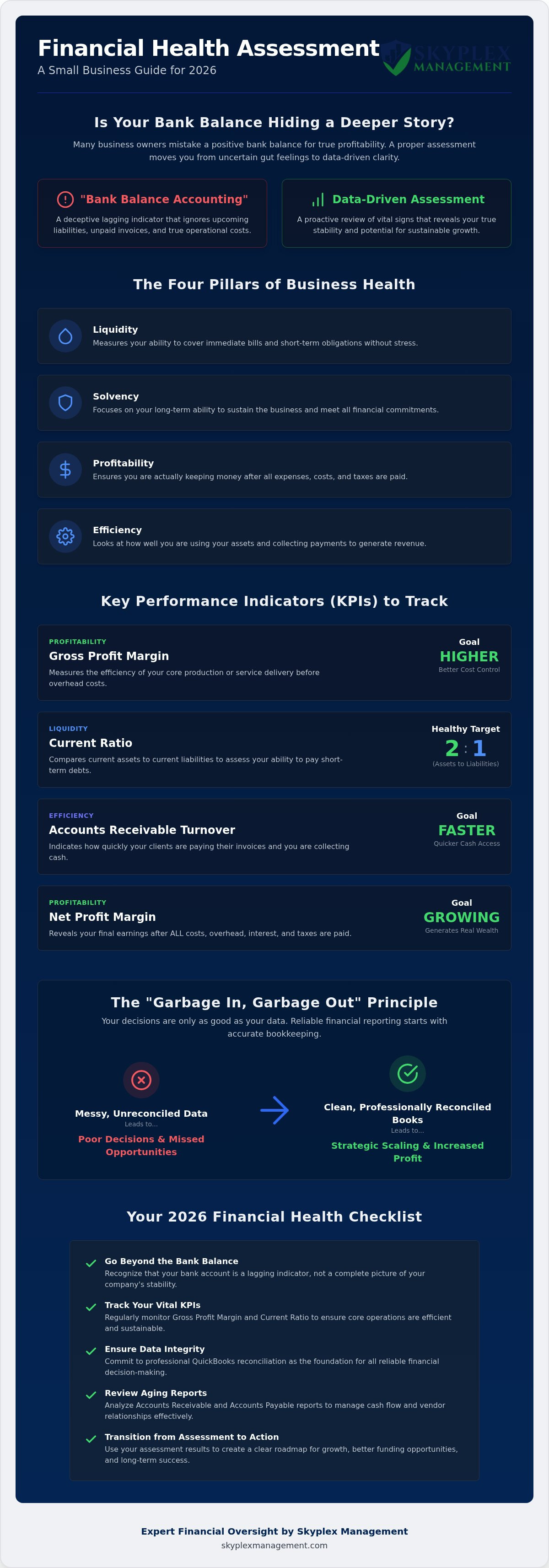
To get a complete picture of your company, we look at four specific areas. Liquidity measures your ability to cover immediate bills, while solvency focuses on your long term ability to sustain the business. Profitability ensures you're actually keeping money after all expenses are paid. Finally, efficiency looks at how well you're using your assets to generate revenue. We often use various financial ratios to compare these pillars against industry standards, giving you a clear benchmark for success. When these four areas are in balance, you gain the freedom to focus on your core strengths rather than putting out financial fires.
When Should You Perform an Assessment?
While an annual deep dive is standard for tax season, monthly reviews are the gold standard for maintaining clarity. Waiting twelve months to check your vital signs means you're often too late to correct a downward trend. You should also trigger a formal assessment during major business milestones, such as scaling your team in Medina or applying for an SBA 7(a) loan. For Northeast Ohio businesses, it's particularly helpful to align these assessments with your quarterly tax estimates. This timing ensures you have the reliable data needed for business advisory services to help you make informed decisions about equipment purchases or hiring before the next filing deadline.
Key Performance Indicators (KPIs) to Track
While the four pillars provide a high level framework, your financial health assessment for business requires specific data points to guide your decisions. These metrics act like a dashboard for your company, helping you spot trouble before it impacts your bank account. For our clients in Strongsville or Cuyahoga Falls, we focus on four primary KPIs that reveal the true story of your operations. Gross Profit Margin measures the efficiency of your core service, while the Current Ratio tests your ability to cover upcoming debt. We also track Accounts Receivable Turnover to see how fast clients are paying and Net Profit Margin to see what's actually left for you after every expense is paid.
To help you distinguish between these vital signs, we've summarized the most critical KPIs below:
| Key Performance Indicator | Category | What it Measures | Strategic Goal |
|---|---|---|---|
| Gross Profit Margin | Profitability | Efficiency of core production or service | Higher margins indicate better cost control |
| Current Ratio | Liquidity | Ability to pay short-term liabilities | A ratio of 2:1 is generally considered healthy |
| AR Turnover | Efficiency | Speed of collecting client payments | Higher turnover means faster cash access |
| Net Profit Margin | Profitability | Final earnings after all costs and taxes | Confirms the business is generating real wealth |
Liquidity and Cash Flow Metrics
Operating Cash Flow is the daily lifeblood of any organization. In a 2026 economy where the Federal Reserve's target rate sits between 3.5% and 3.75%, managing your debt is more expensive than it used to be. For scaling businesses in Hudson or Stow, monitoring your Burn Rate ensures you don't run out of capital before your growth pays off. We also look at the Quick Ratio, which is a more stringent test of your immediate health because it only counts assets you can convert to cash instantly. If your numbers feel unorganized, our team can help you establish a custom KPI dashboard to gain clarity.
Profitability and Growth Metrics
To scale effectively, you must understand your Customer Acquisition Cost (CAC) compared to the Lifetime Value (LTV) of your clients. If it costs more to land a customer than they'll ever spend with you, your business model isn't sustainable. We also analyze your Revenue Growth Rate year-over-year to ensure you're keeping pace with the Northeast Ohio market. For a deeper look at the misconceptions surrounding these numbers, read our guide on improving business financial clarity. Tracking these metrics consistently turns your bookkeeping into a powerful strategic asset.
Operational Health: The 'Garbage In, Garbage Out' Problem
The metrics we discussed in the previous section are only as powerful as the data behind them. If your QuickBooks records are unorganized, your financial health assessment for business will likely produce "false positives" that lead to risky decisions. For instance, a duplicate entry in your income account might make you look far more profitable than you actually are, while uncategorized expenses could hide a significant cash leak. Relying on flawed data is like trying to drive through a Cleveland snowstorm with a cracked windshield; you can't see the hazards until it's too late to react.
Common data entry errors, such as failing to reconcile bank statements or mixing personal and business expenses, skew your Profit and Loss reports. When your records don't match reality, you lose the ability to spot genuine growth opportunities. This is where professional QuickBooks reconciliation services become an essential part of your operational health. By ensuring every penny is accounted for, you gain a crystal-clear view of your margins and overhead. Outsourced bookkeeping takes the guesswork out of the equation, providing a foundation of truth for your strategic planning.
The Cost of Poor Data Integrity
Messy books do more than just confuse you; they create real financial risks. Inaccurate records often lead to incorrect tax filings, which can trigger unwanted attention from the IRS or the Ohio Department of Taxation. Beyond audit risks, unorganized expense tracking usually means you're missing out on valuable tax deductions that could keep more money in your business. There's also a significant psychological toll to consider. Living in a "financial fog" creates constant background stress for owners in Medina and Strongsville, making it difficult to enjoy the freedom that business ownership should provide.
QuickBooks Online Cleanup: The First Step to Health
Before you can perform a meaningful financial health assessment for business, you must clear out the digital clutter. This process involves identifying duplicate transactions, resolving "uncategorized" entries, and ensuring your payroll data is correctly synced with your general ledger. Proper cleanup ensures that your balance sheet actually balances and your income statements reflect your true performance. If you've fallen behind on your record keeping, exploring our QuickBooks Online support and cleanup services can help you regain control. Once your data is accurate, you can move forward with the confidence that your decisions are backed by hard facts rather than hopeful estimates.
The 2026 Small Business Financial Health Checklist
A financial health assessment for business is only effective if you have a repeatable workflow to follow. By organizing your review into specific, actionable steps, you can move beyond simply looking at your bank balance and start understanding the underlying drivers of your success. This checklist is designed to help Northeast Ohio owners maintain clarity and compliance in a shifting economic landscape.
- Reconcile all bank and credit card accounts: Ensure your QuickBooks Online records match your actual bank activity. This is the only way to verify that your reports reflect every penny entering and leaving your business.
- Review your Accounts Receivable aging report: Identify who owes you money and how long those invoices have been outstanding. If clients in Cleveland or Akron are consistently paying late, your cash flow is at risk regardless of your sales volume.
- Analyze your Profit and Loss statement against 2025 benchmarks: Look for significant shifts in overhead or material costs. With the Section 179 deduction limit increased to $2.5 million for 2026, you may find opportunities for tax advantaged equipment purchases that weren't feasible last year.
- Verify payroll tax compliance: Confirm that your withholdings align with current regulations, including Ohio's 2.75% flat personal income tax rate. Checking this now prevents expensive penalties from the Ohio Department of Taxation later.
- Conduct a thorough vendor audit: Review your recurring subscriptions and service contracts. Small, unnecessary costs can act like a drain on your profitability, slowly eroding the margins you work so hard to maintain.
Monthly Health Habits
Consistency turns financial data into a powerful management tool. We suggest dedicating one "Finance Friday" each month to review your company's vital signs. During this time, take a moment to analyze your small business balance sheet to spot any unusual shifts in liabilities or assets. This habit ensures your payroll is fully funded and your records remain clean, making your end of year reporting much smoother for your team in Medina or Strongsville.
Quarterly and Annual Deep Dives
Every quarter, you should step back to evaluate your progress toward long term goals. This is the ideal time to prepare for tax season by organizing 1099s and W-2s before the January rush. For businesses looking to transition from survival to strategic growth, consulting with an outsourced controller provides the high level forecasting needed to navigate 2026's 3.5% to 3.75% federal funds rate target. These deep dives allow you to adjust your strategic plan based on real world performance trends.
From Assessment to Action: Scaling Your Ohio Business
Completing your financial health assessment for business is a significant milestone, but the true value lies in how you use that data to fuel your next move. For many owners in Cleveland and Akron, a clean assessment is the golden ticket to securing much needed capital. As of July 2026, the combined loan limit for SBA 7(a) and 504 loans has increased to $10 million, providing a massive opportunity for local firms to expand their footprint. Whether you're looking to purchase new equipment for an auto repair shop or fund a large scale construction project, having a professional report that proves your solvency makes you a far more attractive candidate to lenders.
Moving from "survival mode" to "strategic growth" requires a shift in how you view your numbers. In the current economy, where the Wall Street Journal Prime Rate sits at 6.75%, every percentage point on a loan matters. Your assessment helps you identify high interest debts that should be refinanced or operational inefficiencies that are eating into your margins. By understanding your true financial position, you can stop guessing about your hiring budget and start making confident investments in your team. This transition is much smoother when you have local expertise to help you navigate regional economic shifts and Ohio specific tax requirements.
Leveraging Advisory Services for Growth
Data alone doesn't build a business; strategy does. This is where business advisory services become an invaluable asset. These services take the raw data from your assessment and turn it into a clear, actionable roadmap for the future. You might discover that your gross profit margins are healthy, but your customer acquisition costs are too high. If your business has reached a level of complexity where monthly bookkeeping isn't enough, it may be time to hire an outsourced controller. This professional oversight allows you to focus on high level forecasting and operational efficiency without getting bogged down in the background details.
Why Skyplex Management is Your Strategic Partner
At Skyplex Management, we're deeply committed to the success of our Northeast Ohio business community. We've spent nearly a decade serving clients in Medina, Strongsville, and Hudson, providing the technical mastery needed to stay compliant in an ever changing regulatory environment. We don't just hand you a spreadsheet and walk away; we act as a supportive partner who is genuinely interested in your individual success. Our team combines the competence of a large firm with the neighborly, approachable feel of a local advisor. We handle the complexities of your financial reporting so you can focus on what you do best: running your business.
You don't have to navigate these complex financial hurdles alone. We're ready to act as your supportive partner, handling the background complexities so you can focus on your own professional strengths. Let's work together to turn your financial data into your company's greatest asset.
Frequently Asked Questions
What is the most important metric in a financial health assessment for business?
Operating cash flow is the most vital metric because it represents the actual money moving through your company to cover daily expenses. While profit shows what you earned on paper, cash flow proves you can meet immediate obligations like payroll and vendor payments. A healthy financial health assessment for business focuses on this flow to ensure your operations remain sustainable even when customer payments are delayed.
How often should a small business perform a financial health check?
You should perform a basic financial review every month to catch data errors or shifting trends before they become crises. These monthly check-ins allow you to reconcile your bank accounts and monitor your burn rate in real time. A more comprehensive deep dive is recommended quarterly to align with Ohio's estimated tax deadlines and annually to prepare for full tax compliance and strategic planning for the next year.
Can I perform a financial health assessment myself using QuickBooks?
You can use QuickBooks Online to generate the necessary reports, but the results are only as accurate as your daily bookkeeping. If your transactions are uncategorized or your bank accounts aren't reconciled, the software will provide "false positives" that lead to risky decisions. Many owners in Cleveland and Akron find that while they can pull reports, they prefer professional oversight to ensure the data is reliable.
What are the warning signs of poor financial health in a business?
Common warning signs include a consistent reliance on credit cards to cover payroll or a growing Accounts Receivable aging report where customers take longer than 60 days to pay. You might also notice shrinking gross profit margins even as your total sales increase. If you feel a sense of "financial fog" where you aren't sure if you're actually making money, it's a signal that your company's vital signs need attention.
How does a financial health assessment help with business taxes in Ohio?
An assessment ensures you are setting aside the correct amounts for the Ohio Commercial Activity Tax (CAT) and the state's 2.75% flat personal income tax rate. By reviewing your numbers regularly, you avoid the stress of underpayment penalties or unexpected bills during tax season. This proactive approach also identifies potential deductions, such as the increased Section 179 limits, which can reduce your overall tax liability when managed correctly.
What is the difference between an accountant and a controller for these assessments?
An accountant typically focuses on historical data, tax compliance, and ensuring your books are technically accurate for the past year. In contrast, a fractional controller takes that data and uses it for strategic forecasting and high level operational oversight. While an accountant tells you where your money went, a controller helps you decide where it should go next. This distinction is crucial for scaling businesses in Northeast Ohio.
How much does a professional financial health assessment cost for a small business?
The investment for a professional financial health assessment for business depends on the complexity of your records and your total transaction volume. Factors like the number of bank accounts, the current state of your QuickBooks cleanup, and whether you require ongoing advisory services will influence the final cost. Most firms provide a custom quote after an initial consultation to ensure the service level matches your specific operational goals.
Disclaimer
The information provided in this article is for general educational purposes only and should not be considered accounting, tax, or legal advice. Every business is unique. Consult a qualified accounting professional before making financial or tax decisions. Contact Skyplex Management for guidance specific to your business.


