

To understand how to read a cash flow statement, start with its purpose: tracking cash moving into and out of a business over a defined period. The statement groups those movements into operating, investing, and financing activities, then reconciles the change in cash with the beginning and ending balances. This shows where cash came from and where it went.
A profitable business can still face cash pressure, and positive cash flow alone doesn’t prove profitability. The cash flow statement complements the income statement by showing whether day-to-day operations generate cash, whether investments use it, and how borrowing or debt payments affect the balance.
This guide explains what each section shows, how to interpret operating cash flow, and what direct and indirect reporting methods reveal. You’ll also learn how to read the overall pattern alongside other financial statements to assess financial health and identify questions that merit a closer look.
Key Takeaways
- Read the statement across operating, investing, and financing sections to understand what is driving the change in cash.
- Look beyond net income: receivables, inventory, payables, and noncash expenses can make operating cash flow tell a different story.
- Use the direct and indirect methods as two ways to explain operating cash movement, and focus on what the adjustments reveal.
- Review cash flow alongside other financial statements to spot patterns that may affect the business’s ability to meet obligations and plan ahead.
- Reliable, up-to-date records make cash flow reports more useful for decisions about spending, borrowing, and day-to-day operations.
What Is a Cash Flow Statement?
A cash flow statement records cash moving into and out of a business during a defined period. Its sections explain how operating decisions, asset activity, and funding choices affect cash on hand.
Operating, Investing, and Financing Activities
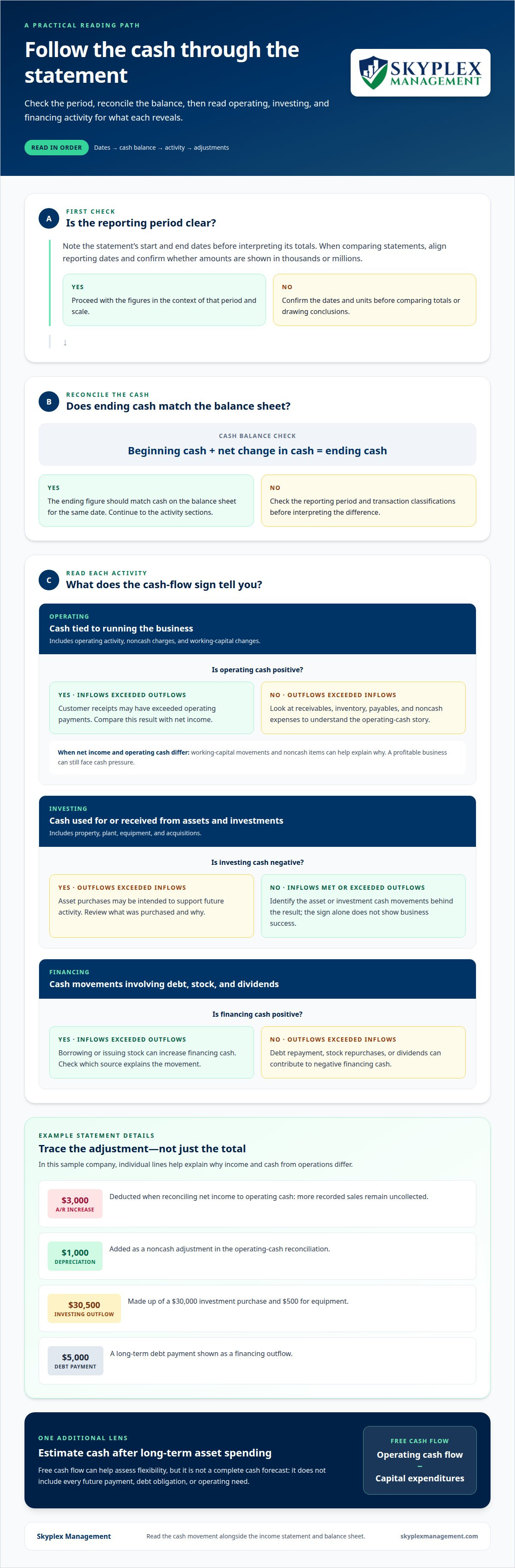
The statement groups cash movements by business purpose: operating, investing, and financing activities. Operating covers cash tied to running the business, noncash charges, and working capital changes. Investing includes cash spent on property, plant, equipment, and acquisitions. Financing includes cash from issuing stock or borrowing, repaying debt, repurchasing stock, and paying dividends. These categories help identify what drives cash movement.
A company’s annual or quarterly report usually includes its cash flow statement alongside the other financial statements. Publicly traded companies file regular reports, including cash flow statements, with the U.S. Securities and Exchange Commission. Find the statement in the report’s financial statements section, then note its start and end dates before interpreting the figures. The reporting period provides essential context for each total.
Positive and Negative Cash Flows
Positive cash flow in a category means inflows exceeded outflows during the period; negative cash flow means outflows exceeded inflows. The sign shows direction, not business success. Positive operating cash can mean customer receipts exceeded operating payments, while negative investing cash can reflect purchases intended to support future activity.
Financing cash can turn positive when a business borrows or issues stock, and negative when it repays debt or pays dividends. For example, a Northeast Ohio manufacturer might show negative investing cash after buying production equipment, while financing cash rises from a new loan. Read both signs together to see how the purchase was funded.
The statement also links the period’s cash movement to the balance sheet. Add the net change in cash to beginning cash to calculate ending cash. That ending figure should match the cash reported on the balance sheet for the same date. If it doesn’t, check the reporting period and transaction classifications before drawing conclusions.
Consider a Cleveland service business preparing reports for a lender. Its cash flow statement can distinguish cash generated through customer work from cash received through borrowing. That gives the lender and owner a clearer view of the business’s sources of cash, while the income statement and balance sheet provide complementary information.
- Operating: Cash connected to regular business activity, noncash charges, and working capital changes.
- Investing: Cash used for or received from assets and investments.
- Financing: Cash movements involving debt, stock, and dividends.
Read the categories as parts of one explanation: what the business generated, invested, or obtained through financing during the reporting period. This structure helps owners in Cleveland, Akron, and nearby communities understand how business activity connects to the cash balance.
Illustrative cash flow statement example
A useful example shows how individual adjustments shape the cash story, even when income looks straightforward. Focus on what each line reveals about timing, asset purchases, and funding.
Analyzing an Example Cash Flow Statement
Consider a sample company whose accounts receivable increased by $3,000. That increase is deducted when reconciling net income to operating cash because more recorded sales remain uncollected. A $1,000 depreciation adjustment is added as a noncash item. These lines help explain why accounting income and cash available from operations can differ, without treating either figure as an error.
In the investing section, the company purchases investments for $30,000 and equipment for $500. Those outflows produce net cash used in investing activities of $30,500. A separate $5,000 payment of long-term debt appears as a financing outflow. Read each entry against the company’s purpose: investment purchases, equipment needs, and debt reduction have different implications for future planning.
When comparing companies or periods, first align the reporting dates and units. Statements may show amounts in thousands or millions, so confirm the scale before comparing totals. Then consider the businesses’ size, activity, and investment needs. A larger outflow alone doesn’t indicate weaker performance; it may reflect more asset purchases or a planned change in financing.
Calculating Free Cash Flow
Free cash flow is operating cash flow minus capital expenditures. It estimates the cash remaining after spending on long-term assets and can help owners assess flexibility for business needs. Use the operating cash figure and capital expenditures from the same reporting period to keep the calculation consistent.
Treat free cash flow as one useful measure, not a complete cash forecast. It doesn’t include every future payment, debt obligation, or operating need. A company with positive free cash flow may still have scheduled debt payments or other commitments. A negative result may reflect planned investment, but repeated shortfalls can prompt a closer review of operating cash generation and spending priorities.
Use the statement’s detail to connect the figures to management decisions. An increase in accounts receivable can point to slower collections; an equipment outflow can reflect investment in productive capacity; debt repayment shows cash going toward reducing borrowing. Compare these explanations across periods and note whether the same drivers persist or change. This makes the statement more useful than comparing ending balances alone.
For a review that connects statement figures to business decisions, discuss your cash flow reporting questions.
Interpreting operating cash flow
Operating cash flow helps assess whether routine business activity produces usable cash. Compare it with net income, then investigate the transactions behind any gap.
Calculating Operating Cash Flow Directly
The direct method calculates operating cash flow by subtracting operating cash disbursements from operating cash collections. It presents actual cash received from customers and cash paid for operating needs, such as payroll, suppliers, and rent. This layout helps owners see which payment streams affect available cash, rather than relying only on the final operating total.
For example, an auto repair shop might collect customer payments at the counter while paying parts suppliers on account. Comparing cash collected with supplier and payroll payments shows whether incoming receipts are keeping pace with near-term operating needs. A mismatch may point to collection timing, rising costs, or both, so review the underlying lines before drawing a conclusion.
Reading Operating Cash Flow With Net Income
Reading operating cash flow alongside net income shows how much recorded profit is reflected in cash generated from operations. The measures use different accounting perspectives, so a gap can reveal timing differences or adjustments that merit attention.
Operating cash flow and net income can differ from period to period for understandable reasons. If a consulting firm records completed work before collecting client invoices, net income may rise while operating cash lags. Compare the receivable balance and collection activity with the reporting period to understand whether that gap reflects delayed payments or a persistent issue.
Interpret the relationship as a trend, not a pass-or-fail test. If operating cash remains below net income across reports, examine the reconciliation and the business’s collection cycle. If operating cash exceeds income, determine whether collections of earlier invoices or changes in payment timing explain the difference. Positive cash flow alone doesn’t establish profitability, so keep net income in the analysis.
Cash Flow and Earnings Quality Warning Signs
Warning signs include rising net income alongside weakening operating cash, recurring gaps between invoices and collections, or cash supported by delayed supplier payments. These patterns matter because reported earnings may not translate into funds available for current commitments.
Use a focused review: compare operating cash with net income across periods, trace changes in receivables and payables, and identify whether unusual timing explains the result. For instance, if customer balances keep growing while collections fall behind, review invoice aging and assess whether credit terms or billing practices contribute. A single period may reflect timing; a repeated pattern deserves closer scrutiny.
Also distinguish an operating shortfall from a planned change in the business. A seasonal company may collect less during a slower period, while a new service line may bring temporary startup costs. Review the timing and source of cash alongside sales activity, payroll, and supplier payments. This makes the assessment more specific than labeling a result simply “good” or “bad.”
For owners, the practical question is whether routine cash generation supports the business’s normal cycle. Examine collection delays, expense timing, and repeated adjustments together. This helps explain what operating cash flow says about financial performance and which records merit closer review.
Direct and indirect calculation methods
The direct and indirect methods present operating cash flow from different starting points. Understanding each format helps you connect customer payments, operating bills, and accrual adjustments to the reported cash result.
The Direct Method Starts With Cash Transactions
The direct method calculates operating cash flow by subtracting operating cash disbursements from operating cash collections. It groups actual receipts and payments, such as customer collections, supplier payments, payroll, and rent.
This view answers a practical question: which operating activities brought in cash, and which used it? For example, a business can compare cash received from customers with payments to suppliers. If customer collections lag while supplier payments continue, the direct presentation makes that timing pressure easier to see.
The Indirect Method Reconciles Net Income
The indirect method starts with net income and adjusts it for the effects of accruals. It then accounts for noncash items and working capital changes, connecting reported earnings to cash generated by operations.
Depreciation illustrates a noncash adjustment: it reduces income but doesn’t represent a current-period cash payment. Changes in receivables, inventory, and payables also affect the reconciliation. For example, an increase in accounts receivable generally means some recorded revenue has not yet become cash, reducing cash flow relative to net income.
Both methods organize the operating section differently, but each explains cash from business operations. The direct method emphasizes cash receipts and payments. The indirect method explains why operating cash flow differs from net income. When reviewing reports, first identify which method each uses, then compare operating cash flow and its supporting details.
- Direct method: Follow customer receipts and operating payments to see cash activity by type.
- Indirect method: Start with net income, then examine noncash adjustments and working capital changes.
For instance, an indirect statement may show a depreciation adjustment and a deduction for increased receivables. A direct statement instead presents customer cash collections and payments, without starting its operating section at net income. These layouts describe the same operating period from distinct angles, so format alone doesn’t indicate stronger performance.
Use the method to guide your next question. If direct reporting shows collections below operating payments, investigate payment timing and expenses. If indirect reporting shows net income but weaker operating cash, inspect the reconciliation, especially receivables, inventory, payables, and noncash expenses. The explanation matters more than the label.
For a business owner, the direct method can make cash movement easier to follow, while the indirect method links operating cash to the income statement. Reading the adjustments carefully shows whether reported profit is converting into cash or remaining tied up in unpaid invoices and other working capital. Pair the method with the underlying accounts for a more useful interpretation.
Cash flow statement purpose and financial health
A cash flow statement shows whether a business can turn its activity into available cash. This perspective matters because accounting income, asset purchases, and debt payments affect financial health in different ways.
An income statement measures revenue and expenses, but it may not accurately represent cash flowing into and out of a business, according to Carnegie Mellon University. For example, a contractor may record income after completing work while the customer’s invoice remains unpaid. The cash flow statement makes that collection timing visible.
Use the statement to understand how operating cash supports routine obligations, how investing affects assets, and how financing changes available funds. A business might report strong operating receipts while using cash to replace equipment or repay borrowing. Those choices can be sound, but they shape the cash available for payroll, suppliers, and upcoming commitments.
- Operating activity: Assess whether customer receipts support regular payments such as payroll and supplier invoices.
- Investing activity: Identify cash used for equipment or other assets, then consider what business need that spending serves.
- Financing activity: Review borrowing, repayments, and owner distributions to understand how funding decisions affect cash.
- Ending cash: Compare the reported balance with upcoming obligations and the business’s operating needs.
Financial health becomes clearer when you read the cash flow statement alongside the income statement and balance sheet. The income statement shows performance over a period; the balance sheet shows financial position at a point in time. The cash flow statement explains how activity during that period changed cash. Together, these reports help distinguish earned revenue from collected cash and asset growth from available funds.
Look for patterns across reporting periods rather than treating one result as a complete diagnosis. If operating cash weakens while receivables rise, unpaid customer invoices may be delaying collections. If investing cash is negative after equipment purchases, consider whether those assets support current operations or planned growth. If financing cash repeatedly supports regular expenses, examine whether core operations generate enough cash.
These connections make the statement useful for decisions, not just recordkeeping. Before committing to a large asset purchase, consider its effect on cash alongside expected operating needs. Before relying on a profitable income statement, examine customer collections and payment timing. For a seasonal service business, comparing cash movement across periods can clarify whether a low balance reflects normal timing or a developing shortfall.
A practical review follows cash movement from operating activity to the ending balance, then checks whether investing or financing explains the change. This sequence helps identify what drives available cash and which assumptions deserve attention. Financial reporting is most useful when each statement agrees with the underlying records and gives owners a consistent view of business performance and position.
Skyplex Management
Skyplex Management helps business owners turn accurate bookkeeping and accounting records into clearer cash flow reports. When cash balances don’t seem to match reported income, or operating cash flow is difficult to interpret, organized records make it easier to trace collections, payments, and adjustments. Small Business Bookkeeping and Small Business Accounting support dependable reporting, while QuickBooks Online Support & Cleanup can help address records that need correction before they guide decisions. This work is useful when reports are incomplete, transactions are misclassified, or financial activity needs a clearer explanation. Contact Skyplex Management to discuss support for understanding your business’s cash flow.
Put Cash Flow Insight to Work
Use your cash flow statement as a decision tool, not just a record of past activity. As you plan hiring, purchases, or changes to payment timing, connect each decision to the cash the business can access and the obligations it needs to meet. Knowing how to read a cash flow statement helps turn financial reports into more informed choices.
Reliable records support that process. Skyplex Management offers Small Business Bookkeeping and Small Business Accounting to help keep financial information organized, along with QuickBooks Online Support & Cleanup when records need attention. Clear, consistent books make it easier to understand cash movement and identify questions that deserve a closer look.
Start with the decision in front of you, then use current financial information to understand its cash impact. A steady view of your numbers can help you move forward with greater clarity.
With dependable records and thoughtful review, you can approach your next business decision with confidence.
Frequently Asked Questions
Why is it important?
A cash flow statement helps owners judge whether available cash can support upcoming business decisions. For example, a company planning to hire may have recorded strong sales but still need to account for delayed customer payments and payroll timing. Reviewing cash movement alongside other reports helps distinguish a timing gap from a broader operating concern, so decisions about spending, borrowing, or growth reflect liquidity as well as reported performance.
What are the three sections of a cash flow statement?
The three sections are operating, investing, and financing activities. Operating covers cash related to regular business activity; investing reflects purchases and sales of assets or investments; financing shows cash involving borrowing, debt repayments, stock, and dividends. For example, a customer payment belongs to operating activity, equipment purchased for business use belongs to investing, and a loan received belongs to financing. Classification shows what drove the cash change.
What is the difference between direct and indirect cash flow methods?
The direct method lists operating cash collected and paid, while the indirect method begins with net income and adjusts it to calculate operating cash flow. Both methods present operating cash flow, but their layouts emphasize different details. The direct view highlights transaction types; the indirect view helps trace differences between earnings and cash. When comparing reports, identify the method first and review the supporting line items before judging a change.
How can changes in working capital affect cash flow?
Working capital changes affect cash timing as receivables, inventory, and payables move. If a distributor buys inventory before customers pay for earlier orders, cash may be tied up in both stock and unpaid invoices. Collecting outstanding invoices can improve cash without a matching increase in current-period sales. A rise in unpaid supplier bills can also preserve cash temporarily while creating obligations for a later period.
How do capital expenditures and asset sales appear on a cash flow statement?
Capital expenditures generally appear as investing cash outflows because the business pays to acquire long-term assets, such as equipment. Cash received from selling an asset generally appears as an investing inflow. Consider both sides when reviewing a period: a sale can offset some purchase spending, but it doesn’t represent cash generated by routine customer activity. The purchase or sale also changes the assets the business holds.
How do dividends, debt repayment, and stock issuance affect cash flow?
Dividends paid and debt repayments reduce cash and appear as financing outflows. Borrowing and issuing stock bring cash into the business and appear as financing inflows; repurchasing stock uses cash. These transactions show how a business funds itself and distributes funds, rather than how its core operations performed. For example, a new loan can raise cash even when operating activity is weak, so read the sections together.
Disclaimer
The information provided in this article is for general educational purposes only and should not be considered accounting, tax, or legal advice. Every business is unique. Consult a qualified accounting professional before making financial or tax decisions. Contact Skyplex Management for guidance specific to your business.


