

The IRS generally has three years from the date you file a return to assess penalties for incorrect payroll filings. But that deadline is only one part of the picture: late deposits, late returns, and inaccurate wage statements can each trigger different penalties, and interest may increase the balance.
A payroll error can feel settled once a return is filed, but correcting it promptly can help limit confusion and give you a clearer record of what happened. This guide explains how the assessment period works, which federal penalties may apply, what records can support a penalty abatement request, and how to correct common filing errors, including errors on Form 941 and Form W-2.
A corrected return does not automatically remove a penalty. Knowing which records to gather and how the rules apply can help you understand your exposure and decide how to address a payroll filing issue.
Key Takeaways
- Understand how the IRS assessment period relates to the date a payroll return is filed, and why correcting errors promptly matters.
- Learn how late deposits, late returns, and unpaid taxes after an IRS notice can lead to different penalties.
- Organize payroll records that may help support a First-Time Abate request or a reasonable-cause claim.
- See when Form 941-X or Form W-2c may be used to correct common payroll filing errors.
- Use payroll service support to keep filings, payments, and payroll records better organized.
How long does the IRS have to assess a payroll tax penalty?
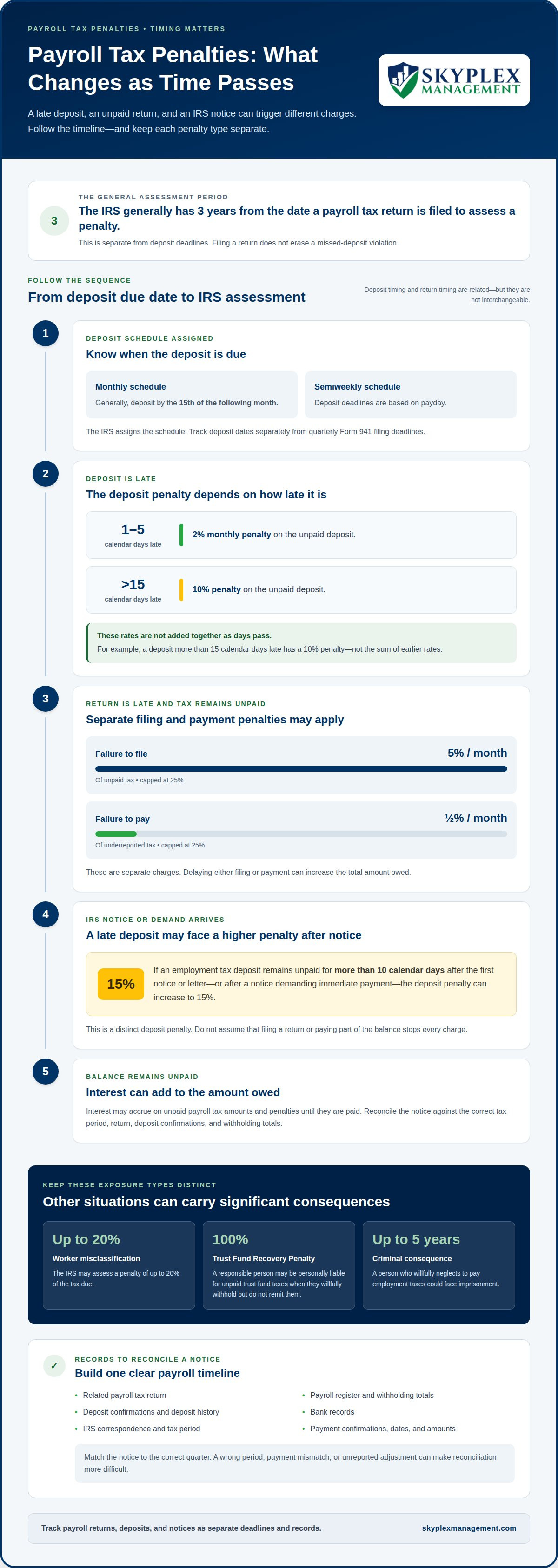
The IRS generally has three years from the date a payroll tax return is filed to assess a penalty. This assessment period is separate from the deadlines for making employment tax deposits. A missed deposit can trigger a penalty even before the IRS assesses it, so filing a return does not erase a deposit violation.
Employers generally withhold federal income tax and employees’ Social Security and Medicare taxes from wages. They also pay the employer’s share of Social Security and Medicare taxes. These amounts must be deposited with the IRS and reported on payroll tax returns. For a late deposit, the penalty depends on how many calendar days have passed since its due date.
- A deposit 1-5 calendar days late carries a 2% monthly penalty on the unpaid deposit.
- Late employment tax deposits can result in a penalty, with the amount depending on how late the deposit is.
- For an employment tax deposit more than 15 calendar days late, the Internal Revenue Service penalty is 10% of the unpaid deposit.
These rates are not added together as the days pass. For example, a deposit more than 15 calendar days late has a 10% penalty, not the sum of the earlier rates. Paying the deposit late can also leave interest accruing on the balance. The longer an employer waits, the more important it is to reconcile payroll records, deposits, and filed returns.
The deposit schedule depends on the employer’s employment tax liability during the relevant lookback period. Employers assigned a monthly schedule generally deposit by the 15th of the following month. Employers assigned a semiweekly schedule follow deposit deadlines based on payday. The IRS assigns the schedule, so payroll dates and deposit dates must be tracked separately.
Employment taxes reported on Form 941 are generally filed quarterly, while federal unemployment tax deposits are generally made quarterly when required. The Form 941 filing deadline is not a substitute for a deposit deadline. A business may file its quarterly return on time and still owe a deposit penalty if it deposited withholding late.
Misclassifying an employee as an independent contractor can leave employment taxes unpaid or underreported. The IRS may assess a misclassification penalty of up to 20% of the tax due. The classification issue can also require correcting payroll records and reporting, rather than simply changing a worker’s label for future payments.
Willful failure to remit withheld taxes creates a more serious risk. The Trust Fund Recovery Penalty can make a responsible person personally liable for 100% of unpaid trust fund taxes when they willfully withhold but don’t remit payroll taxes. The potential liability is personal, not limited to the business’s accounts. Clear payroll records showing withholding, deposits, and payment decisions help establish what happened and when.
Failure to pay employment taxes after notice and demand
An unpaid payroll tax balance can become more costly after the IRS sends a notice. The notice date matters because it can affect the deposit penalty and the steps needed to address the balance.
Combined Filing and Payment Penalties
Combined penalties mean separate charges may apply when an employer both files a payroll return late and leaves tax unpaid. The Internal Revenue Service failure-to-file penalty is 5% of unpaid tax per month, up to 25%. A separate failure-to-pay penalty can accrue at ½% per month of underreported tax, up to 25%. Since both relate to the same unpaid balance, delaying either filing or payment can increase the total amount owed.
A deposit penalty can rise after the IRS contacts the employer. For an unpaid employment tax deposit, the Internal Revenue Service penalty can increase to 15% if the deposit remains unpaid for more than 10 calendar days after the first notice or letter, or after a notice demanding immediate payment. This is a distinct deposit penalty, so an employer should not assume that filing a return or paying part of the balance stops every charge.
Read the notice carefully and match its tax period and balance to your payroll records. Compare the amount with the related return, deposit confirmations, and withholding totals. If you have already made a payment, keep its confirmation and note the date and amount. If the return contains an error, identify the affected quarter before responding. An incorrect period can make reconciliation more difficult.
Criminal Consequences of Payroll Tax Failures
Criminal consequences concern willful conduct, not simply an isolated bookkeeping mistake. A person who willfully neglects to pay employment taxes could face imprisonment for up to five years. It is important to distinguish a cash-flow problem or filing error from a deliberate decision to withhold trust fund taxes and not remit them.
Withheld employee taxes are not ordinary operating cash. If your business used those funds for other expenses, document the circumstances, payments, and decisions accurately. Do not alter records or ignore an IRS notice. A clear timeline helps show what was withheld, what was deposited, and when the business acted to address the balance.
Interest may accrue on unpaid payroll tax amounts and penalties until they’re paid. An employer facing a notice can organize the relevant return, payroll register, deposit history, bank records, and IRS correspondence into one file. This makes it easier to identify a payment mismatch, an unreported adjustment, or a balance that needs correction. Discuss a payroll tax notice when you need support reconciling payroll records and filings.
Federal payroll tax penalty types and rates
Federal payroll penalties can follow a missed return, an unpaid balance, or inaccurate wage information. Understanding penalties for incorrect payroll filings starts with separating these issues. Each charge depends on the error, the amount owed, and how long it remains unresolved.
For a late payroll tax return, the Internal Revenue Service failure-to-file penalty is 5% of unpaid tax monthly, up to 25%. The charge is tied to unpaid tax, so filing late with no tax balance doesn’t create this specific penalty on an unpaid amount. A late return can still leave other payroll obligations unresolved.
A separate failure-to-pay penalty may accrue at ½% per month of underreported tax, up to 25%. Interest may also apply to unpaid taxes and penalties until the balance is paid. To understand the charges, separate whether the return was filed, whether the tax was reported correctly, and whether the reported amount was paid.
Incorrect information statements can create another exposure. A Form W-2 error may carry a penalty of $30 per statement if corrected within 30 days of January 31, or $60 per statement if corrected on or before August 1. Incorrect wage statements may carry penalties, so correction timing matters. The timing and type of correction affect which rate applies, so retain the original statement and correction history.
Federal filing requirements follow different schedules. Employers generally report federal income tax withholding, Social Security, and Medicare taxes on Form 941 each quarter. Form 941 is due on the last day of the month following each quarter. Federal unemployment tax is reported on Form 940 annually, and that return is due January 31. Employee Forms W-2 and contractor Forms 1099-NEC are also due January 31 of the following tax year.
One federal return doesn’t cover every payroll obligation. A business may need to reconcile withholding and employment taxes across the quarterly Form 941, annual Form 940, and year-end statements. For example, a wage total that differs between payroll records and Form W-2 can point to a reporting error even when tax deposits were made.
State and local compliance adds another layer. Ohio’s listed payroll tax late-filing penalty is $50 or 5% of the tax due for each overdue month, up to $500 or 50% of the tax due. State and local filing rules are separate from federal deadlines, so a federal filing alone doesn’t resolve an overdue state or local return. Keep each jurisdiction’s notices, filed returns, payment confirmations, and corrected statements together to trace the source of a balance.
What records support a reasonable cause abatement claim?
Penalty relief depends on the type of penalty and the circumstances behind the missed tax obligation. For payroll filings, useful records show what happened, when it happened, and how the business responded.
First-Time Penalty Abatement
First-Time Penalty Abatement may apply when no penalties were assessed during the prior three tax years and all required returns have been filed. It is an administrative option, separate from reasonable-cause relief. Before seeking it, bring required filings up to date and identify the specific penalty being challenged. This helps connect the request to the return and tax period involved.
Organize documents by tax period. A practical file may include:
- The IRS notice showing the penalty, tax period, and amount charged.
- The filed payroll return and any amended or corrected return.
- Payroll registers showing wages, federal income tax withholding, and Social Security and Medicare amounts.
- Deposit confirmations and bank statements that show payment dates and amounts.
- Correspondence or dated notes explaining the event that caused the filing or payment delay.
For example, if a deposit was several days late, its confirmation can establish the actual payment date. A payroll register can show which withholding amounts the deposit covered. Matching those records to the IRS notice helps distinguish a late deposit from a reporting error or a payment applied to another period.
Reasonable-Cause Relief
Reasonable-cause relief may remove or reduce some penalties when a taxpayer acted in good faith and can show a reasonable cause for missing a tax obligation. The records should lay out a clear timeline, not simply state that the business intended to comply. Include the date the problem began, the affected payroll period, when it was discovered, and the corrective action taken.
The right supporting records depend on the explanation. If a payroll system error caused incorrect Social Security withholding, preserve the affected payroll reports, error messages, and correction history. If a payment was initiated but not credited as expected, include its confirmation and relevant bank record. If an employee’s income or wage information was entered incorrectly, retain the original source document and corrected payroll entry.
Keep payroll records for at least three years. A dated record showing who prepared, reviewed, and corrected a filing can help document the business’s actions. State the number of days late accurately and connect each document to the event. A concise, evidence-based request is clearer than a general statement about hardship, and complete records help support your account of what happened.
Correcting payroll filing errors
Correct a payroll filing error on the return or statement where it occurred. Identify the affected tax period, employee, and incorrect information, then compare payroll records with the filed return and payment history. This helps separate a reporting error from a failure to deposit, which may require addressing both the filing and the unpaid amount. Correcting the underlying record can clarify penalties for incorrect payroll filings, but a correction does not by itself remove an assessed charge.
For certain errors on Form 941, employers use Form 941-X, Adjusted Employer’s Quarterly Federal Tax Return or Claim for Refund. An incorrect Form W-2 may require Form W-2c, Corrected Wage and Tax Statement. Choose the form based on the document being corrected. A corrected wage statement doesn’t fix a quarterly return, and amending a return doesn’t automatically update an employee’s statement.
A focused review helps identify what needs to change:
- Match the affected quarter’s payroll register to the filed Form 941.
- Compare reported wages, federal income tax withholding, and Social Security and Medicare amounts.
- Identify whether the error affects an employee’s Form W-2, the employer’s tax return, a deposit, or multiple records.
- Retain the original filing and document the correction and its reason.
For example, if an employee’s Medicare wages were entered incorrectly, trace the amount from the payroll record to the quarterly return and year-end statement. If both documents contain the error, correcting only one leaves conflicting information. Ensure the correction shows consistent wage and tax figures wherever they were reported.
Filing a correction and paying a balance are separate actions. A corrected return updates reported figures, but it does not deposit unpaid employment taxes. Reconcile the correction against deposit confirmations and the business bank account. If your review finds a missed deposit, record the affected period and payment status alongside the corrected filing.
Maintain an error trail showing when the issue was found, which records were reviewed, what changed, and when the correction was filed. Include IRS correspondence and confirmation associated with the corrected return or statement. A concise timeline makes it easier to follow the relationship between the original filing and the correction during a later account review.
Annual payroll documents also need attention when a correction affects year-end reporting. Compare corrected Form W-2 information with the payroll register and the figures previously furnished to the employee. A consistent record across the quarterly return, employee statement, and deposit history helps clarify what changed and how the correction affects the payroll records.
Skyplex Management: Payroll Service
Skyplex Management provides Payroll Service to help small businesses manage payroll tasks and keep payroll information organized. Turn to this support when payroll filings need attention, records are difficult to reconcile, or routine payroll administration takes time away from running your business.
Accurate payroll depends on consistent information across payroll records, tax filings, and bookkeeping. Small Business Bookkeeping and QuickBooks Online Support & Cleanup can help organize financial records and clarify past transactions alongside payroll support. Small Business Accounting can also help you understand your financial information as you address payroll issues.
If you’re working through a filing correction or want more structured payroll support, contact Skyplex Management to discuss your needs.
Build a steadier payroll process from here
A payroll correction can be an opportunity to strengthen the process behind future filings. Clear records, consistent review, and timely follow-through make it easier to catch discrepancies before they become recurring problems. If penalties for incorrect payroll filings have exposed gaps in your workflow, consider what support would help your team maintain accurate books and payroll information.
Skyplex Management offers Small Business Bookkeeping, Small Business Accounting, and QuickBooks Online Support & Cleanup to help organize financial records and clarify payroll-related transactions. More consistent records give you greater visibility into ongoing payroll responsibilities and help you stay focused on running your business.
A practical next step can bring greater clarity to your payroll records and support a more organized path forward.
Frequently Asked Questions
Can I set up a payment plan if I can't pay the full penalty at once?
Yes, taxpayers with IRS balances under $50,000 can apply online for an installment agreement through the IRS Online Payment Agreement tool. Before applying, separate the penalty balance from any other tax amounts shown in the account. A payment arrangement addresses repayment, not whether a penalty was assessed correctly. Keep track of the balance while payments are underway, since interest may continue on unpaid amounts until they’re paid.
What are the IRS penalties for incorrect payroll tax filings?
The IRS may assess different penalties depending on whether the problem involves an unpaid deposit, an inaccurate return, or an incorrect information statement. Start by matching the notice to the form and tax period it identifies. Then compare the stated issue with your payroll records and payment history. This helps distinguish a reporting discrepancy from an unpaid liability, which may need to be addressed separately.
What are the penalties for filing payroll tax returns late?
A federal employment tax return filed more than 60 days late can face a minimum penalty: the IRS-set dollar amount or 100% of the tax due, whichever is less. This minimum rule is distinct from the usual monthly late-filing calculation. If a return is already substantially overdue, identify the tax due and filing date first, since both affect how the minimum is evaluated.
What are the penalties for paying or depositing payroll taxes late?
Your business remains responsible for timely federal tax deposits and payroll tax returns, even when you use an outside payroll provider. This matters if a service handles payroll calculations but a deposit or filing is missed. Compare payroll reports with business bank activity and the IRS account, then identify whether the issue was a late deposit, a missed return, or both.
How does the IRS calculate payroll tax penalties and interest?
Interest on assessed taxes and penalties varies by quarter and is based on three percentage points above the federal short-term interest rate, or five percentage points for large corporate underpayments. The balance can change over time, even when no new payroll error occurs. Review the notice’s tax period, penalty amount, and interest calculation separately, then compare them with payments already credited to the account.
What penalties apply to incorrect Forms 941, 940, W-2, and W-3?
The consequence depends on the form and the nature of the error. Intentional disregard of Form W-2 requirements can result in a penalty of the greater of 10% of the underreported amount or $250 per W-2, with no annual cap. Form W-3 transmits W-2 information, so reconcile the totals across the statements and transmittal to locate discrepancies before correcting records.
Can employers face penalties for underreporting payroll taxes or filing false returns?
Yes. An underpayment caused by negligence, disregard of rules, or substantial understatement can lead to an accuracy-related penalty. Fraud is treated separately, and intentionally false reporting can create additional criminal exposure. The distinction depends on the circumstances and evidence behind the filing, not simply on the existence of a discrepancy. Preserve source wage records and the calculation history so the reported figures can be traced.
How can an employer correct an incorrect payroll tax filing?
Start by documenting the source of the error and its effect on your business records. Keep a correction log identifying when the issue was found, which records were reviewed, what changed, and when corrective filings were submitted. The log helps connect the original entry to the final figures. Keep related payroll reports, employee statements, payment confirmations, and IRS correspondence together so the correction can be traced across records.
Disclaimer
The information provided in this article is for general educational purposes only and should not be considered accounting, tax, or legal advice. Every business is unique. Consult a qualified accounting professional before making financial or tax decisions. Contact Skyplex Management for guidance specific to your business.


