

What if your financial records could do more than satisfy month-end tasks and help you make clearer decisions? When bookkeeping falls behind, payroll competes with customer needs, and reports are hard to interpret, it can be difficult to know whether the business is ready to hire, invest, or take on more work. For owners weighing the benefits of outsourced accounting for small business operations, the practical value is dependable records and timely financial insight.
Outsourcing can take recurring accounting work off your plate while giving you a clearer view of cash flow, expenses, and business results. The support can match your needs, from monthly bookkeeping and payroll to financial reporting and controller-level oversight.
This article explains how outsourced accounting can reduce administrative pressure, improve financial clarity, and support better-informed decisions. You’ll see how connected bookkeeping, QuickBooks Online support, payroll, and financial advisory can help Northeast Ohio businesses, including construction, auto repair, and service businesses, keep their finances organized and useful.
Key Takeaways
- Identify which financial tasks consume the most time and where clearer records or reporting would help you make decisions.
- Match accounting support to your needs, from routine bookkeeping to payroll, financial reporting, and controller oversight.
- Compare owner-managed work, in-house staffing, software, and outsourced accounting by who handles the work and what expertise and reporting you receive.
- Prepare to outsource by gathering records, clarifying responsibilities, and agreeing on the reports that will help you track business performance.
- The benefits of outsourced accounting for small business can include more dependable financial records and support that adapts as the business grows.
What Benefits of Outsourced Accounting Matter Most to a Small Business?
For many owners, financial work arrives in small pieces throughout the week: recording expenses, following up on invoices, sorting receipts, and trying to determine whether reports reflect what is happening in the business. That effort can take time without producing clear answers. Outsourced accounting connects recurring tasks to organized records and financial oversight.
In practical terms, outsourced accounting means an external accounting professional manages agreed financial processes for a business. The scope may include bookkeeping, account review, financial reporting, payroll, or other support. Define the work together so you know which tasks are handled by the accounting professional and which information or decisions still need your attention. A general overview of accounting outsourcing describes the practice and the range of accounting functions it can involve.
Accurate, current records help show how money moves through the business. Organized transactions make it easier to review income, expenses, unpaid invoices, and other activity in financial reports. That visibility does not make decisions for you, but it gives you a more useful starting point when considering staffing, spending, or upcoming commitments. The benefits of outsourced accounting for small business owners are strongest when records are not only maintained but also reviewed in a way that helps answer questions about performance.
Reliable accounting records don’t make business decisions for you, but they give you a clearer basis for making them.
How outsourced accounting can return time to the owner
Delegating recurring financial administration can give owners more time for customers and daily operations. Consider a service business owner who spends evenings entering expenses, checking which invoices were paid, and trying to prepare records for monthly bookkeeping. With responsibilities agreed in advance, the owner can provide invoices, receipts, and account information while an accounting professional organizes and records the activity. The owner stays involved in business decisions without having to manage every routine entry.
Clear handoffs are essential. Agree on who provides source documents, who records transactions, and how questions or missing information will be handled. Without a shared process, outsourcing can shift the administrative burden instead of reducing it.
How dependable records improve financial visibility
Consistently organized transactions make reports more useful for reviewing patterns over time. An owner might compare expenses across periods, notice that customer payments are taking longer, or see that a particular cost is changing. These observations don’t guarantee a particular outcome, but timely information can surface questions while there is time to investigate them. Small-business accounting services can connect recordkeeping with reporting and accounting oversight, helping owners make better sense of their financial activity.
What Does Outsourced Accounting Include Beyond Basic Bookkeeping?
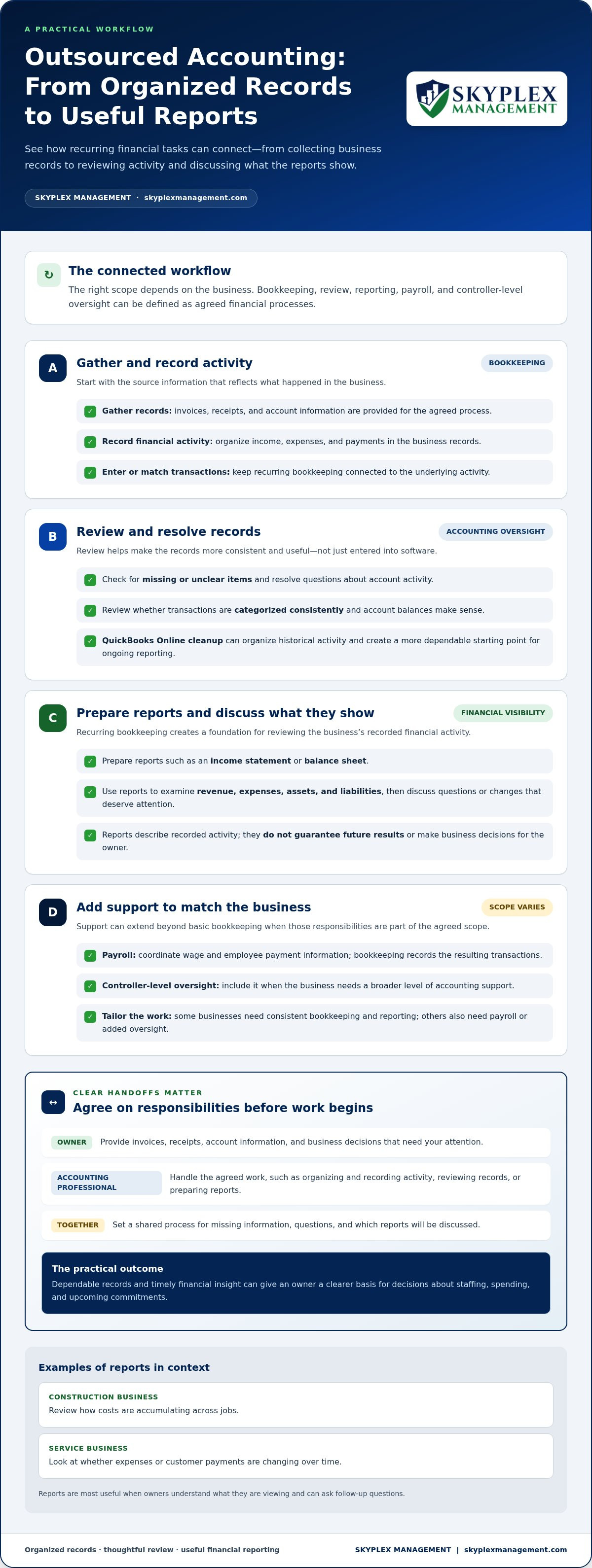
Outsourced accounting can connect several financial tasks in one workflow. Transactions are organized, records are reviewed for missing or unclear items, and financial reports are prepared for discussion with the owner. The right scope depends on the business. One owner may need consistent bookkeeping and reporting, while another may also need payroll administration or controller-level oversight.
Basic bookkeeping focuses on recording financial activity, such as income, expenses, and payments. Accounting oversight adds review and context: Are transactions categorized consistently? Do account balances make sense? What do the reports show about business activity? Software can store information and automate parts of the process, but it does not replace professional review or a discussion about what the information means.
QuickBooks Online support and cleanup can make existing records more useful. If transactions have been categorized inconsistently or past activity has not been fully recorded, cleanup can organize historical information and create a more dependable starting point for ongoing reporting. The goal is not simply to make the software appear current. It is to create records that better reflect the business.
From monthly bookkeeping to financial reporting
Monthly bookkeeping organizes and reviews transactions on a recurring basis, creating a foundation for reports such as an income statement or balance sheet. These reports help owners examine revenue, expenses, assets, and liabilities, then discuss questions or changes that deserve attention. They describe recorded activity, but they do not guarantee future results.
A typical workflow includes gathering records, entering or matching transactions, reviewing account activity, resolving questions, and preparing reports for discussion with the owner. A construction business might use that review to understand how costs are accumulating across jobs. A service business could look at whether expenses or customer payments are changing over time. Reports become more useful when owners understand what they are looking at and can ask follow-up questions.
When payroll or controller support fits the picture
Payroll is a related but distinct responsibility. It involves coordinating wage and employee payment information, while bookkeeping records the resulting transactions in the accounts. Payroll management support connects this recurring administrative work with the business’s broader financial records.
Controller support adds a higher level of financial oversight for businesses that need it. This may include reviewing reporting processes, helping interpret financial results, or supporting planning discussions. It is not necessary for every small business. Start with the tasks causing the most friction, then adjust the scope as operations change. For a broader perspective on typical service components and outsourcing decisions, see Windes’ overview of outsourced accounting benefits.
Once the work is clear, you can identify which tasks belong in an ongoing accounting arrangement and what information you need to provide. If you’re weighing the scope, discuss the accounting support your business needs.
Outsourced Accounting vs. In-House Work and Software: What Changes?
Choosing how to manage accounting means deciding who handles the work, how it is reviewed, and what support the owner receives. Keeping everything in-house offers direct control, while software helps organize financial activity. Outsourced support adds an accounting professional to agreed parts of the process. In every model, the owner remains responsible for the business and its decisions. Outsourcing changes who performs specific tasks, not who owns the results.
Approach
Time responsibility
Process ownership
Expertise and reporting
Owner-managed work
The owner handles entries, follow-up, and reviews alongside other duties.
The owner sets and maintains the process.
Knowledge depends on the owner’s experience and time available to review reports.
In-house staffing
The employee performs assigned accounting tasks; the owner still provides direction.
The business manages the role, procedures, and day-to-day workflow.
Expertise and reporting depend on the employee’s responsibilities and skills.
Software-only tools
The owner or staff enter information, review exceptions, and keep the workflow moving.
The business configures and monitors its own process.
Tools can organize information, but interpretation and follow-up remain with the user.
Outsourced support
An external professional handles the agreed tasks; the owner supplies information and makes decisions.
Responsibilities are shared according to the agreed workflow.
The business can access professional accounting support and reporting suited to the defined scope.
Can accounting software alone provide the same support?
Software and professional support can work together. QuickBooks Online, for example, can organize transactions and support parts of a bookkeeping workflow. But automation does not determine whether a transaction is categorized appropriately, resolve every discrepancy, or explain what a report means for a particular business. Accounting software organizes financial information; professional oversight helps assess whether it is complete, consistent, and useful. Cloud-focused practices like Count On Me highlight how small and medium-sized enterprises can combine software tools with dedicated professional expertise. The benefits of outsourced accounting for small business can include that human review alongside the tools already in use.
How to weigh control, communication, and confidentiality
Outsourcing does not require stepping away from your finances. Agree on which records the accounting professional can access, what you will provide, who handles questions, and how often reports will be reviewed. Clear boundaries help define responsibilities and protect sensitive business information through deliberate access and document-handling practices.
Regular reporting and communication keep you involved in decisions. A report review can clarify an unfamiliar transaction, flag an item that needs attention, or help you understand a change in results. You remain the decision-maker, with the accounting work organized around the information and oversight your business needs.
How Can a Small Business Prepare to Outsource Accounting?
A little preparation helps an accounting professional understand what is working, what is behind, and where support could make day-to-day processes clearer. You do not need perfectly organized books to begin. First, note the tasks causing the most friction, such as overdue reconciliations, payroll coordination, or reports you are unsure how to interpret. These pain points help shape a practical scope of support.
- Identify your needs. List the tasks you want handled and the questions you want your financial information to answer. A construction business might want a clearer way to organize job-related costs. An auto repair shop may want to understand how parts and operating expenses are recorded. A service business could need help keeping invoices and expenses current.
- Gather the records you have. Collect available bookkeeping files, banking records, payroll information, and prior financial reports. Include incomplete or older records. If reconciliations are overdue or QuickBooks Online needs cleanup, note which accounts or periods are affected instead of trying to fix everything before asking for help.
- Clarify responsibilities. Decide who will provide documents, answer transaction questions, manage payroll information, and review reports. Clear ownership helps prevent missed handoffs and avoids assuming that a task is covered when it has not been assigned.
- Agree on reporting. Identify the reports you want to review and what you hope to learn from them. You may want a regular view of income and expenses or a way to discuss changes in costs. The right reporting approach depends on how your business operates.
- Review progress together. Set a routine for discussing questions, outstanding records, and whether the agreed scope still fits. As your business changes, revisit which accounting tasks need attention and whether the information you receive is useful.
What records and questions should owners organize?
Along with available financial files, note your current accounting software, recurring bookkeeping and payroll workflows, and unresolved questions. A short list is enough: a bank account that has not been reconciled, a report that does not make sense, or transactions that need review. For Ohio-specific tax questions, verify current guidance with the Ohio Department of Taxation or the relevant federal authority rather than relying on outdated notes or assumptions.
How to set expectations for a smooth working relationship
Agree on how documents will be handed off, how questions will be raised, and when reports will be reviewed. An initial review can help identify recordkeeping gaps and prioritize next steps, especially if historical cleanup is needed. Discussing the scope and included work also sets clear expectations for the ongoing arrangement. The aim is a manageable process, not a perfect set of books on day one.
How Skyplex Management Supports Small Businesses With Outsourced Accounting
Small businesses need financial support that fits how they operate. Skyplex Management provides bookkeeping and accounting services, payroll management, QuickBooks Online support and cleanup, financial reporting, and outsourced controller services. The firm serves Northeast Ohio businesses in Cleveland, Akron, Medina, Strongsville, Brecksville, Hudson, Stow, Cuyahoga Falls, Fairlawn, Brunswick, Wadsworth, North Royalton, Canton, Wooster, Richfield, Macedonia, Broadview Heights, and Solon.
The right starting point depends on what is creating the most pressure. One business may need consistent monthly bookkeeping and reports it can understand. Another may need payroll management coordinated with accounting records or additional oversight as operations become more complex. The benefits of outsourced accounting for small business owners can include support that addresses current needs and can adapt as those needs evolve.
A connected service approach for changing business needs
Skyplex can bring together monthly bookkeeping, payroll services, and financial reporting so related tasks do not have to be managed as disconnected pieces. QuickBooks Online setup, support, or historical record cleanup can help organize information and establish more dependable records. As a business grows or its financial questions become more involved, outsourced controller support can add another level of review and oversight.
Reporting creates a useful starting point for discussion. Through business advisory services, owners can review financial information and consider practical questions about operations. The goal is to connect the numbers with the decisions the owner needs to make, while keeping the business’s circumstances in view.
An auto repair shop, for example, may want financial records, payroll activity, and reports handled as connected parts of its operations. A contractor may need organized records that make it easier to review activity across the business. Services can be arranged around the work and oversight that are most useful, rather than assuming every company needs the same level of support.
What a first conversation can help clarify
A first conversation is an opportunity to describe your current bookkeeping process, the reports you rely on, and the recurring tasks that take time. It can also help identify questions about QuickBooks Online records, payroll coordination, or the level of financial oversight you need. Sharing those details gives the discussion a practical focus, even if your records or processes are not perfectly organized.
Skyplex Management supports small businesses throughout Northeast Ohio with outsourced accounting that connects recordkeeping to reporting and guidance. If your business is in Cleveland, Akron, Medina, Strongsville, Brecksville, Hudson, Stow, Cuyahoga Falls, Fairlawn, Brunswick, Wadsworth, North Royalton, Canton, Wooster, Richfield, Macedonia, Broadview Heights, or Solon, a conversation can help clarify which financial tasks need attention and what to tackle first.
Give Your Business Room to Grow With Clearer Financial Support
As your business changes, the way you manage its finances may need to change too. Start by identifying one accounting task or financial question you want to handle more deliberately. That gives you a practical way to shape support around your priorities without trying to redesign every process at once.
Skyplex Management provides small-business bookkeeping and accounting support, including QuickBooks Online assistance and historical record cleanup. A conversation can help you explain what is working, what is becoming difficult, and what you would like to understand better. From there, you can choose a next step that fits your business.
Clearer financial processes can give you a steadier foundation for the decisions ahead. Contact Skyplex Management to discuss outsourced accounting support for your Northeast Ohio business.
Frequently Asked Questions
Is outsourced accounting worth it for a small business?
It can be worthwhile if the support addresses a recurring operational need, not just a busy period. Consider whether financial tasks are making it harder to review business performance, plan for upcoming commitments, or focus on core work. A business with straightforward activity may need limited support, while changing operations or several sources of income may call for more review. The right fit depends on the work involved and the value of having it handled consistently.
What is the difference between outsourced accounting and bookkeeping?
Bookkeeping is a core part of accounting, but “outsourced accounting” can describe a broader engagement. Service names alone do not tell you exactly what work is included. Look at the deliverables: transaction records, reconciliations, financial statements, or discussion of what the numbers indicate. Defining those outputs helps you understand whether support is focused on maintaining records or also includes analysis and oversight.
Can a small business outsource accounting while keeping control of its finances?
Yes. A useful way to maintain control is to separate accounting access from authority to move money. Set clear rules about who can initiate or approve payments, and keep the owner involved in reviewing bank activity and significant transactions. Documenting those boundaries helps prevent confusion about responsibilities. Outsourcing accounting work does not require giving up the owner’s role in financial approvals or business decisions.
Does outsourced accounting include payroll services?
It can, depending on the agreed scope. Before payroll work begins, clarify how employee changes, time or wage information, and payroll reports will be handled and shared. Also establish how payroll activity will be reflected in the business’s accounts, so labor expenses can be reviewed alongside other operating costs. Clear timing and handoffs are especially helpful when payroll information needs to be coordinated with regular financial reviews.
How does outsourced accounting work with QuickBooks Online?
QuickBooks Online can serve as the shared accounting record that the business and accounting professional use to organize and review activity. To keep work orderly, decide who maintains the account, how access is managed, and where supporting documents will be stored. Avoid maintaining separate versions of the same records in multiple spreadsheets when possible. A consistent source of information makes questions easier to trace and follow up.
When should a small business consider outsourced controller services?
Consider controller support when you need help evaluating financial information before making larger operational choices. For example, a business weighing a new recurring commitment may want to review how it could affect cash needs in upcoming months. Controller-level oversight can help structure that review and identify assumptions to examine. It is most relevant when you need more than transaction processing to understand the financial implications of a plan.
Can Northeast Ohio small businesses work with Skyplex Management?
Yes. Skyplex Management works with small businesses in Northeast Ohio, including Cleveland, Akron, Medina, Strongsville, Brecksville, Hudson, Stow, Cuyahoga Falls, Fairlawn, Brunswick, Wadsworth, North Royalton, Canton, Wooster, Richfield, Macedonia, Broadview Heights, and Solon. Owners can describe their type of business, current accounting setup, and the questions they want financial information to answer. That context helps focus the discussion on practical priorities, whether the immediate concern is bookkeeping, payroll coordination, or understanding business results.
Disclaimer
The information provided in this article is for general educational purposes only and should not be considered accounting, tax, or legal advice. Every business is unique. Consult a qualified accounting professional before making financial or tax decisions. Contact Skyplex Management for guidance specific to your business.


