
It’s the end of the month, and you’re still sorting receipts, checking payroll entries, and wondering whether your reports reflect what’s really happening in the business. Outsourced bookkeeping services can take recurring recordkeeping tasks off your plate, while keeping you involved in understanding the numbers and deciding what needs attention.
That balance matters. Customer work and daily operations already compete for your time, while unreconciled accounts or disconnected payroll and QuickBooks Online records can make financial reports hard to trust. A dependable monthly routine clarifies who handles each task and gives you current records to review and use in business decisions.
This guide explains what outsourced bookkeeping can cover, how to assess the level of help your business needs, and what to clarify about communication and monthly deliverables. You’ll also see how bookkeeping can connect with payroll, QuickBooks Online support, financial reporting, and controller services as your needs change. For small businesses across Northeast Ohio, including Cleveland and Akron, an organized process can make it easier to understand your financial position and focus on running the business.
Key Takeaways
- Recognize when recurring backlogs, growth, or payroll demands signal that bookkeeping support could free up time for business operations.
- See how outsourced bookkeeping services organize records through transaction categorization, reconciliations, and financial reporting.
- Compare ongoing bookkeeping with software-only workflows, in-house support, and one-time cleanup to identify the right fit for your business.
- Prepare for a smoother transition by gathering financial records, identifying pain points, and agreeing on responsibilities and review routines.
- Explore how Skyplex Management connects monthly bookkeeping with QuickBooks Online support, payroll, reporting, and controller services for Northeast Ohio businesses.
When do outsourced bookkeeping services make sense for a small business?
Reconciliations slip to next month. Receipts sit in email, in a truck, or on a desk. Payroll gets processed, but there’s little time left to review the books and understand what the numbers show. If this sounds familiar, the issue may not be a lack of effort. Bookkeeping is competing with the work that keeps the business running.
Outsourced bookkeeping services can make sense when keeping records accurate and current has become a recurring burden, not just a temporary busy-season challenge. Common signs include:
- Growth: More customers, jobs, or transactions make the old bookkeeping routine harder to maintain.
- Recurring backlogs: Reconciliations and transaction reviews repeatedly fall behind.
- Payroll complexity: Payroll activity adds records and coordination to an already stretched process.
- Reports you can’t use confidently: You receive financial statements but aren’t sure what’s driving changes in income, expenses, or account balances.
For example, a service business in the Cleveland area may spend the day scheduling jobs, serving customers, and following up on invoices. If its owner can review the books only after hours, monthly records may keep slipping. Regular bookkeeping support creates a more dependable process while leaving the owner involved in reviewing financial information and raising questions.
Signs your current bookkeeping routine needs support
An unreconciled account hasn’t been checked against its bank or credit card statement, so the recorded balance may not match what actually cleared. Uncategorized transactions create another problem: spending is recorded, but its purpose isn’t clear. Either gap can weaken confidence in reports. One hectic month may be manageable, but repeated delays or unresolved errors point to a workload or accuracy issue that needs a consistent solution.
Look for patterns, not just a single late close. If you regularly postpone reviews, can’t explain changes in account balances, or rely on memory to fill in missing details, the records may not be giving you a dependable view of the business.
What outsourced bookkeeping can help owners see more clearly
Outsourced bookkeeping is ongoing support for organizing and maintaining a business’s financial records. The work helps keep income and expenses recorded consistently, so owners have clearer information to review. Understanding the principles of bookkeeping can also help owners see why complete records and consistent classification matter.
Organized information lets owners discuss operating priorities using recorded activity rather than guesswork. For instance, reviewing expense categories alongside income may raise useful questions: Is a cost recurring, or is it tied to a particular job or part of the business? Skyplex Management provides small-business bookkeeping support for Northeast Ohio businesses, helping owners maintain financial records while staying informed and involved.
Monthly Tasks in Outsourced Bookkeeping Services
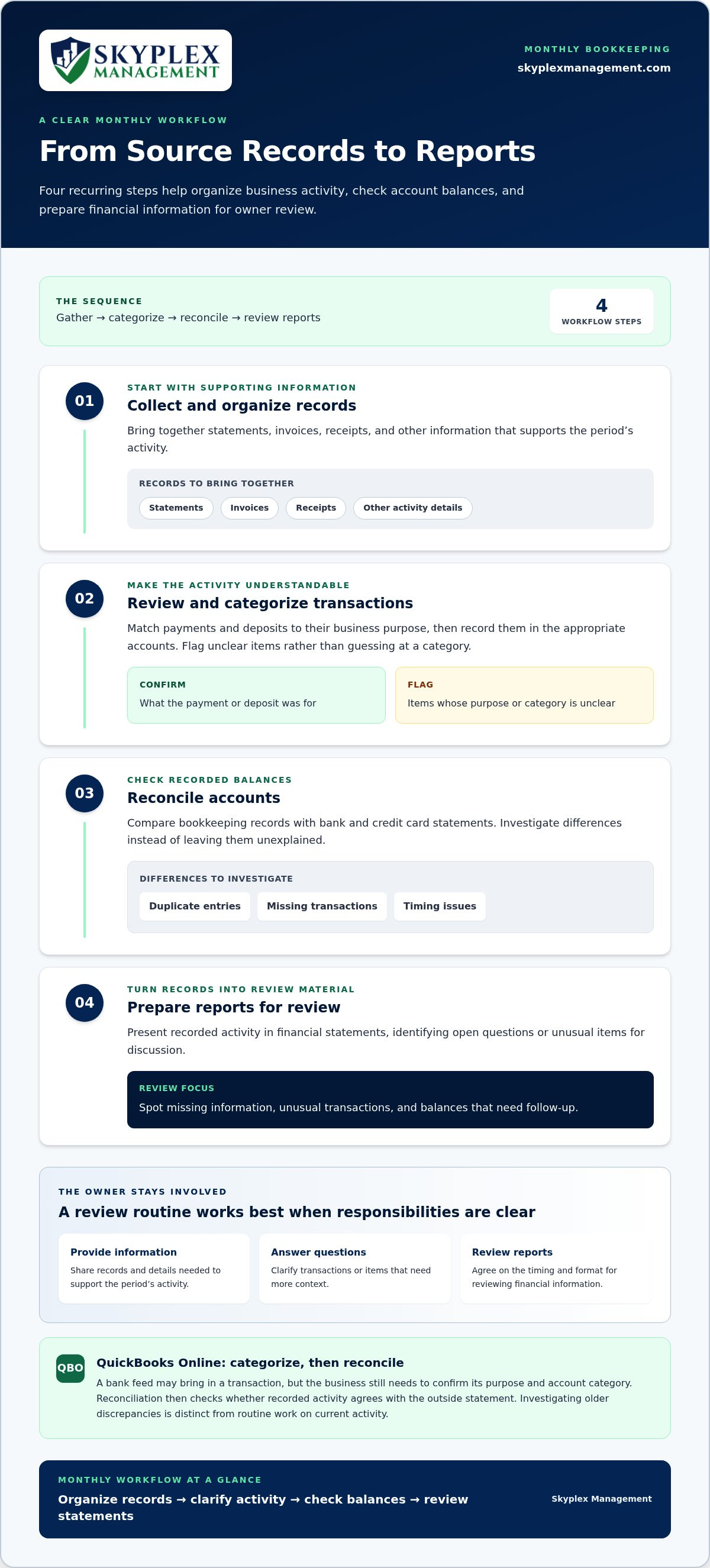
A typical bookkeeping workflow moves from gathering source documents to reviewing recorded activity and preparing reports. The exact tasks depend on the business’s records and needs, so clarify responsibilities and deliverables at the start. A useful monthly review should make it possible to spot missing information, unusual transactions, and balances that need follow-up.
- Collect and organize records: Bring together statements, invoices, receipts, and other information that supports the period’s activity.
- Review and categorize transactions: Match payments and deposits to their business purpose and record them in the appropriate accounts. Flag unclear items rather than guessing at a category.
- Reconcile accounts: Compare bookkeeping records with bank and credit card statements, then investigate differences such as duplicate entries, missing transactions, or timing issues.
- Prepare reports for review: Present the recorded activity in financial statements, with open questions or unusual items identified for discussion.
Owners remain part of the process by providing information, answering questions, and reviewing reports. Agree on the timing and format of that review to fit the business. Skyplex Management’s monthly bookkeeping services support this recurring workflow and help owners stay connected to the information they use to manage operations.
Recurring records work and QuickBooks Online support
In QuickBooks Online, categorization assigns a transaction to the appropriate account, while reconciliation checks whether recorded activity agrees with an outside statement. For example, a bank feed may bring in a transaction, but the business still needs to confirm its purpose and account category. Software support can help keep the file organized and address questions about how transactions are entered or displayed.
Routine work on current activity differs from investigating older discrepancies. If prior periods contain unresolved differences or inconsistent entries, professional QuickBooks reconciliation support can address the historical records as a distinct task.
How payroll and reporting fit alongside bookkeeping
Payroll management involves processing payroll, while bookkeeping records payroll activity in the business accounts. These responsibilities connect, but they are distinct. Skyplex Management provides payroll services alongside bookkeeping and accounting support.
Financial reports present recorded activity for review. An income statement can show revenue and expenses for a period, while a balance sheet shows recorded assets, liabilities, and equity at a point in time. Reports help owners identify patterns and questions for discussion, but they don’t guarantee a particular result or explain every change by themselves. Controller-level oversight adds broader analysis and operational perspective. Cleanup focuses on past records, and tax return preparation or filing is separate from bookkeeping.
Before work begins, clarify which records you’ll provide, who handles payroll responsibilities, how questions will be resolved, and which reports you’ll review. To map the bookkeeping workflow to your business, contact Skyplex Management.
How should you compare outsourced bookkeeping with other support options?
The right setup depends on how much continuity your records need, how much time you can give the process, and whether you need help interpreting reports. Accounting software can organize and store transactions, but it doesn’t replace careful review, reconciliation, or follow-up on unclear entries. Use the comparison below to see where your current approach works and where support may be missing.
| Option | Continuity | Owner time and coordination | Reporting fit |
|---|---|---|---|
| In-house bookkeeping | Ongoing, with continuity tied to staffing. | Requires hiring or assigning staff, sharing records, and reviewing work. | Can support regular reporting when review responsibilities are clear. |
| Software-only workflow | Transactions can be recorded as they occur, but consistency depends on internal upkeep. | The owner or team handles categorization, corrections, and account checks. | Reports reflect entered data, so missing or misclassified activity can limit usefulness. |
| One-time cleanup | Addresses a defined period of past records, not ongoing maintenance. | Requires gathering historical information and resolving questions about older entries. | Can help establish a more organized starting point for future reporting. |
| Ongoing outsourcing | Provides recurring bookkeeping support. | Requires coordination to share records and clarify questions, while shifting routine bookkeeping work away from the owner. | Supports regular review of organized financial information. |
These options can also work in sequence. A business might first address old discrepancies, then maintain current records with a recurring process. For a separate look at how service scope relates to pricing, see this guide to outsourced bookkeeping pricing and support.
Ongoing bookkeeping or a one-time records cleanup?
Cleanup focuses on historical disorganization; monthly bookkeeping maintains current records after that work. For example, a QuickBooks Online file may contain uncategorized transactions, unreconciled accounts, or balances that don’t match statements from earlier periods. Those issues may need investigation before routine monthly work can produce reports the owner can use confidently.
A cleanup doesn’t replace an ongoing process. Once past records are organized, a recurring routine helps prevent a similar backlog from building again. If the books are current and the main need is continued maintenance, monthly support may be the more relevant starting point—whether managed locally or through dedicated services like Blu Bookkeeping that focus on routine, compliant recordkeeping for small businesses.
When bookkeeping needs broader accounting oversight
Bookkeeping records and organizes transactions. Broader accounting and controller-level oversight goes further by examining financial information, helping owners understand patterns, and supporting operational planning. A growing business may need more than a record of expenses; it may need help considering how costs, cash flow, and reporting relate to decisions.
Start with the questions you need answered. If the priority is accurate, organized records, bookkeeping may address the core need. If you also need financial analysis and guidance on operating priorities, broader advisory or controller support may be appropriate. Skyplex Management offers bookkeeping, financial reporting and advisory, and outsourced controller services to help match support to your business needs. Start a conversation about your bookkeeping needs.
How can a small business prepare for outsourced bookkeeping?
A smooth transition starts with a clear picture of what’s working, what’s falling behind, and what you want to understand from your financial records. You don’t need perfectly organized books before getting support. A practical handoff helps outsourced bookkeeping services fit your current workflow and makes it easier to decide who handles each task.
Use this sequence to prepare:
- Identify pain points. Note what takes too long, what gets delayed, and which numbers or reports are difficult to interpret. Separate recurring issues from one-time interruptions.
- Gather available records. Collect recent bank and credit card statements, bookkeeping files, payroll records, and relevant invoices or receipts. Include what you have, even if some records are incomplete.
- Clarify responsibilities. Decide who will provide records, explain unusual transactions, respond to questions, and review reports. Identify payroll or recordkeeping tasks that need separate coordination.
- Agree on review routines. Set a practical way to share information, resolve open questions, and discuss reports. Choose a routine that fits your operating schedule and keeps financial review from being postponed indefinitely.
Organize records and explain the current workflow
Start with the information available: bank and credit card statements, existing QuickBooks Online files, payroll records, and a list of unresolved questions. Note recurring transactions that are hard to categorize, known gaps in records, and how payroll information currently reaches the books. These details help distinguish missing documents from entries that simply need explanation.
For example, an Akron service business might have customer invoices, deposits, and job-related purchases moving through several accounts. A short note explaining how those records are currently collected can help identify where handoffs or gaps occur, without assuming every business needs the same process.
- Account records: Statements and details for the business accounts used for transactions.
- Bookkeeping information: Current files, prior reports, and notes about changes or unresolved items.
- Payroll records: Existing payroll information and a description of how payroll activity is recorded.
- Open questions: Transactions, balances, or categories you want reviewed.
Set clear responsibilities and a useful review cadence
Decide who gathers and shares records, who answers questions about unfamiliar transactions, and who reviews the resulting reports. Keep access to your records and bookkeeping platform so you can remain involved, follow the work, and discuss anything that needs your attention. Tie the review routine to an existing business meeting or another recurring point in your schedule.
As needs expand beyond maintaining records, specialized providers like Patrick Palmedo Accounting can connect bookkeeping with broader financial management. Clear responsibilities and regular conversations help you understand what the records show and where further analysis may be useful.
How does Skyplex Management support outsourced bookkeeping in Northeast Ohio?
Skyplex Management supports small businesses across Northeast Ohio, including Cleveland, Akron, Medina, Hudson, Canton, and Cuyahoga Falls. Its outsourced bookkeeping services connect monthly recordkeeping with QuickBooks Online support and cleanup, payroll, financial reporting, and outsourced controller services. The right combination depends on what your business needs to keep financial information organized and useful.
Match support to the business’s current needs
Different industries create different bookkeeping questions. A construction business may need clear records for income and expenses tied to individual jobs. An auto repair shop may want parts and labor activity recorded in a way that supports review of operating costs. A service business may need customer invoices and business expenses organized to show recorded activity clearly. These examples can help owners identify what they want to track, though the right workflow depends on the business.
For any business, monthly bookkeeping supports current records and reporting. QuickBooks Online cleanup is relevant when historical entries need attention. Payroll support addresses payroll needs, while controller services offer broader financial oversight when owners need help interpreting information or considering operational questions.
Turn organized records into a practical working relationship
Useful support starts with a clear understanding of how your business operates. Sharing how you track jobs, customer work, purchases, and payroll helps connect bookkeeping tasks to the records you rely on. Agree on how documents and questions will be shared, who will respond to requests for context, and which reports you’ll review. Regular owner involvement keeps the information connected to day-to-day decisions.
Skyplex Management works with business owners to align bookkeeping, QuickBooks Online support, payroll, reporting, and controller services with their needs. Organized records and clear communication create a sound basis for understanding business activity, whether you run a construction company, an auto repair shop, or a service business. Skyplex Management serves businesses in Cleveland, Akron, Medina, Strongsville, Brecksville, Hudson, Stow, Cuyahoga Falls, Fairlawn, Brunswick, Wadsworth, North Royalton, Canton, Wooster, Richfield, Macedonia, Broadview Heights, and Solon.
Make your next financial review more useful
The next step doesn’t have to be a major overhaul. Start by choosing one question you want your books to answer more clearly, such as which expenses need closer review or what information would make planning the coming months easier. That gives your bookkeeping process a practical purpose and keeps conversations focused on decisions, not just data entry.
With the right outsourced bookkeeping services, organized records can become part of a steady working rhythm. You stay involved in understanding the numbers while routine financial tasks receive consistent attention. Skyplex Management can help you identify the support that fits your business now and how it may adapt as your needs change.
A clearer view of your finances begins with a useful conversation. Contact Skyplex Management to discuss outsourced bookkeeping services for your business.
Frequently Asked Questions
Is outsourced bookkeeping worth it for a small business?
It can be worthwhile when recordkeeping repeatedly takes time away from serving customers or managing operations. Consider whether you postpone other work to sort transactions, or whether financial questions remain unanswered because records aren’t ready to review. A Cleveland service business, for example, might find support useful when the owner spends regular admin time correcting entries instead of handling scheduling or customer follow-up.
Can I keep using QuickBooks Online with an outsourced bookkeeper?
Yes, you can keep using your existing QuickBooks Online file. Before work starts, agree on how your team and bookkeeper will handle tasks that touch the same records. For example, clarify who enters bills, records customer deposits, and updates transaction descriptions. Shared responsibilities can reduce duplicate entries and make it easier to follow activity in the file.
What records should I gather before outsourcing bookkeeping?
Gather the records that help explain activity in your accounts, including statements, invoices, receipts, payroll information, and existing bookkeeping reports. Organize what you have by account and time period, then flag missing documents rather than trying to fill gaps from memory. A brief note about an unusual deposit or a purchase with an unclear business purpose can help resolve questions more efficiently during review.
Does outsourced bookkeeping include payroll services?
Payroll support can be part of a broader financial relationship, but it should be discussed as a distinct responsibility. Skyplex Management provides payroll services alongside bookkeeping and accounting support. Before work begins, define who handles payroll-related changes, what information needs to be shared, and how payroll activity will be reflected in the business records. Clear ownership helps prevent important steps from being overlooked.
What is the difference between bookkeeping and outsourced controller services?
Choose based on the kind of financial help you need. If your main concern is keeping transaction records organized, bookkeeping may address it. If you’re asking why cash availability changes from month to month or how spending compares across parts of the business, controller-level oversight can provide broader analysis. The goal is to match the level of support to the decisions you’re trying to make.
How do I know whether I need bookkeeping cleanup or ongoing support?
Look at whether your current records can support a useful review. If you can’t explain an account balance or find the records behind older transactions, cleanup may be the first step. If you can review current activity but struggle to keep it up to date consistently, ongoing support may be a better fit. Write down the periods, accounts, or questions causing difficulty to help define the work.
Can an outsourced bookkeeper help my business understand its financial reports?
Yes. Bring specific questions to a report review, such as why an expense category changed or whether a recent purchase is included in the right account. A bookkeeper can help clarify how recorded transactions appear in reports and identify items that need more context. That makes the review more useful than simply receiving statements, while keeping the focus on what the records show and what you may want to investigate further.
Disclaimer
The information provided in this article is for general educational purposes only and should not be considered accounting, tax, or legal advice. Every business is unique. Consult a qualified accounting professional before making financial or tax decisions. Contact Skyplex Management for guidance specific to your business.


