

A buyer can understand a business with a complicated history, but unexplained numbers can make it harder to trust the story behind its performance. Bookkeeping cleanup before selling a business helps connect earnings claims to records a buyer can trace, rather than leaving you to explain unreconciled accounts, personal expenses, or inconsistent reports one question at a time.
Start with the records buyers and their advisors are likely to examine: financial statements, tax returns, account reconciliations, and support for unusual transactions. The goal isn’t to make every year look perfect. It’s to identify gaps, correct errors that can be supported, and document what still needs an explanation.
This checklist will help you prioritize cleanup, organize commonly requested due diligence documents, and understand how bookkeeping support differs from an audit. You’ll find practical steps for reconciling accounts, reviewing classifications, separating business and personal activity, and checking that financial reports agree with the records behind them. A clear process can make diligence questions easier to answer while you continue running the business.
Key Takeaways
- Start bookkeeping cleanup before selling a business by assessing the records you have and working from the most recent closed periods backward.
- Gather financial statements, tax returns, bank and credit-card statements, loan records, payroll reports, and transaction support in one organized place.
- Reconcile key accounts and review revenue, expenses, owner transactions, and unusual items so reported earnings have clear supporting records.
- Document unresolved exceptions and corrections instead of leaving buyers to guess why numbers changed or don’t match.
- Ongoing bookkeeping, payroll, QuickBooks Online cleanup, and financial reporting support can help maintain clearer records as sale preparations continue.
Why bookkeeping cleanup before selling a business matters to buyers
Books built to keep daily operations moving may need attention before a buyer reviews them. Transactions get recorded, bills get paid, and payroll gets processed, but that doesn’t always mean every account is reconciled or every unusual entry is easy to explain. Bookkeeping cleanup before selling a business means correcting supported errors, reconciling account balances, and documenting transactions so the financial records tell a consistent, traceable story.
Buyers use financial statements to understand how a business earns revenue, manages expenses, and performs over time. If reported sales don’t agree with sales records, or expenses shift between categories without a clear reason, a buyer may request an explanation and supporting documents. That doesn’t automatically mean the books are wrong, but gaps can make earnings harder to interpret and add work to the review process.
Cleanup is preparation, not a promise about valuation or a substitute for a buyer’s independent financial diligence. It also isn’t an audit. Bookkeeping organizes and records financial activity; an audit is a separate assurance engagement. The bookkeeping process provides the foundation for financial reports, while a buyer’s advisors may perform their own analysis. Skyplex Management supports owners with small business bookkeeping to help make financial records more organized and understandable.
What buyers need the financial records to show
A useful starting point is traceability. Reported revenue and expenses should connect to underlying records, such as invoices, receipts, deposit details, and payroll reports. Consistent accounting periods matter, too. Comparing the same months or fiscal periods helps a buyer distinguish a recurring pattern from a one-time change, such as seasonal sales or an unusual repair expense.
Buyer requests vary with the business and transaction. For example, in specialized sectors like hospitality—where buyers evaluate opportunities on platforms such as restaurantforsales.com—due diligence often centers on detailed supplier invoices, inventory adjustments, and labor costs. Clear records help you respond with context and documentation instead of relying on memory.
Why clean books matter beyond the income statement
The income statement shows revenue and expenses over a period. Balance-sheet accounts show what the business owns and owes at a point in time. Cash, accounts receivable, inventory, loans, and unpaid bills can all shape a buyer’s understanding of the business’s financial position. If an account balance doesn’t agree with statements or other support, investigate the difference and document the result.
Sale-ready bookkeeping means financial reports can be traced back to organized records, with differences explained rather than left to guesswork. That gives owners a practical way to prepare for questions while keeping the underlying records, not just headline earnings, at the center of the review.
Build a buyer-ready financial records checklist before the sale
A useful due diligence file connects each financial report to the documents behind it. As part of bookkeeping cleanup before selling a business, gather monthly profit-and-loss statements, balance sheets, general ledgers, and available tax returns. Then organize the records buyers may use to understand those figures, including bank and credit-card statements, loan statements, payroll reports, invoices, receipts, and other transaction support.
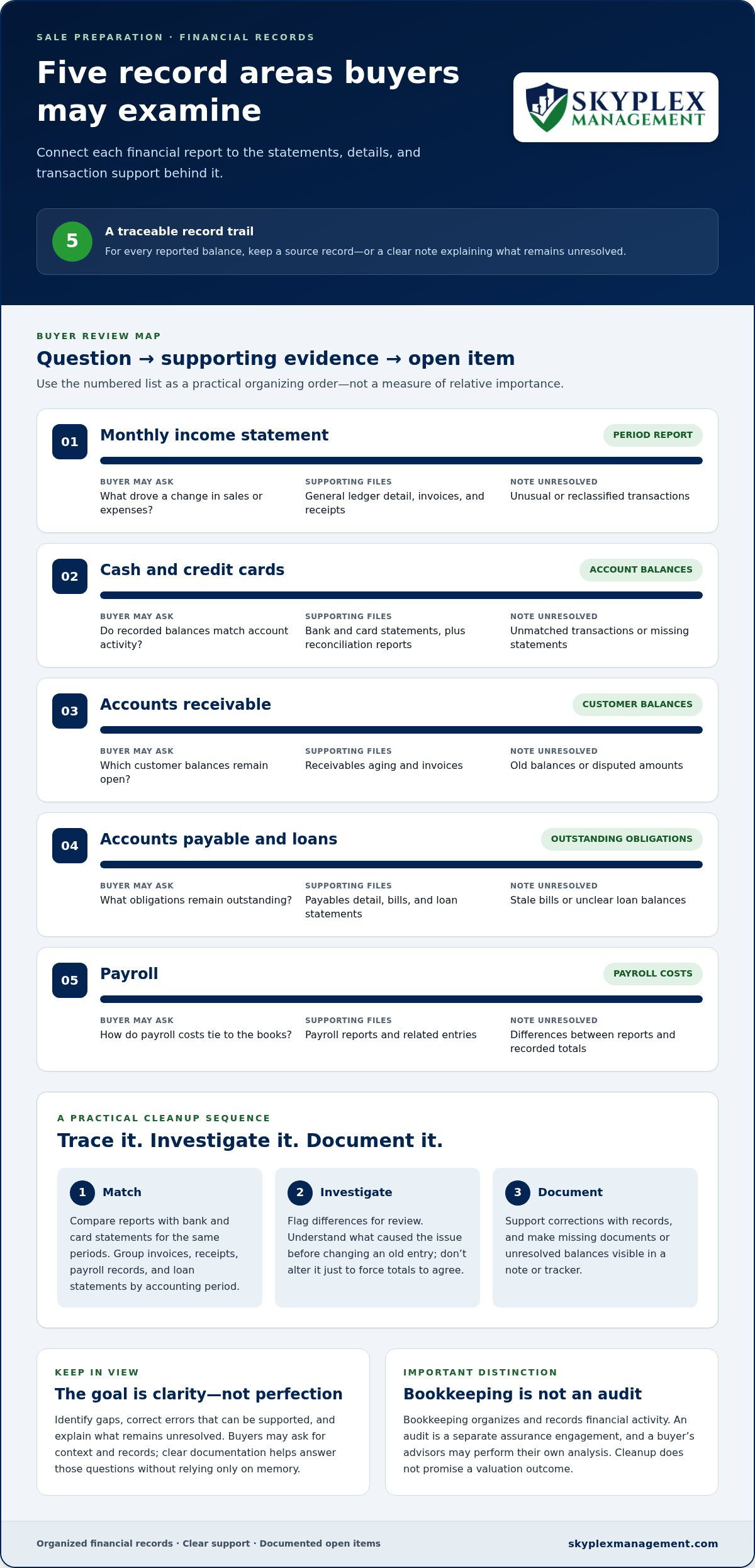
Use a simple tracker to connect likely buyer questions with the records that answer them. Add a note for any unresolved balance or missing document. This makes open questions visible instead of burying them in a folder of files.
| Record category | Buyer question | Supporting file | Unresolved item to note |
|---|---|---|---|
| Monthly income statement | What drove a change in sales or expenses? | General ledger detail, invoices, receipts | Unusual or reclassified transactions |
| Cash and credit cards | Do recorded balances match account activity? | Statements and reconciliation reports | Unmatched transactions or missing statements |
| Accounts receivable | Which customer balances remain open? | Receivables aging and invoices | Old balances or disputed amounts |
| Accounts payable and loans | What obligations remain outstanding? | Payables detail, bills, loan statements | Stale bills or unclear loan balances |
| Payroll | How do payroll costs tie to the books? | Payroll reports and related entries | Differences between reports and recorded totals |
Checklist rule: Every reported balance should have a traceable source or a clear note explaining what remains unresolved.
Match financial reports to source records
Compare bookkeeping reports with bank and credit-card statements for the same periods. Keep invoices, receipts, payroll records, and loan statements grouped by accounting period. If a report doesn’t match its support, flag the difference for investigation. Don’t silently change an old entry to force the totals to agree. First understand the issue, then document the correction and its support.
Create a clear, secure diligence file structure
Organize files by year, then by account or category, using consistent names that make periods easy to identify. Keep a request log with each buyer request, the person responsible, status, and response date. Before sharing files, limit access to relevant information and protect confidential employee and customer details through appropriate redaction or restricted files.
A tidy folder system is most useful when the underlying bookkeeping is current and consistent. Skyplex Management’s bookkeeping support can help organize financial records and reporting as sale preparation progresses. To discuss help sorting records or addressing gaps, contact the team.
Reconcile accounts, classify transactions, and explain earnings clearly
Once key records are assembled, check that account balances and transaction categories support the financial reports. Reconcile bank, credit-card, loan, and other material balance-sheet accounts through the latest closed period. A reconciliation compares the bookkeeping records with an independent statement or supporting schedule. It can help identify missing entries, duplicates, and timing differences.
Next, review revenue timing, expense categories, duplicate entries, owner transactions, and unusual items. A payment recorded twice can overstate expenses, while a personal charge left in business expenses can distort operating costs. Don’t recategorize an item just to improve reported earnings. Confirm what happened, retain the support, and document any correction.
| Item type | How to handle it | What to retain |
|---|---|---|
| Bookkeeping correction | Correct a supported error, such as a duplicate entry or a transaction posted to the wrong account. | Original entry, source document, correction details, and reason |
| Documented unusual expense | Describe the transaction factually without assuming a buyer will exclude it from earnings. | Invoice or receipt, business purpose, accounting period, and relevant explanation |
| Unresolved item | Keep it visible for follow-up rather than forcing a classification or adjustment. | Known details, missing support, and the question requiring review |
Resolve reconciliations and balance-sheet questions
Investigate unreconciled differences and old balances before producing updated reports. Compare receivables, payables, loans, and payroll liabilities with available statements, aging reports, and payroll records. A stale customer balance, for instance, may reflect a payment applied incorrectly or an amount that still needs follow-up. For QuickBooks Online files, Skyplex Management’s bookkeeping support can help owners work through historical records and account cleanup.
Document owner expenses and potential add-backs carefully
Separate personal and business activity only when the records support a clear classification. For each potential add-back, note the transaction, business purpose, period, and available evidence. An owner-related or unusual expense isn’t automatically an accepted adjustment. Bookkeeping can organize and describe the underlying transaction, while a buyer or transaction professional assesses whether an adjustment is appropriate.
Keep supporting documents with a short explanation, and make sure the explanation agrees with the accounting entry. If the purpose or classification is uncertain, flag it for review rather than presenting it as settled. Careful bookkeeping cleanup before selling a business makes reported earnings easier to follow without overstating what the records prove.
Prioritize bookkeeping cleanup before buyer due diligence begins
A clear order helps you make progress without trying to fix every historical issue at once. Start with the most recent closed periods, then work backward. Recent records are often the first ones needed to discuss current performance. Reviewing earlier periods can show whether a discrepancy is isolated or recurring. Bookkeeping cleanup before selling a business is more manageable when you track and prioritize each issue instead of handling it from memory.
- Assess the records. Identify which periods are closed, which reports are available, and where statements or transaction support are missing.
- Reconcile accounts. Compare key bank, credit-card, loan, and balance-sheet accounts with supporting records. List differences that need investigation.
- Correct classifications. Fix supported errors, such as duplicate entries or transactions posted to the wrong account, and retain the reason for each correction.
- Document exceptions. Separate completed corrections from open questions, missing documents, and balances that need an explanation.
- Package the files. Organize updated reports and support by period and category, and keep a log of outstanding requests.
If the sale timeline is short, prioritize the latest closed periods, material balances, and records that directly support reported revenue and expenses. Mark unresolved items clearly and identify what evidence or follow-up is needed. Some historical issues take time to research, so don’t present an unverified correction as final just to complete a file.
Set a realistic cleanup order and track open items
Use an issue list with the account, period, discrepancy, person responsible, and next action. For example, an old payable might need a vendor statement, while a bank difference may require tracing a deposit to its source. Close each item with a supported correction, or retain it as an explained exception. A consistent monthly close process helps keep new periods current while older records are reviewed.
Coordinate bookkeeping with tax and transaction professionals
Bookkeeping support organizes and documents records; it doesn’t replace an audit, legal advice, or transaction-specific analysis. Tax treatment can depend on the facts of the sale and the business. For Ohio tax questions, refer to a qualified tax professional and relevant Ohio Department of Taxation guidance. For federal matters, use IRS guidance or consult a qualified tax professional. A bookkeeper can make financial information easier to review, while tax and transaction professionals address questions within their roles.
Skyplex Management provides bookkeeping and QuickBooks Online cleanup to help small businesses organize historical records and maintain clearer financial reporting. Owners who need a structured approach can explore bookkeeping support as part of preparing their records.
Prepare Northeast Ohio business records with ongoing bookkeeping support
Historical records can be difficult to organize while you’re also running the business. Skyplex Management helps small businesses with bookkeeping and QuickBooks Online cleanup, including organizing past activity and improving the clarity of financial records. For an owner in Cleveland, Akron, or Medina, that support can create a more consistent working file without suggesting that cleanup guarantees a particular buyer response or sale outcome.
Cleanup may be useful if bank accounts remain unreconciled, transactions have been classified inconsistently, or monthly reports are delayed or incomplete. In QuickBooks Online, historical data cleanup can help address issues in prior periods so updated reports are based on better-organized records. For example, a business might need to investigate old balances, correct supported coding errors, or identify missing documentation before relying on a report to explain performance.
When professional bookkeeping cleanup can help
Professional support can bring structure to a scattered cleanup effort: determine which periods and accounts need attention, review available source records, and keep a clear record of corrections and items still requiring follow-up. This can be especially useful when owners have inherited inconsistent bookkeeping or need help understanding how past transactions flow into current reports. Skyplex’s QuickBooks Online support and historical data cleanup can help make those records easier to review.
If your QuickBooks file has accumulated old entries, duplicate transactions, or unclear account balances, a methodical review can help identify what needs correction and what requires an explanation. The goal is accurate, supportable records, not simply a polished-looking report.
Keep financial records clear after the cleanup
Cleanup is a starting point. Monthly bookkeeping helps maintain reconciliations and consistent financial reports, reducing the chance that new months add to the same backlog. Payroll Services can help keep payroll activity organized alongside bookkeeping, while Outsourced Accounting & Controller Services provide ongoing accounting oversight. Regular financial reporting gives owners a clearer view of operating activity as preparations continue.
Some owners need more context than standard reports provide. Financial Reporting & Advisory support can help organize information around the questions an owner needs to manage the business, while keeping the underlying records available for review. That routine supports clearer decisions and a more orderly financial file, whether a sale process is underway or still being considered.
For help maintaining reconciliations and consistent reports after cleanup, explore Skyplex bookkeeping services. A steady bookkeeping process can keep financial information current and easier to explain as the business changes.
If you’d like to talk through your records and next steps, discuss bookkeeping cleanup with Skyplex Management.
Take the Next Step Toward Sale Preparation
You don’t need to solve every historical bookkeeping question before making progress. Choose a practical starting point, such as the most recent closed period or the account creating the most uncertainty, then build from there. A steady, well-documented process can make the work more manageable and help you stay focused on running the business.
Bookkeeping cleanup before selling a business is also a chance to create a clearer financial routine for the months ahead, not just assemble records for a single review. If you’d like help deciding where to begin or organizing the work around your current records, Skyplex Management can help you plan a practical path forward.
With a thoughtful first step and the right support, you can move toward sale preparation with greater clarity and confidence.
Frequently Asked Questions
What financial records do buyers usually request during due diligence?
Buyers commonly request financial statements, tax returns, bank records, payroll information, debt details, and accounts-receivable and accounts-payable schedules. Requests vary by transaction, and a buyer or advisor may ask for additional records based on the company’s operations. Organize files by accounting period and retain supporting documents, such as invoices behind major sales or loan statements that explain debt balances. Clear filenames make it easier to locate a requested period without searching through unrelated files.
How many years of bookkeeping should I clean up before selling my business?
There isn’t one fixed number of years that fits every sale. The buyer’s requests and transaction context shape the review window, so don’t assume that cleaning up a particular period will satisfy due diligence. Start by making recent closed periods internally consistent, then organize the available historical records. If older records are incomplete, note which periods have gaps and discuss the cleanup scope with your transaction professionals before deciding where to focus next.
Do I need to switch from cash-basis to accrual-basis accounting before a sale?
Not automatically. The appropriate accounting method depends on the business, its records, and buyer expectations. Cash-basis records generally reflect cash received and paid, while accrual-basis records also account for revenue earned and expenses incurred before payment. Changing methods can affect how revenue, expenses, receivables, and payables appear across periods. Before making a change, discuss the reporting and tax implications with the company’s tax and transaction professionals.
Can bookkeeping cleanup make a buyer accept every seller add-back?
No. Cleanup can organize the records behind a proposed add-back, but it can’t determine whether a buyer will accept it. For each item, retain the transaction details, business purpose, period, and available evidence. For example, a receipt and explanation may help clarify an unusual expense, but they don’t establish that it should be excluded from earnings. The buyer and their advisors assess whether an adjustment is appropriate during due diligence.
What should I do if my QuickBooks records are incomplete before a sale?
First identify which periods are missing, which accounts haven’t been reconciled, and what source documents aren’t available. Preserve the existing records and list open questions rather than entering unsupported estimates to fill gaps. Historical QuickBooks cleanup can help organize what is available and clarify account activity. Document unresolved gaps, including what information is missing. The scope and priority of the work depend on the records and the seller’s timeline.
Can my bookkeeper perform a financial audit for a business sale?
Bookkeeping cleanup and an audit are different services. A bookkeeper can organize records, reconcile accounts, correct supported entries, and prepare financial reports. An audit is an assurance engagement performed under applicable professional standards by an appropriately qualified provider. If a buyer requests an audit or other assurance work, clarify the request with your transaction advisors and engage a suitable professional. Bookkeeping support can help organize the records used in that separate review.
How can a Northeast Ohio small business keep its books ready for a future sale?
Make record maintenance part of the regular operating routine: close each period consistently, retain support for transactions, and investigate unexplained changes in reports. This can help owners avoid rebuilding records under time pressure. Skyplex Management supports small businesses across Northeast Ohio, including Cleveland, Akron, Medina, Strongsville, Brecksville, Hudson, Stow, Cuyahoga Falls, Fairlawn, Brunswick, Wadsworth, North Royalton, Canton, Wooster, Richfield, Macedonia, Broadview Heights, and Solon, with bookkeeping and financial reporting support. Regular attention to the books can make it easier to explain financial activity when a buyer begins asking questions.
Disclaimer
The information provided in this article is for general educational purposes only and should not be considered accounting, tax, or legal advice. Every business is unique. Consult a qualified accounting professional before making financial or tax decisions. Contact Skyplex Management for guidance specific to your business.


