

What if the lowest accounting quote leaves you paying extra for the work your business actually needs? If you’re asking how much do outsourced accounting services cost, the answer depends on what’s included, how complex your finances are, and how much oversight you need.
It’s reasonable to want a clear number for your monthly budget. But online price ranges often compare different services, from routine transaction recording to payroll, financial reporting, and controller-level guidance. Without a defined scope, a low quote and a higher quote may not cover the same work.
This guide explains the business factors that shape outsourced accounting fees and how to compare service scopes, deliverables, and billing structures. You’ll see how bookkeeping, payroll, QuickBooks Online support, reporting, and controller services address different needs, with examples relevant to construction, auto repair, and service-based businesses. You’ll also learn what to gather before discussing your needs with a Northeast Ohio accounting partner, so you can build a practical budget around the support that fits your business.
Key Takeaways
- There’s no reliable one-size-fits-all answer to how much do outsourced accounting services cost. Define the work and level of support before comparing fees.
- List transaction volume, accounts, locations, and reporting needs to clarify the workload behind a tailored scope.
- Compare fixed recurring, hourly, project-based, and transaction-based pricing by how each measures work and handles changes in workload.
- Separate essential monthly bookkeeping or payroll from one-time QuickBooks cleanup and optional reporting or controller support when planning your budget.
- Prepare a task list, work frequency, current pain points, and reporting goals to make a pricing conversation with Skyplex Management more useful.
How much do outsourced accounting services cost when every business is different?
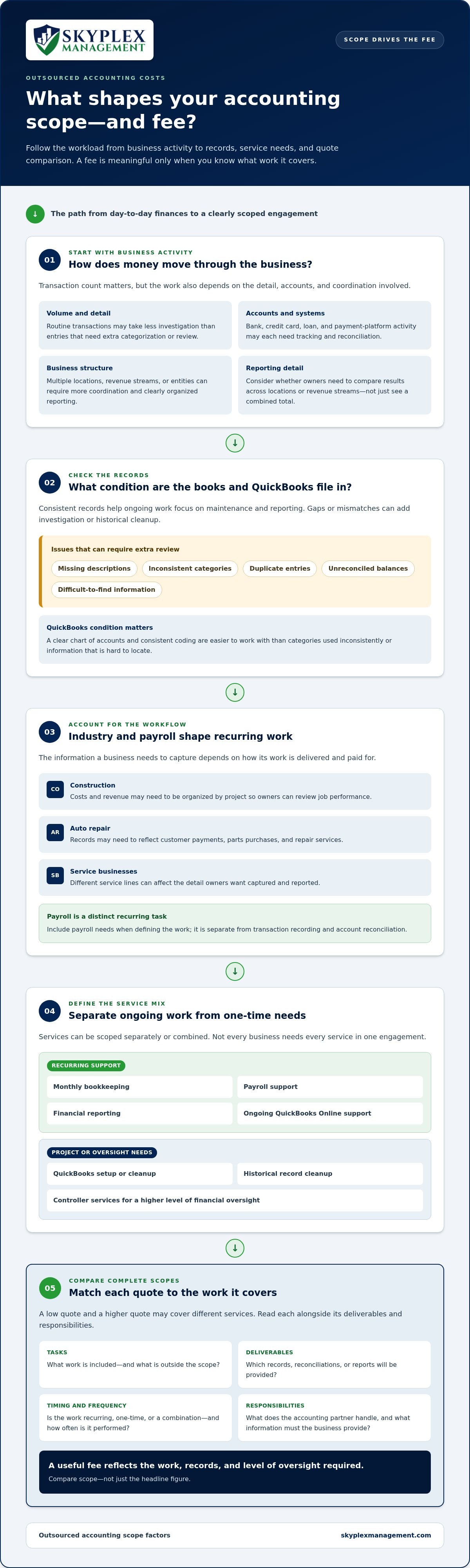
There’s no single reliable fee for outsourced accounting without first defining the business’s workload and the support it needs. The answer to how much do outsourced accounting services cost depends on the work being delegated, how often it’s performed, the condition of the records, and the level of review or guidance expected. A quote is meaningful only when you can see what work it covers.
Cost in brief: Scope, complexity, record quality, and service frequency shape an outsourced accounting engagement. Compare the tasks, deliverables, timing, and responsibilities behind a fee, not just the headline figure.
What does an outsourced accounting engagement cover?
Outsourced accounting means delegating some or all of a business’s financial work to an outside accounting partner. That work can range from recording transactions and reconciling accounts to preparing reports and providing oversight. Bookkeeping organizes and maintains financial records, while broader accounting oversight reviews those records and helps interpret what they say about the business. The IRS business recordkeeping guidance offers a useful reference for understanding the records businesses need to maintain.
Services can be scoped separately or combined based on the business’s needs. Monthly bookkeeping can keep transactions and account balances organized. Payroll support handles a different recurring task, while financial reporting turns the records into information owners can use to understand performance. QuickBooks Online support can help with setup or ongoing use, and cleanup can address historical records that need attention. Controller services add a higher level of financial oversight.
Not every business needs every service in one engagement. An owner with reliable books may need regular reporting, while a business with disorganized historical records may first need a cleanup project before routine monthly work can run smoothly. Small business accounting support can be tailored around the tasks and oversight a company needs.
Why generic price ranges can mislead small businesses
Two businesses with similar revenue can have very different accounting workloads. One might have a straightforward flow of sales and expenses. Another might manage multiple locations, revenue streams, payroll, inventory, or more detailed reporting. The coordination and review required can differ even when revenue looks similar.
Record condition also affects the work. If transactions are consistently categorized and accounts reconciled, the engagement can focus on maintaining accurate records and producing reports. If past transactions are missing or accounts don’t reconcile, historical cleanup may be needed before ongoing bookkeeping can provide dependable information. Treating both situations as the same scope can make two quotes seem comparable when they cover different work.
A useful accounting fee reflects the work, records, and level of oversight required, not a headline figure in isolation. Read each quote alongside its deliverables, service frequency, and division of responsibilities. Clarify what the accounting partner handles, what information the business provides, and whether the proposed work is recurring, one-time, or a combination. Those details give owners a practical basis for comparing engagements and planning support that fits.
Which business factors change outsourced accounting fees?
The effort behind accounting support depends on how financial activity moves through a business and how much detail owners need to see. Transaction volume matters, but it doesn’t tell the whole story. A large number of routine sales can be easier to process than fewer transactions that require investigation, separate categorization, or review across several accounts.
Account structure affects the workflow, too. Each bank, credit card, loan, or payment platform may need to be tracked and reconciled. If transactions flow through different systems, the bookkeeping process may involve more coordination to capture activity consistently. Multiple locations, revenue streams, or entities can also call for reports organized so owners can compare results instead of seeing only a combined total.
How records, transactions, and QuickBooks condition affect the scope
Record quality affects how much review is needed to understand the numbers. Missing descriptions, inconsistent categories, duplicate entries, or balances that don’t match supporting statements can create questions that require investigation. QuickBooks condition matters, too. A file with a clear chart of accounts and consistent coding is easier to work with than one where categories have been used inconsistently or key information is difficult to locate.
To describe the workload, identify which accounts connect to the books, how transactions are recorded, and where reports or balances have been difficult to interpret. Skyplex Management provides small-business accounting support tailored to the records and processes involved.
How industry and payroll needs shape recurring work
Industry workflows affect what information the accounting process needs to capture. A construction company may want costs and revenue organized by project to review how jobs are performing. An auto repair shop may need records that reflect customer payments, parts purchases, and repair services. A service business may have several service lines, each with different revenue or expense patterns. Those details influence how records are organized and reviewed.
Payroll adds another workflow to consider. The number of employees, how payroll information is gathered and approved, and the reports management wants all affect the work involved. A useful scope accounts for the business’s actual process rather than assuming every payroll workflow is alike.
A contractor in Medina and a repair shop in Akron may both need accounting support, but their project tracking, transaction patterns, and reporting priorities can differ. Mapping those workflows makes the scope specific without assuming businesses in the same community have identical needs.
Which outsourced accounting pricing models should you compare?
Billing models shape how work is measured and how changes are handled. Compare each approach by its boundaries: what starts the work, what counts as completion, and how requests outside the agreed scope are treated.
| Approach | How the work is measured | Where boundaries matter |
|---|---|---|
| Fixed recurring | A defined group of repeating tasks and deliverables over an agreed service period. | Clarify which tasks are included and how a change in responsibilities affects the scope. |
| Hourly | Time recorded for assigned work. | Set expectations for approvals, updates, and requests that extend beyond the original task. |
| Project-based | A specific assignment with a stated starting point and completion criteria. | Define the expected deliverables and how newly discovered work will be handled. |
| Transaction-based | A count of transactions processed during a specified period. | Clarify what qualifies as a transaction and how review or exceptions are treated. |
Recurring monthly support versus project-based cleanup
Recurring arrangements are designed around work that continues on a regular cycle, while project-based arrangements define a particular assignment and its endpoint. For example, an owner might want ongoing bookkeeping as a consistent part of the operating routine, then separately define a historical records project with its own deliverables. Skyplex Management’s bookkeeping services can be scoped around the ongoing tasks a business wants handled.
To keep the boundaries clear, specify which reporting or review tasks repeat, what information the business provides, and how additional requests are addressed. For a project, describe the intended result and how decisions about work beyond that result will be made. This helps distinguish a change in scope from an ordinary part of the agreed work.
Hourly, fixed-scope, and transaction-based arrangements
Hourly billing ties the work to time recorded, which can suit requests that are difficult to define fully in advance. Understand how time is documented and how new work is approved. A fixed-scope arrangement sets out deliverables and limits ahead of time, so clarity depends on describing the work precisely and agreeing on how changes are handled.
Transaction-based arrangements use volume as the measure, but a count alone may leave important questions unanswered. Clarify whether the count refers to individual entries, batches, or another agreed unit, and how unusual items are treated. A straightforward count can help define activity, but it doesn’t automatically describe the review or reporting expected alongside it.
Before comparing approaches, write down the unit of work, expected deliverables, scope boundaries, and process for additional requests. That makes each model easier to assess against your workflow without assuming one billing structure is automatically the best fit. For instance, dedicated accounting partners like Proledger demonstrate how transparent service scopes across bookkeeping, tax compliance, and business advisory help startups and SMEs avoid billing surprises.
How can you build a realistic outsourced accounting budget?
A useful budget starts with the work your business needs, not a guessed monthly amount. Write down what happens regularly, what’s currently falling behind, and what information you need to make decisions. This turns the question of how much do outsourced accounting services cost into a practical scope conversation, without treating every business as if it needs the same package.
A four-step scope worksheet for owners
Use this worksheet to organize your needs before comparing proposals. Keep recurring work separate from cleanup or advisory requests so the ongoing budget remains clear.
- List the work. Note monthly bookkeeping, payroll, QuickBooks support, financial reports, and any advisory work you want to discuss. Mark each task as essential, optional, or one-time.
- Set the frequency. Record how often each task needs attention, such as recurring bookkeeping or reports prepared on a regular schedule. Include seasonal changes that affect your workflow.
- Describe current pain points. Note unreconciled accounts, delayed reports, confusing QuickBooks records, or information you can’t easily find. Describe the issue rather than guessing what it will cost to fix.
- Assign responsibilities. Identify who provides statements and other records, who approves payroll information, and who reviews reports. Clear handoffs help define the work and reduce avoidable delays.
This process also helps separate ongoing support from a one-time effort to organize historical records. For bookkeeping-focused cost considerations, explore this outsourced bookkeeping pricing guidance alongside the broader scope factors discussed here.
How to evaluate value beyond the monthly amount
Compare proposals against the same worksheet. Look at which tasks are included, how often deliverables arrive, who is accountable for each step, and how changes to the scope are handled. Consider whether the support provides consistent records and reports you can use, and which tasks you or your team currently spend time managing.
For example, an auto repair shop in Akron may need a clear view of service revenue, parts purchases, and operating expenses to understand its financial activity. If records arrive late or are difficult to review, the owner may have less timely information for routine decisions. A service business in Cleveland may have different workflows and reporting priorities. In either case, useful support depends on matching the work and reporting to the business, not assuming every local company needs the same scope.
A proposal is easier to assess when it explains deliverables, responsibilities, communication, and the process for addressing work outside the original scope. If those details are unclear, the headline amount alone won’t tell you what the business will receive.
How does Skyplex Management tailor outsourced accounting support?
Skyplex Management works with small businesses across Northeast Ohio to match accounting support to the tasks, records, and financial visibility each owner needs. A business in Medina may need consistent monthly bookkeeping, while a growing company in Hudson may also want clearer reporting or controller-level oversight. The right scope starts with the work itself, not a standard package or an assumption that every business needs the same services.
That practical approach also helps answer how much do outsourced accounting services cost for your business: identify what needs to be handled, how often, and what you want to understand from your financial information. Once the work is clear, it’s easier to shape a scope that supports day-to-day operations and planning.
Match the level of support to the work your business needs
Monthly bookkeeping keeps financial records organized as business activity continues. Payroll supports a separate operational function, while financial reporting helps owners review performance and make decisions. QuickBooks Online support and cleanup can address software or historical-record needs. These services can be considered individually or combined in a broader accounting engagement, depending on the business’s priorities.
Some businesses also benefit from higher-level accounting oversight. Controller and advisory support can help owners review financial information, understand trends, and consider cash flow or other business decisions. Practices such as Stewart Private Accounting illustrate how professional advisory support can assist business leaders with strategic guidance and tax planning alongside routine reporting. This level of support may suit a company that has routine transaction processing covered but needs stronger financial review. A contractor in Canton, for example, may want to understand project performance, while a service business in Cuyahoga Falls may prioritize revenue and expense reporting. The useful scope depends on the decisions the owner needs to make.
Prepare for a practical accounting conversation
A short preparation list can make a discussion with an accounting partner more productive. Bring a summary of your current QuickBooks records, note any reporting concerns, and identify recurring tasks that take time or regularly fall behind. You don’t need to solve every bookkeeping issue before discussing it. A clear description of what’s happening is a helpful starting point.
- List the tasks: Include bookkeeping, payroll, QuickBooks support, reporting, and any advisory needs.
- Describe the current records: Note whether accounts are reconciled and whether historical activity needs attention.
- Name the decisions: Explain what you want reports to help you understand, such as cash flow, operating costs, or business performance.
With those details, Skyplex Management can discuss how the work can be organized around your actual needs. Skyplex serves small businesses in Cleveland, Akron, Medina, Strongsville, Brecksville, Hudson, Stow, Cuyahoga Falls, Fairlawn, Brunswick, Wadsworth, North Royalton, Canton, Wooster, Richfield, Macedonia, Broadview Heights, and Solon. A conversation can help clarify which tasks belong in ongoing support and which call for separate attention.
Turn your accounting needs into a clear next step
A practical budget is more than a line in your expenses. It’s a way to decide which financial tasks you’re ready to hand off and what information would help you lead with greater confidence. Once you’ve identified those priorities, you can have a more focused conversation about how much do outsourced accounting services cost for the scope your business actually needs.
Skyplex Management works with small businesses across Northeast Ohio, including Cleveland, Akron, and Medina. The discussion can start with the work that feels most pressing, from ongoing bookkeeping to QuickBooks Online support and historical cleanup. You don’t need every detail resolved before taking that step. A clear picture of your records, current workload, and goals is enough to begin shaping a practical path forward.
With the right support in place, you can spend less time carrying the financial workload alone and more time moving your business forward.
Frequently Asked Questions
How much do outsourced accounting services cost for a small business?
There isn’t one standard fee for every small business. How much do outsourced accounting services cost depends on the scope, record condition, transaction workload, payroll needs, reporting, and level of oversight. A business with current records may need a different engagement from one facing a backlog. Compare defined deliverables and recurring responsibilities, then discuss your workload and priorities with Skyplex Management to clarify a suitable scope.
What factors affect the cost of outsourced accounting services?
The work involved depends on transaction volume, account complexity, payroll needs, reporting frequency, software condition, and whether records need cleanup. These factors change the tasks and review required rather than adding up to a universal pricing formula. For example, a construction company may track activity by job, an auto repair shop may handle parts and service transactions, and a service business may need reports organized around distinct revenue streams.
Is outsourced accounting cheaper than hiring an in-house accountant?
It depends on the role, workload, benefits, management time, and expertise your business needs. An in-house position may cover duties beyond bookkeeping, while an outsourced scope may focus on specific financial tasks or oversight. Compare the full responsibilities, continuity of support, and internal time required, not just compensation or a service fee. Consider which responsibilities your business would otherwise assign to an employee and what level of financial guidance it needs.
Can a small business outsource bookkeeping and keep accounting decisions in-house?
Yes. A business can delegate recordkeeping while keeping control of approvals, spending choices, and other management decisions. Bookkeeping organizes financial activity, and reporting helps you review it. Advisory support can be scoped separately if you want help interpreting trends. Skyplex Management supports small businesses with bookkeeping and accounting services. Describe the tasks you want to hand off and the decisions you prefer to retain to define a workable division of responsibilities.
What is usually included in outsourced accounting services?
Depending on the engagement, outsourced accounting can include bookkeeping, account reconciliations, payroll, financial reporting, QuickBooks support, or controller-level oversight. A business might need only a subset, such as bookkeeping and reports, rather than every service. Historical cleanup or catch-up work may be scoped separately from routine recurring tasks. Review the actual deliverables, how often they’re provided, and who handles each responsibility instead of assuming a service is automatically included.
Do outsourced accounting services include QuickBooks cleanup?
QuickBooks cleanup can be scoped as focused work on historical records, distinct from maintaining current books each month. For instance, past periods may contain unreconciled accounts or incomplete transaction details that need review. Skyplex Management provides QuickBooks Online support and cleanup for small businesses. If you’re identifying common record issues, this guide to fixing messy QuickBooks records offers a useful starting point for describing what you’re seeing.
How do I compare outsourced accounting quotes without choosing the cheapest option?
Compare each scope against the same needs: services, report frequency, payroll responsibilities, cleanup work, communication, and how additional requests are handled. A lower headline amount may cover fewer tasks, while a broader scope may include work your business doesn’t currently need. Check whether the proposed deliverables address your workflow and reporting priorities. A clear match between responsibilities and business needs is more useful than ranking quotes by price alone.
Disclaimer
The information provided in this article is for general educational purposes only and should not be considered accounting, tax, or legal advice. Every business is unique. Consult a qualified accounting professional before making financial or tax decisions. Contact Skyplex Management for guidance specific to your business.


