

The lowest bookkeeping quote isn’t always the least expensive option. Monthly bookkeeping fees 2026 can differ because one estimate may cover account reconciliations and routine reports, while another includes more hands-on oversight. The headline number tells only part of the story.
If you’re comparing estimates, it’s reasonable to want a clear monthly cost and know exactly what you’ll receive. The fee depends on factors such as transaction volume, the number of accounts, the condition of your records, and whether payroll, cleanup, or more detailed reporting is included. These services affect the scope, so don’t assume they come with every bookkeeping engagement.
This guide explains what shapes a monthly fee, how to compare service descriptions, and what to gather before discussing your needs with a bookkeeping firm. It also covers how accurate monthly records support useful financial reporting and when QuickBooks Online cleanup or outsourced accounting support may help. Skyplex Management provides bookkeeping and accounting services for small businesses in Northeast Ohio, including Cleveland, Akron, Medina, Hudson, and Canton.
Key Takeaways
- Monthly bookkeeping fees 2026 depend on the work involved, so compare service scope instead of relying on a headline figure.
- Transaction activity, account count, reconciliation needs, and record condition help define the work your business needs.
- Compare hourly, fixed monthly, and project-based billing by how each handles changing workloads and one-time cleanup.
- Gather recent transaction patterns, account lists, payroll needs, and reporting priorities before discussing your requirements.
- Bookkeeping, QuickBooks Online support, payroll, and financial reporting can work together, but each service should have a clear scope.
Monthly bookkeeping fees in 2026: why one figure rarely fits every business
A recurring bookkeeping fee covers an agreed set of ongoing work. That may include organizing financial activity, recording transactions, reconciling accounts, and maintaining usable records. The exact scope matters: two businesses may both need monthly bookkeeping but require different amounts and types of support.
A headline figure is useful only when you know what it covers. A business with a steady flow of transactions and organized records has different needs from one with multiple payment channels, several accounts, or months of incomplete entries. Compare the work behind each estimate, not just the fee.
What does a monthly bookkeeping fee usually represent?
A monthly bookkeeping fee is a recurring charge for maintaining a business’s financial records and providing the related support agreed upon with that business. The scope may include recording activity and reconciling accounts, which means matching records against bank or credit card statements. For a basic overview of the work, see What is Bookkeeping?
Reporting, payroll, historical cleanup, and financial advisory may have separate scopes. Bookkeeping maintains the records; tax preparation uses financial information for tax filings, while audits and broader advisory work have different purposes. Clarify the deliverables so you know what the recurring work is intended to accomplish.
Why a published average may not fit your business
Published estimates for monthly bookkeeping fees 2026 can offer general context, but they aren’t a quote for your business or a reliable local benchmark on their own. Figures may reflect different provider types, business profiles, and definitions of “bookkeeping.” An estimate based on a different market or service model can’t account for your records, workflow, and support needs in Northeast Ohio.
Consider two businesses in the same community. A service company that receives payments through a few channels and maintains orderly records has different needs from a contractor handling more accounts and project-related activity. Even businesses in the same industry can differ if one has current, organized books and the other needs earlier records corrected before routine monthly work can begin.
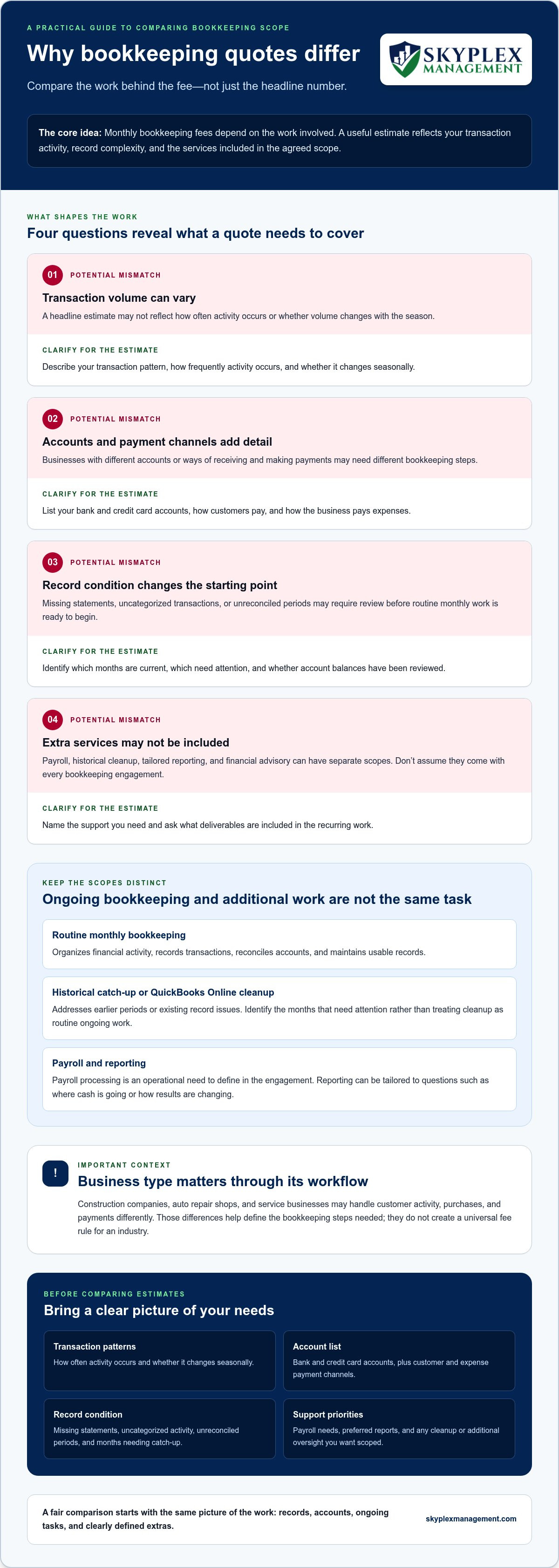
- Transaction pattern: Note how frequently activity occurs and whether volume changes with the season.
- Accounts and payment channels: List bank and credit card accounts, plus the ways customers pay and the business pays expenses.
- Record condition: Identify missing statements, uncategorized transactions, or periods that haven’t been reconciled.
These details connect a pricing conversation to the actual work. For Northeast Ohio businesses seeking monthly bookkeeping support, a clear description of records and priorities is a better starting point than an estimate that may reflect a different market.
What drives monthly bookkeeping fees: volume, complexity, and service scope
A fee reflects the effort needed to keep records accurate and the level of support agreed upon. Transaction count is one factor, but it doesn’t tell the whole story. The number of accounts, how payments move through the business, the condition of the records, and the reporting or oversight requested can all affect the work.
Monthly bookkeeping fees are shaped by transaction volume, record complexity, and the specific services included in the agreed scope. Understanding those factors helps you explain what your business needs instead of relying on a rough comparison with another company.
How transaction volume and record condition affect the work
Each account and payment channel can create activity that needs to be organized and checked. The effort depends on how much activity needs review, whether entries are complete, and how readily questions about unusual or unmatched items can be resolved.
A business that regularly provides complete records may be ready for routine monthly work. If records arrive late or transactions remain uncategorized, extra review may be needed to establish what happened before the books can be brought up to date.
Routine bookkeeping maintains current records, while historical catch-up or QuickBooks Online cleanup addresses earlier periods or existing issues. Treating both as one ongoing task can make the expected scope unclear. Identify which months are current, which need attention, and whether account balances have been reviewed.
How payroll, reporting, and business complexity change scope
Payroll processing is an operational need to define in the engagement, not an automatic part of every bookkeeping scope. Reporting also varies. Maintaining transaction records supports accurate books, while tailored reports organize that information around questions an owner needs to answer, such as where cash is going or how results are changing.
Workflow differs by business. A construction company, auto repair shop, and service business may handle customer activity, purchases, and payments differently. These differences don’t create a universal fee rule for an industry. They help identify the actual steps and information the bookkeeping process must support.
- For recurring work: Describe accounts, payment channels, transaction patterns, and how records are provided.
- For additional support: List payroll needs, preferred reports, and the level of financial oversight you want.
- For older records: Note unrecorded periods or QuickBooks Online issues that may require separate cleanup.
Monthly bookkeeping, payroll, reporting, and controller oversight can be coordinated, but each needs a clear purpose and scope. This connects recordkeeping to the financial information you need without assuming every service is bundled together. Skyplex Management provides bookkeeping, payroll, reporting, and outsourced controller services for small businesses. You can discuss your bookkeeping needs with the team.
Compare monthly bookkeeping fees by pricing model and deliverables
A billing model describes how charges are calculated, not what work gets done. Two proposals can use the same model and cover different tasks, or use different models for comparable work. To assess monthly bookkeeping fees 2026 fairly, compare deliverables and the working relationship alongside the billing method. A lower headline fee doesn’t necessarily mean better value if essential tasks or support fall outside the scope.
Hourly, fixed monthly, and project-based billing
Hourly billing follows the time spent on the work, while a fixed monthly fee is tied to an agreed recurring scope. Project-based billing covers a defined task, such as historical catch-up or QuickBooks Online cleanup, rather than ongoing monthly record maintenance. None is automatically right for every business.
Changes in transaction patterns, account needs, or requested services can affect the work. With hourly billing, they may change the time required; with a fixed fee, they may call for a scope review. A project may also need a revised plan if the records reveal more work than originally understood.
| Billing model | What varies | Questions to resolve |
|---|---|---|
| Hourly | Time needed as work and records vary | Which tasks are billed, how is time reported, and how are changing needs handled? |
| Fixed monthly | Services and workload defined in the recurring scope | Which recurring tasks are included, and what changes would prompt a scope review? |
| Project-based | Work required to complete a defined one-time task | What records and time period does the project cover, and where does ongoing bookkeeping begin? |
Which deliverables make two monthly fees comparable?
Put the work side by side before comparing totals. Check whether each scope addresses account reconciliations, transaction categorization, payroll processing, and the reports you need. Payroll and reporting can be separate services, so don’t assume they’re included just because a proposal mentions bookkeeping.
- Records: Which accounts are reconciled, and how are transactions categorized?
- Payroll: Is payroll processing part of the scope or handled separately?
- Reports and review: Which financial reports are provided, how often are they reviewed, and is there a discussion of what they show?
- Communication: How do you share records, raise questions, and address issues?
- Cleanup: Is historical cleanup separate from recurring monthly work?
For a deeper look at how support and billing approaches relate, explore Skyplex’s small-business financial articles. A clear comparison helps you choose a scope that fits your workflow and provides useful, consistent financial information. Skyplex’s bookkeeping support can be shaped around the work your records and reporting needs require.
Estimate your monthly bookkeeping needs as a Northeast Ohio business
A useful estimate starts with a clear picture of the work, not a local average or online calculator. This inventory helps you describe your bookkeeping workload and identify which services matter. It won’t produce a guaranteed fee; the scope depends on your records, workflow, and support needs.
A practical checklist for describing your bookkeeping workload
Gather what you can before discussing monthly support. Recent records show the normal pattern of activity, while a list of outstanding tasks makes one-time needs easier to separate from routine bookkeeping.
- Map your accounts and payment channels. List business bank and credit card accounts, payment platforms, and the ways you receive and pay money. Note any accounts that need regular reconciliation.
- Describe transaction patterns. Review recent months for recurring activity, changes in volume, and busier or quieter periods. Mention whether transactions are recorded consistently or need to be organized.
- Identify your recordkeeping setup. Name the software you use and note whether your records are current. Flag unreconciled accounts, missing periods, or historical QuickBooks Online cleanup needs.
- Set out additional support needs. Identify whether you need payroll processing, which reports would help you review the business, and any cash flow questions you want to monitor regularly.
This information gives a bookkeeping firm a practical starting point. It also distinguishes recurring tasks from catch-up work, so the discussion can focus on the right responsibilities rather than an unclear bundle of services.
Apply the checklist to common Northeast Ohio businesses
A service business in Cleveland or Hudson might have recurring customer payments, regular operating expenses, and a need to see monthly income and spending clearly. A construction business may organize activity around different projects, while an auto repair shop may have its own flow of customer payments and business purchases. These are workflow differences, not automatic rules about what records a business must keep.
For each business, ask what information the owner needs to maintain and review. List accounts and transaction channels, note the condition of the records, and identify priorities such as payroll, tailored reporting, or cash flow visibility. That lets the scope reflect the business rather than a generic local estimate.
Skyplex Management provides small business bookkeeping services for businesses in Northeast Ohio, including Cleveland, Akron, Medina, Strongsville, Brecksville, Hudson, Stow, Cuyahoga Falls, Fairlawn, Brunswick, Wadsworth, North Royalton, Canton, Wooster, Richfield, Macedonia, Broadview Heights, and Solon. A clear inventory makes it easier to discuss monthly bookkeeping alongside separate cleanup, payroll, or reporting needs.
How Skyplex Management connects bookkeeping scope with financial clarity
Comparing monthly bookkeeping fees 2026 is more useful when you know what work your business needs. Skyplex Management provides small businesses with bookkeeping and accounting scoped around day-to-day records, the condition of the books, and the level of financial oversight they need. The goal is a clear understanding of the work, not a one-size-fits-all package.
Bookkeeping support shaped around the business's needs
Routine bookkeeping helps keep financial records organized and current. That creates a foundation for understanding business activity and preparing useful reports. Some businesses also need help getting started in QuickBooks Online or resolving issues in historical records. Skyplex provides QuickBooks Online support and cleanup, with the work defined around the records and needs involved.
If earlier periods need attention, QuickBooks Online cleanup services can address historical data before ongoing bookkeeping proceeds on a clearer footing. The work depends on the records and periods requiring review. Separating cleanup from recurring record maintenance helps owners understand what each part of the engagement is meant to accomplish.
QuickBooks Online reconciliation is another practical topic for business owners assessing their records. Reconciliation means comparing the books with account activity to identify differences that need attention. A separate guide to QuickBooks Online reconciliation can help explain the process and the questions it raises when records don’t match.
A local conversation about scope and next steps
Skyplex works with small businesses across Northeast Ohio, helping owners connect bookkeeping with the information they need to run their business. One company may want reliable monthly records first. Another may also need payroll processing, tailored reporting, advisory support, or controller-level oversight. These services address different needs, so each should have a clear purpose and scope.
Financial reports organize the numbers into a clearer view of business performance. An owner might use regular reports to review income and expenses, then discuss what the figures suggest about cash flow or changing business priorities. Reports provide information for decision-making, but their usefulness depends on accurate underlying records and the questions the owner wants to answer.
Skyplex pairs bookkeeping with financial reporting and advisory services when that broader perspective fits the business’s needs. Defining the work this way keeps the conversation practical: what should happen each month, what needs separate attention, and what financial insight would be useful to the owner.
Set a clear next step for your business
Use your next planning conversation to decide what you want your financial records to help you see. Perhaps you need a steadier view of cash flow, a clearer picture of operating results, or more time to focus on customers. Defining that priority can make a bookkeeping arrangement more useful than choosing a service based on a headline alone.
As you consider monthly bookkeeping fees 2026, treat the scope as a practical decision about the information and support your business needs now, with room to revisit it as operations change. Skyplex Management works with small businesses in Northeast Ohio to provide bookkeeping and related financial support around each business’s needs.
A thoughtful conversation is a strong starting point. With a clear view of what you need, you can move forward with greater confidence in your financial records and the decisions they support.
Frequently Asked Questions
How much are monthly bookkeeping fees in 2026?
There isn’t one standard amount for monthly bookkeeping fees 2026 because each business has a different workload and service scope. Transaction activity, account count, record condition, payroll needs, and reporting priorities all affect the work behind an estimate. National or provider-specific examples aren’t a personalized quote for a Northeast Ohio business. Before discussing scope, prepare a short inventory of your accounts, recent activity, outstanding record issues, and the support you want.
What is usually included in a monthly bookkeeping fee?
Inclusions depend on the specific engagement. A scope may cover tasks such as categorizing transactions, reconciling accounts, and maintaining routine financial records, while payroll, historical cleanup, or tailored reporting may be separate. For example, a business that needs payroll processing should distinguish that work from maintaining its books. Review written deliverables and communication expectations together so you understand what recurring support covers instead of relying on a service label.
Are bookkeeping fees tax deductible for a small business?
The tax treatment of bookkeeping fees depends on the business’s circumstances and current tax guidance, so there isn’t a universal answer for every owner. Review current information from the IRS or discuss your situation with a tax professional to understand how the expense applies to your business. Bookkeeping support maintains financial records; it’s distinct from tax preparation. Don’t assume a particular deduction or tax result without guidance specific to your facts.
Can monthly bookkeeping fees change as a business grows?
Yes, the agreed fee or scope may need review if growth changes the work required. Adding accounts, expanding payroll needs, increasing transaction activity, or requesting more detailed reporting can affect the bookkeeping workload. Discuss operational changes and clarify which deliverables should be adjusted rather than assuming an existing arrangement covers new needs. Regular communication helps keep expectations aligned as the business evolves, without presuming a specific fee increase or review schedule.
Is QuickBooks cleanup part of monthly bookkeeping?
Not necessarily. Maintaining current records differs from correcting older, incomplete, or disorganized entries. If prior periods need review, QuickBooks Online cleanup may require a separate, defined effort before routine bookkeeping can continue smoothly. The work depends on the records and period involved. For instance, a business might first need account activity checked for an earlier period. A QuickBooks reconciliation guide can help explain how to identify records that need correction.
Does a small business need a bookkeeper if it already uses accounting software?
Not every business needs the same level of bookkeeping support, even if it uses accounting software. Software can store and organize financial information, but owners still need to determine whether records are complete, accounts are reconciled, and reports answer practical questions. Consider how much time you spend maintaining the books and whether you trust the information when making decisions. If recordkeeping is taking focus from operations, professional oversight may be worth discussing.
How should I compare bookkeeping fees from different firms?
Compare the written work scope and communication expectations, not just the monthly figure. Check which accounts are reconciled, how transactions are maintained, whether payroll or reporting is addressed, and how historical cleanup is handled. Also note how often financial information is reviewed and how questions are managed. Two proposals with similar totals can describe different support. A side-by-side deliverables list makes those differences easier to see before you decide.
For help defining a bookkeeping scope that fits your business, contact Skyplex Management to discuss your monthly bookkeeping needs.
Disclaimer
The information provided in this article is for general educational purposes only and should not be considered accounting, tax, or legal advice. Every business is unique. Consult a qualified accounting professional before making financial or tax decisions. Contact Skyplex Management for guidance specific to your business.


