
Bookkeeping problems rarely stay behind the scenes. When records fall behind or reports don’t make sense, decisions about hiring, spending, and cash flow become harder. Recognizing the signs you need a professional bookkeeper can help you address the problem before bookkeeping pulls you away from customers and day-to-day operations.
Handling the books yourself can make sense when a business is small or just getting started. But if the work is consistently late, incomplete, or difficult to trust, it may be time for a more reliable process. The right support can make your financial records clearer and more useful without adding another recurring task to your plate.
This article covers practical signals that your bookkeeping process needs attention, how to match support to the problem, and what to review before discussing next steps. We’ll look at common trouble spots, including QuickBooks Online cleanup, catch-up bookkeeping, payroll, and financial reporting, so you can focus on running your business with a clearer view of its finances.
Key Takeaways
- Repeated bookkeeping interruptions are a reason to reassess your process, not a personal failure.
- Late or inconsistent records make it harder to rely on reports and understand business performance.
- The signs you need a professional bookkeeper can help you decide whether DIY maintenance, targeted cleanup, or ongoing support fits your situation.
- Review delayed records, recurring errors, and postponed tasks to find where bookkeeping is creating friction.
- QuickBooks support, payroll, and financial reporting address different bookkeeping needs for businesses in Cleveland, Akron, and Northeast Ohio.
Signs You Need a Professional Bookkeeper Start With Recurring Bookkeeping Friction
Needing bookkeeping help isn’t a personal failure. It’s an operational decision, like recognizing that a recurring task needs a clearer process or dedicated support. The useful question isn’t whether you can do the books yourself. It’s whether keeping them current repeatedly competes with the work only you can do.
A professional bookkeeper maintains organized, up-to-date financial records so an owner can use them with more confidence. The work can include recording and categorizing transactions, matching account activity to bank or credit card statements, and organizing invoices and receipts. For a foundational overview, see What is bookkeeping?
When bookkeeping repeatedly takes time away from running the business
Picture a service-business owner whose days are filled with customer appointments, estimates, and follow-up calls. Reconciliations get pushed to the weekend, transaction categories remain undecided, and invoices are tracked in scattered notes. One demanding week may be an exception. If those tasks keep getting postponed as part of the normal work cycle, bookkeeping is competing with business operations.
Look for a pattern. Do bookkeeping tasks regularly interrupt customer work, planning, or management? Do you set aside time to update records, only to spend it answering customers or handling urgent work? If so, the issue may not be motivation. The workflow may require more time or consistency than you can reliably provide.
When books remain behind or require repeated fixes
Late entries make reports a view of the past rather than a dependable snapshot of current activity. You may struggle to answer everyday questions, such as whether a customer has paid or which expenses have been recorded. Missing receipts and unclear transaction details can also create repeat work: revisiting a charge, searching messages for context, or correcting an earlier guess.
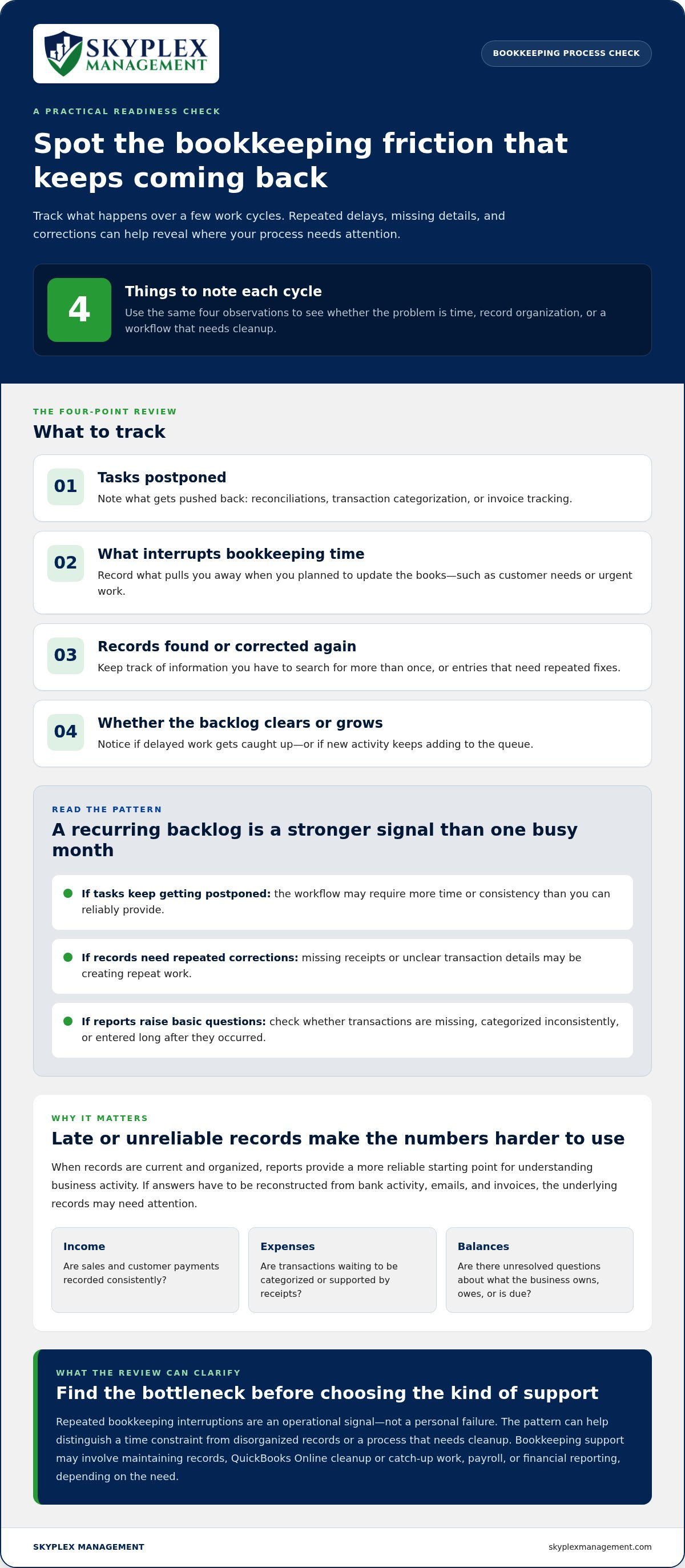
One unusually busy month doesn’t necessarily point to a lasting problem. A persistent backlog is a more useful signal. If each attempt to catch up leaves new transactions waiting, or records need repeated corrections before they’re usable, the process may need attention. Note which tasks fall behind and what information is repeatedly missing. That can help show whether the main issue is time, record organization, or a workflow that needs cleanup.
Bookkeeping friction is easier to assess when you track what happens, not just how frustrating it feels. For a few work cycles, jot down:
- Which tasks are postponed, such as reconciliations, categorization, or invoice tracking.
- What pulls you away when you planned to work on the books.
- Which records need to be found or corrected more than once.
- Whether the backlog clears or continues to grow as new activity comes in.
If the same obstacles keep returning, that’s one of the practical signs you need a professional bookkeeper. Skyplex Management provides small business bookkeeping to help owners maintain clearer, more current records. Identifying the recurring bottleneck is a useful first step toward deciding what support would make the books easier to manage.
What Late or Unreliable Books Can Hide From a Business Owner
Financial reports can look complete and still leave important questions unanswered. If transactions are missing, recorded in the wrong categories, or entered long after they occurred, you may not know whether a report reflects current business activity. That uncertainty makes the numbers a less dependable starting point for decisions.
When financial reports do not answer basic business questions
Can you tell how much income came in during the period, which expenses were recorded, or what customers still owe? If you have to reconstruct the answers from bank activity, emails, and invoices, the underlying records may need attention. Reports are only as useful as the information behind them and how recently it was updated.
Bookkeeping organizes and records financial activity. Interpreting what that activity means for the business is a separate step. Current records can help you see cash coming in and going out, identify outstanding customer balances, and understand upcoming payables. They don’t guarantee a particular result, but they provide a more reliable foundation for planning. Owners reviewing their financial position can also benefit from understanding small business accounting support.
Review a report alongside the records that support it. If income seems unclear, check whether sales and customer payments are recorded consistently. If expenses look incomplete, identify transactions waiting to be categorized or supported by receipts. For a balance sheet, unresolved questions about what the business owns, owes, or is due can make the report harder to rely on.
When growth or added complexity strains existing routines
More transactions, employees, or locations can add coordination to routine bookkeeping. A service business that adds another crew, for example, may need to organize customer invoices, employee payroll, supplier bills, and incoming payments across more activity. The challenge isn’t growth itself. It’s whether recordkeeping routines can keep pace with the added moving parts.
Payroll, receivables, and payables are related to the books, but each has its own recurring workflow. Payroll requires accurate employee and pay information. Receivables involve tracking what customers have been invoiced and paid. Payables involve organizing bills and payments. When these processes aren’t coordinated with transaction records, owners may have to piece together the business’s position from separate sources. The signs you need a professional bookkeeper may show up across several of these workflows, rather than as one isolated reporting question.
Choose a recent reporting period and note what you couldn’t readily verify:
- Income or expenses without clear supporting records.
- Customer balances that are difficult to match to invoices and payments.
- Payroll or bills that aren’t clearly reflected in the financial records.
- Cash-flow questions that require searching through several systems or files.
If the same gaps keep appearing, a conversation about your records and workflow can help clarify the support that would be useful. You can discuss your bookkeeping needs with Skyplex Management.
DIY Bookkeeping or Professional Help: How to Tell the Difference
The right level of bookkeeping support depends less on business size than on the condition of your records, the time routine tasks require, and how much you rely on timely reports. You may be able to maintain straightforward records yourself, need a one-time cleanup, or benefit from ongoing support. The signs you need a professional bookkeeper can point to the kind of help that addresses the actual bottleneck.
| Approach | Record condition and workload | Reporting and workflow fit |
|---|---|---|
| DIY maintenance | Records are organized, transactions are updated consistently, and routine work fits your schedule. | You can produce the reports you need and manage your current transaction, payroll, and invoicing workflows. |
| Targeted cleanup | Past entries are incomplete, uncategorized, or inconsistent, and your immediate need is to organize existing records. | A focused review or QuickBooks Online guidance can address specific problems before you resume or refine routine work. |
| Ongoing bookkeeping support | Updates repeatedly fall behind, or transaction volume and recurring tasks compete with running the business. | Regular bookkeeping, payroll support, or financial reporting may fit when consistent coordination and current records matter. |
This isn’t an all-or-nothing choice. Owners can retain oversight, review reports, and make business decisions while delegating recurring transaction updates or other bookkeeping tasks. Set clear expectations about which work you’ll handle and which work needs consistent support. That keeps you involved without requiring you to manage every entry yourself.
When a focused cleanup or QuickBooks support may fit
If historical records need attention before a dependable routine can begin, targeted cleanup may be a practical starting point. QuickBooks Online support can help with setup, guidance on using the accounting system, or cleanup of existing records. For example, an owner might need help organizing prior activity and understanding how to maintain records going forward, rather than ongoing bookkeeping right away.
When ongoing bookkeeping, payroll, or reporting support may fit
Choose ongoing support when the need keeps returning. Monthly transaction updates point to bookkeeping support; repeated payroll administration may call for payroll service; and reports that are hard to use may call for financial reporting and advisory support. A growing business may need one or several of these. Small business accounting support can bring related financial tasks into a more coordinated process, similar to how firms like CTC Tax & Accounting structure ongoing bookkeeping to ensure full compliance with evolving corporate tax rules.
The right workflow also depends on the kind of work your business does. A construction company may need costs organized by project to understand how each job is tracking. An auto repair shop may need a consistent way to record parts, labor, and customer payments together. A service business may focus on matching completed work to invoices and payments, while professional service providers like accounting firms might rely on specialized systems such as Ape-X Generation to manage firm growth and client acquisition. These different workflows shape which records and reports are most useful.
Before choosing a level of support, identify what’s driving the strain: historical records that need cleanup, recurring work that doesn’t get done, or reports that don’t answer your questions. Matching support to the problem helps preserve your oversight while making bookkeeping more manageable.
A Practical Readiness Check: What to Review Before Getting Bookkeeping Help
You don’t need to solve every bookkeeping issue before discussing support. A clear snapshot of what’s happening now can make that conversation more useful. Use this review to describe your current process and priorities, not to assign yourself a score or meet a hiring threshold.
- Note where the records stand. Identify which updates are delayed, which records are incomplete, and whether there are recurring errors or corrections. Describe the pattern rather than trying to estimate how serious it is. For example, note whether transaction categorization is often postponed or certain entries regularly need another review.
- Map the routine work. List the bookkeeping tasks you handle, who is responsible for each one, and which tasks you regularly put off. Include reconciliations, invoice tracking, transaction recording, or receipt organization if they apply. This can reveal whether the main challenge is time, an unclear process, or a task that needs specialized support.
- Identify your tools and workflows. Note which accounting software you use, how payroll information is handled, and how customer invoices and bills are tracked. You don’t need to share account credentials. A general description of how information moves from sales, expenses, and payroll into your records is enough to explain where coordination feels difficult.
- Name the reports you need. Consider which reports you use, what questions you expect them to answer, and where the information feels incomplete or hard to interpret. You might need a clearer view of income and expenses, outstanding customer balances, or cash coming in and going out. Your reporting needs help indicate what kind of support may be useful.
What to gather for a useful bookkeeping conversation
Bring a short overview of your process and the concerns you want addressed. Note which records or reports feel incomplete, what has been difficult to explain, and what you’ve already tried to resolve. You don’t need to prepare a perfect file or assemble a mandatory document package first. The goal is to describe the situation clearly enough to identify useful next steps.
How to describe the outcome you want
Choose the outcome that matters most right now: current records, more dependable reporting, better payroll coordination, or QuickBooks support. Separate past activity that needs cleanup from tasks that will recur each month. If consistent record management is the ongoing need, small business bookkeeping support can help maintain organized records over time.
This snapshot helps you explain both the immediate problem and the process you want going forward. The signs you need a professional bookkeeper may call for focused cleanup, recurring monthly help, or support with a particular workflow. Knowing which need you’re addressing helps keep the conversation practical and specific.
How Skyplex Management Helps Northeast Ohio Businesses Get Clearer Books
Once you’ve identified what makes the books difficult to maintain or use, match that need with the right kind of support. Skyplex Management is locally owned and serves businesses in Cleveland, Akron, and across Northeast Ohio. Support can focus on recurring recordkeeping, a QuickBooks issue, payroll, financial reporting, or broader outsourced accounting and controller services, depending on what’s creating the strain.
Match Skyplex support to the bookkeeping issue
If transaction updates and reconciliations keep recurring, small business bookkeeping support can help keep records organized as business activity continues. For owners with QuickBooks Online questions or historical records that need attention, QuickBooks support and cleanup can address system guidance and record issues. The goal is to connect the work to the problem, rather than assume every business needs the same arrangement.
Payroll administration is a distinct, recurring workflow. Skyplex’s payroll service supports businesses that need help managing that part of their financial process. Financial reporting and advisory support help owners make better use of organized records by discussing what reports show and which business questions they should inform. For businesses that need broader financial oversight, outsourced accounting and controller services provide support beyond day-to-day bookkeeping.
These needs can overlap. A business might need QuickBooks cleanup before routine bookkeeping can proceed smoothly, or bookkeeping support alongside payroll and reporting. You can stay involved in reviewing financial information and making decisions while getting help with work that needs consistent attention. The signs you need a professional bookkeeper don’t dictate a single arrangement; they help clarify where support could be most useful.
Take a low-pressure next step with a local team
A useful first conversation can start with the snapshot you prepared: what’s behind, what keeps needing correction, which tools you use, and what you want your reports to help you understand. That gives the discussion a practical focus. Skyplex provides personalized bookkeeping and accounting support for businesses across Northeast Ohio, with the conversation centered on your current priorities and workflow.
Skyplex Management works with clients’ CPAs on their behalf, but does not file taxes directly. Bookkeeping and accounting support can complement your existing tax relationship by helping keep financial records organized.
To discuss the support that fits your situation, schedule a free 30-minute strategy call with Skyplex Management.
Choose a More Sustainable Next Step for Your Books
Recognizing the signs you need a professional bookkeeper gives you a chance to make a deliberate change before the books feel unmanageable. You don’t have to hand over every financial task to improve the process. Start by deciding what you want to stay involved in and what would be more reliable with ongoing support.
Skyplex Management brings more than ten years of overall business-finance experience to its work with local business owners. A focused conversation can help turn your concerns into a practical plan, whether you’re addressing a current bookkeeping challenge or making the process more sustainable as your needs change.
Clearer books are a practical foundation for moving forward. You can take the next step at a pace that feels right for your business.
Frequently Asked Questions
Can I hire a bookkeeper just to clean up old records?
Yes. Some businesses start with a focused cleanup before deciding whether they need recurring support. The work depends on the condition of the records and the accounting system involved. Skyplex Management provides QuickBooks support and cleanup, and a free 30-minute strategy call can help you discuss your records and goals. You can describe the areas that concern you without settling on a specific cleanup plan first.
Does a professional bookkeeper replace my CPA?
No. Bookkeeping support doesn’t automatically replace your relationship with a CPA; the roles can complement each other. Skyplex Management helps maintain and organize financial records and works with your CPA on your behalf. The firm doesn’t file taxes directly. Organized transaction records can make it easier to share clear financial information with the professionals involved in your business and coordinate questions about your records.
Can a bookkeeper help if I already use QuickBooks Online?
Yes. Having QuickBooks Online doesn’t ensure that its setup, records, or reports match the way your business operates. Support may include setup, guidance, training, bookkeeping, or cleanup, depending on your needs. For instance, you might need help understanding how to record a recurring transaction or resolving older entries that make a current report confusing. Skyplex Management provides QuickBooks services, including support and cleanup.
How often should a small business update its books?
There isn’t one routine that fits every business. Consider how often transactions occur, whether payroll is part of your workflow, and when you need reports to make decisions. A business with frequent customer payments and supplier bills may need a different rhythm than one with simpler activity. The practical test is whether updates keep pace with your reporting and coordination needs. If they repeatedly lag, review the process with a bookkeeper.
Can I keep control of my finances after hiring a bookkeeper?
Yes. You can retain ownership and decision-making while delegating agreed bookkeeping tasks. For example, you might ask for regular records and reports while keeping responsibility for approvals, spending choices, and business planning. Before work begins, clarify who handles transaction questions, how you’ll review reports, and which tasks stay with you. A shared understanding of responsibilities helps you stay involved without personally completing every bookkeeping task.
Does Skyplex Management work with businesses outside Cleveland?
Yes. Skyplex Management serves Cleveland, Akron, and Northeast Ohio, including Medina, Strongsville, Brecksville, Hudson, Stow, Cuyahoga Falls, Fairlawn, Brunswick, Wadsworth, North Royalton, Canton, Wooster, Richfield, Macedonia, Broadview Heights, and Solon. The firm is locally owned and operated and supports small and midsize businesses with bookkeeping, QuickBooks, payroll, and reporting. If your business is in the region, you can arrange a conversation with Skyplex Management.
Disclaimer
The information provided in this article is for general educational purposes only and should not be considered accounting, tax, or legal advice. Every business is unique. Consult a qualified accounting professional before making financial or tax decisions. Contact Skyplex Management for guidance specific to your business.


