
What if your books are up to date, but still don’t tell you whether the business is on track? If you’re wondering “what does an outsourced controller do,” the short answer is that they oversee financial processes and help turn accurate, timely records into reports you can use to manage the business.
It’s understandable to be unsure where a controller’s work begins. Bookkeeping keeps transactions organized, while controller support adds oversight to the month-end close, financial reporting, cash flow information, and accounting processes. CFO support generally focuses further ahead on broader financial strategy. These roles can work together, but they aren’t interchangeable.
This article explains an outsourced controller’s practical responsibilities, the reports and controls they may oversee, and how the role differs from bookkeeping and CFO support. You’ll also learn when stronger financial oversight could help, and how fractional controller services can complement bookkeeping, payroll, or QuickBooks support without requiring a full-time senior finance hire. For small and midsize businesses in Cleveland, Akron, and Northeast Ohio, understanding these distinctions can help you identify the support that fits your needs.
Key Takeaways
- Understand what does an outsourced controller do, from overseeing the month-end close to reviewing financial information for accuracy and consistency.
- Learn how bookkeeping, accounting, controller support, and CFO guidance serve different needs while working together.
- Use reporting delays, unclear financial information, and increasingly complex processes to assess whether your business needs stronger financial oversight.
- Use reliable financial reports and cash flow information to make more informed operating decisions.
- Explore how Skyplex Management’s bookkeeping, payroll, QuickBooks, reporting, and advisory services work alongside outsourced controller support.
What Does an Outsourced Controller Do in a Small Business?
Outsourced controller support provides financial oversight through an external provider. A controller helps ensure bookkeeping is complete and consistent, brings financial information together, and turns it into reports the owner can use. The specific responsibilities depend on the business’s needs and the agreed scope, so the role can address particular gaps without taking over every finance task.
An outsourced controller oversees the accuracy and organization of a business’s financial information, then helps translate it into clear reporting and management insight. Rather than focusing only on transaction entry, the work involves reviewing how the numbers fit together and whether they’re ready to inform decisions.
How a controller turns records into financial visibility
A controller starts with organized records and reviews recurring financial information to help create a coherent picture of the business. That can include checking whether transactions are recorded in the right categories, comparing account balances with supporting records, and following up on items that don’t match. The goal is to give the owner reports that reflect the business’s activity, not just a list of entries.
For example, a service business may record customer payments, payroll, and operating expenses throughout the month. A useful monthly report brings those figures together to show income, expenses, and the resulting profit or loss. The owner can then see whether expenses rose, whether sales covered operating costs, and which questions need attention. The Controller (accounting) overview provides additional background on the role’s place in an organization’s accounting function.
What outsourced means for a small business
“Outsourced” means the controller works externally rather than as an employee on the company’s staff. The business receives ongoing oversight without adding an in-house controller position. The work is shaped around the agreed responsibilities and may complement an existing bookkeeper, payroll process, or accounting system.
Clean transaction records are the foundation, but they don’t automatically answer management questions. A bookkeeper may maintain entries and records, while controller support reviews the overall process and helps organize the results for decision-making. Businesses that need stronger recordkeeping as well as oversight can connect controller work with small business accounting support.
The practical benefit for an owner is a clearer view of what the numbers show and where follow-up may be needed. Responsibilities can be tailored to the business’s situation, such as reviewing recurring reports or improving how financial information is assembled. Define the scope upfront so everyone understands which tasks the controller handles and which remain with the business’s existing team.
What Are an Outsourced Controller’s Core Responsibilities?
A controller’s work is more than a checklist of accounting tasks. It creates a dependable process for checking financial information, producing useful reports, and helping the owner understand what the numbers may mean for day-to-day operations. The exact mix depends on the business and the agreed scope of support.
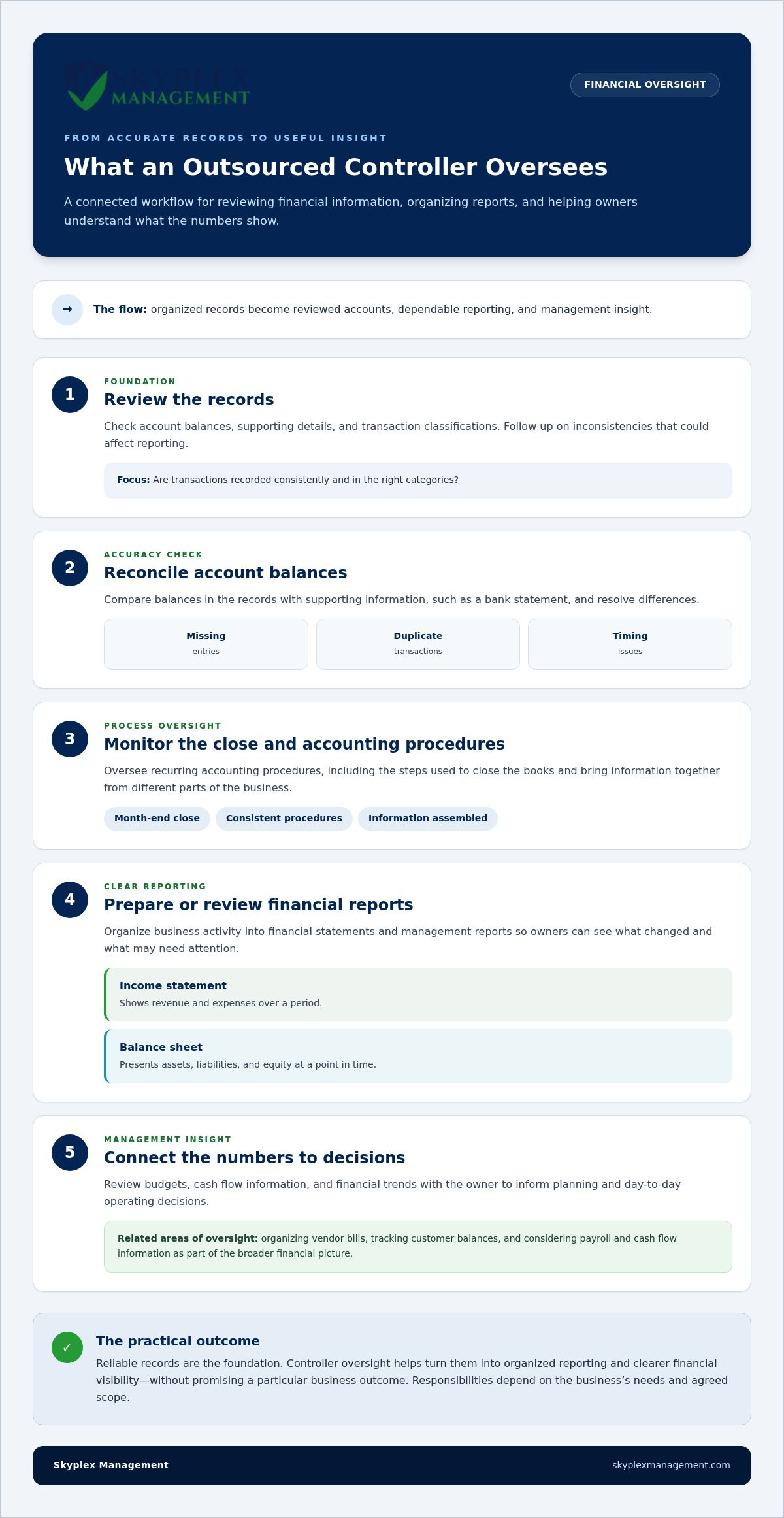
Controller oversight connects reliable records to useful reporting by reviewing how financial information is recorded, reconciled, and presented for management decisions.
In practice, responsibilities often fall into four connected areas:
- Record review: Check account balances, supporting details, and transaction classifications for inconsistencies that could affect reporting.
- Reporting: Prepare or review financial statements and management reports so the owner can see business activity in an organized format.
- Financial-process oversight: Monitor recurring accounting procedures, including the steps used to close the books and assemble information from different parts of the business.
- Decision support: Review budgets, cash flow information, and financial trends with the owner to inform planning, without promising a particular business outcome.
Financial close, reconciliations, and reporting
Reconciliation means comparing an account balance in the records with information from a supporting source, such as a bank statement, then resolving differences. Recurring reconciliations can uncover missing entries, duplicate transactions, or timing issues before they carry into reports. A controller may also review whether figures are categorized consistently, making changes from one period to another easier to understand.
Financial statements summarize different parts of the business. An income statement shows revenue and expenses over a period, while a balance sheet presents assets, liabilities, and equity at a point in time. Reviewing the balance sheet helps an owner consider what the business owns and owes, rather than relying on sales or profit alone. Clear reporting gives management a stronger basis for asking what changed and what deserves attention.
Payables, receivables, payroll, and cash flow oversight
Accounts payable and receivable affect both record accuracy and visibility into upcoming cash needs. Controller oversight can help organize the process for recording vendor bills, tracking customer balances, and reviewing overdue amounts. The owner can then see whether expected collections and scheduled payments are reflected in the financial picture.
Payroll information also feeds into expenses and cash planning. Reviewing payroll entries as part of the broader accounting process helps represent labor costs in reports and gives the owner a clearer view of cash leaving the business. This financial oversight doesn’t replace specialized tax, legal, or payroll compliance advice.
Budget and cash flow reviews help owners compare expectations with actual activity. For example, if customer payments arrive later than planned while recurring expenses remain due, that information can prompt a timely discussion about scheduling and priorities. A controller organizes the facts for that conversation, not a guaranteed result. Businesses looking to strengthen the underlying accounting process can explore small business accounting support.
If financial reports are difficult to interpret or reconciliations keep surfacing unexplained differences, talk with Skyplex Management about how outsourced controller support can fit your needs.
Outsourced Controller vs. Bookkeeper, Accountant, and CFO
These finance roles are related, but they don’t serve the same purpose. Bookkeeping maintains the records, accounting work helps organize and interpret financial information, controller support oversees the accounting process and reporting, and a CFO provides broader financial leadership. A business may use several of these functions through internal staff, outside support, or both.
| Role | Primary focus | Typical work | Relationship to the owner |
|---|---|---|---|
| Bookkeeper | Transaction and record maintenance | Recording income and expenses, organizing transactions, maintaining account records | Keeps financial activity documented and accessible |
| Accountant or CPA | Accounting analysis and specialized accounting or tax responsibilities | May prepare or review financial information and handle distinct accounting or tax work | Provides expertise for specific accounting needs |
| Controller | Financial-process oversight and dependable reporting | Reviewing records, overseeing close and reconciliations, organizing reports | Helps the owner understand the reliability and meaning of financial information |
| CFO | Broader financial strategy and leadership | Forward-looking planning and financial guidance | Helps the owner evaluate larger strategic choices |
Controller and bookkeeper: oversight versus recordkeeping
Accurate bookkeeping is essential. It creates the organized records a controller needs to review and report on the business’s finances. The distinction is not that one role matters more, but that the work serves different purposes: bookkeeping maintains the underlying information, while controller oversight focuses on the accounting process and how the results are presented. A business may need both when transaction volume, reporting needs, or internal workflows call for separate responsibilities. Skyplex’s bookkeeping services support the recordkeeping foundation.
For example, a bookkeeper may record customer payments and vendor expenses. Controller support can then review how those records come together in recurring reports and flag questions for follow-up. Understanding what does an outsourced controller do starts with this distinction: the controller’s focus is not simply entering transactions, but overseeing the quality and usefulness of the financial information built from them.
Accountants, CPAs, and controllers
“Accountant” can describe a range of accounting work, and a CPA may handle distinct accounting or tax responsibilities. The controller role centers on financial operations and reporting, but it can coordinate with a CPA when the business needs that expertise. Skyplex works with your CPA on your behalf, helping connect ongoing financial records with the CPA’s separate work without treating the roles as interchangeable.
Controller and CFO: financial operations versus broader strategy
A controller concentrates on the reliability of financial processes and reports. CFO support looks further ahead, helping leadership consider financial direction and strategic choices. Controller reporting can provide a stronger information base for those conversations, but oversight and strategic leadership remain distinct functions. The right balance depends on whether the owner’s immediate need is better reporting, broader planning, or both.
To compare controller and CFO support, start with the decisions your business needs help making and the financial information available to support them.
When Should a Business Consider an Outsourced Controller?
There’s no single revenue, employee, or growth threshold that determines when controller support makes sense. A more useful test is whether your financial processes give you dependable information when you need it. Use this self-assessment to identify where added oversight could help:
- Reports arrive late: Do you regularly wait for financial reports before reviewing results or making routine decisions?
- The numbers are hard to interpret: Do reports raise questions about profitability, cash position, or customer balances that are difficult to answer?
- Records don’t feel dependable: Do you find unexplained differences, inconsistent categories, or corrections that carry from one reporting period to another?
- Processes are getting harder to coordinate: Are bookkeeping, payroll, bill payments, customer collections, and CPA requests handled in separate workflows with unclear ownership?
- Planning relies on guesswork: Do you lack organized information to compare a budget with actual results or understand upcoming cash needs?
A “yes” doesn’t automatically mean you need a controller. It points to a practical question: would clearer responsibility, review, or reporting make your financial process more useful?
Practical signs that financial oversight may help
Consider an owner who receives a monthly report but can’t tell which customer balances are overdue or whether all recent transactions are included. The owner delays a hiring or purchasing decision while trying to piece together the information. If this pattern repeats, the issue may be more than report timing. The business may need a consistent process for reviewing records, investigating open questions, and presenting results. Asking “What does an outsourced controller do?” is a useful first step toward identifying whether that oversight addresses the problem.
What to prepare before discussing controller support
Before a conversation, gather the most recent financial statements, note whether bookkeeping is current, and outline how payroll information moves into the books. Write down the questions your reports haven’t answered. It also helps to map who currently handles bookkeeping, accounting, payroll, and communication with your CPA, so responsibilities and gaps are clear.
Bring practical examples rather than trying to diagnose the accounting process yourself. You might note that customer balances aren’t followed up consistently, reports arrive after decisions are due, or the owner spends time reconciling conflicting figures. If your main need is budgeting, planning, or reviewing ways to improve profit, business advisory support may also be relevant alongside controller oversight.
Skyplex Management offers a free 30-minute strategy call to discuss your financial processes, current support, and questions. Use it to clarify whether the need is bookkeeping, controller oversight, advisory support, or a combination.
How Skyplex Management Supports Northeast Ohio Businesses
For an owner in Cleveland, Akron, or elsewhere in Northeast Ohio, financial support works best when the pieces connect. Skyplex Management is a locally owned partner offering outsourced controller and accounting support for small and midsize businesses. With more than ten years of overall business-finance experience, the team helps owners bring bookkeeping, payroll information, and reporting into a clearer working picture. Skyplex serves businesses in Cleveland, Akron, Medina, Strongsville, Brecksville, Hudson, Stow, Cuyahoga Falls, Fairlawn, Brunswick, Wadsworth, North Royalton, Canton, Wooster, Richfield, Macedonia, Broadview Heights, and Solon.
That connection matters because controller support depends on reliable records. If bookkeeping is behind or financial information is scattered, reports may not answer the questions an owner needs to resolve. Support can be shaped around the business’s processes and needs, rather than treating bookkeeping, payroll, and controller oversight as interchangeable tasks.
A connected approach to bookkeeping, payroll, and reporting
Bookkeeping maintains the transaction records that financial reports draw on. Payroll information also needs to be reflected appropriately in the books so labor costs appear in the broader financial picture. Controller support can build on those records through review and reporting, helping owners understand business activity and follow up on questions. Skyplex’s small business accounting services connect these needs with broader accounting support.
QuickBooks Online support and cleanup can help organize financial records when the accounting file needs attention. With cleaner, more consistent information, recurring reports are easier to review and discuss. The practical goal isn’t simply to produce statements; it’s to help the owner understand what the information says about operations, cash flow, and areas that may need attention.
For example, a business owner may have bookkeeping and payroll information handled through separate processes, then struggle to make sense of costs in a monthly report. Coordinated accounting support can help bring the information together so the owner has a more useful basis for reviewing results. The right division of work depends on what is already in place and where added oversight would be most helpful.
A local next step for Northeast Ohio business owners
Owners don’t need to arrive with a perfect accounting system or a fully formed list of solutions. Start by identifying what feels unclear: reports that don’t arrive when needed, records that are difficult to interpret, or uncertainty about how bookkeeping, payroll, and reporting fit together. That conversation can help clarify which support would be useful and how it can work alongside existing staff or professional relationships.
In this context, asking “what does an outsourced controller do” can lead to a practical discussion about your own processes, not just a general description of the role. Skyplex Management offers a free 30-minute strategy call for business owners in Cleveland, Akron, and Northeast Ohio to discuss their financial needs and questions. It’s a straightforward way to talk through what is working and where stronger oversight may help.
Make Your Next Finance Decision With Greater Clarity
You don’t need to redesign every financial process at once. Start by identifying the recurring question that takes the most effort to answer, then consider what information or review would make that decision easier. That gives you a practical way to discuss whether controller support fits your current needs and how it could work alongside the people already supporting your finances.
Understanding what does an outsourced controller do is most useful when you connect the role to a real challenge in your business. Skyplex Management’s bookkeeping, accounting, payroll, QuickBooks, reporting, and advisory services help owners organize financial information and understand what it can tell them.
If you’re ready to talk through your needs, schedule a free 30-minute strategy call with Skyplex Management:
With the right support in place, financial information can become easier to use, giving you more room to focus on running your business.
Frequently Asked Questions
What does an outsourced controller do each month?
An outsourced controller typically reviews recent accounting activity, checks reconciliations, and helps prepare or review financial reports. They may also follow up on unusual balances, missing information, or changes that need an owner’s attention. The precise monthly work depends on the business’s needs and the agreed scope. For example, one business may need a closer review of account balances, while another may prioritize timely reporting for management discussions.
Can an outsourced controller work with my existing bookkeeper?
Yes. A controller can review and work from records maintained by your bookkeeper when responsibilities and information handoffs are clear. For example, the bookkeeper might record bills and customer payments, while the controller reviews the resulting reports and follows up on unexplained items. Agreeing on who updates records, handles corrections, and shares reports helps prevent duplicated work and keeps questions from falling between roles.
Does an outsourced controller file business tax returns?
No. Skyplex Management does not file taxes directly and works with your CPA on your behalf. Controller support focuses on financial oversight, organized records, and reporting. Preparing or filing a business tax return is a separate responsibility. Keeping those roles clear helps your CPA work with organized financial information while your controller supports the ongoing accounting process. Discuss tax-return questions with your CPA, who handles that work.
What financial reports can an outsourced controller help a small business understand?
An outsourced controller can help explain reports such as an income statement, balance sheet, and cash flow information, along with management reports built from the business’s records. An income statement summarizes revenue and expenses; a balance sheet shows assets, liabilities, and equity at a point in time. A practical review might help an owner see why reported profit differs from available cash or which expense categories changed.
Is an outsourced controller the same as a CPA?
No. The titles describe different roles, and responsibilities can vary. Controller support generally centers on the business’s ongoing accounting processes, financial oversight, and reporting. A CPA may handle distinct accounting or tax responsibilities for the business. Skyplex Management works with your CPA on your behalf, helping coordinate financial information without treating controller support and CPA work as interchangeable. Clear communication about each person’s responsibilities helps avoid gaps or duplicate tasks.
Does a small business need a full-time controller?
Not necessarily. The right level of support depends on how complex the reporting process is, what the internal team can manage, and how much oversight the owner needs. A business may benefit from outside controller support if its staff can maintain records but lacks capacity to review reports or coordinate financial processes. Needs can differ even among similar small businesses across Northeast Ohio.
Disclaimer
The information provided in this article is for general educational purposes only and should not be considered accounting, tax, or legal advice. Every business is unique. Consult a qualified accounting professional before making financial or tax decisions. Contact Skyplex Management for guidance specific to your business.


