

The lowest-cost accounting setup isn’t always the least expensive in practice. To understand how to choose an outsourced accounting firm, start by matching its services to the work your business needs, then compare relevant experience, security practices, communication, and total cost. Outsourced accounting means assigning financial tasks such as bookkeeping, payroll, and reporting to an external team rather than relying only on in-house staff.
Cost matters because accounting takes time and resources away from running your business. A useful comparison considers the work included and the level of oversight alongside the fee, so a lower quote doesn’t hide gaps in support or additional charges.
This guide explains what outsourced accounting can include and walks through practical steps for assessing a provider. You’ll learn how to evaluate qualifications and relevant experience, understand data-protection practices, compare pricing structures, and spot signs that a firm’s approach fits your business. The goal is a clear, dependable accounting relationship that gives you better financial visibility and more room to focus on your work.
Key Takeaways
- Define which accounting tasks you need handled, from routine bookkeeping to reporting, before comparing service models.
- Look for relevant industry experience and a team whose qualifications match the complexity of the work.
- Assess how the firm protects financial data, manages access, and reviews work for accuracy.
- Compare the full scope of services and potential additional charges, not just the headline fee.
- Choose a provider whose communication, processes, and capacity fit your business as it grows.
What is Outsourced Accounting?
Outsourced accounting assigns selected financial work to an external team rather than employees alone. To compare service models, first define the tasks, oversight, and industry knowledge your business needs.
1. Define Outsourced Services and Scope
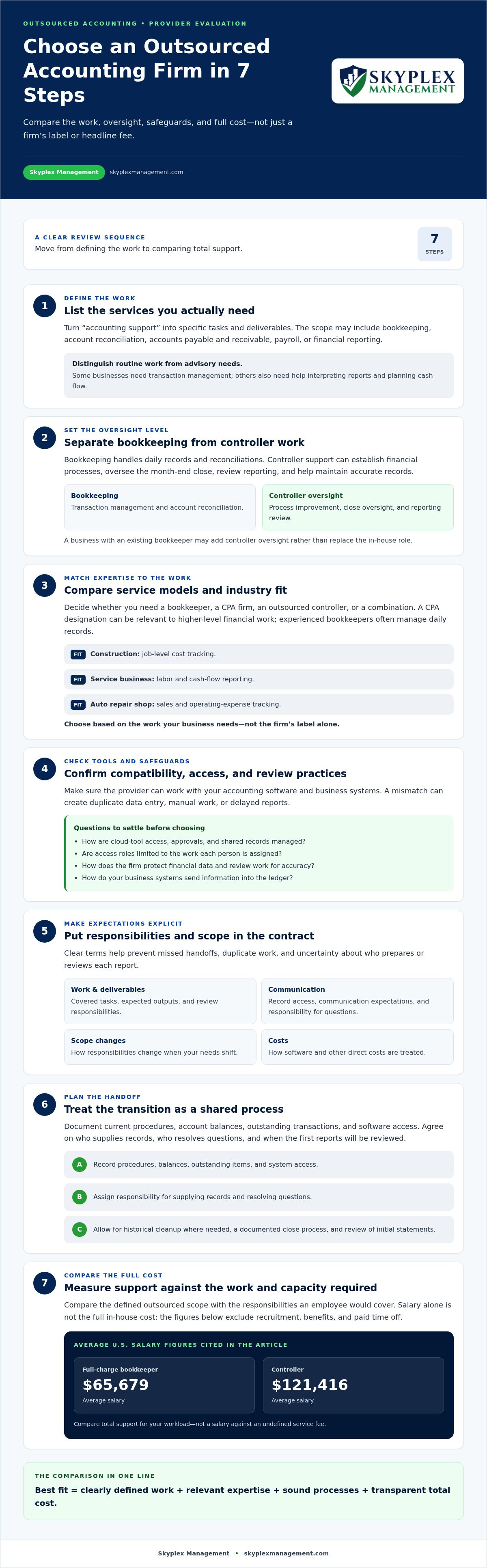
List the work you need done, then match each task to a service. Outsourced accounting may cover bookkeeping, account reconciliation, accounts payable and receivable, payroll, and financial reporting. Some businesses need routine transaction management; others also need advisory support to interpret reports and plan cash flow. Replace broad requests such as “accounting support” with specific tasks, responsibilities, and expected deliverables.
2. Review Controller Services and Tasks
Separate day-to-day accounting from controller oversight before comparing proposals. An outsourced controller can help establish financial processes, oversee the month-end close, review reporting, and support accurate records. A growing business may need this higher-level guidance without outsourcing every accounting task. Identify where controller input would help, such as investigating unusual account balances or improving reporting procedures, and define how that work fits with bookkeeping.
- Compare service models and specialization. Decide whether you need a bookkeeper, a CPA firm, an outsourced controller, or a combination. A CPA designation can be relevant to higher-level financial work, while experienced bookkeepers often manage daily records. Then assess whether the team understands your business model. A construction company may need job-level cost tracking, while a service business may prioritize labor and cash-flow reporting. Match expertise to actual work, not firm labels.
- Put responsibilities in the contract. Define covered tasks, deliverables, access to records, communication expectations, review responsibilities, and how changes in scope are handled. The contract should also explain how software and other direct costs are treated. Clear terms help prevent missed handoffs, duplicate work, or confusion about who prepares and reviews each report.
- Plan the transition as a shared process. Start by documenting current procedures, account balances, outstanding transactions, and software access. Agree on who supplies records, who resolves questions, and when the first reports will be reviewed. A practical transition includes historical cleanup where needed, a documented close process, and a review of initial financial statements before relying on the new routine.
- Compare total staffing costs with the work required. The average U.S. salary for a full-charge bookkeeper is $65,679, while the average controller salary is $121,416. These salary figures don’t include recruitment, benefits, or paid time off. Compare the responsibilities and capacity each employee would cover against the defined outsourced scope. The useful comparison is total support for your workload, not salary against an undefined service fee.
Criteria for choosing an accounting outsourcing company
Compare providers against your workload, systems, growth plans, and need for oversight. To decide how to choose an outsourced accounting firm, match its services and processes to your actual operating needs.
Compare In-House and Outsourced Accounting
Compare the responsibilities you need covered, not just a job title or service label. An in-house bookkeeper provides a direct daily contact, while an outsourced team can combine bookkeeping with accounting oversight. When comparing costs, include recruitment, benefits, and paid time off for an employee. For example, a business with a capable bookkeeper might outsource controller oversight rather than replace the existing role.
Check Software Compatibility and Cloud Tools
Confirm that the provider can work with your accounting software and business systems. A mismatch can lead to duplicate data entry, manual work, or delayed reports. Ask how the team manages access, approvals, and shared records in cloud tools. If your sales system sends transactions to the ledger, map that workflow before choosing a provider. Set clear access roles so everyone can do their assigned work without unnecessary permissions.
Compare Engagement Flexibility
Choose an engagement model that fits your workload now and can adjust as it changes. A growing company may begin with bookkeeping, then add controller oversight as reporting needs become more complex. A hybrid approach can pair an internal bookkeeper with an outsourced controller who improves processes or oversees the month-end close. Avoid paying for a broad package when you need specific support, and clarify how responsibilities can shift over time.
Compare Firms With Bookkeeping Services
Distinguish transaction processing from broader accounting and decision support. Bookkeeping generally involves recording activity and reconciling accounts; a broader accounting engagement may also include financial statements, payroll coordination, and advisory. Compare deliverables and review processes, not titles alone. A construction business, for example, may need clear job-cost reporting, while an auto repair shop may focus on tracking sales and operating expenses.
- Assess communication and problem-solving. Identify who handles questions, how outstanding records are tracked, and how the team flags unusual transactions. A useful process makes owners’ responsibilities clear, rather than leaving unresolved items buried in email.
- Set a growth trigger for added support. Companies experiencing year-over-year growth of 50% or more may need outsourced help when internal finance capacity can’t keep pace with transaction volume and complexity. As you decide how to choose an outsourced accounting firm, assess whether its support can adapt as your workload changes. To discuss which support model fits your records and operations, talk through your accounting needs.
Evaluating provider credentials and industry experience
Match each team member’s qualifications and industry knowledge to the work your business needs. A credential matters most when it aligns with the responsibilities in your engagement.
-
Assess Experience Across Relevant Industries
Ask how the team’s experience applies to the accounting challenges in your industry. Construction businesses may need clear job-cost information, while auto repair shops must track service revenue and operating expenses. Service-based companies may focus on labor costs and cash flow. Ask for examples of relevant workflows, reports, and recurring issues the team has handled. A broad claim of “industry expertise” means little without practical detail.
- Match credentials to responsibilities. Identify who will handle bookkeeping, payroll, financial reporting, and higher-level analysis. Experienced bookkeepers typically support day-to-day accounting, while certified public accountants may be relevant for higher-level financial tasks. Ask which individuals will work on your account and what each person is responsible for. This helps you assess the actual team rather than assume everyone has the same training or role.
-
Review Reputation and Accreditation
Check professional affiliations and the firm’s approach to ethical practice. The American Institute of CPAs (AICPA) is a professional organization, and accreditation from the AICPA can indicate a firm’s commitment to high practice standards. Ask whether the team follows the AICPA Code of Professional Conduct. Consider how its work is reviewed, how it communicates issues, and whether its stated processes align with your expectations for accurate records.
- Evaluate experience through specific examples. Ask how the firm handled a challenge similar to yours, without requesting confidential client information. For instance, an outsourced controller with consumer packaged goods (CPG) expertise supported a startup with interim leadership while it sought a full-time controller. The example shows how specialized knowledge can fill a defined gap. Assess the tasks performed and how closely they relate to your needs.
- Distinguish industry familiarity from a useful fit. Accounting firms may serve construction, retail, professional services, and other sectors, but a long client list alone doesn’t prove relevant expertise. Compare the provider’s experience with your business model, transaction patterns, reporting needs, and payroll complexity. A construction firm tracking job costs needs different reporting insight than a service business managing labor and recurring client payments.
Security certifications and client-data controls
Review security practices, communication, and reporting processes before sharing financial records. Outsourcing can create data exposure, communication gaps, and dependence on another team’s availability. Clear access, review, and response procedures help manage these risks.
-
Review Security and Data Controls
Ask how the provider protects financial information, controls access, and updates security practices. Review its SOC 2 Type II report and ISO/IEC 27001 certificate, if applicable, and discuss how the team addresses IRS Section 7216. A certification alone doesn’t explain day-to-day handling. Clarify who can access payroll, bank, and revenue records, how access changes when staff responsibilities change, and how incidents are communicated.
-
Identify Outsourcing Risks and Mitigations
Connect each risk to a specific control before work begins. Less direct oversight can make errors or missing records harder to spot, while communication gaps can delay decisions. Agree on named contacts, escalation steps, review responsibilities, and backup coverage for absences. For example, assign an internal approver for payments and require unusual transactions to be reviewed before monthly reports are finalized.
- Set communication and reporting expectations. Define the monthly close schedule, report delivery date, and meeting rhythm in writing. A strong provider should deliver financials on a consistent monthly schedule, ideally by the 15th, and hold a monthly financial review lasting 30 to 60 minutes. Also clarify how the team tracks missing documents and outstanding questions, so a delayed receipt doesn’t silently hold up reporting.
- Evaluate client proof points. Ask for case studies that describe the client’s situation, the work performed, and resulting process changes. Useful examples explain how the provider improved reporting workflows or clarified revenue and expense records. Look for details that match your business size and accounting needs. A polished story without a clear scope or outcome offers little basis for judging fit.
- Review references and past work. Ask for references from businesses with comparable operations, then discuss communication, accuracy, and how challenges were resolved. Focus on the working relationship and deliverables, not confidential financial details. When reviewing sample reports, check whether categories are understandable, reconciliations are visible, and commentary explains significant changes. These details show whether the information is useful for decisions.
- Document the ongoing review process. Agree on how you’ll assess quality and timeliness after onboarding. Track whether reports arrive as scheduled, open items receive clear follow-up, and agreed review steps happen. If an issue recurs, record its cause, owner, and resolution. A simple issue log gives both teams a shared way to address problems before they affect decisions or cash-flow planning.
Cost savings from accounting outsourcing
Compare the total cost of getting the work done, not one salary against one service quote. Savings depend on the tasks, transaction volume, staffing needs, software, and level of oversight your business requires.
- Build a complete in-house cost picture. Include compensation, recruitment, benefits, paid time off, software, and supervision. Then list the work the role must cover, such as reconciliations, payroll processing, and monthly reporting. A bookkeeper’s salary alone doesn’t show the full cost of maintaining an accounting function. Compare the complete staffing commitment with the defined outsourced scope, rather than treating one salary as the entire in-house expense.
- Compare equivalent responsibilities. List each recurring task and expected deliverable before reviewing proposals. Compare bookkeeping and reconciliations separately from controller oversight or advisory. Basic transaction processing isn’t comparable to a broader finance function that includes reporting review. Match responsibilities across options to see whether a quote leaves work for your staff or includes tasks you don’t need.
- Assess how volume affects the work. Transaction volume, payroll complexity, number of accounts, and the condition of existing records all affect the work involved. A business with frequent sales and purchases may need more transaction processing than one with fewer monthly entries. Historical cleanup can add work before routine reporting becomes consistent. Map these needs to the proposed scope and identify which changes could affect the workload.
- Account for costs beyond the recurring fee. Ask how onboarding, software, year-end work, cleanup, and additional advisory are handled. Cost depends on the case, and the quote should reflect factors such as transaction volume, service scope, record condition, and reporting needs. Get inclusions and exclusions in writing. This makes proposals easier to compare and helps prevent a low initial quote from hiding necessary work.
- Measure value through usable financial information. Consider whether timely, accurate reports help you make decisions about cash flow, staffing, and spending. Clear monthly expense categories, for example, can help an owner spot rising costs before setting the next budget. Value isn’t limited to payroll savings; it can also come from reducing time spent correcting records or chasing missing information. Compare these benefits with the work your team will retain.
- Revisit the comparison as the business changes. Growth can increase transaction volume, reporting demands, and the need for financial oversight. Review whether the current model still covers those responsibilities instead of assuming the original arrangement will always fit. A hybrid setup may retain an internal bookkeeper while adding outsourced controller oversight. The right arrangement meets current needs without duplicating work or leaving important tasks uncovered.
Skyplex Management: Small Business Bookkeeping
Skyplex Management helps small businesses in Northeast Ohio keep financial records organized through Small Business Bookkeeping and Small Business Accounting. If transactions are behind, QuickBooks Online Support & Cleanup can help bring records into usable shape. Payroll Service is also available for businesses seeking support with payroll tasks.
Consider outsourced support when bookkeeping takes time away from operations, reports are hard to interpret, or your accounting workload has outgrown your current process. Clear records and consistent reporting can make it easier to understand business performance and plan next steps.
If you’re ready to discuss the accounting support that fits your business, contact Skyplex Management.
Put the Right Accounting Support in Motion
Start with one accounting pressure point, such as delayed reconciliations, unclear reports, or time-consuming transaction entry. A focused starting point gives you a practical way to assess whether the working relationship and process fit your business. It also keeps the conversation grounded in the work you need handled.
As you consider how to choose an outsourced accounting firm, look beyond the immediate backlog. Decide what you want your financial process to support next, whether that’s consistent bookkeeping, clearer business records, or more effective use of QuickBooks Online. These priorities can guide a service discussion without committing you to support your business doesn’t need.
Skyplex Management offers Small Business Bookkeeping, Small Business Accounting, and QuickBooks Services, including setup, bookkeeping, guidance, and training. The right starting point depends on where your current process creates the most friction and what would help your business move forward.
A thoughtful next step can make your financial work easier to manage and your business decisions clearer.
Frequently Asked Questions
Can I do both, with someone in-house and an outside firm?
Yes, a hybrid arrangement can pair an employee with external accounting support. For example, an in-house administrator might gather receipts and approve invoices, while an outside team reconciles accounts and prepares reports. Decide who owns each handoff, including payroll changes and month-end questions. Clear responsibilities help avoid duplicate data entry and prevent important tasks from falling between the employee and the firm.
Can I keep my current accounting software?
An outsourced team can often work with a business’s existing accounting software. Before starting, map how transactions enter the system, who can approve changes, and how reports are shared. If your sales platform exports daily transactions, for example, define how to review errors and match deposits. Keeping familiar software can reduce disruption when the workflow supports accurate records and useful reporting.
In-House or Outsourced: Which One Fits Your Business?
Choose in-house support when daily coordination and immediate internal collaboration are central to the role. Outsourcing may suit a business that needs specialized help without assigning every accounting responsibility to an employee. A business with a staff member handling invoices might outsource reconciliations or financial reporting. Compare the recurring work, expertise required, and level of internal supervision your team can provide.
What happens if the person handling my books leaves the firm?
Your business should be able to access its records, not just one staff member. Before engaging a firm, establish how files, account access, open questions, and recurring procedures will be documented. If a team member leaves, arrange a clear handoff that identifies unfinished work and upcoming deadlines. Shared records and written procedures help another qualified person continue without relying on one employee’s memory.
What services do outsourced accounting firms provide?
Services may include bookkeeping, reconciliations, accounts payable and receivable, payroll, financial statements, and controller oversight. Some firms also provide advisory support to help owners interpret results and plan cash flow. For example, a business might outsource transaction recording while retaining approval of vendor payments. Compare specific deliverables and responsibilities rather than assuming every firm includes the same work.
How much does outsourced accounting cost in the United States?
There isn’t one standard fee for outsourced accounting across the United States. The amount depends on service scope, transaction volume, record condition, payroll needs, reporting requirements, and level of oversight. A business seeking basic bookkeeping has different needs from one requiring cleanup and controller support. To compare proposals fairly, align each quote with the same tasks, deliverables, and terms for additional work.
How do outsourced accounting firms price their services?
Firms commonly use hourly pricing, fixed monthly fees, or tiered packages. Hourly billing may suit a defined project, while a fixed fee can make recurring work easier to budget. Tiered packages may group services by scope. Ask how setup, cleanup, software, year-end work, and additional transactions affect charges. Review the written terms to understand what the quoted engagement includes and excludes.
What qualifications and certifications should an outsourced accounting firm have?
Match qualifications to the responsibilities assigned. Experienced bookkeepers can handle routine recordkeeping, while a certified public accountant may be appropriate for higher-level financial work. Ask which team members will perform and review your work, and whether the firm follows the AICPA Code of Professional Conduct. For data security, review relevant reports or certificates, such as SOC 2 Type II or ISO/IEC 27001, when applicable.
Disclaimer
The information provided in this article is for general educational purposes only and should not be considered accounting, tax, or legal advice. Every business is unique. Consult a qualified accounting professional before making financial or tax decisions. Contact Skyplex Management for guidance specific to your business.


