

The most useful questions to ask a potential bookkeeping service cover the work they’ll handle, how you’ll communicate, which software and records they’ll use, and how they’ll get started. Ask about past bookkeeping experiences, too: what hasn’t worked before can help you define what you need from a new working relationship. Clear answers make it easier to compare the service with your business’s day-to-day needs.
It’s reasonable to start with the service list, but the working relationship matters just as much. A capable bookkeeper should explain their process in plain language, including how you’ll share financial information and how reporting fits into your routine.
This guide covers practical questions about service scope, communication, software, financial records, past bookkeeping experiences, and onboarding. You’ll also learn what clear answers can tell you, so you can spot gaps early and agree on expectations before work begins.
Key Takeaways
- Define the bookkeeping tasks you need, including whether payroll, reporting, or cleanup should be part of the engagement.
- Agree on a communication rhythm, a direct point of contact, and when you’ll receive financial reports.
- Discuss your current accounting and payroll software, along with how information will move between systems.
- Review your financial records together to identify cleanup needs and clarify what the work will involve.
- Explain what has or hasn’t worked with past bookkeeping support, then recap responsibilities and onboarding steps before moving ahead.
1. Communication preferences and reporting schedules
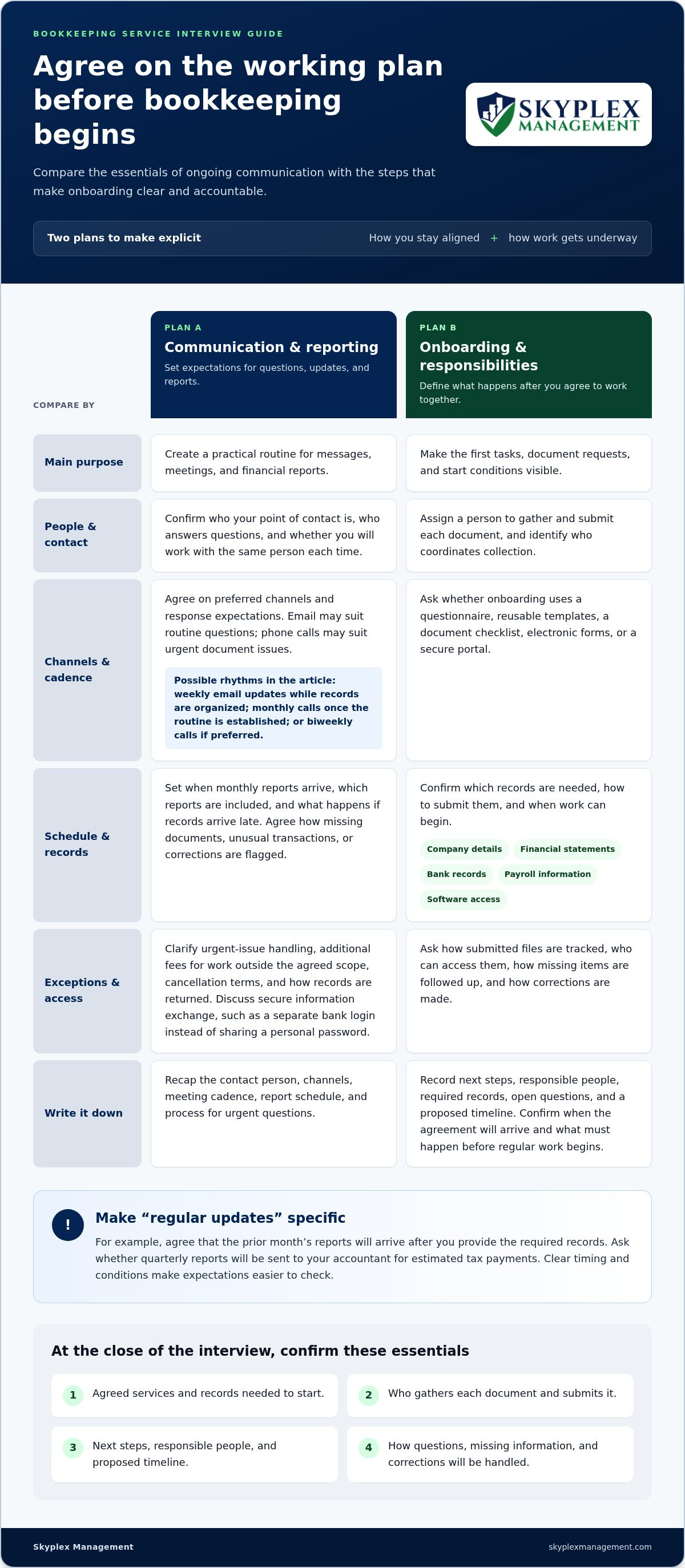
Discuss communication before bookkeeping begins. Establish your point of contact, preferred channels, reporting needs, and expected response times. For example, you might use email for routine questions and phone calls for urgent document issues. A clear process prevents messages from getting lost and helps both sides manage the relationship.
How will the bookkeeper communicate and respond to questions? Ask which channels they use, who will answer you, and what response timeframe they can commit to. If you prefer phone conversations, discuss regular check-ins. If you want written updates, agree on email or another shared channel.
Choose a check-in schedule that supports your decisions, not just the bookkeeper’s workflow. You might request weekly email updates while records are being organized, then switch to monthly calls once the routine is established. If you prefer phone communication, ask about biweekly calls. Confirm whether you’ll contact the same person each time, especially when a payroll or cash-flow question requires context.
Set a reporting calendar, too. Ask when monthly reports will arrive, which reports are included, and whether the bookkeeper sends quarterly reports to your accountant for estimated tax payments. Agree on what happens if records arrive late, since missing bank statements or receipts can delay reports. A defined schedule makes it easier to review results and prepare questions before a meeting.
Ask for specific delivery expectations rather than vague promises of “regular updates.” For example, agree that the prior month’s reports will arrive after you provide the required records. Discuss how the bookkeeper will flag missing documents, unusual transactions, or corrections. This makes “timely service” concrete and easier to evaluate.
What are the contract terms, cancellation policy, and additional fees? Request a written agreement that explains the notice required to end service, how your records will be returned, and which extra tasks may incur fees. Clarify how work outside the agreed scope, such as organizing paper receipts or addressing overdue entries, is approved and billed.
Before signing, summarize the communication plan in a short written recap. Record the contact person, channels, meeting cadence, report delivery schedule, and process for raising urgent issues. A routine built around small business bookkeeping should also explain how information is exchanged securely, such as using a separate bank login rather than sharing a personal password. That written plan gives both sides a practical reference when questions arise.
2. Summarizing the interview and defining onboarding next steps
Before ending the interview, recap what you discussed and invite the bookkeeper to correct any misunderstandings. Confirm your business structure, industry, location, formation date, employees, customers, and main bookkeeping challenge. These details help shape onboarding around your actual operations. A business with employees, for example, may need to provide payroll information as well as bank and transaction records.
Ask what happens after you agree to work together. A clear onboarding plan identifies who handles each task, which documents are needed, how to submit them, and when work can begin. If your accountant needs to provide prior reports or opening balances, assign that request to someone specific. A written recap keeps responsibilities visible and reduces follow-up.
- Confirm the agreed services and the records needed to start.
- Identify who will gather each document and submit it.
- Record the next steps, responsible people, and proposed timeline.
- Clarify how questions or missing information will be handled.
Ask whether the firm uses an onboarding questionnaire or reusable templates. A structured form can gather business details consistently, while a document checklist shows which records are still outstanding. The questionnaire may cover entity type, revenue, employees, customers, and business goals. Make sure you can also explain unusual circumstances, such as a change in ownership or incomplete records.
Document collection should follow a clear sequence. For example, the bookkeeper might request company details first, followed by financial statements, bank records, payroll information, and accounting software access. Ask how the firm tracks submitted files and follows up on missing items. If information must also support requirements such as KYC or GDPR, ask what details are collected and how those requirements fit into the process.
Digital onboarding tools can make submitting and tracking documents easier. Ask whether you’ll complete forms electronically, upload files through a secure portal, or exchange documents another way. Then clarify who can access submitted information and how corrections are made. A useful process lets you see what’s complete without searching through scattered email attachments.
At the interview’s close, ask the bookkeeper to summarize the discussion, list open questions, and outline onboarding steps with a proposed timeline. Confirm when you’ll receive the agreement, who will coordinate document collection, and what must happen before regular work begins. If the interview raises bookkeeping or reporting questions, discuss your next steps with a professional before moving forward.
3. Current bookkeeping software
Describe your current bookkeeping process before discussing a change. Name the accounting software, payroll system, invoicing tool, and spreadsheets your team relies on. Explain who enters transactions, who reviews them, and where delays occur. For example, you might use QuickBooks Online for expenses, a separate app for invoices, and a spreadsheet to track customer payments.
Ask how the bookkeeper would work with your existing systems. Find out which tools they use, what access they need, and whether their service fits your operations. If they recommend different accounting apps, ask why a change would help and what the transition involves. Switching systems without a clear reason can create duplicate work instead of simplifying the process.
If you use QuickBooks, ask about the bookkeeper’s experience with the platform and whether they are a QuickBooks Certified ProAdvisor. Ask how they handle your chart of accounts, transaction reviews, and recurring reports. A practical example can reveal their approach: what would they review first if a QuickBooks Online balance didn’t match the bank statement?
If your business uses billing or case-management software, ask how its information will reach your accounting system. A law firm, for example, might use one platform for billing and another for bookkeeping. Ask whether the systems integrate, what information transfers, and where manual entry may still be necessary. Without a clear process, invoices or payments may need to be entered twice.
Map how information moves from a sale to your financial records. Identify where customer invoices originate, how payments are recorded, and how payroll data reaches the books. Then ask who handles each step. If an auto repair shop uses service software for invoices and parts, for instance, the bookkeeper should understand how those records connect to accounting reports.
Watch for vague answers about required apps, unclear access needs, or pressure to switch software without a clear reason. If the bookkeeper can’t explain how invoices, bank activity, and payroll information flow into your books, ask for a specific example before proceeding.
Before agreeing to a process, clarify how software access and changes will be managed. Ask whether you’ll retain access to your accounts, how data can be exported, and who approves changes to accounting settings. A separate user login is safer than sharing a personal password. If a new app is proposed, document its purpose and which records it will replace.
Compare the bookkeeper’s process with your actual operations. Questions about software compatibility, integrations, and manual steps can uncover hidden work before it becomes part of your routine. Write down the agreed tools and responsibilities so your team knows where to enter information and find accurate records.
4. Financial statements and bookkeeping cleanup
Ask the bookkeeper to review your existing accounts before estimating the work. Request a review of financial statements for the last three years, then discuss missing periods, unreconciled accounts, and unclear balances. A bank reconciliation compares the bookkeeping balance with the bank statement. If they differ, ask how the bookkeeper will identify and document the cause.
Clarify what cleanup includes and how the completed work will be checked. Old transactions may need categorizing, duplicate entries may need correcting, and account balances may need reconciling. Ask which periods need attention, what records support corrections, and how adjustments will be explained. This gives you a clearer picture of the work before regular reporting begins.
Discuss receipt handling separately. Explain whether receipts arrive as paper copies, email attachments, or files downloaded from bookkeeping software. Ask how each document will be matched to a transaction and what happens when a receipt is missing. If you use paper records, agree on a consistent way to organize and submit them.
Connect your records to your business goals. Tell the bookkeeper what decisions your financial statements need to support, such as monitoring cash flow, reviewing service profitability, or planning equipment purchases. Then ask which reports and account details would help answer those questions. Name both your short-term priorities and longer-term plans.
- Identify the financial reports you currently review and what information they leave out.
- Describe the records available for bank accounts, credit cards, payroll, and sales.
- Explain which bookkeeping tasks cause the most delays or uncertainty.
- Ask how cleanup findings will be shared and which points need your approval.
Be direct about financial management challenges. If payroll totals don’t match the amounts in your books, describe when the mismatch occurs and which reports you can provide. If customer balances are difficult to track, ask how receivables will be reviewed. Specific examples help the bookkeeper assess the process instead of guessing at the problem.
Discuss tax records as part of your overall financial picture. Ask whether prior tax returns are current and whether statements or supporting documents are available. Several years of unfiled returns may point to bookkeeping or accounting difficulties, so explain the timeline and available records. The bookkeeper can then identify which accounting information needs organizing for your tax professional.
Before agreeing to cleanup work, request a written summary of the records reviewed, unresolved items, proposed corrections, and next steps. Keep copies of source documents and preserve the original files. This record helps you understand what changed and gives future reviews a dependable starting point.
Previous bookkeeping service experience
Your last bookkeeping relationship can show what the next one should do differently. Explain why you’re leaving your current bookkeeper or accountant, then discuss a specific example. Was the problem an unresolved discrepancy, unclear ownership of a task, or advice that didn’t fit your business? The questions to ask a potential bookkeeping service should reveal what happened and what might have prevented the frustration.
Consider what worked, too. Perhaps your previous provider understood your business model or kept consistent records, even if another part of the relationship fell short. Identify the practices you want to retain, then describe the gap you need addressed. This helps you make a deliberate choice instead of assuming the entire previous arrangement was ineffective.
How much does a bookkeeping service cost in the U.S.? The price depends on the case and is provided after a quote request. Scope, transaction volume, payroll, cleanup needs, and accounting software complexity shape the quote.
Does the bookkeeping service work with your industry and business size? Ask whether its experience fits your industry, employee count, and business model. A construction company managing project costs, for example, has different needs from a service business that bills by appointment. Ask for relevant examples and how that experience would shape the work.
Turn dissatisfaction into a practical standard. If you had to correct recurring mistakes, ask how the bookkeeper reviews completed work and investigates errors. If advice felt disconnected from your business, describe a decision where you needed useful financial context. The questions to ask a potential bookkeeping service can show whether the provider addresses the underlying issue, not just the immediate complaint.
References can help you understand how a provider manages working relationships. Ask whether you can speak with a past or current client whose business has similar needs. Focus on practical topics, such as how the provider handled a change in business activity or resolved a misunderstanding. If they can’t offer references, ask more about their relevant experience.
Consider why the previous arrangement stopped fitting. A business may have added a service line, changed its operating model, or hired employees. Explain what changed and ask how the bookkeeping approach would adapt. This helps distinguish a provider mismatch from needs that have grown beyond the original arrangement.
Before deciding, compare each provider’s answers with the lessons you’ve drawn from past experience. Look for a thoughtful explanation of how they would address your concerns, and make sure important commitments appear in the written agreement. A clear fit can make a difficult transition the start of a more useful working relationship.
Skyplex Management: Small Business Bookkeeping
Skyplex Management helps small businesses keep financial records organized through Small Business Bookkeeping and Small Business Accounting. Turn to the firm when routine transaction tracking needs consistent attention, past entries need cleanup, or your books aren’t giving you a clear picture of business activity.
For QuickBooks Online users, QuickBooks Online Support & Cleanup can help resolve software questions and bookkeeping issues. Payroll Service supports businesses that want payroll handled alongside their financial records. The right starting point depends on your books, software, payroll needs, and reporting priorities.
If you’re ready to discuss your bookkeeping needs, contact Skyplex Management.
Turn a Strong First Conversation Into a Clear Working Relationship
Treat your interview as the start of an ongoing partnership, not just a hiring decision. The questions to ask a potential bookkeeping service should help you define dependable support for your business and how you’ll work together as your needs change.
Before moving ahead, consider what would help you feel informed and confident as the owner. A useful working relationship gives you room to ask questions, understand your financial information, and make decisions with greater clarity. Use that standard to guide your next conversation with Skyplex Management.
Skyplex Management offers Small Business Bookkeeping, Small Business Accounting, and QuickBooks Online Support & Cleanup. If you’re ready to discuss bookkeeping support for your situation, reach out to start a conversation.
A thoughtful next step can bring greater clarity to how you manage your business finances.
Frequently Asked Questions
What is the scope of the services you offer?
The scope should specify which recurring tasks and advisory work are included. Skyplex Management provides Small Business Bookkeeping, Small Business Accounting, QuickBooks Online Support & Cleanup, and Payroll Service. Ask how the agreement distinguishes ongoing work, such as recording transactions, from one-time needs, such as historical cleanup. Also clarify whether financial reports are prepared and explained, so you know what the service handles and what remains your responsibility.
Who owns my bookkeeping data?
Your agreement should explain your rights to the company’s books and records, including how you can access them during and after the engagement. Ask whether you can download your accounting data and reports, and in what format. If you change bookkeepers, for example, you’ll want transaction history and supporting records organized well enough to continue without rebuilding the books.
Who will I work with directly?
Know who is responsible for your account and who handles routine questions or urgent bookkeeping issues. Ask whether the same contact reviews your records, prepares reports, and follows up on missing information. If several staff members are involved, request a clear division of responsibilities. That way, when you explain a transaction, its context can carry through to later reviews.
Where is the work performed?
Bookkeeping can be handled remotely, on-site, or through a combination, so ask where the work takes place and how records are exchanged. If your business is in Cleveland, clarify whether meetings happen in person or online and which documents must be uploaded. Confirm how access to accounting records is arranged, who can see them, and whether your team needs specific digital tools.
Can I contact past or current clients?
Ask whether the bookkeeper can connect you with a client whose business needs resemble yours. A useful reference can describe practical experience, such as managing a software transition or explaining reporting concerns. The bookkeeper should obtain permission before sharing a client’s contact information. If they can’t provide references, ask more about their experience and working process.
What services are included in bookkeeping packages?
There’s no standard definition of a bookkeeping package, so compare the written task list rather than relying on the package name. Check whether it covers transaction categorization, account reconciliation, financial statements, payroll entries, or follow-up on missing records. Ask how one-time cleanup differs from ongoing bookkeeping. Bringing past transactions up to date, for example, may be separate from maintaining accurate records in future reporting periods.
What bookkeeping credentials and experience should you look for?
Look for experience that matches your accounting software, transaction types, and business structure. If you use QuickBooks, ask about QuickBooks Certified ProAdvisor status and how the bookkeeper applies that knowledge to your records. Request relevant examples, such as organizing contractor costs or tracking service income. Credentials can indicate technical knowledge, while clear explanations of real bookkeeping situations help you assess practical fit.
How does the service handle data security and confidentiality?
Ask how financial and employee information is protected during access, storage, and file transfer. Clarify whether each user receives an individual account, how access is limited, and how sensitive documents should be shared. A separate bank login for bookkeeping access is preferable to sharing your personal password. Also ask whom to contact if you suspect unauthorized access and how the firm would communicate about a security incident.
Disclaimer
The information provided in this article is for general educational purposes only and should not be considered accounting, tax, or legal advice. Every business is unique. Consult a qualified accounting professional before making financial or tax decisions. Contact Skyplex Management for guidance specific to your business.


