

The biggest red flags in an accounting service proposal are often the details it leaves unclear: who leads the work, what’s included, how extra work affects costs, and who owns or can access your financial data. A proposal should spell out the services, fees, payment terms, and how the work fits your business. If those details are vague, it’s harder to assess the scope and value before you agree.
You should expect more than a polished pitch. You need to know who will manage your books, what experience supports the work, how communication will happen, and what happens to your records if the relationship ends. Data ownership matters because your business needs ongoing access to its financial information.
This article explains how to assess a proposal’s leadership, value, expertise, scope, costs, and data ownership. You’ll learn which gaps warrant closer scrutiny, how to distinguish a clear service boundary from a hidden extra, and what practical details can help you make a confident decision.
Key Takeaways
- Look for clear leadership and dependable coverage so your accounting work doesn’t stall when staffing changes.
- A useful proposal connects its recommendations to your business needs, industry, and goals rather than relying on broad promises.
- Compare the stated services, exclusions, extra-work process, and billing terms to understand the full scope before agreeing.
- Clarify how you’ll access and retain your financial records if the working relationship ends.
- Use the proposal’s communication, reporting, and transition details to judge whether the arrangement will work in practice.
1. Controller leadership and staff turnover
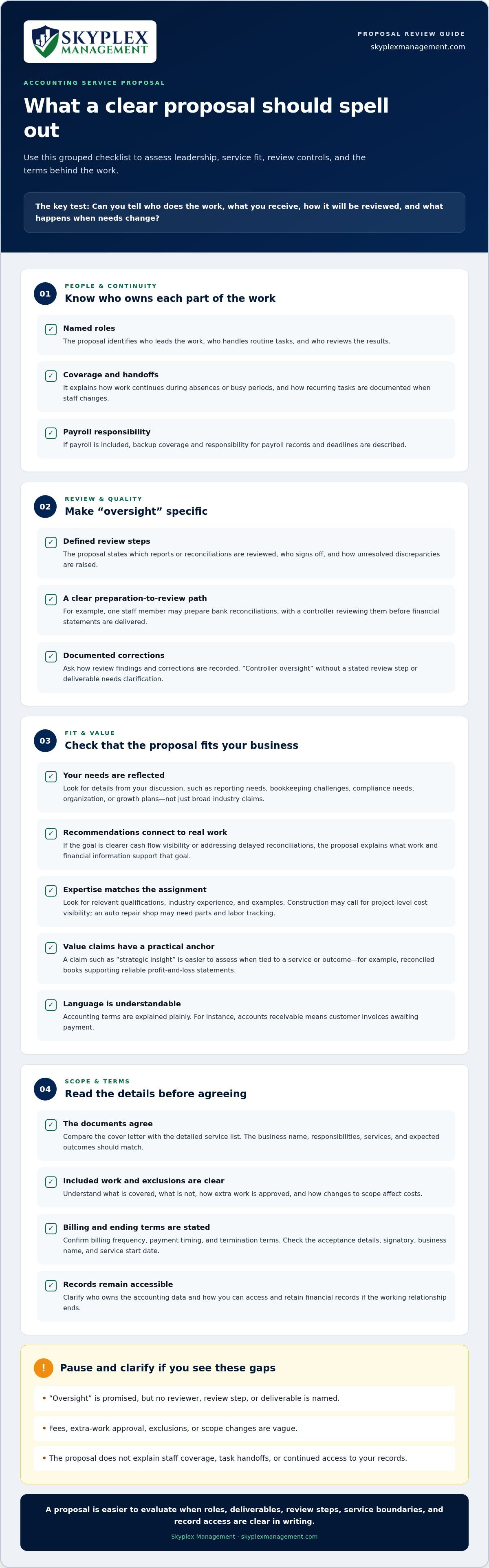
A proposal should identify who leads the work, who handles routine tasks, and who reviews the results. If one controller appears responsible for everything, ask how coverage works during absences or busy periods. Without effective delegation, work can bottleneck, especially when month-end tasks and payroll deadlines overlap. A practical proposal names the roles involved and explains how records move from preparation to review.
Look for operational signals, not just reassuring promises. Repeatedly late closes, missed compliance deadlines, or frequent changes in assigned staff can point to capacity problems. For example, if a new bookkeeper must repeatedly learn your chart of accounts, the handoff process may be weak. Ask how the team documents recurring tasks and maintains continuity when an employee leaves. If payroll is in scope, the proposal should describe backup coverage and responsibilities; payroll service support depends on clear handling of payroll records and deadlines.
Controller review should have a defined purpose. The proposal should say which reports or reconciliations are reviewed, who signs off, and how unresolved discrepancies are brought to your attention. For example, one staff member might prepare bank reconciliations, with a controller reviewing them before financial statements are delivered. If “controller oversight” appears without a specific review step or deliverable, that’s a red flag. Ask for the review process in writing, including how corrections are documented.
Technical currency also matters. For 2025 returns, the Internal Revenue Service allows the simplified home office deduction method at $5 per square foot, up to 300 square feet. The standard IRS business mileage rate was 70 cents per mile for 2025, according to the Internal Revenue Service. The Internal Revenue Service requires third party settlement organizations (TPSOs), including payment apps and online marketplaces, to report payments on Form 1099-K when payments received for goods or services through the platform exceed $20,000 in more than 200 transactions. These details illustrate why assigned reviewers need current, accurate records and clear responsibility for tax-related information.
Before accepting, compare the contract with the proposal. Confirm that the included work, exclusions, extra-work approval, billing frequency, payment timing, and termination terms are clearly stated. The acceptance section should include applicable legal requirements and a signature or e-signature space. Check that the signatory, business name, and service start date are correct. If the fees or scope changes are vague, request precise wording before signing, not after an extra task comes up.
2. Cover letter and value proposition
A cover letter should show that the proposal is tailored to your business, not just your industry. Check whether it reflects details from your initial meeting, such as reporting needs, bookkeeping challenges, or growth plans. A generic greeting followed by broad claims offers little evidence that the provider understood your situation. For example, a service business with several revenue streams may need reports organized by service line, while another business may need clearer expense tracking.
Look for a concise summary of your current needs and the proposed work to address them. A useful letter can identify your industry, explain relevant compliance needs, describe your organization, and connect those details to your short- and long-term goals. If you discussed delayed reconciliations, the proposal should explain how the work will address them. If your goal is clearer cash flow visibility, it should describe which financial information will help.
Test each value statement against a service, process, or outcome. “We provide strategic insight” is difficult to assess on its own. A stronger explanation might say that reconciled books support reliable profit-and-loss statements, helping you compare revenue and expenses. The proposal should also explain accounting terms in plain language. If it uses “accounts receivable,” it should clarify that this means customer invoices awaiting payment. Clear wording makes it easier to share the proposal with a business partner or manager.
A proposal should stand on its own after the meeting. Review it as if you were explaining the decision to someone who wasn’t there. Can they understand the business need, recommended work, expected deliverables, and how progress will be reviewed? Check that the rationale reflects your actual operations. For example, a construction company may need project-level cost visibility, while an auto repair shop may need consistent tracking of parts and labor. Be wary of promised results that aren’t tied to specific services.
Before deciding, compare the cover letter with the detailed proposal. Confirm that its summary matches the listed services, responsibilities, and proposed outcomes. Watch for contradictions, copied business names, or goals that weren’t discussed. A mismatch between the cover letter and service details can signal a rushed or poorly tailored document. If your needs have changed since the meeting, request a revised explanation before accepting. A focused conversation can help clarify what the proposal is designed to solve; discuss your accounting needs when you’re ready to review the fit.
3. Reviewing an accountant's value and expertise
Experience matters when it connects to the work your business needs. Look for named qualifications, relevant industry experience, and examples of similar assignments. A construction company, for instance, may need job-cost reports that show labor and materials by project. An auto repair shop may need clear tracking of parts, labor, and sales. Broad claims about “business expertise” don’t show how the accountant will handle those details.
Ask how the proposed team keeps its knowledge current and applies it to your records. A credible explanation connects relevant accounting standards, tax requirements, or industry reporting needs to specific procedures. For example, the proposal might explain who reviews account reconciliations and how unusual transactions are documented. A claim that the firm “handles compliance” without naming the work, responsibilities, or review process is a warning sign.
What security and confidentiality protections should an accounting provider offer? The proposal should explain who can access your financial records, how access is controlled, and how information is stored and shared. It should also describe how the provider handles suspected data exposure and protects records during staff changes or when the service ends.
Assess value against the proposed deliverables, not just impressive language. If the proposal promises “better decisions,” identify the reports, analysis, or conversations that support that result. For example, a useful reporting structure could show revenue and expenses by business line, then explain significant changes from the prior period. Ask who prepares the documentation, who reviews it, and how questions or corrections are handled.
What are signs that an accounting provider may be unqualified or overpromising? Watch for guaranteed financial outcomes, vague answers about who performs the work, or recommendations that bypass rules or distort reporting. Claims should align with the provider’s stated experience and the services listed in the proposal.
Use a focused review before signing:
- Match experience to needs: Compare the team’s examples with your industry, software, and reporting requirements.
- Trace each promise: Connect every claimed benefit to a deliverable, responsible role, or documented process.
- Test the explanations: Ask the provider to explain one unfamiliar accounting term and one likely exception in plain language.
- Check the review structure: Identify who prepares the records, who checks them, and how corrections are recorded.
These steps help distinguish demonstrated expertise from polished assurances. If the proposal doesn’t explain how the work is performed, reviewed, and protected, treat that omission as a meaningful warning sign.
4. Scope of work and cost transparency
A clear scope names the tasks, records, and deliverables included in the engagement. For bookkeeping, that may mean transaction categorization, account reconciliations, and financial statements. “Accounting support” alone leaves too much open. The proposal should also identify exclusions, such as historical cleanup or special reporting, so routine work doesn’t become an unexpected add-on.
How do proposals differ for bookkeeping, tax preparation, and advisory work? Bookkeeping proposals define recurring transaction processing, reconciliations, and reports. Tax preparation proposals specify which returns are prepared from the records provided. Advisory proposals should describe the decisions or planning topics covered, such as cash flow forecasting, and identify the resulting analysis or meetings.
Review the fee structure alongside each task. A proposal should state how often billing occurs, when payment is due, accepted payment methods, and what triggers additional charges. The price depends on the work involved: transaction volume, account complexity, payroll needs, cleanup, and reporting requirements can all affect the cost. Avoid vague terms like “as needed” unless the agreement explains how the work is approved and billed.
Ask how the provider handles work outside the agreed scope. For example, if reconciling an account reveals old unreconciled transactions, the proposal should explain how the issue is assessed and how you approve extra work before it begins. A defined change process protects both sides: document the requested task, its effect on timing, and any fee adjustment before work proceeds. This helps prevent disagreements when records need correction or an unusual transaction requires investigation.
How should deadlines, response times, and service levels be described? The proposal should set expected delivery dates, communication channels, operating hours, and response times. It should also explain how late or incomplete records affect timelines. For example, it can specify when you provide statements and when to expect reconciliations or reports.
How should the proposal define your responsibilities and required records? It should list the documents and access you must provide, such as bank statements, invoices, receipts, and accounting-system access, and identify who is responsible for supplying them. It should also explain how missing or inconsistent records are handled, since incomplete source documents can delay reconciliations and lead to errors.
A plan of action should connect each step to clear objectives and explain how progress will be monitored. Look for a process for resolving discrepancies, approving adjustments, and reviewing reports before delivery. If the proposal promises “complete bookkeeping” but never defines the close process or review point, its scope may not match your expectations.
Before signing, compare the proposal with the agreement and note any conflicting task, deadline, or billing process. Get unclear terms clarified in writing, especially if they could change the work or payment during the relationship. Clear boundaries help you understand the provider’s responsibilities and reduce scope disputes.
5. Client ownership of accounting data
Your records should remain usable by your business, not just accessible through a provider’s workflow. The proposal should explain who owns the accounting data, who can view or download it, and how access works during the engagement. For example, clarify whether you retain administrator access to your accounting software while the provider handles bookkeeping. If the agreement promises only “access,” ask which records you can retrieve and in what format.
Identify the records covered by the handoff. These may include transaction details, reconciliations, financial statements, payroll reports, invoices, receipts, and supporting documentation. Ask whether the provider will return files stored outside your accounting system, such as spreadsheets used to prepare reports. A clear agreement distinguishes your original records from the provider’s internal workpapers and explains which items you receive when the service ends.
The contract should set out a practical exit process. It should explain how the provider transfers records, removes or changes user access, and handles copies retained for internal processes. Agree on a transition timeline, delivery method, and the person responsible for each step. For example, name who exports the general ledger and reconciliations, who transfers payroll reports, and how you confirm receipt.
Also review access to connected systems. If a provider works with your bank feed, payroll platform, or payment processor, the agreement should explain how those connections are managed. When the relationship ends, define how the provider’s access will be removed without disrupting yours. Keep account ownership and recovery information under your business’s control, and don’t rely on a former provider’s personal login to retrieve essential records.
Clarify how the provider handles sensitive information throughout the relationship. The proposal should identify authorized users, approved sharing methods, and the process for reporting suspected exposure. Ask how long records are retained after termination and how they are securely disposed of when retention ends. These terms clarify the provider’s responsibilities without assuming a software login alone protects every file.
Before signing, add or confirm these details in the agreement:
- Access: Specify your administrator rights and the records available during service.
- Delivery: Name the files, format, transfer method, and responsible person for handoff.
- Exit: Set a transition timeline and explain how connected-system access will change.
- Retention: Describe record retention, copies, and secure disposal after service ends.
A contract that lets the provider control access without explaining how your business can retrieve its records is a red flag. Resolve that gap before accepting, especially if a filing deadline or lender request depends on timely financial statements. Clear data terms support continuity when staff, software, or accounting providers change.
Skyplex Management: Small Business Bookkeeping
Skyplex Management provides Small Business Bookkeeping for owners who need organized records and clearer financial information. For small businesses in Cleveland and across Northeast Ohio, support can include Small Business Accounting, QuickBooks Online Support & Cleanup, and Payroll Service.
Consider turning to Skyplex Management when delayed records make it harder to understand performance, QuickBooks Online needs cleanup, or payroll tasks are taking time away from operations. Financial Reporting & Advisory can help you make better use of business reports, while Outsourced Accounting & Controller Services can provide broader accounting support.
The right next step is a conversation about the work your business needs and the support that fits. Contact Skyplex Management to discuss your bookkeeping or accounting needs.
Make the proposal a practical next step
A sound accounting decision rests on a few essentials: dependable leadership, expertise suited to your business, clearly defined work, transparent costs, and continued access to your records. Use these criteria to judge whether a proposal offers a workable relationship, not just a polished presentation. Red flags in an accounting service proposal are reasons to pause and seek clarity before committing.
Skyplex Management offers Small Business Bookkeeping, Small Business Accounting, and QuickBooks Online Support & Cleanup. If you want help assessing your accounting needs or organizing your books, a conversation can help you identify a practical next step.
Clear decisions can give you a steadier foundation for running your business.
Frequently Asked Questions
What Is an Accounting Services Proposal?
An accounting services proposal turns an initial business discussion into a written recommendation. It gives owners and other decision-makers a way to review the provider’s approach before moving forward. For example, a business partner who missed the introductory meeting can use it to understand why certain accounting support was recommended. Treat it as a decision document, then compare it with the final agreement before accepting.
What red flags should I look for in an accounting services proposal?
Watch for assumptions that don’t match how your business operates. A proposal addressed to the wrong business entity, for example, may signal that the provider misunderstood which company’s records are involved. Check the document date and version, especially if you received revisions after discussing changes. If the proposal refers to a system or business structure you don’t use, request an updated version before relying on its recommendations.
What services and deliverables should an accounting proposal clearly specify?
Check whether the proposed outputs answer the questions you use to run the business. An owner who reviews performance by location, for example, needs reports that separate locations rather than combine them. Consider who will read each report, what decisions it should support, and whether a sample format would clarify expectations. This helps you assess whether the work will be useful beyond producing standard statements.
How should accounting service fees and pricing terms be disclosed?
Compare the quoted amount with the assumptions used to prepare it. If the proposal assumes one entity, a stable transaction pattern, or a particular accounting platform, make sure those assumptions fit your situation. Ask how the provider handles changes, such as adding a new business entity. Comparing the assumptions with your operations can reveal whether the quote reflects the work you expect to need.
What hidden fees or extra charges commonly appear in accounting proposals?
Pay attention to one-time transition tasks that may fall outside ongoing accounting work. Moving from another system, importing historical transactions, or setting up a new reporting structure can require separate effort. Ask whether those activities are part of the initial engagement or treated as distinct projects. Also consider whether a rush request, such as preparing information for a lender meeting, changes the work arrangement. The proposal should make these boundaries clear.
What qualifications, licenses, and experience should an accounting firm have?
Assess credentials in relation to the specific work you’re hiring the provider to perform. For example, a business seeking routine bookkeeping should understand who will maintain its records, while an assurance engagement is a different service category. Ask the provider to identify the person responsible for your account and explain how that person’s background fits your needs. Don’t assume a title alone explains the work or responsibilities included in your engagement.
What contract terms, cancellation clauses, and auto-renewals should I review?
Check how the proposal, service agreement, and later written changes fit together. If one document describes a different arrangement, determine which document controls before signing. Note whether changes require written approval from both parties and who can authorize them for your business. Keep the accepted version with related correspondence so you can refer to the same terms in future discussions. This creates a clear record if your needs or working arrangements change.
Disclaimer
The information provided in this article is for general educational purposes only and should not be considered accounting, tax, or legal advice. Every business is unique. Consult a qualified accounting professional before making financial or tax decisions. Contact Skyplex Management for guidance specific to your business.


