

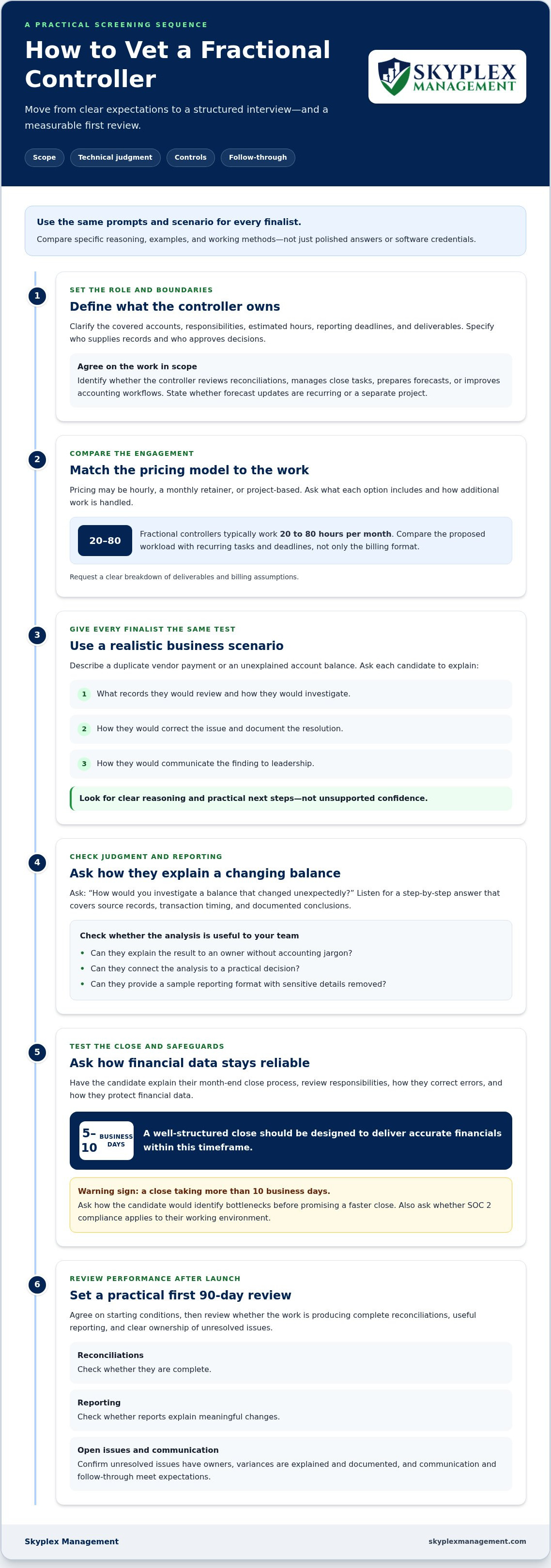
A fast close means little if the numbers aren’t reliable. Knowing how to vet a fractional controller starts with assessing how they protect financial data: ask them to explain their month-end close process, review controls, and how they correct errors. A well-structured close process should be designed to deliver accurate financials within 5-10 business days.
You’re right to look beyond a résumé or software credentials. A fractional controller’s work can shape decisions you make using financial reports, so you need someone who can explain their approach and connect it to your business’s needs. This guide shows you how to assess technical ability, financial controls, relevant industry experience, systems knowledge, and references.
You’ll also find practical interview questions, warning signs to watch for, and ways to distinguish controller-level oversight from transaction-focused bookkeeping. Use these criteria to compare candidates and decide whether their experience and working style fit your business.
Key Takeaways
- Assess whether the candidate can explain controller-level oversight, not just transaction recording, in terms that fit your business needs.
- Use practical questions about reconciliations, review steps, and error correction to evaluate how they protect financial data.
- Compare industry experience with the accounting challenges your business actually faces, then explore relevant examples from past work.
- Confirm the candidate can work effectively with your accounting software and payment systems, and use references to understand their communication and follow-through.
- Bring a consistent set of interview questions so you can compare candidates on skills, controls, systems, and working style.
How Do You Hire the Right Fractional Controller?
Start by matching the role to your business’s financial needs. Compare responsibilities, reporting, engagement terms, and how each candidate explains their approach.
An in-house controller works within your business, while a fractional controller provides controller-level support on a part-time basis. Bookkeepers generally record transactions; controllers oversee financial processes and reporting. Outsourced accounting firms may provide broader accounting services, depending on the engagement.
Controller Responsibilities and Reporting
Ask candidates to describe who handles each step, from coding transactions through review and reporting. A controller may oversee the monthly close, review account reconciliations, and prepare financial statements that help owners understand performance. If your business has no CFO, ask how the controller would coordinate with your bank and CPA. Their answer should clarify responsibilities, decision-making boundaries, and reporting frequency.
Set a practical performance review for the first 90 days. Agree on starting conditions, then assess whether reconciliations are complete, reports explain meaningful changes, and unresolved issues have owners. For example, if a cash balance differs from the bank statement, the controller should explain the variance and document its resolution. Measure communication and follow-through alongside reporting quality.
Pricing Models and Costs
Fractional controller pricing may use an hourly rate, a monthly retainer, or project-based fees. The cost depends on scope, expected hours, financial complexity, and the level of oversight required; establish the fee through a quote request. Fractional controllers typically work 20 to 80 hours per month, so compare the proposed workload with recurring tasks and deadlines, not just the billing format.
Ask what each pricing model includes and how additional work is handled. A monthly retainer may suit recurring close and reporting duties, while project pricing can fit a defined systems or process assignment. Before comparing proposals, request a clear breakdown of deliverables and billing assumptions.
Engagement Scope and Deliverables
The agreement should identify covered accounts, responsibilities, estimated hours, reporting deadlines, and deliverables. Specify whether the controller reviews reconciliations, manages close tasks, prepares forecasts, or improves accounting workflows. Name who supplies records and approves decisions. Clear ownership helps prevent routine work from falling between the controller and your staff.
Set expectations for meetings, communication, access to financial systems, and approval of scope changes. For example, clarify whether forecast updates are recurring or a separate project. A written schedule links the engagement’s hours to specific outputs, making progress easier to review.
Controller screening and technical vetting
Use a consistent screening process to assess technical judgment, communication, and fit. Give each finalist the same business scenario so you can compare their approach.
For example, describe a duplicate vendor payment or an unexplained account balance. Ask the candidate to explain how they would investigate, which records they would review, how they would correct the issue, and how they would communicate it to leadership. Look for clear reasoning and practical next steps, not unsupported confidence.
- Ask how they identify and resolve errors in transaction records.
- Request a sample reporting format with sensitive details removed.
- Compare their analysis with the decisions your leadership team needs to make.
- Ask how they manage deadlines when records arrive late or incomplete.
Use the same prompts in every interview, then record specific examples. This makes candidates easier to compare and helps distinguish polished answers from relevant experience.
Interview Questions and Responses
Ask, “How would you investigate a balance that changed unexpectedly?” Look for a step-by-step answer that covers source records, transaction timing, and documented conclusions. Then ask how they would explain the result to an owner without accounting jargon. A strong response connects the analysis to a practical decision, rather than merely describing a report.
Also ask what information they need before preparing a forecast. Listen for questions about business plans, cash timing, and significant upcoming commitments. Their explanation should make assumptions clear and show how the analysis supports decisions. These answers help you learn how to vet a fractional controller based on judgment, not just résumé claims.
Hiring Red Flags and Risks
Be cautious if a candidate promises results before asking about your accounts, records, or current process. A month-end close taking more than 10 business days is a warning sign for the business. Ask how they would identify bottlenecks before promising a faster close.
Other red flags include unclear review responsibilities, reluctance to describe data-protection practices, or vague answers about correcting errors. Ask candidates to explain relevant safeguards, including whether SOC 2 compliance applies to their working environment. Treat credentials as supporting evidence, not a substitute for a sound method.
Use a short scenario exercise to assess technical judgment. Candidates for an advertised role may need experience managing books for organizations with $10 million to $50 million in annual revenue. Ask for examples at a comparable scale, while recognizing that revenue alone doesn’t establish fit. For a 1099 candidate, confirm capacity for at least 20 hours per week when that fits the engagement.
An accounting or finance degree may be relevant, and a CPA, CMA, or CFA can be an additional qualification. Ask which experience supports the work you need and how the candidate would apply it to your accounting challenges.
If screening results leave you weighing the right level of accounting support, discuss your accounting needs and the decisions your reports should support.
Financial data accuracy and internal controls
Assess how a controller keeps financial information accurate from source documents through management reports. Ask for a practical walkthrough of reconciliations, review steps, accounting policies, and system access. Their answers should show how each control fits your finance workflow and business complexity.
Ask the candidate to explain a month-end close from start to finish. How do bank activity, credit card transactions, payroll reports, and bills reach the accounting records? What happens when a statement arrives late or a balance doesn’t match? A structured close process should be designed to deliver accurate financials within 5-10 business days. Focus on the sequence of checks, not only the target date.
Use a distinct scenario to test their judgment about controls: a manager submits a reimbursement without a clear business purpose. Ask what supporting documents the controller would request, who should review the claim, and how the transaction should be recorded. A strong response explains how to resolve the issue while documenting the decision appropriately.
- Reconciliations: Ask who compares bank and credit card statements with ledger balances and resolves differences.
- Approvals: Ask how spending approvals work when employees submit expenses or purchase requests.
- Access: Ask how system permissions reflect each person’s role, including a member who approves transactions.
- Review: Ask what the controller examines before financial statements are shared with management.
In a small team, separating every task may be difficult. Ask the candidate to suggest a practical second review, such as having an owner approve unusual reimbursements. Ask how that review would be documented and how access should be reconsidered when responsibilities change. Their answer should reflect the team’s actual workflow.
Accounting policies also support consistent reporting. Ask how the controller would address two employees coding similar expenses differently. They should explain how to review the transactions, establish consistent treatment, and communicate the policy. Consistency makes it easier to compare expenses across reporting periods and spot changes that need attention.
For payroll controls, ask how payroll reports are checked against accounting records and related payments. The IRS publishes employer guidance on employment taxes and recordkeeping, which can help frame questions about how payroll information is organized and reviewed. Listen for a clear process connecting payroll records with the company’s financial reporting.
Finally, ask the candidate to describe how they review a financial statement before releasing it. If travel expenses rise, for example, they should trace the change to supporting transactions and explain the result plainly. Ask how they flag unresolved items so management can distinguish reviewed figures from open questions.
Industry, systems, and reference checks
Compare each candidate’s industry knowledge, software experience, reporting skills, and control practices with your business’s needs. To learn how to vet a fractional controller, ask for specific examples and examine how the candidate applied their experience.
Industry and Reference Checks
Industry experience matters because accounting practices differ by business model. For a construction company, ask whether the candidate has worked with work-in-progress schedules and percentage-of-completion accounting. Request a case study or client example showing how they handled similar reporting needs. Ask which tasks they completed personally and where they coordinated with the client’s team.
Use references to understand how the candidate works during an engagement. Ask former clients about communication, reporting timeliness, and follow-through on unresolved questions. Compare their answers with the candidate’s published case studies or work examples. Specific accounts of the candidate’s responsibilities provide more useful evidence than a general endorsement.
Software and Reporting Capabilities
Ask which accounting software and payment processors the candidate has used, then compare those tools with yours. For example, ask how they would reconcile payment processor deposits with sales records and bank activity. Their explanation should address fees, timing differences, and unmatched transactions. This helps you judge whether they can apply their knowledge to your actual workflow.
Assess whether the candidate can tailor reports to management’s needs. Ask how they would organize a profit and loss statement, balance sheet, or cash flow report for your business. Request a sample with confidential details removed. Then ask how they would explain a change in gross margin or outstanding receivables to an owner making an operating decision.
Internal-Control Capabilities
Ask the candidate to walk through a workflow, such as paying a vendor, from invoice receipt through approval and recording. Listen for defined responsibilities, documented reviews, and a process for handling exceptions. If one employee enters and approves payments, ask what additional review could fit your team’s structure.
Discuss access to accounting software and payment systems. Ask how the candidate assigns permissions by role and reviews access when responsibilities change. For example, an employee who enters payroll data may not need authority to approve every related payment. The candidate should explain how controls can fit your workflow without obstructing routine work.
Use consistent questions to compare candidates’ industry examples, software experience, and control procedures. A construction candidate, for instance, should explain how project reporting connects with work-in-progress schedules. A candidate familiar with your payment processor should describe how its activity ties to sales and bank deposits. These specifics help you assess fit with your operations.
Finally, compare references with interview answers and work samples. Ask a former client whether reports arrived as agreed, explanations were understandable, and open items received follow-up. When the reference’s account aligns with the candidate’s examples, you have clearer evidence of their working approach and fit.
What questions should you ask when interviewing a fractional controller?
Use the interview to see how a candidate thinks through your actual work. Give each finalist the same business scenario, then compare their steps, explanations, and follow-up questions.
Ask for a practical walkthrough
Describe a decision you expect to make, such as whether to add staff or delay a purchase. Ask what financial information the controller would review, which assumptions matter, and how they would present the analysis. A strong answer connects records to the decision, identifies missing context, and explains the next step without burying you in accounting terms.
- Priorities: “What would you review first in our current financial reports?” Look for a reasoned sequence tied to business decisions.
- Forecasting: “How would you build a cash forecast from our recent activity?” Listen for questions about expected receipts, scheduled payments, and assumptions.
- Variances: “If an expense rises sharply, how would you explain the change?” A useful answer traces the difference to transactions, timing, or coding.
- Communication: “How would you explain an unfavorable result to an owner?” Ask for a plain-language example and a recommended management action.
- Capacity: “How do you prioritize when several deadlines compete?” The candidate should describe how they set expectations and flag conflicts early.
- Collaboration: “What information do you need from our team each month?” Their answer should identify records, owners, and handoffs.
Then test whether the candidate can adapt. Add a detail, such as a customer paying later than expected, and ask how it changes the forecast. Notice whether they revise the analysis, state the impact clearly, and explain what information would improve the estimate. This shows how they respond when business conditions shift.
Ask about the early stages of an engagement: “How would you learn our reporting process, identify gaps, and agree on priorities?” Look for a sequence that includes reviewing existing records, meeting key staff, documenting findings, and setting deliverables. A candidate should distinguish immediate fixes from longer-term process improvements.
Close by asking for a relevant client example and a reference who can discuss similar work. Ask what the candidate personally handled, what changed in the reporting process, and how they kept owners informed. Compare those details with their interview answers. Clear, consistent examples help you assess both technical judgment and working style.
Skyplex Management: Small Business Bookkeeping
Skyplex Management helps small businesses keep financial records organized and useful for day-to-day decisions. If you’re assessing controller-level support, consistent bookkeeping and accounting can give you a clearer starting point for reviewing your accounts and reporting needs.
Skyplex Management provides Small Business Bookkeeping and Small Business Accounting, along with QuickBooks Online Support & Cleanup to help businesses correct or organize their records. Payroll Service supports payroll processing and related bookkeeping. These services help owners address gaps in routine financial work while determining what level of oversight the business needs.
If your records need attention before you evaluate controller support, or you’d like help with ongoing accounting, contact Skyplex Management to discuss your needs.
Turn your financial needs into a clear next step
Learning how to vet a fractional controller is most useful when you start with a decision your business needs to make. Identify where you need greater clarity, such as hiring plans, cash timing, or the financial information you rely on to set priorities. That focus can help you determine what support would be useful now and what can wait.
Before taking the next step, write down the finance questions that keep coming up and the reports or processes that would help answer them. A focused conversation can help you separate immediate accounting needs from longer-term controller oversight. Skyplex Management can discuss how bookkeeping, accounting, and QuickBooks Online support fit into your needs.
With a clear view of the decisions ahead, you can move forward with greater confidence and build a stronger foundation for your business’s next stage.
Frequently Asked Questions
What does a fractional controller do, and what services are typically included?
A fractional controller provides part-time oversight of a business’s accounting operations and financial information. Depending on the engagement, the work can include coordinating the close, setting accounting policies, preparing or reviewing financial statements, and supporting budgets or forecasts. For example, an owner preparing to hire may need projections showing how payroll could affect cash flow. Define in the agreement which decisions and deliverables the controller will support.
What qualifications and experience should a fractional controller have?
Look for hands-on experience managing accounting operations, reviewing financial records, and explaining results to business leaders. A degree in accounting or finance may suit some roles; credentials such as CPA or CMA can add relevant expertise. Treat credentials as one part of the assessment. Ask candidates how they handled a real reporting problem, what they personally did, and how they communicated the outcome to management.
What industries and company sizes should a fractional controller have experience with?
Prioritize experience with your business model and its financial complexity, rather than relying on revenue alone. A construction company may need familiarity with project tracking, while a service business may focus on labor costs and customer billing. As a market example, companies generating $1M to $5M USD ARR are a typical fit for fractional-controller services. Some advertised construction roles require 10+ years of construction accounting experience, but that is role-specific, not a universal rule.
How can you verify a fractional controller’s references, credentials, and work history?
Verify each claim against a concrete example. Contact references who can describe the candidate’s responsibilities, communication, and follow-through, then compare their accounts with the résumé. For credentials, confirm the exact designation and its current standing through the issuing organization. Ask about employment dates, role changes, and the candidate’s specific contribution to a project. A redacted report or process document can demonstrate work quality without exposing confidential client information.
Disclaimer
The information provided in this article is for general educational purposes only and should not be considered accounting, tax, or legal advice. Every business is unique. Consult a qualified accounting professional before making financial or tax decisions. Contact Skyplex Management for guidance specific to your business.


