

A strong sales month doesn’t always mean there’ll be enough cash for payroll, materials, and recurring bills next month. That’s why learning how to create a business budget is less about predicting every dollar perfectly and more about making informed plans with the records you have.
If uneven income makes forecasting difficult, or financial reports feel hard to interpret, you’re not alone. A useful budget connects expected revenue and expenses to cash flow, so you can see where pressure may build and make decisions before it becomes urgent.
This guide walks you through building a realistic budget from your existing records, planning for regular costs and payroll, and accounting for changes in revenue. You’ll also learn how to compare your budget with actual results and update your assumptions throughout the year. Consistent monthly bookkeeping, clear financial reporting, and organized payroll records make those decisions easier. For small businesses in Cleveland, Akron, Medina, Strongsville, Brecksville, Hudson, Stow, Cuyahoga Falls, Fairlawn, Brunswick, Wadsworth, North Royalton, Canton, Wooster, Richfield, Macedonia, Broadview Heights, and Solon, a budget can turn reliable financial records into a practical planning tool.
Key Takeaways
- Learn how to create a business budget using reliable records and realistic assumptions, rather than relying on guesswork.
- Organize revenue, direct costs, operating expenses, payroll, taxes, and planned investments to see the full picture.
- Estimate income and expenses by category, accounting for fixed, variable, and occasional costs.
- Compare planned figures with actual results using consistent bookkeeping categories, then adjust assumptions when circumstances change.
- Use dependable bookkeeping, payroll records, and financial reports to make budget reviews clearer and more useful.
Why a Business Budget Matters for Small-Business Decisions
A business budget is a forward-looking plan for expected revenue, costs, and financial priorities over a set period. It gives you a structured way to decide how the business may use its resources, rather than relying on memory or reacting to each bill as it arrives. For a broader overview of budgeting, see this introduction to the business budget.
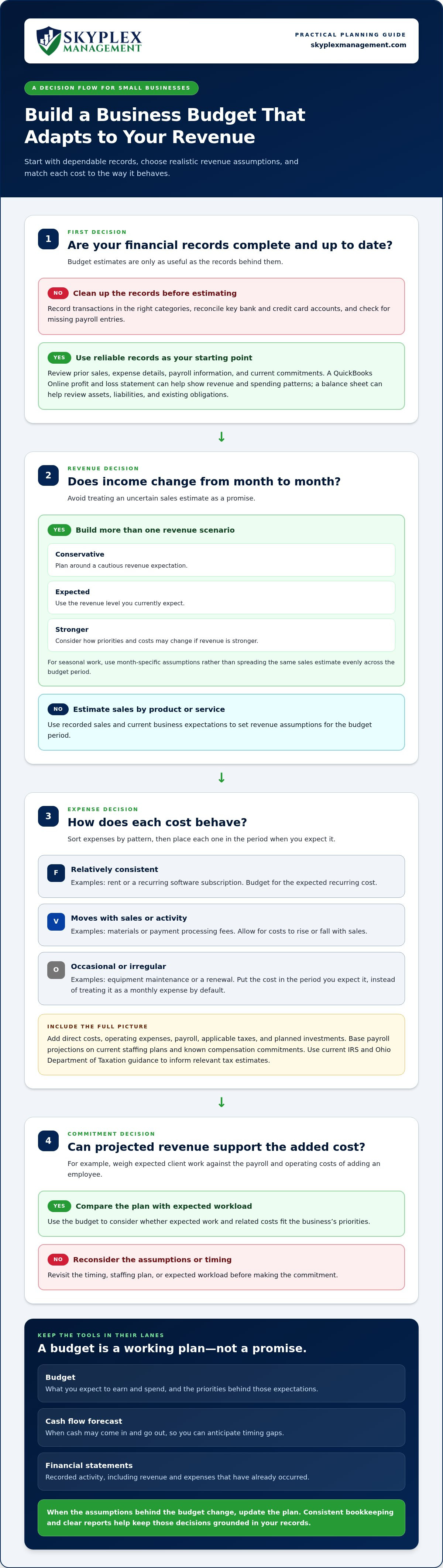
A budget is useful even when actual results differ from the plan. It helps you make decisions with the information available, then gives you a reference point for understanding what changed. It’s also distinct from two other financial tools:
- A budget lays out what you expect to earn and spend, and the priorities behind those expectations.
- A cash flow forecast estimates when cash may come in and go out, helping you anticipate timing gaps.
- Financial statements summarize recorded activity, such as revenue and expenses that have already occurred.
Used together, these tools show different parts of the financial picture. Consistent bookkeeping and clear reports help make budget assumptions more dependable, while cash flow planning helps you consider whether money will be available when payments are due.
What does a business budget help an owner understand?
A budget connects expected sales to the costs of delivering work, operating the business, paying employees, and investing in growth. It can also flag potential cash pressure early, giving you time to weigh options before a decision becomes urgent.
For example, a service business considering another employee can compare expected client work with the added payroll and operating costs. If projected revenue may not cover the commitment, the owner can reconsider the timing, staffing plan, or expected workload before moving forward.
Is a budget useful when income changes month to month?
Yes. Variable revenue makes planning more important, even if it makes exact predictions less realistic. Instead of treating one sales estimate as certain, prepare conservative, expected, and stronger revenue scenarios. These show how costs and priorities might change under different conditions.
Seasonal businesses around Cleveland, Akron, and nearby communities may need month-specific assumptions. A service company with busier periods at certain times of year can plan for revenue and expenses to rise or fall across the budget period, rather than spreading the same estimate evenly across every month.
A budget should change when the assumptions behind it change. Treat it as a working decision tool, not a promise that results will match projections. That flexibility is the foundation for learning how to create a business budget that stays useful throughout the year.
The Building Blocks of a Realistic Business Budget
A useful budget separates the money coming in from the costs required to earn it and run the business. Start with revenue, then organize expenses into direct costs, operating expenses, payroll, applicable taxes, and planned investments. Direct costs are tied to delivering a product or service, while operating expenses support the business more broadly.
Classify expenses by how they behave. Rent or a recurring software subscription may stay relatively consistent during the budget period; materials or payment processing fees may rise or fall with sales. Occasional expenses, such as equipment maintenance or a renewal, may not appear every month but can still affect the plan. Harvard Business School Online’s guide to preparing a budget also emphasizes organizing estimates around the business’s priorities and expected activity.
Which financial records should inform budget estimates?
Use prior sales records, expense details, payroll information, and current commitments as starting points. In QuickBooks Online, reports such as the profit and loss statement can help identify revenue and spending patterns. Payroll records add detail about wages and related costs, while a balance sheet can help you review assets, liabilities, and existing obligations before planning investments.
These records are only useful if they’re complete and up to date. Unreconciled bank or credit card accounts, uncategorized transactions, or missing payroll entries can distort the patterns you rely on. Before building estimates, check that transactions are recorded in the right categories and that key accounts have been reconciled. Consistent bookkeeping gives your assumptions a firmer foundation.
How should owners handle taxes, payroll, and irregular costs?
Include payroll and tax categories that apply to your business, using current guidance from the IRS and Ohio Department of Taxation to inform relevant estimates. Tax obligations vary by business, so don’t assume every company has the same requirements. For payroll, base projections on current staffing plans and known compensation commitments, then account for changes you expect to make.
Review irregular expenses deliberately, too. Consider whether maintenance, renewals, or seasonal hiring are relevant to your operations. Record these costs in the periods when you expect them, rather than treating them as monthly expenses by default. If the timing or amount is uncertain, note that assumption so you can revisit it during a budget review.
| Budget item | Budget assumption | Actual result | Source record |
|---|---|---|---|
| Revenue | Expected sales by service or product | Recorded sales for the period | Sales records or profit and loss report |
| Payroll | Planned staffing and wages | Wages recorded and paid | Payroll reports |
| Operating expense | Expected recurring or variable costs | Expenses recorded | Expense details and account records |
| Planned investment | Expected purchase or improvement | Amount and timing recorded | Commitments, invoices, and accounting records |
This comparison helps show which assumptions need attention as you continue learning how to create a business budget. If your records need organizing before you can make dependable estimates, discuss your bookkeeping and budgeting needs with Skyplex Management.
How to Create a Business Budget Step by Step
A practical budget starts with records you can trust and assumptions you can explain. Follow these steps to build a first draft that reflects how your business operates, not just how you hope it will perform.
- Step 1: Choose the budget period. Decide whether you’re planning month by month, for a quarter, or for a full year. Use a period that supports the decisions you need to make, and break longer plans into months if revenue or expenses change through the year.
- Step 2: Gather reliable records. Pull together recent sales and expense records, payroll information, current commitments, and details of planned purchases. Review your bookkeeping for missing or misclassified transactions first. Organized records make it easier to set assumptions you can later compare with actual results.
- Step 3: Estimate revenue using evidence. Start with historical sales, known contracts, customer patterns, and planned changes, such as adding a service. Break revenue down by product, service, customer, or season when your records support that detail. Separate recurring income from uncertain or one-time work so a possible sale doesn’t look like dependable revenue.
- Step 4: Add expected costs and payroll. List recurring commitments, then estimate variable costs that rise or fall with sales or service delivery. Review staffing plans and payroll records, and include applicable tax categories based on your business and current guidance. Add planned purchases in the periods you expect them.
- Step 5: Document assumptions and review the draft. Note the reason behind each estimate, such as a contract, prior sales pattern, or planned staffing change. For uncertain or seasonal revenue, build conservative, expected, and stronger scenarios. Check that the plan reflects your priorities and doesn’t rely on uncertain income to cover committed costs.
How do you estimate business revenue without guessing?
Use the clearest evidence available, and make uncertainty visible. A service business might base recurring work on existing client arrangements, while treating a prospective project separately until it’s more certain. If your sales are seasonal, assign estimates to the months when work typically occurs rather than assuming revenue arrives evenly. Keep a brief note explaining each estimate, including the records or business conditions behind it.
How do you estimate expenses and assemble the first draft?
Begin with costs already committed, then add expenses tied to delivering expected work. Use current vendor terms or known commitments where available, and review payroll plans and planned purchases against current records and business priorities. A budget assumption is an estimate that should be compared with actual results. If you need more consistent records to begin, small-business bookkeeping services can help organize the financial information behind your plan.
Once the draft is complete, compare its assumptions with your cash flow needs and financial reports. That connection helps you see not only whether the plan adds up, but when incoming cash may need to cover expenses. This is the practical foundation of how to create a business budget you can revisit and refine.
How to Review Budget Variances and Keep the Plan Useful
A variance is the difference between a planned figure and the actual result. It isn’t automatically a sign that something went wrong. Revenue may arrive later than expected, a cost may fall in a different reporting period, or an unexpected repair may affect expenses. The key is to understand the reason before changing the plan.
Compare budget and actual results using the same bookkeeping categories and time periods. If payroll is grouped differently in your records than in your budget, the comparison won’t tell you much. Consistent categories in your bookkeeping and financial reports make meaningful patterns easier to spot.
What should owners do when actual results differ from the budget?
Start with the details behind the difference. Confirm that the transaction is recorded in the right account and reporting period, then consider whether timing, sales activity, payroll changes, or an unexpected expense explains the variance.
- Check timing: A customer payment or vendor bill may have landed in a different period than expected.
- Look for a continuing change: A shift in customer demand or staffing may affect future periods, not just the current one.
- Separate one-time events: An unusual repair may not belong in the recurring expense assumption.
- Update when needed: Revise assumptions if new information makes the original plan less useful, and note what changed and why.
This review turns a difference into useful information. A key part of how to create a business budget is making sure it can reflect what the business learns as the year unfolds. Keep a short record of significant changes and the reasons behind them so the next review starts with context.
How often should a small business review its budget?
Set a review rhythm that fits your reporting routine and the pace of your business. For many owners, reviewing the budget alongside monthly bookkeeping and financial reports provides a consistent basis for comparing planned and actual activity. Businesses with changing sales or costs may benefit from checking key assumptions more often.
During each review, note the largest differences, identify what caused them, and decide whether to monitor, correct, or revise the forecast. This keeps updates focused instead of turning every small fluctuation into a reason to rebuild the budget.
If financial reports are difficult to interpret or you’d like support connecting results to decisions, discuss your budgeting and reporting needs with Skyplex Management.
When Bookkeeping or Advisory Support Can Improve Your Budget
A budget is only as useful as the information behind it and the attention you can give it. If transactions are recorded inconsistently, reports are difficult to interpret, or regular reviews keep slipping, bookkeeping or advisory support can bring structure to the process. The goal is dependable information you can use, not a more complicated spreadsheet.
What support can help prepare budget-ready financial information?
Monthly bookkeeping keeps transaction records organized and current, so revenue and expenses are easier to review. Payroll management provides a clearer view of staffing costs, while consistent account categories help you compare actual results with budget assumptions.
If historical records in QuickBooks Online are disorganized or accounts haven’t been reconciled, QuickBooks Online cleanup can help address the gaps. Reconciliation means comparing your accounting records with bank or credit card statements and resolving differences. Doing this work before relying on reports reduces the risk of building estimates on incomplete information.
These steps are especially helpful when you’re starting a budget from records that haven’t been maintained consistently. Organized books give you a better basis for identifying patterns and deciding which assumptions need further review.
How can an owner get help applying the budget to decisions?
Financial reports can show whether actual spending and revenue are tracking with the plan. Advisory support can help you interpret what those differences mean for practical decisions, such as adjusting expenses, planning staffing changes, or evaluating a growth priority. An outsourced controller can provide financial oversight and help connect bookkeeping and reporting to those decisions.
This support is useful when the numbers are available but the next step isn’t clear, or when the owner doesn’t have enough time to review results regularly. Skyplex Management’s business advisory services help owners use financial information to plan and make informed business decisions.
If you’d like help making your books, reports, and budget work together, start a conversation with Skyplex Management.
Put Your Budget to Work Throughout the Year
A practical budget gives you a clear starting point for decisions, not a promise that every estimate will match reality. Build it from organized records, separate income and costs into useful categories, and review actual results regularly. When revenue shifts or expenses change, update the assumptions so your plan stays relevant.
Knowing how to create a business budget is one part of the process. Reliable monthly bookkeeping, accurate payroll information, and clear financial reports help keep the numbers useful. QuickBooks Online support and cleanup can help prepare your records for review. When you need help interpreting results or planning next steps, outsourced controller and advisory support can bring added financial perspective.
Skyplex Management supports small businesses with bookkeeping and accounting, QuickBooks Online support and cleanup, payroll, financial reporting, and outsourced controller services. A clear conversation about your needs can help identify practical next steps.
With dependable information and a regular review habit, you can approach the year’s decisions with greater clarity and confidence.
Frequently Asked Questions
How do you create a business budget for the first time?
To create a business budget for the first time, choose a planning period and gather available sales, expense, and payroll records. Estimate revenue from documented patterns, list recurring and variable costs, and write down the assumptions behind uncertain items. Small businesses across Northeast Ohio can use the same practical approach. Organize incomplete records before relying on projections, then compare your budget with actual results regularly.
What should be included in a small-business budget?
A small-business budget should include expected revenue, direct costs, operating expenses, payroll, relevant taxes, planned purchases, and other known commitments. Your categories depend on how the business operates, so use bookkeeping records to identify what applies. Keep assumptions visible, especially for uncertain revenue or occasional expenses. This makes it easier to understand why a figure was included and compare your plan with financial reports without treating estimates as guaranteed results.
Can you create a business budget with irregular income?
Yes. Use available sales history, known contracts, and seasonal patterns to estimate revenue by month or another useful period. If income is difficult to predict, create conservative, expected, and stronger scenarios rather than relying on one precise forecast. Keep a short note explaining the assumptions behind each scenario, such as expected customer activity or known work. Compare the estimates with actual results and revise the plan when sales patterns or business conditions change.
How often should a business budget be reviewed?
Review your budget regularly alongside your bookkeeping and financial reporting routine. Comparing planned and actual figures monthly gives many owners a consistent way to spot changes, though the right schedule depends on how quickly your revenue and costs move. If a difference stands out, investigate its cause before changing the forecast. A useful review helps you decide whether the difference is temporary, likely to continue, or a reason to revisit current priorities and assumptions.
What is the difference between a business budget and a cash flow forecast?
A business budget plans expected revenue and expenses over a period, helping you organize priorities and assess performance. A cash flow forecast estimates when money is expected to enter and leave the business. The budget helps answer whether planned income and spending support your goals; the forecast helps you consider whether cash may be available when payments are due. Reviewing both gives a fuller view, while recognizing that projections can differ from actual results.
What should you do if your business budget is inaccurate?
First, check that your bookkeeping is complete and that the budget and actual figures cover the same period. Then identify what caused the difference: timing, a one-time event, changed sales, or a recurring cost. Update assumptions when new information shows the original estimate is no longer useful, and note why you changed it. A forecast that misses the mark can still help you improve the next version. Use the findings to refine your planning, not abandon budgeting.
Disclaimer
The information provided in this article is for general educational purposes only and should not be considered accounting, tax, or legal advice. Every business is unique. Consult a qualified accounting professional before making financial or tax decisions. Contact Skyplex Management for guidance specific to your business.


