
What if your books are current, but you still can’t tell whether there’s enough cash to hire, how a project is performing, or what needs attention before month-end? That gap is where professional accounting oversight matters. Recording transactions creates the financial record; reviewing it helps turn that record into information you can use.
For a small-business owner, keeping up with the books while running daily operations is a real challenge. Even with regular bookkeeping, reports can be hard to trust or interpret. An overlooked discrepancy may only become obvious when a deadline or major decision is close. Oversight adds a consistent review process, so financial information is checked and connected to the questions you need answered.
In this guide, you’ll learn how bookkeeping differs from accounting oversight, what a practical monthly review can include, and how to recognize when your business may need added support. We’ll also look at how monthly bookkeeping, QuickBooks Online support and cleanup, financial reporting, and outsourced controller services work together. For businesses in Northeast Ohio, Skyplex Management helps make financial records more dependable and useful for day-to-day decisions.
Key Takeaways
- Professional accounting oversight connects accurate records and regular review with financial reports you can use to make business decisions.
- A monthly accounting cycle can help surface discrepancies and give you a clearer view of business performance.
- Bookkeeping, controller support, and audits serve different purposes. Understanding the distinctions helps you identify the kind of support your business needs.
- A repeatable routine for organizing documents, reconciling accounts, reviewing reports, and following up makes financial management more consistent.
- Outsourced bookkeeping, reporting, and controller support can be tailored to your business’s complexity, available time, and decision-making needs.
What professional accounting oversight means for a small business
Entering transactions is essential, but it doesn’t answer every business question. Professional accounting oversight adds a review step: someone checks whether records are complete and make sense, then helps connect the numbers to the decisions an owner needs to make.
In brief: Professional accounting oversight is the ongoing review of a business’s financial records, reconciliations, account balances, and reports to identify questions, improve confidence in the information, and support informed decisions.
This work is not an audit or assurance engagement. It’s a practical accounting process that can help owners understand what their records show and what may need follow-up. Good records are the foundation; review and useful reporting make them more meaningful.
What does accounting oversight include?
A review can include checking bank and credit card reconciliations, reviewing account balances, and assessing whether financial reports reflect the business’s activity. A reconciliation compares accounting records with an outside statement, such as a bank statement, to identify differences that need attention.
Professional accounting oversight is the recurring review of financial records and reports to identify issues or questions and provide clearer information for business decisions. It can also support sensible internal control, such as separating responsibilities where practical and keeping organized documentation. A review doesn’t assume that an error exists. It helps determine whether an unusual balance has a reasonable explanation or deserves a closer look.
For example, an owner might see a higher-than-usual balance in a materials account. A reviewer can trace the balance to recorded transactions, compare it with prior periods, and flag questions. Was a purchase coded to the right account? Does it belong to a particular job? The owner gets a specific issue to resolve instead of relying on a guess.
Why can bookkeeping alone leave owners with unanswered questions?
Bookkeeping records and organizes financial activity. That work is valuable: timely, accurate transaction entry gives the business a dependable starting point. But recording an expense doesn’t automatically explain why it increased, whether it’s recurring, or how it affects profitability and cash flow.
Consider a service business whose monthly expenses rise while revenue stays steady. The bookkeeper may correctly record a higher subcontractor bill or supply cost. Oversight adds a closer look at the reports and asks what changed. Is the increase tied to more work, a higher cost per job, or an expense assigned to the wrong category? Each possibility points to a different follow-up.
When regular bookkeeping feeds consistent review and clear financial reporting, owners can spot questions earlier and make decisions with better context. Skyplex Management provides small business accounting services that connect dependable records with practical financial insight.
What professional accounting oversight covers each month
A monthly review turns recorded activity into a clearer picture of the business. The exact process depends on its accounts, transactions, and reporting needs, but it should connect reconciled records with questions an owner can act on. Accurate, reviewed financial reports give owners a more dependable basis for business decisions.
From transaction records to reviewed financial reports
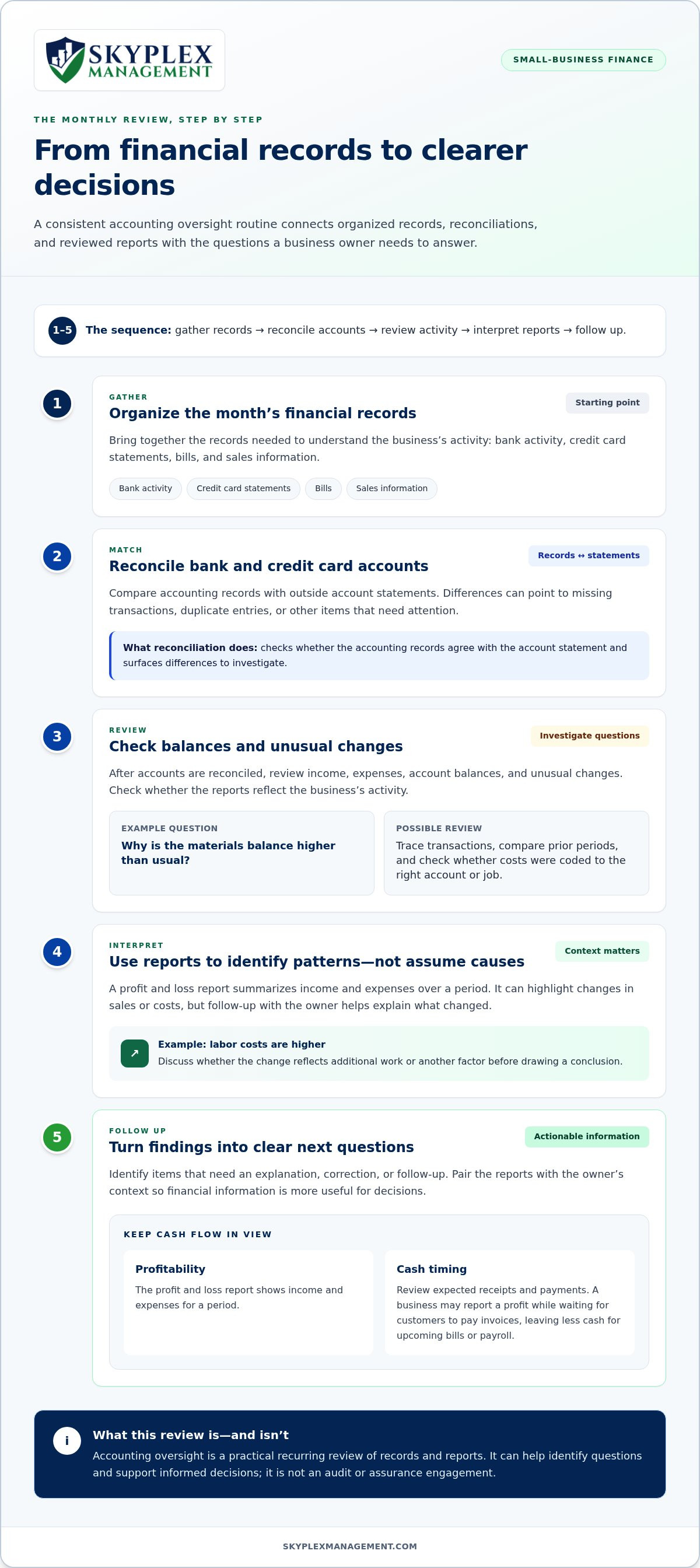
A typical cycle starts by organizing records such as bank activity, credit card statements, bills, and sales information. Bank and credit card reconciliations compare the accounting records with account statements, helping identify missing transactions, duplicates, or other differences. Once records are reconciled, a reviewer can examine income, expenses, account balances, and unusual changes before reports are shared.
The review doesn’t stop at producing reports. It identifies items that need an explanation, correction, or follow-up. Skyplex Management’s small business accounting services connect bookkeeping with financial review and reporting. For additional background on record keeping and cash flow, the FDIC’s Money Smart for Small Business resource offers practical guidance for business owners.
How reporting and follow-up support better decisions
A profit and loss report summarizes income and expenses over a period. It can prompt useful questions: Did sales change? Which expense categories moved? Are costs rising faster than revenue? The report highlights patterns to investigate, but it doesn’t explain every cause by itself. Follow-up with the owner adds context, such as a new contract, a one-time purchase, or a staffing change.
Profitability and cash flow are related, but they aren’t the same. A business may show a profit for the month while waiting for customers to pay invoices, leaving less cash available for upcoming bills or payroll. Reviewing expected receipts and payments alongside financial reports helps the owner plan around timing.
Sample month: A small service business organizes its sales and expense records, reconciles its bank and credit card accounts, and reviews its profit and loss report. The report shows higher labor costs. The owner and reviewer discuss whether the change reflects additional work or a staffing shift. They also look at expected customer payments and payroll needs to understand near-term cash flow. That follow-up turns a line on a report into a practical planning conversation.
A repeatable process makes monthly figures easier to interpret, even as the specific review steps vary by business. If you’d like support connecting bookkeeping, review, and reporting, contact Skyplex Management to discuss your accounting needs.
Bookkeeping, accounting oversight, controller support, and audits compared
These services can overlap, but they serve different purposes. Professional accounting oversight usually builds on bookkeeping, adding review and interpretation without becoming an audit. The right level of support depends on the business’s records, reporting needs, and the decisions its owner needs to make.
| Service | Purpose and typical work | Decision support |
|---|---|---|
| Bookkeeping | Organizes and records transactions, such as sales, expenses, and payments, and maintains the accounting records. | Provides an organized record of activity that supports reporting and routine business administration. |
| Accounting oversight | Reviews reconciliations, account balances, and financial reports, then identifies questions or items needing follow-up. | Helps owners understand what reports indicate and where more context may be needed. |
| Controller support | Adds higher-level financial management, which may include more involved reporting, processes, and planning support. | Can help owners use financial information for operational planning as business complexity grows. |
| Audit | An independent examination of financial statements, conducted as a distinct engagement. | Provides an auditor’s conclusion under the scope and standards of that engagement, rather than routine management guidance. |
How does oversight differ from day-to-day bookkeeping?
Bookkeeping maintains organized transaction records. That foundation matters: if activity is incomplete or poorly categorized, reports may not answer the owner’s questions. Oversight adds a review of those records and the reports they produce. An expense category that changes sharply, for example, may be correctly recorded and still deserve a closer look to understand the reason and its business impact.
Skyplex Management’s bookkeeping services maintain the records that support review and reporting. The exact division of tasks can vary with the business and its service arrangement, so clarify who handles transaction entry, reconciliations, report review, and follow-up.
When might a business need controller-level support instead?
Controller support may be appropriate when routine reports no longer address the owner’s needs. A business managing several projects, tracking performance across different lines of work, or planning around changing costs may need more developed reporting and operational analysis. Controller-level support can help organize that financial picture and support planning, while the owner remains responsible for business decisions.
An audit is not simply a more thorough monthly review. Professional accounting oversight supports management’s understanding of financial records; an audit is a separate engagement with a different purpose. For background on financial reporting considerations for smaller entities, the AICPA & CIMA resource on the Financial Reporting Framework for Small- and Medium-Sized Entities offers another reference. Match the support to the reporting and decision-making work your business needs.
How to build a practical accounting oversight routine
A useful routine doesn’t need to be complicated. It needs to happen consistently enough that records stay organized, unusual items get attention, and reports lead to clear next steps. Adapt the sequence below to your business’s activity and reporting needs.
- Gather and organize records. Collect bank and credit card activity, sales and expense documents, payroll records, and information about customer payments and bills. Keep documents easy to match to transactions so questions can be resolved without searching through scattered files.
- Reconcile key accounts. Compare the accounting records with bank and card statements. Review payroll-related balances and other accounts that need regular reconciliation. Investigate differences instead of carrying unexplained amounts forward.
- Review reports and changes. Look at the profit and loss report, balance sheet, and relevant cash flow information. Compare results with prior periods and look for changes in revenue, expenses, account balances, or margins. A change is a prompt to ask questions, not proof of a problem by itself.
- Record follow-up actions. For each open question, name who will investigate it and what they’ll do next. Note the answer or correction when it’s resolved, then bring recurring issues into the next review.
Which records and reports should owners review?
Start with records that support the reports: bank activity, card activity, payroll records, and completed account reconciliations. Then review financial statements and any business-specific detail that helps explain results, such as revenue or costs by project, service line, or location. Comparing periods can show where to investigate, but seasonality, timing, or one-time activity may affect the numbers. A comparison is a useful signal, not a complete explanation.
If QuickBooks records are difficult to review because accounts are unreconciled or transactions are inconsistently categorized, a cleanup may be a practical first step. Skyplex Management’s article on fixing messy QuickBooks records can help you understand how to approach disorganized books.
How can a business turn review findings into follow-up?
Make each finding specific: identify the account or report, describe the question, assign an owner, and set the next action. For example, an auto repair shop sees its parts costs rise compared with the previous period. The owner can review recent purchasing and sales activity, while the person handling the books checks whether transactions were categorized consistently. The increase may have a reasonable explanation, but documenting the answer helps the next review.
This is the practical value of professional accounting oversight: findings become questions someone can resolve, rather than unexplained numbers that linger in a report.
How outsourced professional accounting oversight supports Northeast Ohio businesses
As a business grows, financial tasks can become harder to manage alongside daily operations. Outsourced professional accounting oversight can bring bookkeeping, report preparation, and financial review together, giving the owner a clearer picture without requiring them to handle every accounting task personally. The right support depends on the business’s complexity, the time the owner can devote to financial administration, and the information needed to make decisions.
For a service business in Cleveland, a contractor in Akron, or a shop in Medina, the pressure points may differ. One owner may need reconciliations caught up and records organized. Another may have consistent books but need reports that make project costs or cash needs easier to understand. Support should fit the actual gaps, rather than adding tasks the business doesn’t need.
What can an outsourced accounting relationship help manage?
Skyplex Management supports small businesses with bookkeeping, QuickBooks Online support and cleanup, payroll, financial reporting, advisory, and outsourced controller services. These services can work together: organized records support dependable reports, while review helps identify questions that call for follow-up. The combination can be tailored to the business’s accounting needs, current processes, and reporting priorities.
For example, a business may need help maintaining monthly records and coordinating payroll information, while its owner also wants reports that show how operations are performing. Another business may already have bookkeeping in place but need more structured financial review and planning support. Skyplex Management’s financial reporting and advisory services connect financial information with practical business decisions.
What should an owner prepare for an initial discussion?
You don’t need to solve every accounting issue before asking for support. A useful conversation starts with a clear picture of what’s working, what’s taking too much time, and what information would help you run the business with more confidence. Consider gathering:
- Your business goals: Explain upcoming changes, such as adding staff, expanding services, or improving visibility into cash needs.
- Your current process: Describe how transactions, documents, payroll details, and reports are handled now.
- Your main pain points: Note late reconciliations, unclear reports, QuickBooks questions, or challenges coordinating payroll information.
- Your decision needs: Identify the reports or financial questions you wish you could answer more easily.
These details help focus the discussion on useful next steps, whether that means strengthening bookkeeping, improving reporting, or adding more involved controller support. With the right accounting structure in place, owners can spend less time sorting through uncertainty and more time acting on reliable information.
Make your financial information work harder
Reliable records are a starting point, not the finish line. A consistent review routine connects bookkeeping, reconciliations, and financial reports so you can spot questions, understand changes, and make decisions with better context. Professional accounting oversight can grow with your needs, from organized monthly books to more involved reporting and controller support.
Skyplex Management supports Northeast Ohio businesses with small-business bookkeeping and accounting, QuickBooks Online support and cleanup, payroll, financial reporting, and outsourced controller services. The right combination can ease the administrative load while giving you a clearer view of your business finances.
If late reconciliations, unclear reports, or limited time to review the books are getting in the way, start by identifying the support that would make the biggest difference.
With dependable records and thoughtful review, you can approach your next business decision with greater confidence.
Frequently Asked Questions
What is professional accounting oversight?
Professional accounting oversight is the review and interpretation of a business’s financial records and reports, beyond entering transactions. It can include reviewing reconciliations, examining account activity, and discussing questions raised by reports. For example, an unusual expense balance may prompt a closer look at its source or classification. The goal is to give the owner clearer information for managing the business. The specific scope depends on the business’s needs and the agreed services.
How is accounting oversight different from bookkeeping?
Bookkeeping focuses on organizing and recording financial transactions and maintaining the records. Accounting oversight adds review and interpretation, helping an owner understand what reports show and which items need follow-up. The functions work together: dependable review relies on organized books, while bookkeeping becomes more useful when owners can interpret the information those records produce. A bookkeeper might record a supplier payment; oversight can help identify how changes in that expense affect the business’s results.
Does professional accounting oversight include an audit?
No. Professional accounting oversight and an audit are different types of work. Oversight reviews business records and financial reports to support internal management; an audit is a separate assurance engagement with its own purpose and requirements. When discussing accounting support, be clear about the outcome you need and understand the agreed scope, including what review and reporting work it covers.
How often should a small business review its financial reports?
A consistent recurring review, often as part of a monthly accounting routine, gives owners a regular opportunity to examine results and follow up on questions. The right cadence depends on transaction volume, payroll, reporting needs, and how quickly you need information for decisions. A review is most useful when records are current and open questions are tracked. For filing deadlines or other requirements, consult relevant official guidance, such as the IRS or Ohio Department of Taxation.
Can outsourced accounting oversight replace an in-house controller?
Outsourced accounting support can provide bookkeeping, reporting, and controller-level help without creating an in-house position, depending on the business’s needs and agreed service scope. It isn’t automatically a like-for-like replacement for every role. Consider the complexity of your reporting, internal processes, and the decisions your business needs to support. Skyplex Management provides small-business accounting, advisory, and outsourced controller services shaped around a business’s accounting needs.
What should I do if my QuickBooks records are behind or inaccurate?
Start by identifying the affected periods, accounts, and reports, then gather available statements and supporting records. Avoid unexplained adjustments made only to force balances to match, since they can make the records harder to understand and review. A structured cleanup can help restore useful records before ongoing accounting review begins. Skyplex Management provides QuickBooks Online support and cleanup for small businesses, including assistance with historical records.
How can accounting oversight help a Northeast Ohio small business?
Consistent review can help owners understand reports, track questions, and plan follow-up using organized financial information. Needs vary by business, whether it operates in Cleveland, Akron, Medina, Strongsville, Brecksville, Hudson, Stow, Cuyahoga Falls, Fairlawn, Brunswick, Wadsworth, North Royalton, Canton, Wooster, Richfield, Macedonia, Broadview Heights, or Solon. Skyplex Management supports small businesses with bookkeeping, payroll, QuickBooks Online, reporting, and advisory services tailored to their needs.
Disclaimer
The information provided in this article is for general educational purposes only and should not be considered accounting, tax, or legal advice. Every business is unique. Consult a qualified accounting professional before making financial or tax decisions. Contact Skyplex Management for guidance specific to your business.


