

What good is a profit report if it arrives too late to guide a decision, or shows a change without explaining what caused it? That’s a common frustration with management reporting for small business. Owners need more than financial statements: they need timely, reliable numbers connected to what’s happening in daily operations.
If you’ve looked at a result and wondered whether it came from pricing, payroll, project costs, or a shift in sales, the report needs more context. Useful reporting pairs accurate bookkeeping with clear explanations, so you can spot trends and decide what to do next.
This article explains what to include in management reports, how to set a reporting rhythm that supports day-to-day decisions, and how to describe results, trends, and assumptions in plain language. You’ll also learn how to connect explanations for lenders or potential investors to the underlying financial records. With a consistent process, your reports can become a practical guide to the business, not just a record of what already happened.
Key Takeaways
- Use management reporting for small business to connect financial results with the operational decisions behind them.
- Read the profit and loss statement, balance sheet, and cash flow report together to understand performance, financial position, and cash movement.
- Compare results across periods or against a plan to identify meaningful changes and questions that need follow-up.
- Choose a reporting approach based on record reliability, the time it takes to maintain, and how clearly it answers your business questions.
- Build a monthly process that starts with reconciled bookkeeping and ends with clear explanations and assigned next steps.
What Management Reporting for Small Business Owners Should Accomplish
A transaction record tells you what was entered into the books. On its own, it doesn’t explain whether sales are improving, costs are rising, or a plan is working. Management reporting turns recorded financial information into recurring analysis that helps business owners understand performance and decide what to do next.
At its simplest, data reporting organizes information so it can be communicated and reviewed. Management reporting adds a business purpose: it selects and explains the information that helps an owner make a decision. The right format depends on the decision, the audience, and the quality of the available records.
Management reports versus financial statements
Financial statements provide structured views of a business’s financial position and performance. A profit and loss statement summarizes income and expenses over a period, while a balance sheet shows assets, liabilities, and equity at a particular point in time. These statements are an essential foundation, but they may not answer every question an owner needs to resolve.
Management reports can add comparisons, explanations, and operational measures. You might compare monthly expenses with the prior month, review actual results against a budget, or pair revenue trends with the number of completed jobs. That context helps turn a figure into a useful question or follow-up action. Shape reports around the decisions at hand instead of adding figures that don’t help the reader.
Why a small business may need an investor-ready story
Potential investors or lenders need more than a collection of figures. A clear performance narrative connects reported results to the business context: what changed, what contributed to the change, and what the company plans to do in response. The explanation should be consistent with the underlying records and clear about assumptions or uncertainties.
Explaining performance is not a promise of future results or a recommendation to invest. It is a factual account of what the records show and how management understands the business’s direction. That distinction supports a grounded conversation and helps owners avoid presenting projections as guaranteed outcomes.
Hypothetical example: A local service business reports stronger revenue this quarter but also higher labor expenses. Its owner could explain that demand increased, note the labor cost trend, and describe plans to review scheduling and job mix. The report wouldn’t prove those plans will raise profit. It would give a reader a clearer view of current performance and the questions management is working through.
Skyplex Management’s business advisory services help connect financial results with practical business decisions, making reports easier to interpret and discuss.
Which Small-Business Reports Create a Clear Performance Story?
Each financial report answers a different question. Read together, they help you see whether the business is earning a profit, what it owns and owes, and how cash is moving. For management reporting for small business, the goal isn’t to produce more pages. It’s to connect relevant results to useful comparisons and a clear explanation of what changed.
Start with the core financial reports
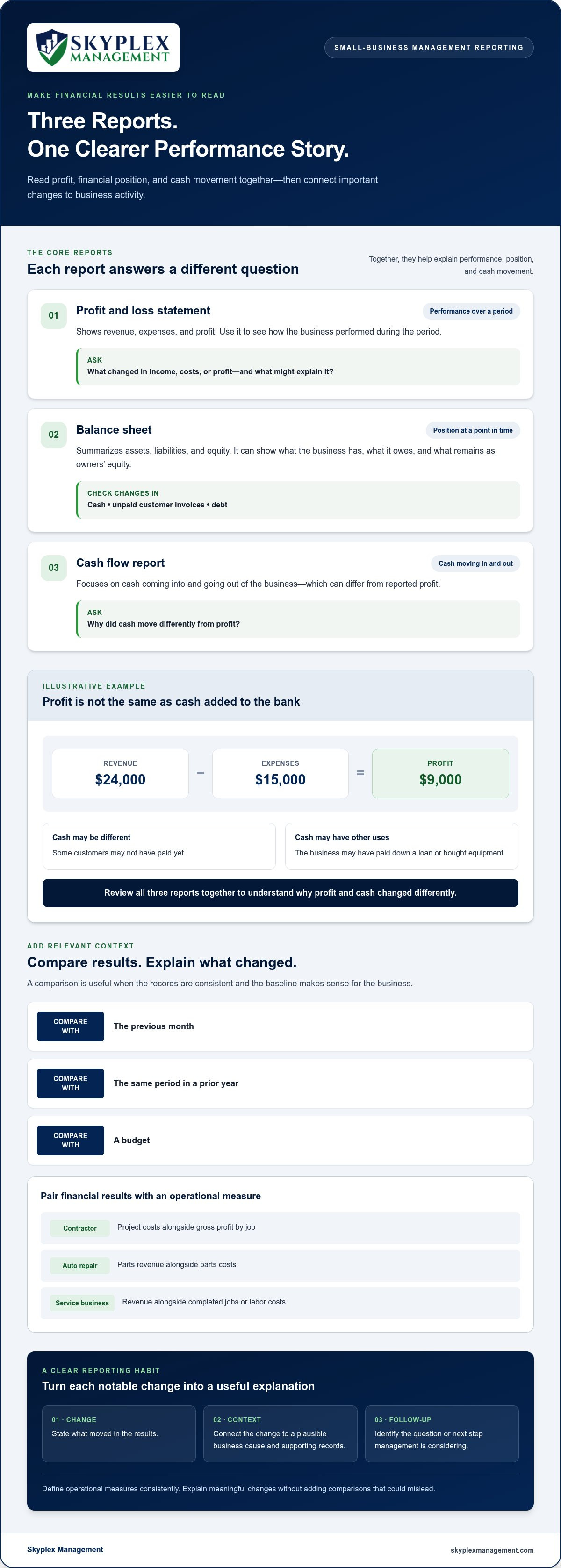
A profit and loss statement shows revenue, expenses, and profit over a period. A balance sheet summarizes assets, liabilities, and equity at a specific point in time. A cash flow report focuses on cash coming into and going out of the business, which can differ from reported profit.
Illustrative example: A business records $24,000 in revenue and $15,000 in expenses for a month, leaving $9,000 in profit. That doesn’t mean its bank balance increased by $9,000. Some customers may not have paid yet, or the business may have used cash to pay down a loan or buy equipment. Reviewing the reports together helps explain why profit and cash changed differently.
The balance sheet adds another perspective. It can show whether the business has cash and other assets available, how much it owes, and how much remains as owners’ equity. When reviewing it, look for changes in key balances, such as unpaid customer invoices, debt, or cash, and investigate movements that don’t match what you expected. For a closer look at interpreting these figures, see this small-business balance sheet analysis guide.
Add context without overwhelming the reader
A report becomes more useful when you compare it with a relevant baseline. Look at the same period in a prior year, the previous month, or a budget, provided the records are consistent and the comparison is meaningful. If the business has changed substantially, explain that too. A comparison should clarify performance, not create a misleading impression.
Choose operational measures that help explain financial movement. A contractor might review project costs alongside gross profit by job. An auto repair shop might compare parts revenue with parts costs. A service business might look at revenue alongside completed jobs or labor costs. These measures can help locate a possible cause, but define them consistently and support them with dependable records.
Keep the explanation concise. For each notable change, state what moved, how it compares with expectations, and what appears to have contributed. Separate confirmed facts from assumptions. For example: “Travel expense rose compared with the prior quarter, mainly because the team served more out-of-area jobs.” If the cause isn’t clear, say what needs review instead of guessing.
Financial reports show the result; business context explains what shaped it and what management plans to do next. That connection matters in investor or lender discussions, where a credible account of performance should align with the underlying records and avoid presenting plans as guaranteed outcomes. Skyplex Management’s financial reporting and advisory support can help turn results into clear business explanations. Learn more about discussing your reporting needs with Skyplex Management.
How to Choose a Reporting Approach That Fits Your Business
The right reporting setup depends less on business size than on the questions you need answered and the reliability of your records. A simple spreadsheet may be sufficient for straightforward operations, while a growing business with more complex transactions may need a supported process. Useful management reporting for small business doesn’t require choosing between basic reports and detailed analysis. Start with a manageable routine and add oversight as decisions become more involved.
Compare options by asking four questions: Are the underlying numbers reliable? How much owner time does the process require? Can you understand the reports? Do they answer the questions that guide your decisions?
When software or spreadsheets may be enough
If transactions are limited, categories are clear, and you mainly need to monitor a few consistent measures, a spreadsheet or accounting-software reports may meet your needs. Keep the process simple: use the same definitions each period and document any adjustments. Neither tool can correct missing transactions, inaccurate coding, or unreconciled accounts. If the figures don’t tie back to reliable records, a polished report can still mislead.
When bookkeeping or controller support can help
Consider support if closing the books regularly falls behind, reports raise questions you can’t answer, or you spend too much time assembling numbers instead of using them. Bookkeeping support focuses on recording and organizing transactions, reconciling accounts, and maintaining dependable records. Controller oversight works at a broader level, helping review financial information, interpret trends, and connect reporting with planning and decisions.
Skyplex Management provides small-business accounting support that brings bookkeeping and reporting together. Monthly bookkeeping helps maintain organized records, while financial reporting and advisory support helps owners interpret results. Outsourced controller services provide broader financial oversight for businesses that need it. Learn more about Skyplex Management’s small-business accounting services.
Choose the approach that gives you dependable answers without creating unnecessary work. Skyplex Management can discuss how its bookkeeping, reporting, and controller services fit the questions your business needs to answer: review your reporting needs with Skyplex Management.
How to Build a Monthly Management Reporting Process
A dependable monthly process helps you move from recorded activity to decisions without rushing past important checks. Keep the sequence consistent, even if the reports change as your business grows. The aim is to review trustworthy numbers, understand meaningful changes, and leave with clear follow-up actions.
Prepare reliable records before reviewing results
Start by completing the month’s bookkeeping and checking that transactions are recorded in consistent categories. Reconciliation means comparing an account’s records with an independent statement, such as a bank statement, and resolving differences. This helps make account balances dependable before you interpret a trend. For more on correcting record issues, see this guide to QuickBooks reconciliation support.
Once the records are ready, follow a repeatable monthly workflow:
- Complete bookkeeping. Record the month’s income and expenses, and organize transactions consistently so comparisons remain meaningful.
- Reconcile key accounts. Compare recorded balances with supporting statements and investigate differences before relying on the reports.
- Review the reports. Look at current results alongside a relevant prior period or business plan. Note changes that may affect decisions.
- Investigate notable variances. Ask what changed, what may have contributed, and whether the movement reflects timing, a one-time event, or an ongoing pattern.
- Assign follow-up. Record the next step, who will handle it, and any assumption that still needs to be checked. Revisit open items in the next reporting cycle.
Turn report findings into decisions and next steps
A variance is a difference between actual results and a comparison point, such as a budget or earlier period. It isn’t automatically a problem. A service business, for example, might see labor expense rise in a month when more work was completed. The useful question is whether the added labor supported the work and revenue, or points to a scheduling or pricing issue worth examining.
For each notable change, write a short explanation: what moved, the likely reason, and what you’ll do next. Label assumptions as assumptions. If the cause is unclear, assign someone to review the relevant transactions or operating details instead of presenting a guess as fact. This keeps reports useful for the owner and makes explanations easier to support in conversations with lenders or potential investors.
Accurate monthly bookkeeping is the groundwork for this process. If QuickBooks Online records need attention, cleanup can address historical issues before you rely on comparisons. Ongoing bookkeeping can then support a consistent reporting rhythm. Skyplex Management provides QuickBooks Online support and cleanup, as well as small-business bookkeeping.
How Skyplex Management Supports Small-Business Reporting in Northeast Ohio
A reporting process should fit the way you run your business and the decisions you need to make. For a small business in Northeast Ohio, that might mean establishing reliable monthly records, understanding a change in cash flow, or preparing a clear explanation of performance for a lender or potential investor. Skyplex Management connects bookkeeping and accounting support with practical financial reporting for businesses in Cleveland, Akron, Medina, Strongsville, Brecksville, Hudson, Stow, Cuyahoga Falls, Fairlawn, Brunswick, Wadsworth, North Royalton, Canton, Wooster, Richfield, Macedonia, Broadview Heights, and Solon.
Match financial support to the reporting challenge
If transactions are falling behind or records need more consistent organization, monthly bookkeeping can provide a steadier foundation for reports. Payroll is part of that picture, too. Consistent payroll records help owners review labor expenses alongside the rest of their business activity. If older QuickBooks Online records contain errors or gaps, support and cleanup can address those issues before you rely on the information to compare results or explain trends.
Different needs call for different levels of support. Financial reporting and advisory can help owners interpret results and connect them to business decisions. Outsourced controller services provide broader financial oversight when an owner needs help reviewing performance and planning what to monitor. These services can support clearer discussions about the business, but they don’t guarantee funding, growth, or any particular financial outcome.
Skyplex Management’s financial advisory services connect financial information with the questions owners face as they manage their businesses. The focus is on making reports understandable and relevant to the decisions in front of you, rather than producing figures without useful context.
Prepare for a productive reporting conversation
You don’t need to arrive with a perfect reporting system. A few notes about what you have and what you need can make an initial discussion more focused. Consider outlining:
- Your key questions: What do you want to understand about profitability, cash flow, expenses, or another area?
- Your current process: How are bookkeeping and reports handled now, and where do delays or confusion tend to arise?
- Your intended audience: Are the reports primarily for your own decisions, conversations with a lender, or discussions with potential investors?
- Your next decision: What choice would clearer, more timely financial information help you make?
Share the reporting challenges you’re comfortable discussing. There’s no need to include account numbers, passwords, or other sensitive financial details in an initial inquiry. Once the questions and process are clear, the next step may be improving bookkeeping consistency, addressing QuickBooks records, or adding reporting and advisory support.
Skyplex Management can help you identify the right reporting support for your business. Start a conversation about your reporting needs.
Give Your Next Reporting Cycle a Clear Purpose
Your reporting process doesn’t need to answer every possible question at once. Its value grows when it helps you make one clearer decision, then improves as your priorities change. Treat management reporting for small business as a working tool: choose the question you most need answered, make sure the records support it, and use the next review to refine what you track.
A first step might be clarifying which numbers are dependable, deciding what comparison would be useful, or identifying who will follow up on a result. A focused routine makes reports easier to use without adding complexity for its own sake. It can also help keep future explanations connected to the records and the decisions ahead.
Skyplex Management supports small businesses with bookkeeping, QuickBooks Online support and cleanup, payroll, financial reporting and advisory, and outsourced controller services.
Frequently Asked Questions
What is management reporting for a small business?
Management reporting is a recurring way to organize business information around decisions the owner needs to make. Its practical value comes from choosing questions that matter now, such as whether a new service is worth continuing or whether hiring fits current demand. The reporting format can change as priorities shift, while consistent categories and time periods make it easier to compare results.
Which management reports should a small business review monthly?
Along with core financial reports, consider supporting schedules that address current operational concerns. An accounts receivable aging report groups unpaid invoices by how long they’ve been outstanding, helping identify follow-up priorities. A payables list can help you plan upcoming obligations, while a payroll summary may help you monitor labor costs. Choose reports that inform a real decision and avoid creating a monthly packet no one uses.
How does management reporting differ from financial statements?
Financial statements use a standard structure to present financial information, while management reports can be arranged around a particular internal question or audience. For example, an owner may want a department-level view or a report grouped by location. Whatever format you use, keep the reporting period and accounting categories clear. That helps readers understand what the figures include and compare them fairly.
Can management reports help prepare a small business for investor discussions?
They can help owners prepare clear, supportable answers to questions about business performance. Before a discussion, check that figures agree with the accounting records, identify estimates separately from actual results, and prepare explanations for unusual items. It’s also useful to keep report periods consistent across materials. These steps make the information easier to follow, but they don’t predict or guarantee an investor’s decision.
How often should a small business prepare management reports?
Choose a schedule that gives you information in time to act and that your team can maintain consistently. A monthly cycle often gives owners a regular review point. A major change, such as opening a location or adding a new service, may call for a focused review outside that cycle. Set the timing based on decisions and information availability, not simply on how often a report can be generated.
What should I do if my bookkeeping is too messy for reliable reports?
Start by identifying where confidence breaks down: missing months, uncategorized transactions, unclear balances, or records that don’t match supporting documents. Gather available statements and source records, then list the periods and accounts needing attention. Avoid making unsupported adjustments just to force a report to balance. A clear issue list helps prioritize cleanup and establish a dependable starting point for future reporting.
Does a small business need a controller for management reporting?
No. The need depends on the complexity of the business and the financial oversight the owner wants. A business with straightforward activity may manage with organized bookkeeping and periodic review. Controller support can be useful when decisions involve several moving parts, reports need deeper interpretation, or the owner wants a more structured review process. The right level of oversight should address a specific need, not add complexity without purpose.
Disclaimer
The information provided in this article is for general educational purposes only and should not be considered accounting, tax, or legal advice. Every business is unique. Consult a qualified accounting professional before making financial or tax decisions. Contact Skyplex Management for guidance specific to your business.


