

Sales are up, but the bank balance is shrinking and payroll is coming due. That disconnect can make a financial report feel confusing, especially when ratios don’t explain what’s happening in daily operations. Understanding your business's key financial metrics means looking beyond revenue to see how profit, cash, and operating performance fit together.
A single metric rarely tells the whole story. Read related measures together, compare them across consistent periods, and connect them to decisions you need to make. This can help you spot changes early and determine what needs a closer look.
This guide covers practical measures of profitability, liquidity, and operating performance, including what each one can reveal and where it can mislead. You’ll also learn how to interpret results in the context of your business and why accurate, consistently maintained books matter. Clear financial reporting can turn unfamiliar numbers into useful guidance for managing cash flow, setting priorities, and planning your next move.
Key Takeaways
- Understanding your business's key financial metrics starts with knowing what each figure measures and what it cannot tell you on its own.
- Separate revenue, gross profit, operating profit, and net profit to see where earnings are generated and reduced.
- Use working capital to consider current assets alongside current liabilities, rather than treating reported profit as available cash.
- Compare consistent periods, account for seasonality, and investigate changes before deciding what action to take.
- Build a regular review around a manageable set of owner priorities, supported by reliable bookkeeping and reconciliations.
Understanding Your Business’s Key Financial Metrics Starts With the Right Questions
A financial metric measures a specific part of business performance. It might show whether sales are producing profit, whether the business can cover near-term bills, or how effectively it uses resources. Some metrics are dollar amounts; others are ratios, such as a profit margin. The Financial Ratios overview groups common ratios by the types of performance they help assess.
Start with a clear question, not a long list of figures. Are services profitable after direct costs? Is cash available for upcoming obligations? Are labor hours, materials, or other operating resources being used effectively? Understanding your business's key financial metrics means connecting each measure to a decision, rather than treating a number as a verdict.
Revenue can rise while expenses rise faster. A business can report a profit but have limited cash available because customers haven’t paid yet or funds have gone toward equipment. Metrics become more informative when you read related measures together, compare consistent periods, and account for how the business operates.
What can financial metrics tell a small business owner?
Hypothetical example: A Cleveland service business sees revenue increase, but its cash balance falls. That is a reason to investigate collections, payroll timing, expenses, and other cash movements, not proof that any one item caused the decline. The income statement and cash flow details can help narrow the questions. A metric points to what to examine; by itself, it does not establish the cause.
Reliable interpretation depends on the records behind the reports. Missing, miscategorized, or unreconciled transactions can make a metric reflect bookkeeping gaps rather than actual performance. Consistent monthly bookkeeping and accurate reconciliations provide a more dependable basis for financial reporting. Small business bookkeeping helps establish that foundation, so owners can focus on what the numbers may mean for operations.
Which reports provide the numbers behind the metrics?
The three core financial statements offer complementary views of your business:
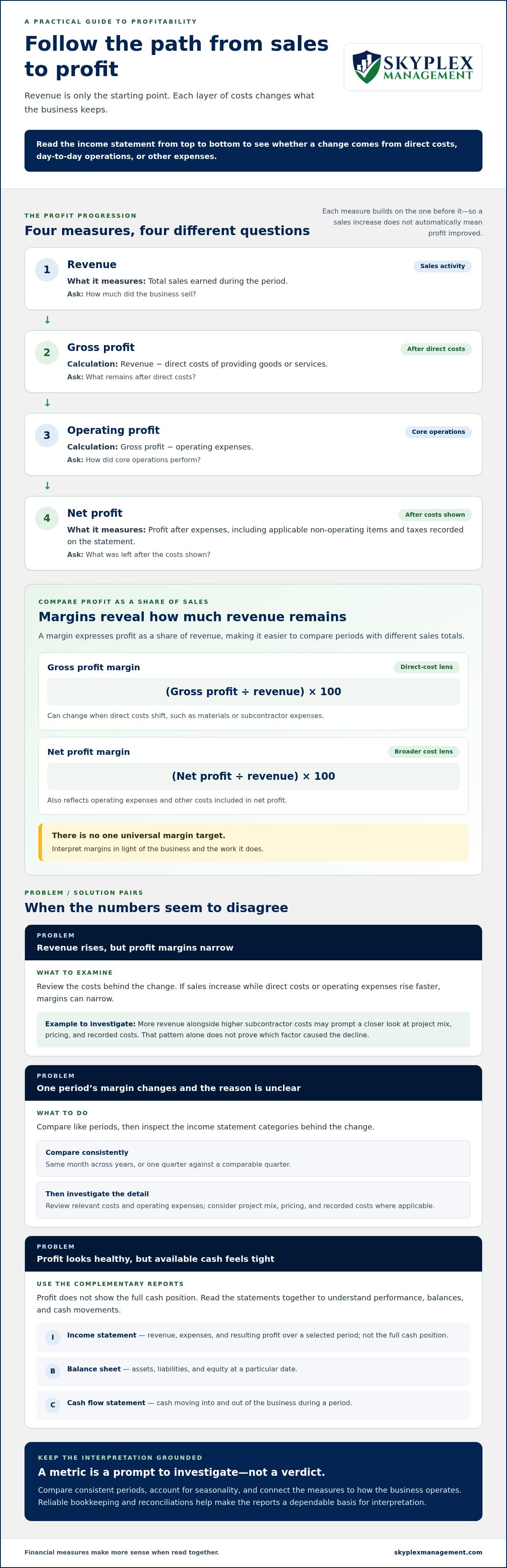
- Income statement: Shows revenue, expenses, and resulting profit over a selected period. It helps explain performance during that span, but not the full cash position.
- Balance sheet: Presents assets, liabilities, and equity at a particular date. It shows what the business owns, owes, and has left after liabilities.
- Cash flow statement: Tracks cash moving into and out of the business during a period, helping explain changes in available cash.
Use the reports together, compare like periods, and consider the business context. A seasonal business may naturally have stronger sales in some months. A project-based company may record revenue and incur costs at different points in a job. Tailored financial reporting can make these patterns easier to see. The aim is not to react to every fluctuation, but to ask informed questions and decide whether a change needs attention.
Profitability Metrics Show Whether Revenue Is Turning Into Profit
Revenue is the money a business earns from sales before expenses are deducted. It shows the scale of sales activity, but not how much the business keeps. Follow the income statement from revenue through successive layers of costs and expenses to see whether a change comes from direct costs, day-to-day operations, or other expenses.
These measures answer different questions:
| Measure | Calculation | Question it helps answer |
|---|---|---|
| Revenue | Total sales earned during the period | How much did the business sell? |
| Gross profit | Revenue minus direct costs of providing goods or services | What remains after direct costs? |
| Operating profit | Gross profit minus operating expenses | How did core operations perform? |
| Net profit | Profit after expenses, including applicable non-operating items and taxes recorded on the statement | What was left after the costs shown? |
How do gross and net profit margins differ?
A margin expresses profit as a share of revenue, making it easier to compare periods with different sales totals. Gross profit margin = (gross profit ÷ revenue) × 100. Net profit margin = (net profit ÷ revenue) × 100. Gross margin can change when direct costs shift, such as materials or subcontractor expenses. Net margin also reflects operating expenses and other costs included in net profit. Neither margin has one universal target. Interpret it in light of the business and the work it does.
Revenue growth alone does not mean profitability has improved. If sales increase while direct costs or operating expenses rise faster, profit margins can narrow. Understanding your business's key financial metrics means reviewing both the sales figure and the costs behind it.
How should owners investigate a changing profit margin?
Compare like periods, such as the same month across years or one quarter against a comparable quarter. Then review the income statement categories behind the change. A hypothetical service business might bring in more revenue but see gross margin fall as subcontractor costs increase. That pattern is a reason to examine project mix, pricing, recorded costs, and other relevant details. It does not prove which factor caused the decline.
Use this practical sequence:
- Confirm that transactions are recorded and categorized consistently.
- Compare equivalent periods and note which margin changed.
- Review the related revenue, direct-cost, and expense categories.
- Investigate plausible causes before deciding what adjustment makes sense.
A clear small business profit and loss report connects margin changes to the accounts behind them. For help interpreting those trends and shaping useful reports, contact Skyplex Management to discuss your financial reporting needs.
Liquidity and Working-Capital Metrics Put Cash Obligations in Context
Profitability and liquidity answer different questions. Profitability shows whether revenue exceeds the costs recorded for a period. Liquidity concerns whether the business has cash or other near-term resources available to meet obligations as they come due. A company can show a profit while waiting for customer payments, so a profitable income statement does not automatically mean cash is ready for payroll, suppliers, or other bills.
Working capital is current assets minus current liabilities. Current assets are resources expected to be used or converted to cash in the near term, such as cash and customer receivables. Current liabilities are obligations due in the near term, such as bills owed to suppliers. Working capital offers a view of the short-term cushion, but it does not show exactly when cash will arrive or payments must be made.
The current ratio compares these categories: current assets ÷ current liabilities. It helps frame whether reported short-term resources appear sufficient in relation to near-term obligations. There is no universal target that fits every business. The result depends on what is included in each category, when assets can be converted to cash, when liabilities are due, and the business’s operating model.
What does the current ratio reveal, and what does it miss?
A ratio is a snapshot, not a cash calendar. Receivables may count as current assets, but an unpaid customer invoice cannot fund today’s payroll. Inventory may also be an asset without being immediately available to cover bills. Read the current ratio alongside the composition and timing of its components, and consider the business’s industry and normal operating cycle. This gives balance sheet analysis more useful context than the ratio alone.
How do receivables and payables affect financial visibility?
Outstanding invoices represent amounts customers owe, not cash already collected. Supplier bills and payroll have their own due dates. If collections arrive later than expected while obligations remain on schedule, cash may feel tight even when sales and reported profit look healthy. Review receivables by age, expected collection timing, upcoming payables, and payroll dates. This can surface questions about billing delays, follow-up, payment terms, or the timing of work.
For example, a Cleveland contractor may have completed work and invoiced a customer while still needing to pay suppliers and employees before collecting. The receivable supports the business’s reported assets, but it does not cover those outflows until payment arrives. Reviewing the timing can help identify a gap early and support planning around expected receipts and obligations.
For a clearer view, review working capital and the current ratio alongside a receivables list and upcoming payment schedule. Consistently maintained bookkeeping keeps these figures current, while cash-flow planning translates them into practical timing decisions. Skyplex Management’s financial reporting and advisory services help owners examine the numbers and plan around their cash-flow needs.
Compare Financial Metrics Over Time Instead of Chasing One Benchmark
A metric becomes more useful when you can see how it changes and ask what may be driving the movement. A single comparison point or industry benchmark can mislead without context. Business model, seasonality, and recordkeeping practices all affect what a result means. For Cleveland businesses, a useful review starts with dependable records and comparisons that reflect how the business actually operates.
Use this sequence to turn a reported change into a practical question:
- Confirm the records. Check that transactions are recorded and categories are applied consistently.
- Choose a comparable period. Compare periods of similar length and, where relevant, similar seasonal conditions.
- Identify the movement. Note which metric changed and whether the movement continued across periods.
- Investigate the cause. Review relevant transactions, account categories, and operating activity.
- Decide on a next step. Determine whether to monitor the change, gather more information, or adjust a business decision.
Which comparisons make a metric more useful?
Compare the current period with a prior period that reflects similar business activity, using consistent account categories. Budget comparisons help when the budget and actual results cover the same timeframe and use assumptions that still fit. External benchmarks offer another perspective, but they cannot replace your own trends. Businesses with different service mixes or cost structures may reasonably report different results.
| Comparison | What it helps show | Use with care |
|---|---|---|
| Trend review | How a metric moves across comparable periods | Keep categories and period lengths consistent; consider seasonality. |
| Budget comparison | How actual performance differs from the plan | Check that the timeframe and assumptions still align. |
| Industry benchmark | How a result compares with external reference data | Use as context, not a universal target or substitute for your own history. |
When should an owner investigate a change?
Do not react to every small fluctuation. Look more closely when a movement matters to an owner’s priorities, persists across comparable periods, or appears alongside other warning signs. Trace it through relevant transactions, categories, and operating activity. For example, a Northeast Ohio landscaping business may see seasonal demand affect monthly sales. Comparing the same season across years can offer better context than treating a quieter month as a sudden performance problem.
As you build experience understanding your business's key financial metrics, note what changed, what you checked, and what decision followed. This creates a useful record for later reviews and helps distinguish recurring patterns from one-off events. Tailored financial reporting and advisory support can help organize comparisons around your priorities.
Turn Key Financial Metrics Into a Useful Reporting and Advisory Routine
Financial metrics are most valuable as part of a steady review, not figures you check only when a problem surfaces. Set a recurring time to look at a manageable group of measures tied to your priorities, such as profitability, cash availability, or operating costs. Understanding your business's key financial metrics also means knowing which changes call for follow-up and which are ordinary variation.
Keep the routine practical. Use reports covering consistent periods, note meaningful changes, and record questions that need more information. If a review leads to a decision, assign someone to handle the next step and set a time to revisit it. Follow-through turns reporting into a management tool rather than a stack of numbers.
What belongs in a practical financial review?
Choose reports and measures that address current owner priorities. Keep metric definitions, account categories, and reporting periods consistent so comparisons remain meaningful. For each noteworthy change, capture what moved, what needs investigation, and who will follow up. A cost increase, for example, might prompt a review of recent transactions before changing a budget or operating plan. Keep notes brief and return to open questions at the next review.
- Review: Look at the same core reports and measures each time.
- Flag: Note unusual movements and questions that need more detail.
- Assign: Give each follow-up a clear owner and next step.
- Revisit: Check whether the action answered the question or needs further attention.
How can bookkeeping and advisory support clarify the numbers?
Monthly bookkeeping keeps transactions organized and records current, while account reconciliations help identify differences between the books and financial accounts. Skyplex Management provides QuickBooks Online support and cleanup, Payroll Services, and Outsourced Accounting and Controller Services, alongside bookkeeping and accounting support. Business advisory services help owners interpret financial information and connect it to practical decisions.
Financial reporting should reflect the questions you need answered. A construction business may want to understand job costs, while a service business may focus on labor expenses and revenue by service line. The useful measures depend on the work and the decisions ahead. Skyplex Management’s financial reporting and advisory services help small businesses make sense of their financial information without treating any single metric as a complete answer.
A dependable routine combines organized records, consistent reports, and clear follow-up. To build a reporting approach around your priorities, discuss your financial reporting needs.
Make Your Next Financial Review More Actionable
Choose one business question you want your next financial review to answer. Then make sure your records and reports are organized around it. This gives your team a practical starting point and makes understanding your business's key financial metrics part of regular planning, not a task reserved for uncertain moments.
Skyplex Management provides small business bookkeeping and accounting, QuickBooks Online support, and historical-record cleanup when past entries need attention. Tailored financial reporting and advisory services can connect well-maintained records to the decisions in front of you. The aim is not to watch every number, but to build a clear, consistent view that supports your priorities.
Skyplex Management supports small businesses across Northeast Ohio, including Cleveland, Akron, Medina, Strongsville, Brecksville, Hudson, Stow, Cuyahoga Falls, Fairlawn, Brunswick, Wadsworth, North Royalton, Canton, Wooster, Richfield, Macedonia, Broadview Heights, and Solon.
A more useful view of your finances can start with one thoughtful question and a reporting routine built to answer it. Take that next step with confidence.
Frequently Asked Questions
Is revenue the same as profit?
No. Keep sales and profit separate in your review, then trace what changed before drawing a conclusion. Sales may rise because a business completed more jobs, while discounts or a shift toward lower-priced work affect how much it retains. Compare the same period and inspect pricing, volume, service mix, direct costs, and operating expenses. That breakdown helps identify which business decision warrants a closer look.
Can a business be profitable but still have cash-flow problems?
Yes. Large equipment purchases, owner distributions, debt principal payments, or building inventory can use cash without appearing as ordinary operating expenses in the same way. Review bank reconciliations and the cash flow statement, then map planned outflows before committing funds. This can reveal whether the cash pressure comes from a one-time use, a recurring commitment, or an operating pattern that needs closer attention. For companies navigating temporary timing mismatches or financing capital growth, consulting finance specialists such as VIR Advisory can help explore appropriate business loan options.
How often should a small business review its financial metrics?
Set a recurring review schedule that matches how quickly you need to make decisions. Monthly is a useful starting cadence, while a major hiring, purchasing, or expansion decision may call for a focused check beforehand. Use completed records and reserve time to follow up on questions from the previous review. A consistent schedule helps you notice developing patterns.
What is a good current ratio for a small business?
There is no current-ratio result that fits every small business. Look beyond the total and examine what makes up the short-term assets and obligations. For example, a balance that includes customer accounts requiring follow-up may offer a different practical picture from one supported by readily available cash. Consider how quickly assets can be used and when obligations are due, then assess the measure alongside the business’s operating needs.
Which financial metrics matter most for a service-based business?
Choose metrics that answer specific operating questions. A service firm managing a team might examine completed jobs, labor hours, and revenue by service line to understand capacity and workload. Another business may need to focus on customer retention or the cost of delivering each type of service. Start with the decisions you face, then keep measures that provide information you can act on and review consistently.
What happens if my bookkeeping records are inaccurate or incomplete?
Locate the gaps before relying on reports for decisions. Review bank and credit card reconciliations, look for duplicate entries, and identify uncategorized transactions or missing documentation. These checks can help determine whether an unusual result reflects business activity or a recordkeeping issue. QuickBooks Online support and cleanup can help organize historical records and address bookkeeping issues, giving you a clearer basis for reviewing financial information.
Should I compare my business’s metrics with industry averages?
You can use industry averages as one point of reference, but first check how the figures were defined and which kinds of businesses were included. A comparison is more useful when the underlying measures, business activities, and reporting periods are reasonably similar. Use any difference to form a specific question, such as whether a cost category needs review. Do not treat an external figure as a required result for your business.
Disclaimer
The information provided in this article is for general educational purposes only and should not be considered accounting, tax, or legal advice. Every business is unique. Consult a qualified accounting professional before making financial or tax decisions. Contact Skyplex Management for guidance specific to your business.


