

What if handing off payroll gave you time back without leaving you in the dark about pay, records, or cash flow? For small-business owners, payroll tasks compete with serving customers and managing daily operations. Choosing to outsource payroll processing can help, but only when you know what the provider handles, what stays with your team, and where approvals happen.
A dependable arrangement is more than a completed pay run. It needs accurate employee information, clear deadlines, review points, and organized records that connect with bookkeeping and financial reporting. Before making a change, ask detailed questions about responsibilities and communication, especially if you have dealt with errors or confusing handoffs.
This guide explains what outsourced payroll processing may involve, how to evaluate a provider’s responsibilities, and how to plan a steady transition. It also covers how payroll can fit into your bookkeeping workflow, so you can retain financial visibility while reducing administrative work. Skyplex Management provides payroll alongside bookkeeping and accounting support for Northeast Ohio businesses, making clear expectations an important foundation for a practical partnership.
Key Takeaways
- Recognize when payroll administration is taking time away from running your business, and distinguish outsourced support from software your team operates internally.
- Before you outsource payroll processing, map the handoffs from approved payroll information to processing, review, and recordkeeping.
- Compare providers using written details about service scope, communication, approvals, record access, and bookkeeping coordination.
- Prepare for a smoother transition by documenting your current process, clarifying responsibilities, and checking existing records for completeness.
- Consider how Skyplex Management’s payroll, bookkeeping, and accounting services may fit your business’s financial workflow.
When should a small business outsource payroll processing?
Payroll administration can become a strain when it repeatedly takes time away from customers, staff, or the work that keeps the business moving. The issue is not simply team size. Payroll may need attention when information arrives late, no one is sure who checks the final figures, or routine administration regularly competes with higher-priority work.
Outsourcing means assigning a provider agreed payroll-processing responsibilities. That differs from using payroll software internally: software gives your team a tool, while outsourcing may shift some tasks to an outside provider. The exact division depends on the agreement. A provider may handle processing steps, while the employer remains responsible for supplying accurate information and making business decisions and approvals. For a basic overview of what payroll is, see the general payroll reference.
What does outsourced payroll processing usually mean?
Payroll processing uses employee and pay information to prepare payroll records and payments. Providers do not all handle the same tasks or use the same workflow. Before engaging one, get the scope in writing. Identify what the provider will do, what your team must supply or approve, who answers questions, and how each party handles corrections. Clear accountability helps prevent gaps at handoff points.
What signs suggest your current payroll process needs support?
Look for recurring friction, not just a busy week. Payroll details may sit in a manager’s inbox, hours or other pay inputs may arrive from several people, or the owner may be the only person who knows what needs review. A growing team or a changing workflow can add coordination work, even when payroll software is already in place.
- Payroll administration regularly gets pushed behind customer or operational work.
- Staff are unsure who reviews information or approves payroll before it is finalized.
- Employee or pay details are gathered through disconnected processes.
These are reasons to review the process, not automatic signals that you should switch. Map the steps, note where delays or confusion occur, and decide whether clearer roles, a better-organized internal workflow, or outside support would address the problem. If you are exploring external help, review the scope of Skyplex Management’s payroll service and ask how responsibilities would be defined for your business. A careful assessment can help you find a suitable arrangement while preserving the review and financial visibility your team needs.
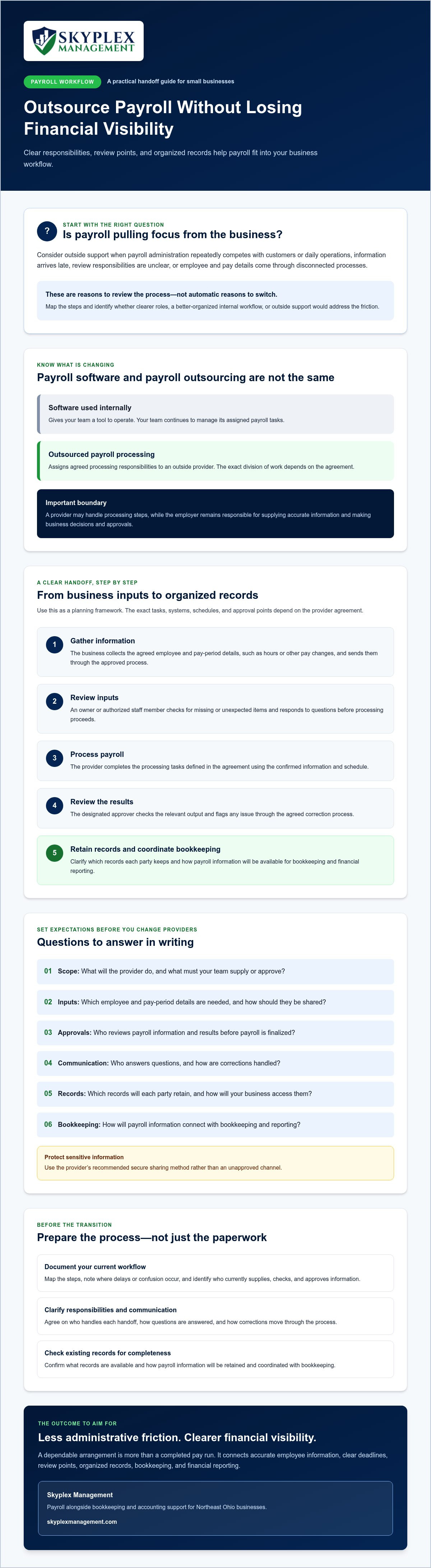
How outsourced payroll processing works from business inputs to records
A reliable payroll handoff has clear steps, named reviewers, and a record of what was approved. The exact tasks, systems, schedules, and approval points depend on the provider agreement, so treat the workflow below as a planning framework, not a promise of what every service includes. Forbes offers an ultimate guide to payroll outsourcing for additional background on how these arrangements can work.
- Gather information. The business collects the agreed employee and pay-period details, such as hours or other pay changes, and sends them through the approved process.
- Review inputs. An owner or authorized staff member checks for missing or unexpected items and responds to questions before processing proceeds.
- Process payroll. The provider completes the processing tasks defined in the agreement using the confirmed information and schedule.
- Review the results. The designated approver checks the relevant output and flags any issue through the agreed correction process.
- Retain records and coordinate bookkeeping. The business and provider clarify which records each will keep and how payroll information will be made available for bookkeeping and reporting.
This sequence makes the handoff visible and gives the business a chance to catch incomplete or incorrect inputs before they flow into payroll records. A provider’s responsibilities do not remove the need to agree on who supplies information, who approves it, and how questions are resolved.
What information and approvals should the business prepare?
Ask which employee and pay-period details the provider needs, how to share them, and who can submit or approve them. Use the provider’s recommended secure sharing method rather than sending sensitive information through an unapproved channel. Confirm how the parties will handle corrections, late changes, and unanswered questions, including who communicates them and what approval is needed before processing continues.
How should payroll records support bookkeeping?
Payroll activity needs to be reflected accurately in the business’s records so owners can review expenses and use financial reports with confidence. Ask how payroll summaries or other agreed records will reach the person responsible for bookkeeping, and whether the process requires a manual handoff. Do not assume payroll and bookkeeping systems connect automatically. Skyplex Management’s small-business bookkeeping services can be part of a conversation about how payroll records fit into your broader financial workflow.
Before choosing to outsource payroll processing, write down the handoffs and identify unanswered questions. Northeast Ohio business owners who want to discuss payroll alongside bookkeeping can contact Skyplex Management to talk through their needs.
How to compare outsourced payroll processing providers
Provider descriptions can sound similar while assigning different work to the business and the provider. Compare written service details, not assumptions. A clear agreement should show who supplies information, who reviews it, how questions are raised, and how payroll records fit your bookkeeping process. Outsourcing can shift agreed administrative work without removing your business’s review and approval responsibilities.
| Area to compare | Questions to ask |
|---|---|
| Scope | Which processing tasks are included? What information and decisions remain our responsibility? |
| Communication | Who is our service contact? How are questions, exceptions, or missing information communicated? |
| Approvals | Who reviews and approves payroll inputs or results? What happens if an approver identifies an issue? |
| Record access | Which records will we receive, how will we access them, and who on our team can view them? |
| Bookkeeping coordination | How will payroll information reach our bookkeeping or accounting process, and who handles the handoff? |
Use the same questions with each provider, then compare the answers side by side. If a proposal says “payroll support” without describing the handoffs, ask for a written explanation of what that means for your business. For broader context on employer responsibilities, review the SBA guidance on hiring and paying employees.
Which questions should you ask before choosing a provider?
Ask which tasks are included, what stays internal, and how exceptions or late changes are communicated. Clarify how corrections are submitted, who can approve them, and how your team accesses records. Also ask how payroll information will fit into your existing bookkeeping or accounting process. Specific answers help you spot gaps before the first handoff.
How can Ohio businesses check compliance support carefully?
Separate processing assistance from legal, tax, or regulatory advice. Ask what the provider handles and what remains your responsibility. Do not treat a service description as a guarantee of compliance. For requirements that apply to your business, consult current IRS and Ohio Department of Taxation guidance, and verify relevant filings, deadlines, and obligations directly with those agencies or an appropriate professional.
The right fit is a provider whose documented scope matches your workflow and leaves no uncertainty about review, records, or accountability. Before you outsource payroll processing, list unresolved questions and ask for clear answers in writing.
How to prepare for a smooth payroll outsourcing transition
A reliable transition starts with a clear picture of your current process. Before you outsource payroll processing, document who gathers pay information, which systems or files hold it, who reviews it, and how questions or corrections are handled. Then compare that workflow with the provider’s written scope. This makes missing responsibilities easier to spot before the handoff.
What should you review before the handoff?
Take inventory before sharing records. Check whether your payroll information is complete and organized, and make a list of gaps or questions for the provider. Confirm what information is needed, how it should be shared, and which staff members are authorized to submit or access it. Have those staff members review the proposed access and information-sharing arrangements.
Clarify roles in writing. The provider agreement should state which tasks the provider handles, what your team supplies, who approves payroll information, and how corrections or late changes are communicated. Do not assume a new provider will know your existing process or resolve unclear handoffs automatically.
How can Northeast Ohio owners keep the process accountable?
Choose a named internal contact who can coordinate questions and route information to the right people. Agree on a review process, including who checks inputs or results and how an issue is raised and followed through. Decide how your team will access payroll records and who is responsible for getting relevant information to bookkeeping. For businesses in Cleveland, Akron, or Medina, these checkpoints can help keep the workflow consistent as responsibilities change.
Use this transition checklist to prepare:
- Document current payroll steps, systems, staff responsibilities, and available records.
- Review existing records for completeness and list unresolved questions.
- Confirm the provider’s scope, your internal responsibilities, and approval ownership.
- Agree on secure information sharing, record access, communication, and issue escalation.
- Clarify how payroll information will reach the bookkeeping or accounting workflow.
Keep the checklist as a reference after the handoff. If the process changes, update responsibilities and review steps so the team and provider are working from the same expectations. Plan the transition around the provider’s agreed process, not an assumed start date or guaranteed outcome.
How Skyplex Management can support outsourced payroll processing
Payroll works best as part of a financial workflow the owner can understand and review. Skyplex Management provides payroll services alongside small-business bookkeeping, accounting, QuickBooks Online support and cleanup, financial reporting and advisory, and outsourced accounting and controller services. Discussing these needs together can help clarify how payroll records may fit into your bookkeeping and reporting process. It does not mean every service is automatically combined or that a particular system connection is included, so confirm the scope and handoffs for your business.
When payroll support and bookkeeping need to work together
Payroll records affect the financial information owners use to understand business expenses and review results. If those records reach bookkeeping late or in an unclear format, it can be harder to maintain an organized picture of business activity. Ask how payroll information will be shared, who will review it, and what your team remains responsible for. You can learn more about Skyplex Management’s payroll services and discuss how they may fit alongside your existing financial workflow.
Owners comparing payroll and bookkeeping support can ask providers to explain each service’s scope separately. That makes it easier to understand what is included and avoid assuming payroll processing automatically covers bookkeeping or reporting. Skyplex Management works with businesses in Cleveland, Akron, Medina, Strongsville, Brecksville, Hudson, Stow, Cuyahoga Falls, Fairlawn, Brunswick, Wadsworth, North Royalton, Canton, Wooster, Richfield, Macedonia, Broadview Heights, and Solon. A clear conversation about connected responsibilities can help set practical expectations from the start.
What to bring to an initial payroll discussion
A short outline of your current process can make the conversation more useful. Note who gathers and approves payroll information, where records are kept, which bookkeeping tools your business uses, and where delays or confusion tend to occur. Bring questions about the provider’s responsibilities, internal approvals, communication, corrections, and access to records. You do not need to have every answer prepared. Identifying the unknowns is a useful first step.
- Describe your current payroll workflow and the people involved.
- Identify recurring issues, handoffs, or missing records.
- Explain how payroll information currently reaches bookkeeping.
- Ask which tasks the service covers and which remain your responsibility.
- Clarify how questions, corrections, approvals, and records will be handled.
These details give both sides a practical starting point without presuming a price, transition schedule, or result. If you are considering whether to outsource payroll processing, a conversation about payroll and related accounting needs can help you assess the fit.
Build a Payroll Process You Can Rely On
Choosing to outsource payroll processing works best when handoffs are clear. Before selecting support, define which tasks belong to the provider, who on your team supplies and approves information, and how payroll records will reach bookkeeping. A written scope and practical review process help protect your financial visibility while reducing administrative pressure.
Skyplex Management provides payroll services alongside bookkeeping, accounting, and QuickBooks Online support. Discussing these needs together can help you consider how payroll fits your broader financial workflow, without assuming that services or systems are automatically bundled. The right arrangement should reflect your business’s responsibilities, records, and reporting needs.
If payroll is taking attention away from daily operations, start by outlining your current process and the questions you want answered. A clear conversation can help you decide what kind of support makes sense for your business.
With defined roles and organized records, you can move forward with greater clarity and keep your attention on running the business.
Frequently Asked Questions
What does it mean to outsource payroll processing?
To outsource payroll processing is to assign an outside provider agreed tasks involved in preparing payroll, rather than having your own team handle every step with internal software. The provider’s role depends on the written agreement. Your business still supplies accurate employee and pay information, makes employment decisions, reviews outputs, and approves items assigned to it. Clarify responsibility for questions, corrections, and records before work begins.
Is outsourcing payroll a good option for a small business?
It may be a good fit if payroll administration takes attention away from operations, your team has limited capacity, or the process has become harder to coordinate as your business changes. First assess how much work payroll requires and which tasks you want help with. Consider how much direct review you want to retain, too. Compare the provider’s scope with your needs rather than assuming outsourcing will reduce costs or resolve every issue.
What payroll tasks can a business outsource?
Depending on the agreement, a provider might help prepare payroll calculations, process approved pay information, or organize payroll records. These are examples, not tasks every service includes. Ask exactly what the provider handles, what information your business must supply, and which decisions and approvals stay internal. Confirm how corrections, exceptions, and records are managed so you understand the full handoff before work begins.
How do I choose an outsourced payroll provider?
Compare providers’ written descriptions of what they handle and what remains your responsibility. Ask who communicates questions, who approves payroll inputs or results, how corrections are raised, and how you will access records. Also clarify how payroll information will reach your bookkeeping or accounting workflow. Specific answers make it easier to compare service scope and accountability, rather than relying on broad descriptions that can mean different things from one provider to another.
Can outsourced payroll processing work with QuickBooks Online?
It may, but compatibility and the handoff depend on the provider’s systems and your agreed workflow. Ask whether payroll information can be used with your QuickBooks Online setup, what records or reports you will receive, and who enters or reviews the information. Skyplex Management provides QuickBooks Online support to businesses in Northeast Ohio, including Cleveland, Akron, and Medina. Confirm the specific workflow and responsibilities before relying on any connection between payroll and bookkeeping.
How do I transition payroll to an outside provider?
Start by documenting your current process, including the staff involved, systems used, and how information is reviewed. Check existing records for completeness, then confirm what the provider needs and how to share it securely. Define who supplies information, approves work, and handles questions or corrections. Agree on communication and record access before the handoff. A written outline of responsibilities gives your team and provider a practical reference as the workflow begins.
Does outsourcing payroll mean giving up control?
No. Outsourcing agreed administrative work does not require giving up business oversight. Your agreement can identify which information your team supplies, who reviews the inputs or results, and who gives approval before the next step. Keep access to relevant payroll records and establish a clear way to raise questions or corrections. These review points let a provider handle assigned tasks while your business retains visibility over decisions and responsibilities.
Disclaimer
The information provided in this article is for general educational purposes only and should not be considered accounting, tax, or legal advice. Every business is unique. Consult a qualified accounting professional before making financial or tax decisions. Contact Skyplex Management for guidance specific to your business.


