
What if your business needs stronger financial oversight but isn’t ready to hire a full-time controller? Virtual controller services may help fill that gap when bookkeeping is getting done but reports still arrive without the context you need to make timely decisions.
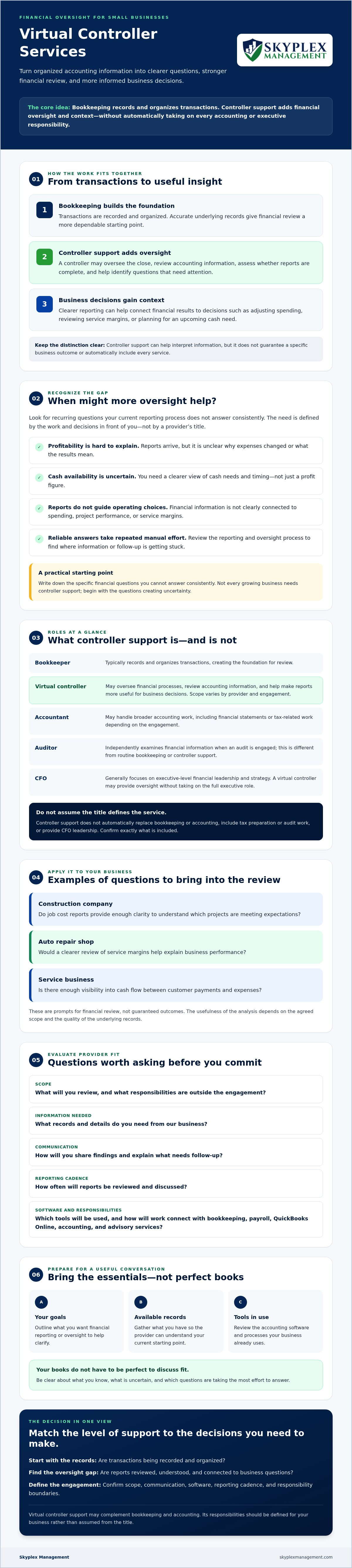
Day-to-day bookkeeping and higher-level financial oversight serve different purposes. A bookkeeper records and organizes transactions. A controller may oversee the close, review reports, and connect financial results to business decisions. The right mix depends on the condition of your records, your priorities, and the questions you need answered.
This article explains what virtual controller support can involve, when it may fit your business, and how it can work alongside bookkeeping and accounting. You’ll also find practical questions to ask prospective providers, including how they define responsibilities and communicate financial results. Whether you run a construction company, an auto repair shop, or a service business, the goal is to match support to the decisions in front of you without adding a full-time role before you need one.
Key Takeaways
- Look beyond transaction entry. Controller support adds financial oversight that can help turn reports into useful business information.
- Use gaps in reporting clarity, review routines, or cash flow visibility to identify where your business needs more support.
- Compare providers by scope, communication, software, reporting cadence, and clear responsibility boundaries before committing to virtual controller services.
- Prepare for a provider conversation by outlining your goals, gathering available records, and reviewing the tools you use. Your books don’t have to be perfect to discuss fit.
- Ask how controller support could work alongside bookkeeping, payroll, QuickBooks Online, accounting, and advisory services. Confirm the specific scope for your business.
What virtual controller services do for a small business
A virtual controller provides outsourced financial oversight remotely, helping a business review its accounting information and financial processes instead of focusing only on transaction entry. The work varies by provider and engagement, so the title alone doesn’t tell you what’s included.
In practice, controller-level support can help an owner assess whether reports are complete, understand how results compare with expectations, and identify financial questions that need attention. Timely, reliable information gives you a firmer basis for decisions such as adjusting spending, reviewing service margins, or planning for an upcoming cash need. The IRS explains that business records help support income and expenses reported on tax returns. Accurate records can also provide a more dependable starting point for financial review. Skyplex Management offers small business accounting services. Discuss and confirm controller responsibilities for your business.
What does a virtual controller do?
A virtual controller may oversee financial processes, review accounting information, and help make reports more useful for business decisions. For example, an owner may receive a profit and loss statement each month but still be unsure why expenses rose or whether reported profit reflects available cash. Depending on the agreed scope and the quality of the underlying records, a controller can help examine those questions.
Think of the role as oversight and interpretation, not a guaranteed checklist of services. Ask what the provider will review, what information they need, and how they’ll share their findings.
Virtual controller, bookkeeper, accountant, or CFO?
These roles can overlap, and responsibilities differ across firms. A bookkeeper typically records and organizes transactions. That accurate foundation helps a controller review financial information and identify questions or patterns. An accountant may handle broader accounting work, which can include preparing financial statements or tax-related work depending on the engagement. Tax preparation is distinct from controller oversight. An auditor independently examines financial information when an audit is engaged. That is not the same as routine bookkeeping or controller support.
A CFO generally focuses on executive-level financial leadership and strategy, though the scope varies by organization. A virtual controller may provide financial oversight without taking on the full executive role. For a closer comparison, see Outsourced Controller vs. CFO: Which Does Your Ohio Business Need in 2026?
The financial controller role is commonly associated with oversight of an organization’s accounting and financial reporting. In a small business, the practical question is how much oversight you need and which responsibilities a provider will actually handle. Virtual controller services may complement bookkeeping and accounting, but they don’t automatically replace either function or include tax preparation, audit work, or CFO leadership.
Which financial oversight needs can virtual controller services address?
Once routine transactions are recorded, the next challenge is making that information useful. Virtual controller services may help address gaps in report reviews, cash needs monitoring, and coordination of accounting tasks. The right scope depends on what is creating uncertainty for your business, not simply on the provider’s title.
Signs your business may need more than bookkeeping
Consider whether you regularly struggle to explain profitability, estimate what cash is available, or connect financial reports to operating decisions. For example, a contractor may need clearer job cost information to understand which projects are meeting expectations. An auto repair shop may want to examine service margins, while a service business may need better visibility into cash flow between customer payments and expenses. If assembling reliable answers takes repeated manual effort, review your reporting and oversight process. Not every growing business needs controller support. Start with the specific questions you can’t answer consistently.
How reporting and advisory support connect
Clear reporting can turn those questions into a focused financial conversation. A review might clarify what changed during a period, what information needs follow-up, or which assumptions to consider before making a plan. That context can support decision-making, but it doesn’t guarantee a particular business outcome. If you want to understand what a balance sheet can show about your business’s financial position, read small business balance sheet analysis. Skyplex Management provides small business accounting services, along with financial reporting and advisory. Ask which responsibilities would be included in a proposed engagement.
When bookkeeping or cleanup should come first
Oversight is only as useful as the records being reviewed. Missing transactions, unreconciled accounts, or inconsistent classifications can make reports difficult to rely on. In that situation, monthly bookkeeping, QuickBooks Online cleanup, or catch-up work may need attention before or alongside controller-level support. For a practical look at one part of accurate recordkeeping, see professional QuickBooks reconciliation services. Reconciliation means comparing account records with statements to identify differences that need review.
Before choosing support, note which reports are unclear, how often you need answers, and where information is scattered. That list can help you and a provider define a realistic scope. If you’re weighing bookkeeping, accounting, or controller support, you can discuss your financial support needs with Skyplex Management.
How to compare virtual controller services and provider fit
Compare the work behind the title, not just the title itself. A clear proposal should explain what the provider will handle, what your team remains responsible for, and how the work will support the decisions you need to make.
| Area | What to clarify |
|---|---|
| Scope | Which bookkeeping, review, reporting, and advisory responsibilities are included? |
| Reporting cadence | How often will reports be prepared or reviewed, and what affects the timing? |
| Communication | Who is your main contact, and how will questions, missing records, or concerns be raised? |
| Software | Which accounting platform will be used, and what access or setup is needed? |
| Responsibilities | What will the provider handle, what will your staff handle, and what is outside the engagement? |
Questions to ask before choosing a provider
Ask who handles bookkeeping, reviews financial information, prepares reports, and follows up on questions. Find out how the provider will learn about your operations and priorities, including which decisions depend on timely financial information. Discuss how missing records, identified issues, or changing needs will be communicated. Ask what the proposed scope includes, what depends on the condition of your records, and which additional work may cost extra.
How to assess reporting and software support
Ask for specifics about the reports and review discussions included rather than assuming a particular cadence or deliverable. If your business uses QuickBooks Online, ask how the provider works with the platform and whether your records need cleanup before review. Data quality matters: unreconciled accounts or inconsistent entries can affect the usefulness of reports. Skyplex Management offers QuickBooks Online cleanup services alongside accounting support. Confirm the scope that fits your situation.
Compare providers based on clear responsibilities, useful communication, and an approach that fits your business, not promises of a standard package. To discuss what financial support may fit your needs, contact Skyplex Management.
How to prepare your business for virtual controller support
You don’t need perfectly organized books to start a conversation about virtual controller services. A little preparation can help you explain what’s unclear, which decisions are coming up, and what kind of financial support may be useful. Treat the first discussion as a chance to understand your needs and clarify a possible scope, not as a test of whether your records are already in order.
Before talking with a provider, consider these practical steps:
- Clarify your goals. Note the decisions you want better financial information to support, such as reviewing cash needs or understanding results.
- Gather what’s available. Collect recent financial reports and details about the bookkeeping system you use. Don’t delay the conversation because something is missing.
- Review your tools. Identify where transactions, payroll information, and reports are currently managed.
- Discuss responsibilities. Explain who handles each finance task now and ask what support could reasonably cover.
Records and questions to gather before a consultation
Bring recent reports if you have them, along with a list of unresolved questions. You might ask why reported profit differs from the cash available in the bank, or which expenses have changed. Be ready to describe the decisions you want those answers to inform. If you’re unsure which documents matter, ask the provider what would be useful for an initial discussion instead of trying to assemble a universal checklist.
What to discuss about systems and responsibilities
Walk through who currently manages bookkeeping, payroll, account reconciliations, and financial reporting. Reconciliation means comparing account records with statements to identify differences. If you use QuickBooks Online, mention whether the records are current and whether you know of setup or cleanup issues. If you use another system, share that too. Your tools and record quality can affect what work is appropriate and how responsibilities should be divided.
Northeast Ohio service conversations
For business owners in Cleveland, Akron, or nearby Northeast Ohio communities, a clear conversation can help establish how financial support will work and how questions will be handled. Skyplex Management serves small businesses across the region, including Cleveland, Akron, Medina, and Hudson. If planning is part of your discussion, its business advisory services may be relevant. Confirm the specific responsibilities and communication approach for any proposed engagement.
Prepare what you can, flag what you can’t, and use the conversation to agree on sensible next steps. Your records don’t have to be perfect to discuss fit.
What working with Skyplex Management could look like
Skyplex Management works with small businesses in Northeast Ohio, offering bookkeeping, accounting, payroll, QuickBooks Online support and cleanup, financial reporting and advisory, and outsourced accounting and controller services. These services address related financial needs, but they aren’t automatically bundled together. The right arrangement depends on your records, priorities, and the responsibilities you agree on with the firm.
Connecting bookkeeping, payroll, and financial oversight
Financial oversight depends on reliable information. Bookkeeping organizes transactions, while payroll and accounting support help maintain other parts of a business’s financial records. Reporting and advisory can help owners examine that information in the context of business decisions. How these areas fit together depends on the engagement, so confirm which services are included and who is responsible for each task.
For example, if you need clearer financial reports but your records also need attention, the discussion may cover both your reporting questions and the condition of the books. If payroll information or QuickBooks Online records are relevant, explain how they fit into the overall picture. Clear records and agreed responsibilities give both the business and provider a more useful starting point.
A practical first conversation about controller support
Start by describing how your business operates, which systems you use, and what you can’t easily determine from your current reports. You might raise questions about cash needs, changing expenses, or how to understand results. Share who currently handles bookkeeping, payroll, and reporting, along with any known gaps in the records. This helps clarify what support may fit without assuming every business needs the same controller scope.
Skyplex Management serves businesses across Northeast Ohio, including Cleveland, Akron, Medina, and Hudson. A first conversation can help establish whether its virtual controller services align with your needs and what next steps may make sense. Confirm the specific controller responsibilities, communication approach, and any related services before deciding how to proceed.
Choose financial support that fits your next decisions
The right virtual controller services should address the financial questions your business needs to answer, not just come with an impressive title. Start by identifying where reporting, cash visibility, or financial processes are falling short. Then compare providers based on clear responsibilities, communication, and the scope you agree on.
You don’t need perfect records to begin exploring support. Sharing your current systems, available reports, and unresolved questions can help clarify whether bookkeeping, cleanup, controller oversight, or a combination may be the right next step.
Skyplex Management serves businesses across Northeast Ohio with bookkeeping, accounting, payroll, QuickBooks Online support and cleanup, financial reporting, advisory, and outsourced accounting and controller services. Responsibilities should be discussed and confirmed for each business so you can understand what fits before moving forward.
A clear conversation can help you find a practical path toward more useful financial information and greater confidence in your decisions.
Frequently Asked Questions
What are virtual controller services?
Virtual controller services provide outsourced financial oversight remotely. Depending on the agreed scope, a controller may review accounting processes and reports, help clarify financial information, and support the owner’s planning conversations. The service isn’t simply transaction entry, and the title doesn’t guarantee a standard list of tasks. Before engaging a provider, confirm which responsibilities are included, what information they’ll need, and how findings or questions will be communicated.
How are virtual controller services different from bookkeeping?
Bookkeeping generally focuses on recording and organizing financial transactions, while controller support may add review and oversight of financial information and processes. Accurate bookkeeping gives that oversight a dependable foundation. Roles can overlap, and providers define their services differently, so ask who handles transaction entry, report review, and follow-up. If records are incomplete or inconsistent, bookkeeping or cleanup may need attention before reports can reliably support decisions.
Does a small business need a virtual controller?
Not necessarily. A small business may be well served by bookkeeping and accounting support if its records are current and its reports answer the owner’s questions. Controller support may be worth exploring when reports are available but hard to interpret, financial processes need oversight, or important decisions rely on unclear information. Start with the gap you want to solve, then discuss whether additional support fits your needs and resources.
When should a business consider virtual controller services?
Consider exploring virtual controller services when you repeatedly can’t explain changes in profitability, understand available cash, or get timely answers from your financial records. You may also need a clearer routine for reviewing reports and coordinating accounting tasks. These signs don’t automatically mean you need a controller. First identify the questions you need answered, check whether the underlying records are reliable, and discuss a scope that addresses the actual gap.
Do virtual controller services include payroll or QuickBooks Online support?
Not automatically. Services depend on the provider and the engagement, so confirm whether payroll or QuickBooks Online work is included, handled separately, or outside the scope. Skyplex Management offers payroll services and QuickBooks Online support and cleanup, along with bookkeeping, accounting, reporting, advisory, and outsourced controller services. Discuss your current systems and needs with the firm to clarify which services may be appropriate and how responsibilities would be defined.
How can a Northeast Ohio business choose a virtual controller provider?
Ask providers to define their scope, reporting approach, communication process, software experience, and responsibility boundaries. Discuss record quality, possible cleanup needs, and what may involve additional work. Skyplex Management serves businesses across Northeast Ohio, including Cleveland, Akron, Medina, Strongsville, Brecksville, Hudson, Stow, Cuyahoga Falls, Fairlawn, Brunswick, Wadsworth, North Royalton, Canton, Wooster, Richfield, Macedonia, Broadview Heights, and Solon. Confirm service fit and arrangements directly with the provider.
Disclaimer
The information provided in this article is for general educational purposes only and should not be considered accounting, tax, or legal advice. Every business is unique. Consult a qualified accounting professional before making financial or tax decisions. Contact Skyplex Management for guidance specific to your business.


