
A payroll run can look complete while a filing, deposit, or employee record still needs attention. That’s why payroll tax compliance services matter beyond payday, especially for small businesses balancing federal, Ohio, and local requirements.
If coordinating payroll details with accounting records feels like a recurring scramble, you’re not alone. Compliance is easier to manage as a documented cycle, with clear responsibilities and reliable records, than as a year-end cleanup. The right support can help organize the work, but confirm exactly which payroll tasks a provider handles.
This guide explains the payroll compliance workflow, the records to keep organized, and the obligations to monitor as your business changes. You’ll also learn what to clarify before choosing payroll support and how coordinated payroll and bookkeeping can support clearer financial reporting. For Northeast Ohio businesses, municipal requirements may add another layer, so a dependable process can help you focus on daily operations.
Key Takeaways
- Keep employee, wage, withholding, and payment records organized throughout the year to make payroll reviews easier.
- Use a consistent payroll-cycle workflow, and verify deposit schedules and filing requirements for your business with official sources.
- Before choosing payroll tax compliance services, clarify which tasks the provider handles and which responsibilities remain with you.
- Review payroll reports and payment evidence alongside your bookkeeping records to support clearer financial reporting.
- Coordinate payroll support with bookkeeping and QuickBooks Online support to build a more dependable process for your business.
What Payroll Tax Compliance Services Help Small Businesses Manage
Payroll tax compliance services help organize the calculations, records, and applicable reporting tasks connected to employee payroll. The exact work varies by provider and agreement, so the term doesn’t mean every payroll tax task is included. A provider may support payroll processing, recordkeeping, reporting, or payment coordination. Confirm each responsibility before work begins.
Payroll taxes are amounts related to employee wages that may be withheld or paid by an employer. For a foundational overview, see Payroll tax. Compliance support focuses on keeping payroll information organized and assisting with agreed administrative tasks. It isn’t automatically broader HR advice, legal services, or tax planning.
Which payroll tax activities may a service provider support?
Depending on the agreed scope, a provider may help process payroll, maintain payroll records, prepare or coordinate reporting, and coordinate payments. These are possible areas of support, not guaranteed inclusions. Ask for a clear description of what the provider handles, what you review, and what remains your responsibility.
Employers may need to supply accurate employee details, hours or other wage inputs, pay changes, and relevant business information. They may also need to review payroll reports and ensure funds are available for payments. Before choosing support, confirm how corrections, approvals, deadlines, and communication will work.
Why does payroll compliance need attention year-round?
Payroll records connect employee information and wage calculations to amounts withheld, payments, and accounting records. Keeping those details current throughout the year makes it easier to compare payroll reports with bookkeeping records and investigate differences while supporting information is still accessible.
For example, if a small business changes an employee’s pay but its payroll records and bookkeeping entries don’t reflect the change consistently, the owner may later need to trace the discrepancy. Regular reviews help identify what needs clarification and support more reliable financial reporting. They don’t replace checking which requirements apply.
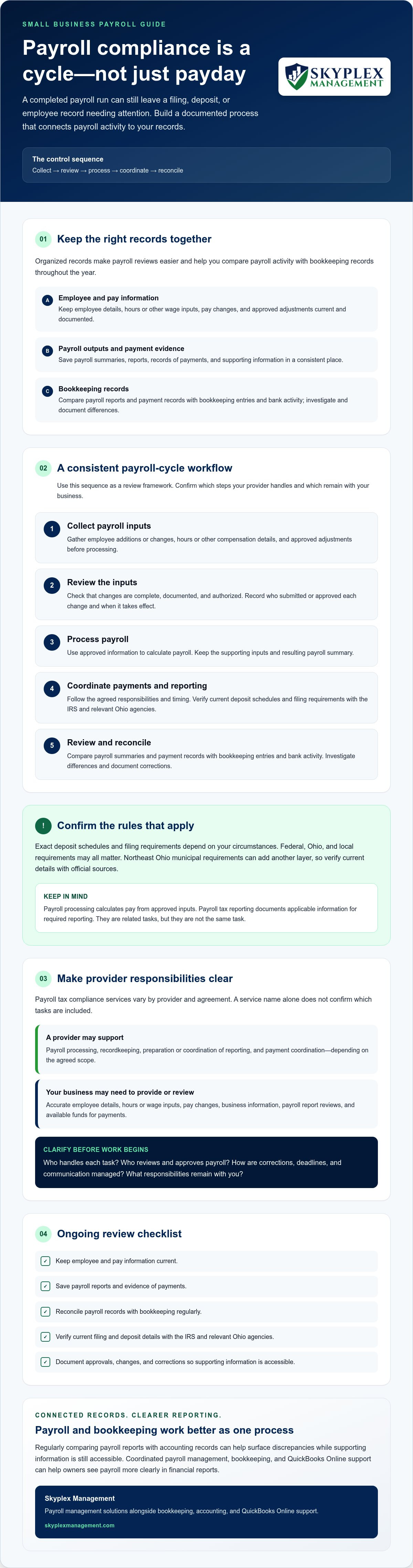
- Keep employee and pay information current.
- Save payroll reports and evidence of payments.
- Reconcile payroll records with bookkeeping regularly.
- Verify current filing and deposit details with the IRS and relevant Ohio agencies.
Skyplex Management provides payroll management solutions alongside bookkeeping, accounting, and QuickBooks Online support. Coordinating these records can help owners see payroll more clearly in their financial reports. To understand how accounting support may fit your business, review the small business accounting services page and confirm which payroll tasks are included before moving forward.
How Payroll Tax Compliance Works Across a Payroll Cycle
A dependable payroll cycle moves from gathering source information to processing, recording, and reviewing the results. Payroll processing calculates pay from approved inputs. Payroll tax reporting documents applicable tax information for required reporting. The tasks are related, but they aren’t the same.
Use this workflow as a control sequence, then confirm which steps your provider handles and which remain with your business. Exact deposit schedules and filing requirements depend on your circumstances. Verify them with the IRS and relevant Ohio agencies.
- Collect payroll inputs. Gather employee additions or changes, hours or other compensation details, and approved adjustments before processing begins.
- Review the inputs. Check that changes are documented, authorized, and complete. A consistent review can catch missing or unclear information before it affects payroll records.
- Process payroll. Use the approved information to calculate payroll. Keep a record of the inputs and the resulting payroll summary.
- Coordinate payments and reporting. Follow the responsibilities and timing agreed with your provider. Check the current Employer's Tax Guide for federal employer guidance, and verify applicable Ohio requirements with the relevant state agency.
- Review and reconcile records. Compare payroll summaries and payment records with bookkeeping entries and bank activity. Investigate differences and document any corrections.
What information should be ready before payroll is processed?
Prepare employee changes, hours or compensation inputs, and approved payroll adjustments in a consistent format. Record who submitted or approved each change, when it takes effect, and how any correction was documented. Complete, timely source information gives the person processing payroll a clear basis for the work and makes later questions easier to resolve.
What records and reports should owners review afterward?
Review the payroll summary, payment records, and relevant tax reports for the period. In bookkeeping, payroll expense is the cost recorded for employee compensation; payroll-related liabilities are amounts recorded as owed but not yet settled. Compare these accounts with payroll reports and bank activity so you can follow up on unexplained differences instead of carrying them into later reporting.
For example, compare the payroll summary with the bookkeeping entry and bank transaction for the same pay period. If they don’t align, check whether an entry is missing, recorded in a different period, or needs correction. Keep supporting records together so you can repeat the review consistently.
Payroll tax compliance services can support parts of this cycle, but deliverables vary. Owners exploring related support can review payroll services for small businesses and clarify the scope directly. To discuss how payroll and bookkeeping records fit together, contact Skyplex Management.
Payroll Tax Compliance Services: In-House Management or Outside Support?
The choice isn’t simply between doing payroll yourself and handing it off completely. The right setup depends on available staff time, documented procedures, confidence reviewing payroll records, and the specific work a provider agrees to handle. Hiring a provider doesn’t mean the business no longer needs oversight. Employers still need to provide accurate information, approve decisions assigned to them, and understand who is responsible for each step.
| Consideration | In-house management | Outside support |
|---|---|---|
| Owner time | Staff coordinate inputs, processing, and follow-up internally. | Agreed tasks can be handled externally, while the business supplies information and reviews work. |
| Internal expertise | Knowledge depends on the staff assigned and the procedures they follow. | A provider may bring payroll experience; confirm the services and expertise included. |
| Record coordination | The business connects payroll information with its bookkeeping records. | Clarify how payroll records will be shared and coordinated with bookkeeping. |
| Provider scope | The business defines and manages the process internally. | Responsibilities depend on the written scope and should be confirmed before engagement. |
When might in-house payroll management remain workable?
In-house management may suit a business with staff time to maintain payroll records, documented procedures for changes and corrections, and a clear review process. Business size alone doesn’t determine the best approach. Consider the actual workload, how discrepancies are handled, and whether another trained person can maintain continuity if the usual payroll contact is unavailable.
What should you confirm before outsourcing payroll tax support?
Ask for a clear description of the processing, reporting, deposit coordination, and year-end tasks included. Confirm what’s excluded, too. Before engaging Skyplex Management, discuss the payroll support your business needs and verify the scope instead of assuming particular filings or deliverables are included.
- Who supplies employee changes and compensation information, and by when?
- Who reviews and approves payroll before it is processed?
- Which reports will be provided, and who checks them?
- How are discrepancies, corrections, or missing information escalated?
- Who coordinates payments, and what remains the employer’s responsibility?
For context on payroll tax components, Forbes offers an overview of Payroll Tax Rates. Use it as general background, then verify current requirements that apply to your business with official sources. A written division of responsibilities helps prevent assumptions and makes oversight practical, whether you manage payroll internally or use payroll tax compliance services.
A Practical Compliance Checklist for Northeast Ohio Employers
A useful payroll checklist keeps records together and makes it easier to spot questions before they become a year-end scramble. Start with the information your business already uses, then confirm which federal, state, and local requirements apply. For example, a Cleveland business with employees working elsewhere should check requirements for those work locations rather than assume one city’s rules apply everywhere.
- Employee records: Keep employee information and documented changes to pay or employment details organized, including when updates were provided and reviewed.
- Payroll reports: Save payroll summaries and relevant tax reports by pay period so reported wages and withholdings can be traced.
- Payment evidence: Retain confirmations or other records showing payroll-related payments, and make them easy to match to the relevant reports.
- Bookkeeping review: Periodically compare payroll activity with bookkeeping entries and bank activity. Monthly bookkeeping can help connect payroll expenses and related liabilities to the general ledger, the accounts used to organize financial activity.
- Location check: Confirm whether municipal requirements apply based on your business operations and employee work locations. Don’t assume requirements in Akron, Medina, or Canton are identical.
Which official sources should Ohio employers consult?
For federal payroll tax information, check the IRS for current guidance, forms, and schedules. For applicable Ohio state tax information, consult the Ohio Department of Taxation and make sure you’re using current guidance. If municipal withholding may apply, check the relevant municipality or tax administrator for the specific work location. Requirements can differ, so information from a neighboring city may not apply.
What records make payroll reviews easier?
Keep employee-change documentation, payroll summaries, payment confirmations, and bookkeeping records organized by period. During a monthly review, compare payroll reports with the related general ledger entries and bank activity, then follow up on differences while the supporting details are easy to locate. Owners looking for broader accounting support can review small business accounting services. Clear records also make it easier to discuss the scope of payroll tax compliance services with a provider.
How Skyplex Management Can Support Payroll and Financial Clarity
Payroll information affects more than employee pay. It also feeds into bookkeeping and financial reports, so organized records help owners understand labor expenses and related amounts recorded as liabilities. Skyplex Management provides payroll management solutions for small businesses, alongside bookkeeping, accounting, QuickBooks Online support, and financial reporting. Its Outsourced Accounting & Controller Services can also support broader financial management needs. The exact payroll tasks included depend on the agreed scope, so discuss your process and confirm responsibilities before getting started.
How can payroll and bookkeeping work together?
Payroll records help explain the labor costs shown in a business’s books. Monthly bookkeeping can connect payroll summaries with accounting records, making it easier to review expense categories and related liabilities as part of the broader financial picture. These services are related, but don’t assume they’re automatically bundled. Confirm how they would work together for your business.
For example, a small service business in Akron might compare its payroll summary with the labor expenses recorded in QuickBooks Online. If the figures don’t match, organized records make it easier to identify what needs review and keep financial reporting grounded in the underlying activity. Skyplex also offers QuickBooks Online support and cleanup, which may be useful if payroll entries or other bookkeeping records need attention.
Payroll tax compliance services can involve different tasks depending on the provider and agreement. Skyplex’s confirmed offering is payroll management support; don’t assume specific filings, deposits, or year-end deliverables are included without confirming the scope. Ask how payroll information will be coordinated with bookkeeping and what reports or records you can expect to review.
What should you prepare for a payroll consultation?
A focused conversation starts with a clear picture of your current process. Consider bringing:
- A high-level outline of who currently supplies payroll information, reviews payroll, and maintains related records.
- Questions about reporting, bookkeeping coordination, and which responsibilities you want support with.
- Examples of tasks that take time or create uncertainty, such as tracking employee changes or matching payroll activity to accounting records.
You don’t need to have every answer ready. Identifying what feels unclear can help you determine whether payroll management, bookkeeping, QuickBooks Online support, financial reporting, or outsourced accounting support may fit your needs. For Northeast Ohio business owners, a dependable process can bring payroll records and financial information into clearer view, leaving more time for day-to-day operations.
In short, keep payroll records organized, clarify provider responsibilities, and connect payroll activity to your bookkeeping. If you’d like to review your current process and discuss suitable support, contact Skyplex Management.
Build a Payroll Process You Can Rely On
Payroll compliance is easier to manage as a recurring process: keep employee and wage records current, review payroll reports and payment evidence, and reconcile payroll activity with your bookkeeping. Confirm current federal, Ohio, and applicable local requirements with official sources, since filing and deposit details depend on your business.
Before choosing payroll tax compliance services, clarify which tasks a provider will handle and what remains your responsibility. Clear approvals and organized records help you maintain oversight while connecting payroll expenses to more useful financial reporting.
Skyplex Management provides payroll management solutions for small businesses in Northeast Ohio, along with bookkeeping, accounting, and QuickBooks Online support. Discussing your current process can help you identify where support may fit and what questions to resolve before moving forward.
With a dependable process and the right support, you can approach payroll with greater clarity and keep more attention on running your business.
Frequently Asked Questions
What do payroll tax compliance services include?
Payroll tax compliance services may support payroll processing, recordkeeping, reporting, and payment coordination, depending on the provider and agreement. Before engaging a provider, ask which tasks are included, what information you must supply, and which reports or records you’ll receive. Clarify who approves payroll, follows up on discrepancies, and handles tasks outside the agreed scope. The term doesn’t automatically mean a provider manages every payroll tax obligation.
Does outsourcing payroll make my business fully compliant?
No. Outsourcing payroll tasks doesn’t remove the need for employer oversight or make compliance automatic. Your business may still need to provide complete employee and wage information, review payroll reports, approve changes, and understand which responsibilities remain yours. Document the division of tasks with the provider before work begins. Continue reviewing the process and confirm applicable requirements with official sources, especially when your workforce or business locations change.
Which payroll tax requirements apply to Ohio small businesses?
Requirements depend on your business and workforce, and may include applicable federal, Ohio state, and local tax obligations. Ohio employers should verify current state information with the Ohio Department of Taxation and federal guidance with the IRS. Also check whether municipal requirements apply based on business operations and employee work locations. A business in Cleveland shouldn’t assume the same local rules apply to employees working in Akron, Medina, or another community.
How often do payroll taxes need to be deposited or reported?
There isn’t one schedule that applies to every business. Federal deposit timing and reporting requirements depend on the employer’s circumstances and the applicable IRS schedule. Ohio and local requirements may have separate rules or schedules. Check current federal details with the IRS and state information with the Ohio Department of Taxation. Confirm local requirements with the relevant municipal authority instead of relying on another employer’s calendar.
What records should a business keep for payroll tax compliance?
Keep employee information and documented changes, wage and compensation inputs, payroll summaries, relevant tax reports, payment confirmations, and records of corrections or approvals. Organize them by pay period so you can trace reported payroll activity to bookkeeping entries and bank transactions. Review records periodically and investigate differences while supporting details are easy to find. Check official guidance for applicable recordkeeping rules and retention periods, since requirements can vary.
Can a bookkeeping firm help with payroll tax compliance?
Yes, if the firm offers payroll support and the specific tasks you need are within its scope. Coordinating payroll with bookkeeping can help connect wage expenses and related liabilities to accounting records and financial reports. Skyplex Management provides payroll management, bookkeeping and accounting, QuickBooks Online support, and financial reporting for Northeast Ohio businesses in Cleveland, Akron, Medina, Strongsville, Brecksville, Hudson, Stow, Cuyahoga Falls, Fairlawn, Brunswick, Wadsworth, North Royalton, Canton, Wooster, Richfield, Macedonia, Broadview Heights, and Solon.
When should a small business consider payroll support?
Consider payroll support if coordinating employee changes, processing, records, or reporting takes time away from operations, or if it’s difficult to keep payroll information aligned with bookkeeping. It may also be worth reviewing support options when responsibilities are unclear or your current process depends heavily on one person. Compare your workload and reporting needs, then confirm exactly what a provider handles and what your business must continue to review.
Disclaimer
The information provided in this article is for general educational purposes only and should not be considered accounting, tax, or legal advice. Every business is unique. Consult a qualified accounting professional before making financial or tax decisions. Contact Skyplex Management for guidance specific to your business.


