
Clean books show you where your money went last month, but they rarely reveal where your business can afford to go next. If you run a growing company in Northeast Ohio, you’ve likely felt the friction of outgrowing routine bookkeeping. Transactions get logged, yet you still face lingering uncertainty around cash flow bottlenecks, payroll compliance, and capital decisions. You need high-level financial leadership, but hiring a full-time executive at an annual salary well over $100,000 isn't practical. That operational gap is why proactive owners turn to outsourced controller services to connect daily transaction records with executive strategy.
You shouldn't have to wait weeks after month-end just to understand your true margins or worry whether internal controls are protecting your bottom line. In this 2026 guide, you’ll discover how outsourced controller oversight brings GAAP-compliant financial statements, proactive cash forecasting, and fraud prevention to your business without executive overhead. We examine the exact differences between bookkeepers and controllers, explore key state and federal compliance hurdles, and outline how the right financial partnership turns historical numbers into forward-looking operational clarity.
Key Takeaways
- Understand why modern outsourced controller services provide the essential operational link between basic bookkeeping and executive growth strategy.
- Identify the core differences between a bookkeeper, controller, and CFO to avoid costly hiring mistakes or operational bottlenecks.
- Discover how fractional oversight strengthens internal controls, eliminates key-person reliance, and protects working capital.
- Learn practical criteria for evaluating prospective partners, from specialized trade industry experience to advanced QuickBooks Online capability.
- See how local accounting integration in Northeast Ohio streamlines daily compliance and delivers reliable management reporting month after month.
What Are Outsourced Controller Services and Why Do Growing Businesses Use Them?
Every growing business eventually hits an operational ceiling where basic data entry is no longer enough. Outsourced controller services provide senior-level financial governance, workflow compliance, and cash management without the crushing overhead of a full-time executive salary. While standard bookkeeping tracks historical transactions, a controller ensures your accounting systems function properly, adhere to established standards, and deliver reliable data you can use to steer operations. By pairing structured small business accounting services with controller oversight, business owners bridge the gap between day-to-day entries and long-term planning.
The Core Responsibilities of an Outsourced Financial Controller
Historically rooted in organizational stewardship, the modern role of a Comptroller or financial controller focuses on the operational health of your entire accounting department. Rather than spending time on routine data entry, an outsourced controller manages the processes and people behind the numbers. Core duties include:
- Supervising accounting workflows: Overseeing accounts payable, billing, accounts receivable aging, and general ledger reconciliation to preserve working capital.
- Executing the month-end close: Completing balance sheet reconciliations, accruals, and adjustments within days of month-end rather than weeks.
- Enforcing internal controls: Creating checks and balances that separate financial duties, eliminate reconciliation discrepancies, and protect company assets.
- Delivering management reporting: Transforming raw numbers into customized monthly reporting packages that highlight gross profit margins, departmental overhead, and cash flow trends.
Signs Your Business Has Outgrown Basic Bookkeeping
Many business owners across Cleveland, Akron, and surrounding communities discover they have outpaced standalone bookkeeping when financial reports no longer reflect operational realities. Watch for these common operational symptoms:
- Persistent cash flow surprises: Sales are climbing, yet available cash stays uncomfortably tight due to loose billing cycles or unmanaged inventory holding costs.
- Delayed financial visibility: You wait three to four weeks after month-end for draft reports, forcing you to make hiring or capital expenditure decisions based on gut feel.
- Unmonitored internal controls: As your team expands, the person writing checks or approving vendor invoices is also reconciling the bank feed, creating dangerous exposure to billing errors and fraud.
Transitioning to reliable outsourced controller services replaces these vulnerabilities with disciplined financial management, protecting your cash reserves while giving you clear visibility into your growth.
Bookkeeper vs. Controller vs. CFO: Understanding the Financial Hierarchy
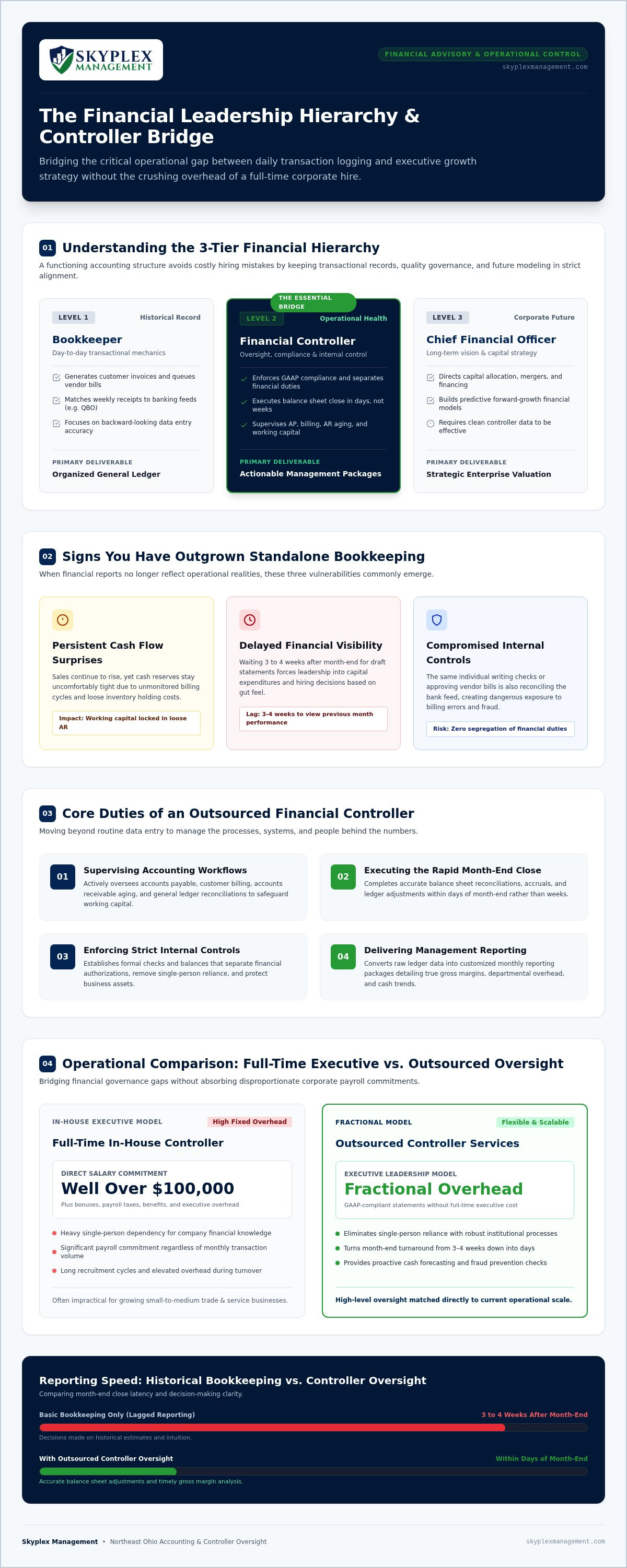
Many growing enterprises run into trouble because they blur the lines between recordkeeping, oversight, and corporate strategy. Bringing on a high-priced Chief Financial Officer without clean operational data is a recipe for expensive disappointment. A CFO cannot model growth scenarios if the underlying ledger is littered with unclassified expenses or delayed bank feeds. A well-run finance department relies on three distinct functional tiers working in harmony, and bridging that middle tier with outsourced controller services ensures your records translate directly into actionable intelligence.
The Bookkeeper: Managing Transactional Accuracy
Bookkeepers focus on the day-to-day mechanics of logging past transactions. They ensure customer invoices are generated, vendor bills get queued, and weekly receipts match banking feeds inside platforms like QuickBooks Online. Their primary deliverable is an organized general ledger. While essential, basic bookkeeping looks backward, documenting where every dollar went without evaluating operational efficiency or balance sheet compliance.
The Controller: Enforcing Operational Quality and Compliance
A controller manages the entire accounting infrastructure, providing the critical supervisory buffer between data entry and executive leadership. This role designs internal controls, monitors job costing, enforces GAAP-aligned accruals, and conducts rigorous reconciliations before the books are finalized. Controllers also monitor regulatory requirements, managing compliance standards such as payroll allocations, sales tax reporting, and state filing deadlines like Ohio's Commercial Activity Tax. As highlighted in discussions surrounding federal oversight of small business programs, strong internal checks protect working capital against fraud, misallocation, and operational drift.
The Fractional CFO: Guiding Long-Term Capital Strategy
Chief Financial Officers direct enterprise-level strategy rather than daily operational accounting. They evaluate major asset purchases, negotiate line-of-credit terms with commercial lenders, analyze mergers, and plan equity distributions. When small businesses need guidance choosing between operational management and forward-looking financial engineering, exploring an in-depth breakdown of outsourced controller vs cfo capabilities helps clarify which level of oversight best fits their current stage of growth.
Skipping the controller layer forces business owners to either micromanage their bookkeepers or pay an executive CFO to fix routine ledger errors. Fractional staffing solves this dilemma by blending these tiers efficiently. If you suspect gaps in your current financial reporting structure, you can speak with our accounting team to assess where controller-level oversight can strengthen your day-to-day operations.
Key Benefits of Outsourcing Your Controllership in 2026
Hiring a full-time in-house financial controller carries a substantial financial burden. In Ohio, base salaries for qualified controllers average around $105,000 annually, with experienced professionals commanding significantly more before factoring in payroll taxes, healthcare benefits, and recruitment costs. Outsourced controller services deliver that same level of technical governance without saddling your business with an executive overhead package. Beyond direct cost savings, outsourcing eliminates key-person risk. If an in-house controller leaves abruptly, internal operations stall; a specialized outsourced team provides continuity, documented standard operating procedures, and uninterrupted reporting.
Strengthening Fraud Prevention and Internal Controls
Small and mid-sized enterprises are particularly vulnerable to internal accounting leakage. Entrusting bill approval, payment disbursement, and account reconciliation to a single person invites operational vulnerabilities. A dedicated external controller establishes strict segregation of duties across your financial workflows. They implement dual-authorization payment systems and calibrate granular user permissions within your accounting software. Standardizing these oversight mechanisms ensures company funds remain thoroughly monitored and accounted for.
Optimizing Working Capital and Cash Flow Predictability
A primary responsibility across the operational duties of a financial controller is protecting liquid reserves through active cash cycle management. Rather than letting uncollected receivables age past 60 or 90 days, an outsourced controller structures automated billing schedules and formal collection cadences. On the expense side, they coordinate accounts payable terms with key suppliers, preventing early payouts that unnecessarily drain operating cash. For companies planning growth initiatives, aligning these working capital fundamentals with a broader small business financial strategy turns reactive cash management into predictable liquidity.
Audit Readiness and Multi-Agency Regulatory Compliance
Operating a business in communities like Medina, Strongsville, or Cuyahoga Falls requires juggling overlapping local, state, and federal reporting requirements. An outsourced controller keeps your balance sheet audit-ready every month by standardizing documentation to meet rigorous regulatory scrutiny:
- Federal payroll governance: Monitoring compliance with IRS payroll withholding mandates, including FICA limits and Medicare thresholds.
- State tax tracking: Ensuring proper calculations for the Ohio Commercial Activity Tax (CAT), which applies a 0.26% rate on taxable gross receipts exceeding the statutory exclusion threshold.
- Year-end tax coordination: Assembling clean reconciliations, depreciation schedules, and trial balances so your CPA can complete corporate income tax returns efficiently without costly cleanup delays.
This systematic oversight protects your business from avoidable penalties while giving you reliable numbers to run daily operations with confidence.
How to Evaluate and Select the Right Outsourced Controller Partner
Selecting an accounting partner requires looking beyond high-level marketing promises to inspect how they handle day-to-day operations. Effective outsourced controller services depend on technical alignment with your software ecosystem, starting with deep, hands-on mastery of QuickBooks Online. A qualified partner should effortlessly manage cloud integrations, configure role-based security settings, and establish clear communication rhythms. Rather than settling for impersonal ticket systems, demand established response-time standards and transparent monthly reporting schedules.
Assessing Industry Expertise and Niche Workflows
Every commercial sector faces unique operational challenges, meaning generic accounting templates often create blind spots. When vetting prospective controllers, look for direct experience solving your specific industry hurdles:
- Construction and trade contractors: Managing progress billings, tracking job profitability, and calculating work-in-progress (WIP) adjustments to prevent cash crunches across multi-month commercial projects.
- Auto repair shops: Synchronizing shop management platforms with general ledgers, maintaining real-time parts inventory tracking, and verifying labor margin realization on repair orders.
- Professional service firms: Establishing clean trust accounting workflows, tracking billable-hour realization rates, and projecting staff utilization to guide strategic hiring.
Essential Questions to Ask During Your Discovery Consultation
To identify the right operational fit, ask targeted questions during your introductory conversations:
- Closing cadence: What exact timeline do you follow for the month-end close, and by what business day will our management reporting package arrive?
- Internal control design: What specific approval chains and segregation policies will you implement across our accounts payable and payroll workflows?
- Tax CPA coordination: How do your controllers collaborate with our external year-end tax preparer to share workpapers and avoid duplicate billings?
- Fee transparency: How do service tiers scale as transaction volume expands? Reviewing our detailed guide on outsourced bookkeeping pricing provides helpful context on how professional scopes are structured.
Partnering with Skyplex Management for Scalable Financial Control in Northeast Ohio
Running a growing business requires dependable financial leadership, not generic software algorithms or distant call centers. Skyplex Management delivers personalized outsourced controller services designed to give regional business owners complete peace of mind. By combining corporate-grade accounting rigor with accessible, local accountability, we integrate daily recordkeeping, payroll execution, and executive reporting under one roof. You gain an experienced financial ally who understands your day-to-day operational hurdles and helps steer your business toward long-term profitability.
The Skyplex Management Approach: From Cleanup to Proactive Control
Many business owners first reach out when their books have fallen behind or when years of rapid growth have created messy categorization errors. We start by conducting a comprehensive diagnostic review of your balance sheet and general ledger accounts. Our team remediates historical discrepancies inside QuickBooks Online, untangles unapplied customer payments, and reconstructs dependable baseline records.
Once your ledger is accurate, we design custom management dashboards tailored to your key operational drivers, tracking gross profit margins, billable utilization, and cash burn rates. Through our comprehensive suite of small business accounting services, we establish structured workflows that turn routine transaction recording into disciplined operational clarity.
Local Dedication Backed by Deep Technical Expertise
Impersonal, venture-backed platforms often route your urgent financial questions through anonymous help tickets and fluctuating remote teams. Skyplex Management provides direct, personal access to seasoned professionals rooted in the local economy. We proudly serve trade contractors, automotive facilities, and growing service firms across Cleveland, Akron, Medina, Strongsville, Canton, Cuyahoga Falls, Hudson, and Brecksville.
We believe in explaining complex accounting standards in plain, practical language so you can make informed hiring, purchasing, and capital decisions without second-guessing your data. If you are ready to eliminate month-end closing delays, protect your working capital, and gain confident visibility into your numbers, contact our team today to schedule an advisory consultation and discover how our outsourced controller services can strengthen your business.
Build Smarter Financial Oversight for Your Business
Scaling a company requires moving beyond routine transaction logs to establish disciplined operational oversight. You shouldn't have to carry the burden of an unreachable executive payroll commitment just to secure dependable numbers. By investing in tailored outsourced controller services, you protect working capital, enforce strict internal controls, and transform historical bookkeeping records into strategic guidance for lasting growth.
With nearly a decade of dedicated small business accounting leadership across Northeast Ohio, Skyplex Management bridges the divide between daily recordkeeping and high-level controllership. Whether you manage a commercial construction crew, oversee an auto repair facility, or direct a professional service firm, structured financial oversight gives you the freedom to focus on what you do best.
Gaining complete command over your cash flow and compliance is the first step toward lasting operational confidence. We're here to help you build a stronger financial foundation for the road ahead.
Frequently Asked Questions
What is the typical time commitment required from an owner when hiring an outsourced controller?
During onboarding, expect to invest two to four hours walking through operational workflows, bank accounts, and software access. Once the controller sets up standard operating rhythms, your monthly commitment drops to roughly one or two hours. This time is typically spent in a monthly review meeting examining gross margins, cash trends, and upcoming capital decisions. The primary goal is reducing your administrative burden, giving you back valuable time to lead operations.
How do outsourced controller services differ from what my year-end tax CPA provides?
A year-end tax CPA focuses primarily on annual tax returns, depreciation planning, and filing compliance once the year has already closed. In contrast, outsourced controller services provide continuous, year-round operational oversight. Controllers manage your monthly closing cycles, enforce internal controls, oversee weekly cash flow, and ensure your ledger remains clean. They collaborate directly with your tax CPA by handing over audit-ready workpapers, preventing rushed cleanups and expensive tax preparation delays at filing time.
Can an outsourced controller help fix historical errors in our QuickBooks Online file?
Yes, comprehensive file cleanup is often the essential first step before establishing ongoing controllership. If historical transactions were miscategorized, accounts were never reconciled, or inventory adjustments fell behind, a controller conducts a thorough general ledger diagnostic. At Skyplex Management, we specialize in QuickBooks Online cleanup, untangling historical ledger discrepancies, resolving duplicate vendor entries, and restating prior periods so you start with dependable, accurate baseline financial records.
Will our business lose control of our bank accounts or vendor disbursements?
No, you maintain complete ownership and final authority over all financial disbursements. An outsourced controller designs internal controls that actually increase your oversight while eliminating manual legwork. They prepare invoice batches, verify receiving documents, and queue disbursements within your bill payment system, but business owners or designated managers hold exclusive release authorization. This separation of duties protects company assets against unauthorized transactions without sacrificing your executive oversight or day-to-day control.
How does an outsourced controller work alongside our existing in-house bookkeeper?
Rather than replacing internal staff, a controller acts as an experienced supervisor and mentor for your in-house bookkeeper. Your internal staff member continues managing daily transaction logging, vendor invoicing, and customer billing. The controller reviews their entries, provides QuickBooks training, completes complex month-end journal entries, and prepares executive management statements. This collaborative partnership elevates your bookkeeper's skills while ensuring your leadership team receives vetted, accurate financial data every single month.
What size or annual revenue should a business reach before hiring an outsourced controller?
Businesses typically benefit most when annual revenues reach between $1 million and $15 million, or whenever operations introduce structural complexity. If you run a construction trade business handling progress billing, an auto shop balancing parts inventory, or a service agency managing growing payroll across Northeast Ohio, operational complexity matters more than top-line revenue. When basic bookkeeping can no longer deliver timely job-costing or reliable cash forecasts, controller oversight becomes an essential investment.
How do outsourced controllers handle compliance for multi-city Ohio municipal income taxes and CAT?
Ohio presents unique local tax hurdles, including municipal withholdings across RITA and CCA communities alongside the Commercial Activity Tax (CAT). A controller tracks receipts to ensure timely quarterly CAT filings at the standard 0.26% rate once taxable gross receipts surpass statutory exclusions. For businesses dispatching mobile crews between Cleveland, Akron, and suburban job sites, controllers calibrate payroll systems to track local municipal work locations accurately, eliminating costly withholding adjustments and penalty notices.
Disclaimer
The information provided in this article is for general educational purposes only and should not be considered accounting, tax, or legal advice. Every business is unique. Consult a qualified accounting professional before making financial or tax decisions. Contact Skyplex Management for guidance specific to your business.


