
When an automated bookkeeping service controls your underlying software, you don't truly own your financial records; you're simply renting access to your own numbers. Many growing business owners search for Bench accounting alternatives after realizing that proprietary platforms lock them in, leaving them stranded without direct QuickBooks Online access, specialized job costing, or responsive human support. If you've grown frustrated with high bookkeeper turnover and cash-basis limits that overlook complex state and local tax compliance, your frustration is completely justified.
A business cannot build sustainable momentum when its general ledger is trapped in a closed system. You need a solution that guarantees complete data portability while delivering proactive advisory beyond basic data entry. In this guide, we break down the top alternatives to Bench for 2026, comparing rigid proprietary tools against flexible QuickBooks platforms. We'll examine the real trade-offs between faceless virtual platforms and dedicated outsourced accounting, helping you select a partner that gives you lasting financial clarity and control.
Key Takeaways
- Relying on closed software restricts your business agility, making portable platforms like QuickBooks Online essential for true financial ownership.
- Evaluating leading Bench accounting alternatives helps you pinpoint providers that combine dedicated human oversight with accrual accounting and job costing capabilities.
- Operating on an industry-standard general ledger simplifies tax season by giving your CPA direct, uninterrupted access to clean records.
- Following a clear four-step migration path safeguards your historical books and prevents reporting interruptions when transitioning away from closed platforms.
- Partnering with a regional outsourced accounting firm protects your business against complex state and local tax missteps, including Ohio CAT and municipal filings.
Why Small Business Owners Look for Bench Accounting Alternatives
Bench Accounting operates on a hybrid model that blends proprietary software with assigned virtual bookkeepers. While this turnkey approach appeals to early-stage startups and sole proprietors wanting hands-off monthly reconciliations, growing companies quickly hit operational roadblocks. As transaction volumes surge and operational complexity increases, relying on an automated box service often reveals significant blind spots in strategic oversight.
The primary driver behind the search for Bench accounting alternatives centers on software autonomy. When you review an objective comparison of accounting software options, open-ecosystem platforms consistently prioritize data transparency and third-party integrations. Closed platforms restrict these capabilities, leaving business owners unable to connect essential operational tools or customize their financial workflows.
Most small businesses encounter several structural pain points with this closed model:
- High Staff Turnover: Frequent reassignments among remote bookkeepers require business owners to continually re-explain their chart of accounts and operational nuances.
- Impersonal Support: Ticket-based messaging systems delay answers to urgent, time-sensitive cash management questions.
- Tax Preparedness Bottlenecks: External CPAs frequently struggle to review records generated within closed systems, causing friction during year-end tax preparation.
The Proprietary Software Trap and Data Portability Risks
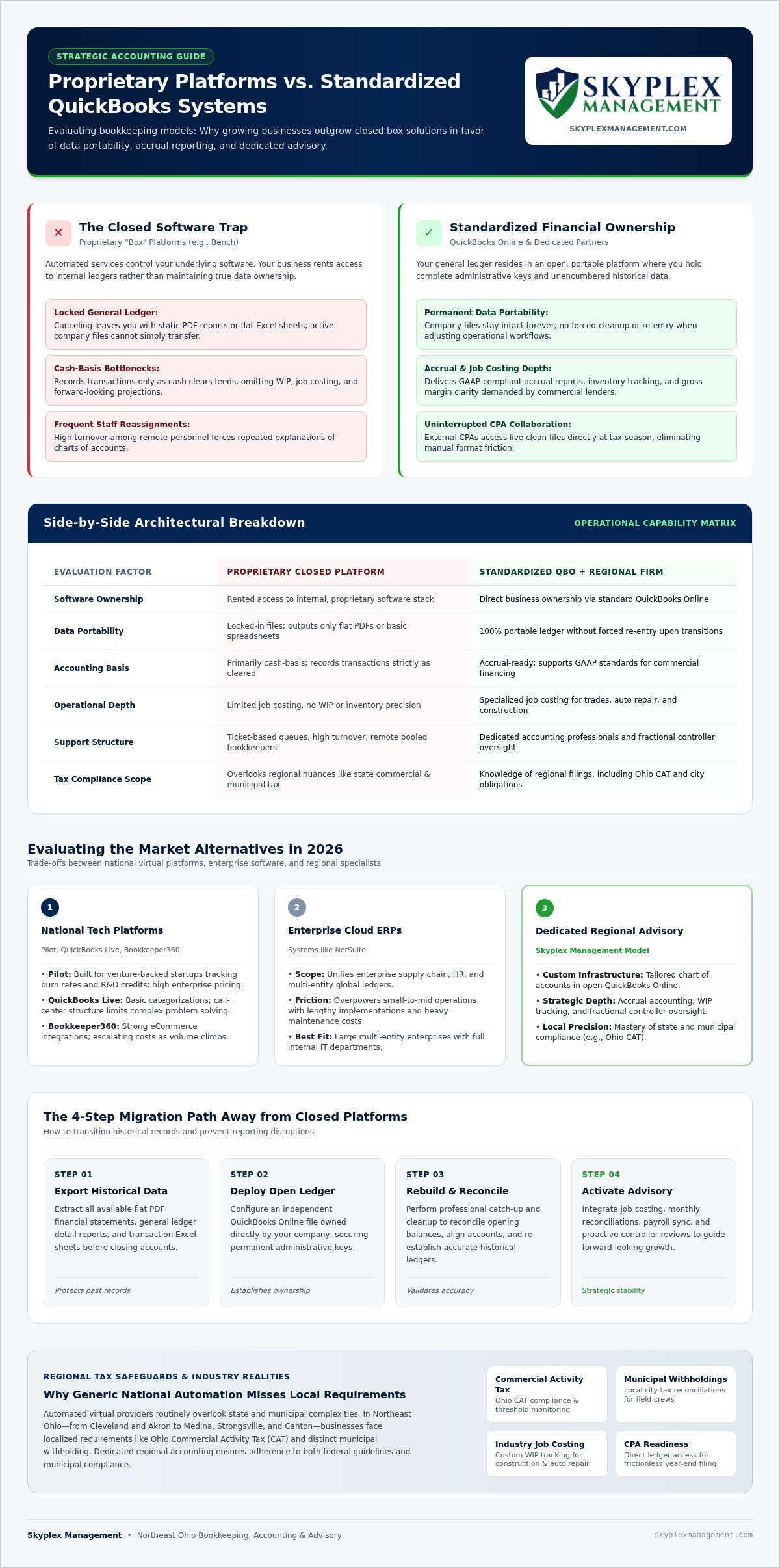
Closed ecosystems create severe data portability hurdles. Bench maintains your general ledger within its internal software rather than standard business tools like QuickBooks Online. If you decide to cancel, you cannot simply transfer an active company file to a new provider. Instead, you receive flat PDF reports or basic Excel spreadsheets. Rebuilding that historical data inside an open platform requires extensive re-entry or professional cleanup services, costing business owners unnecessary time and administrative overhead.
Limitations in Accrual Accounting, Job Costing, and Custom Reporting
Bench primarily functions on a cash-basis framework, recording income and expenses only as money moves through bank feeds. While sufficient for micro-businesses, this structure fails trades, auto repair facilities, and construction firms that require precise job costing, work-in-progress tracking, and inventory tracking. When business owners in areas like Cleveland or Akron seek bank financing, commercial lenders demand GAAP-compliant accrual reports. Without fractional controller oversight or customized financial statements, business owners cannot accurately assess gross margins or project forward-looking cash flow.
Evaluating the Leading Bench Accounting Alternatives in 2026
Choosing the right partner requires a practical framework built on three pillars: software flexibility, pricing transparency, and service depth. Sound recordkeeping isn't just about balancing accounts; as outlined in the SBA guide to managing finances, disciplined financial management safeguards cash flow, strengthens commercial banking relationships, and keeps tax obligations predictable. When assessing Bench accounting alternatives, business owners generally weigh three distinct paths.
National Tech-Enabled Platforms: Pilot, QuickBooks Live, and Bookkeeper360
National virtual providers rely heavily on automated algorithms layered with remote bookkeepers. Pilot focuses squarely on venture-backed technology startups, excelling at tracking burn rates and R&D tax credits, though its enterprise pricing quickly outpaces Main Street budgets. Intuit's QuickBooks Live provides basic transaction categorization inside your own file, yet its call-center structure limits complex problem-solving. Bookkeeper360 offers versatile app integrations for scaling eCommerce sellers, but costs climb rapidly as transaction volumes grow.
Enterprise Cloud ERP Systems: Why NetSuite Overpowers Small Operations
Mid-market software like NetSuite delivers comprehensive enterprise resource planning, unifying supply chains, human resources, and multi-entity ledgers. For small to mid-sized operations, however, full ERP deployments often introduce unnecessary friction. Lengthy implementations, steep annual licensing fees, and dedicated administrative demands pull resources away from daily operations. Most growing businesses gain far greater operational agility by pairing standard QuickBooks Online tools with nimble outsourced accounting support.
Dedicated Regional Bookkeeping Firms: Hands-On Expertise and Local Accountability
Regional firms deliver the direct accountability that faceless platforms lack. Instead of submitting help tickets into an automated queue, you collaborate with an experienced professional who understands your industry workflow, whether you operate an auto repair shop in Medina or a subcontracting firm in Akron. Personalized oversight prevents misclassified expenses, ensures accurate payroll reconciliation, and delivers clear monthly visibility.
Partnering with Skyplex Management gives your business standard software portability combined with proactive financial guidance. If you want to explore how customized oversight compares to one-size-fits-all software, you can schedule a consultation with our team to evaluate your current setup.
Comparing Bookkeeping Models: Proprietary Platforms vs. Standardized QuickBooks Systems
The core difference between closed accounting applications and industry-standard engines lies in who ultimately controls the infrastructure. Proprietary platforms operate as walled gardens. They write your transactions into internal software that only their staff can access. Standard systems like QuickBooks Online, by contrast, function as open platforms where you retain master administrator privileges at all times. For business owners evaluating Bench accounting alternatives, choosing an open architecture protects long-term company value and simplifies relationships with lenders and tax professionals.
Certified public accountants overwhelmingly favor standardized general ledgers because they can log in, review journal entries, and pull trial balances without intermediate file conversions. When you apply for equipment financing in Strongsville or seek an SBA loan in Brecksville, commercial underwriters expect clean, verifiable balance sheets generated by recognizable accounting software. Closed platforms struggle under this scrutiny because export formats frequently lack transaction-level audit trails, complicating due diligence and audit defense.
Data Ownership and Long-Term Software Portability
Canceling a proprietary bookkeeping subscription often means losing real-time access to your historical general ledger. The provider might deliver static spreadsheets or PDF statements, but your interactive transaction history disappears. Rebuilding that financial trail inside a modern platform requires extensive manual setup. If you inherit messy records during a provider transition, learning how to fix messy QuickBooks records with professional reconciliation services ensures your opening balances match tax returns accurately. With QuickBooks Online, your ledger remains entirely yours. If you ever change accounting partners, you simply revoke user permissions without interrupting your software setup.
Custom Workflow Integrations and Industry Scalability
Growing trade, repair, and field service businesses rely on integrated operational software to track labor, materials, and invoicing. Proprietary platforms feature limited app ecosystems, preventing automatic synchronization with tools like ServiceTitan, Housecall Pro, or specialized point-of-sale systems. QuickBooks Online connects directly with hundreds of dedicated business applications.
This connectivity allows contractors and service shops to establish customized chart of accounts structures that map revenue directly to specific job expenses. Rather than forcing your business into generic expense buckets, an open platform scales alongside your field operations while keeping job costing accurate.
How to Transition Away from Bench: A Step-by-Step Migration Guide
Switching accounting software often sparks anxiety for business owners. Concerns about lost transaction histories, disrupted tax filings, or scrambled balances cause many operators to tolerate restrictive platforms longer than they should. Transitioning to flexible Bench accounting alternatives doesn't have to stall your day-to-day operations. Following a structured migration process protects your historical books and establishes a clean foundation in an open platform.
Step 1 & Step 2: Exporting Historical Reports and Establishing Clean Cut-Offs
Begin by securing your historical records before canceling your subscription. Download complete year-by-year General Ledger reports, Balance Sheets, Income Statements, and Trial Balances in both Excel and PDF formats. Maintain these digital archives in secure, redundant cloud storage for at least seven years to satisfy IRS audit defense standards.
Next, establish a strict transition cut-off date. Aligning your migration with a fiscal year-end or a calendar month-end prevents messy split-month reconciliations. Selecting a clean cut-off date ensures you don't import duplicate transactions once you connect your live bank and credit card feeds to your new accounting software.
Step 3 & Step 4: Rebuilding Your Chart of Accounts and Reconciling Opening Balances
Once your cut-off date is set, construct an industry-tailored chart of accounts inside QuickBooks Online. Rather than copying generic categories, structure your revenue, cost of goods sold, and operating expense lines to reflect your real operational workflow. Enter your balance sheet figures as opening balances on the migration date, then reconcile those figures against actual bank statements to confirm that cash, liabilities, and retained earnings tie out to the penny.
Engaging professional small business accounting services eliminates opening balance discrepancies, ensuring your ongoing filings match past tax returns accurately.
Why Dedicated Regional Bookkeeping Outperforms Automated Box Solutions
National software platforms often promote a simple story: plug in your bank feeds, let remote algorithms categorize transactions, and your books are done. In practice, automated box solutions struggle with regional compliance and industry realities. When exploring Bench accounting alternatives, small business owners quickly learn that generic data entry cannot replace an accessible partner who understands your operational ecosystem and regulatory environment.
Navigating State and Local Tax Compliance with Precision
National platforms routinely miss state-specific filings and local tax obligations. In Northeast Ohio, companies must navigate the Ohio Commercial Activity Tax (CAT) alongside complex municipal income tax rules through the Regional Income Tax Agency (RITA) or individual city tax departments. A contractor working across Akron, Stow, and Cuyahoga Falls incurs distinct municipal withholding requirements that generic software algorithms cannot parse.
When automated systems categorize these local liabilities into broad expense buckets, owners face costly penalties and late notices from local tax authorities. A dedicated regional partner ensures your monthly payroll and operational receipts align with local compliance standards, giving your CPA clean, verifiable data when filing returns.
Scaling Beyond Data Entry into Strategic Financial Oversight
Logging past receipts is reactive; growing a profitable business requires proactive oversight. While basic virtual platforms stop at reconciling bank statements, outsourced accounting and fractional controller oversight transform your general ledger into a strategic decision-making engine. Experienced professionals review your books each month to uncover margin leaks, evaluate job profitability, and refine vendor payment terms.
Sound financial controls keep overhead predictable and protect your cash flow during seasonal shifts. Reading the 2026 guide to small business financial strategy offers additional insight into aligning your everyday ledger with long-term expansion goals.
Establishing dependable bookkeeping begins with an open assessment of your current records. Our team reviews your chart of accounts, cleans up historical discrepancies, and sets up a portable QuickBooks Online foundation designed for long-term control. We welcome you to schedule a consultation with Skyplex Management to discuss your business needs and regain total confidence in your numbers.
Reclaim Complete Ownership of Your Business Financials
Your company's financial records shouldn't be trapped inside a closed software ecosystem. Evaluating the top Bench accounting alternatives comes down to choosing long-term portability, dependable tax compliance, and direct professional access. Moving your books to an open, industry-standard platform like QuickBooks Online guarantees 100% data ownership while providing the transparent audit trails that lenders and tax preparers require.
With nearly a decade of specialized bookkeeping, historical cleanup, and fractional controller experience across Northeast Ohio, Skyplex Management delivers hands-on support tailored to your operation. We integrate monthly bookkeeping with payroll processing and proactive advisory, ensuring your numbers actively support your growth instead of holding you back.
Clean financial data gives you the clarity to lead your business forward with genuine confidence and peace of mind.
Frequently Asked Questions
What is the biggest difference between Bench and QuickBooks Online?
The biggest difference is software ownership versus proprietary rental. QuickBooks Online is an industry-standard accounting engine where you retain full administrative ownership of your general ledger and can connect third-party apps. Bench operates on closed, proprietary software bundled with its internal bookkeeping service. If you change providers in QuickBooks, your ledger stays intact; if you cancel Bench, you lose direct access to your interactive software interface.
Can I export my historical bookkeeping data if I leave Bench?
You can export flat summary reports, but you cannot export a portable company file. When canceling Bench, you typically receive historical balance sheets, profit and loss statements, and general ledgers as static PDFs or spreadsheets. Transitioning to flexible Bench accounting alternatives requires using those exported reports to establish beginning balances, rebuild a chart of accounts, and reconfigure bank feeds within standard platforms like QuickBooks Online.
Why do CPAs often prefer QuickBooks Online over proprietary platforms like Bench?
CPAs prefer QuickBooks Online because it grants them immediate, direct access to your general ledger and detailed transaction audit trails. Proprietary platforms often produce condensed summary statements that force CPAs to request manual reconciliations during tax season. Direct file access lets your tax professional post adjusting journal entries directly, verify depreciation schedules, and complete corporate filings without administrative delays or unexpected year-end cleanups. Whether handling corporate accounts or specific payroll filings, maintaining clear records is essential—for helpful insights on managing employee payroll forms and tax documents, check out Performance Accountancy.
How much work is required to switch from Bench to a private bookkeeping firm?
The transition requires very little effort from the business owner when working with an experienced firm. You simply export your past financial statements, provide recent bank and loan statements, and share access. A dedicated provider like Skyplex Management handles the heavy lifting, including rebuilding your chart of accounts, verifying opening balances, and establishing automated transaction rules in QuickBooks Online so your daily routine remains uninterrupted.
Does Bench Accounting handle local municipal and state tax compliance?
Bench's standard bookkeeping packages generally do not manage local municipal withholdings or regional business taxes. For companies operating across Northeast Ohio communities like Cuyahoga Falls, Brecksville, or Stow, compliance involves tracking RITA filings, municipal withholdings, and the Ohio Commercial Activity Tax. National box services primarily address federal returns, leaving regional business owners vulnerable to city-level late notices, interest, and noncompliance penalties.
Can Bench support job costing for contractors and trade businesses?
Bench does not natively support advanced job costing or progress invoicing for trade businesses. Because Bench relies primarily on cash-basis recording, it cannot track direct labor allocations, material receipts, and project profitability in real time. Contractors, field technicians, and auto repair shops need specialized project tracking inside QuickBooks Online to measure job profitability accurately and protect their gross profit margins.
When should a small business upgrade to fractional controller services?
A business should upgrade to fractional controller oversight when transaction volumes increase and operations require accrual accounting, rolling cash flow forecasts, or department budgets. If you plan to secure commercial loans or need customized reporting to identify margin leaks, basic transaction logging is insufficient. Exploring Bench accounting alternatives that offer controller-level advisory provides the strategic executive guidance needed to protect company cash flow. For businesses seeking experienced financial professionals to help guide their growth and reporting systems, discover Brown Hamilton Partners.
Disclaimer
The information provided in this article is for general educational purposes only and should not be considered accounting, tax, or legal advice. Every business is unique. Consult a qualified accounting professional before making financial or tax decisions. Contact Skyplex Management for guidance specific to your business.


