

What if your business looks profitable on paper, but there isn’t enough cash in the bank to cover next month’s bills? That disconnect can make small business profit and loss reports confusing, especially when accounting terms obscure what the numbers mean. A P&L shows revenue, expenses, and profit over a period, but it doesn’t tell the whole cash story on its own.
If you’ve wondered whether sales are keeping pace with expenses, or which changes deserve a closer look, you’re asking the right questions. Understanding the report’s structure helps you look beyond the bottom line and assess what’s driving it.
This guide explains the main sections and figures in a profit and loss report, including gross profit, operating expenses, and net income. You’ll learn how to compare periods, spot trends worth investigating, and understand why reported profit may differ from available cash. We’ll also cover how consistent bookkeeping and financial reporting can give you a more dependable basis for decisions, whether you manage the numbers yourself or work with an accounting professional.
Key Takeaways
- Start with the report period and revenue lines, then review expenses before drawing conclusions from net income.
- Small business profit and loss reports track performance over time, but they don’t show your full cash position.
- Compare periods consistently and investigate unusual changes rather than assuming every business uses the same account categories.
- Reconcile records and use QuickBooks Online categories consistently to make monthly reports more useful.
- Consider bookkeeping or financial reporting support when unclear categories, recurring errors, or unanswered trends make decisions harder.
What Small Business Profit and Loss Reports Show
A profit and loss report, often called a P&L or income statement, summarizes a business’s income and expenses over a selected period. It shows whether operations resulted in a profit or loss during that time. The income statement is another common name for this report.
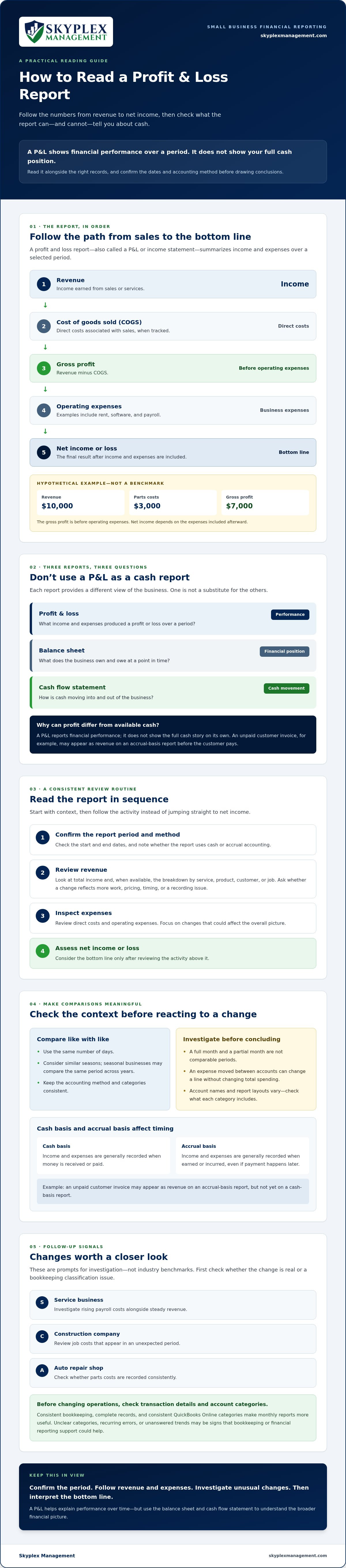
A P&L shows financial performance over time; a balance sheet shows what the business owns and owes at a point in time, while a cash flow statement tracks cash moving in and out. Each report answers a different question, so one shouldn’t be used as a substitute for the others.
Useful small business profit and loss reports depend on complete records and consistent categorization. If a purchase is coded differently each month, or income is missing, a report may look tidy without accurately reflecting the business. Consistent bookkeeping helps keep entries organized so the figures are easier to interpret.
What Information Appears on an Income Statement?
Most P&Ls begin with revenue, the income earned from sales or services. Businesses that sell products or track direct job costs may also show cost of goods sold (COGS), the direct costs associated with those sales. Revenue minus COGS equals gross profit. The report then lists operating expenses, such as rent, software, or payroll, before calculating net income or loss.
Hypothetical example, not a benchmark: A repair shop records $10,000 in revenue and $3,000 in parts costs for a period. Its gross profit is $7,000 before operating expenses. After those expenses are included, net income shows what remains, or whether expenses exceeded income. Account names and report layouts vary, so focus on what each category includes.
Why the Reporting Period and Accounting Method Matter
Check the report’s start and end dates before comparing results. A full month and a partial month aren’t comparable periods, and seasonal businesses may get more context by comparing the same period across years. Keep categories consistent, too. Moving an expense between accounts can make one line appear to rise or fall even when the underlying spending hasn’t changed.
The accounting method also affects timing. Under cash-basis accounting, income and expenses are generally recorded when money is received or paid. Under accrual accounting, they’re generally recorded when income is earned or expenses are incurred, even if payment happens later. For example, an unpaid customer invoice may appear as revenue on an accrual-basis report but not yet on a cash-basis report. Confirm which method the report uses before drawing conclusions.
How to Read Small Business Profit and Loss Reports Line by Line
Read the report in sequence rather than jumping straight to the bottom line. This helps you see what changed and where to ask follow-up questions. For small business profit and loss reports, use this practical order:
- Confirm the period. Check the start and end dates, then note whether the report uses cash or accrual accounting.
- Review revenue. Look at total income and, if available, the breakdown by service, product, customer, or job. Ask whether a change reflects more work, different pricing, timing, or a recording issue.
- Inspect expenses. Review direct costs and operating expenses. Focus on categories that changed enough to affect the overall picture.
- Assess net income. After reviewing the activity above it, consider what the final profit or loss says about the period.
Account names differ between bookkeeping systems and businesses. One company may group costs under “subcontractors,” while another uses a different label. Check what’s included in a category before comparing it or drawing a conclusion.
Which Revenue and Expense Changes Deserve a Closer Look?
Start with changes that could affect a decision, not every small fluctuation. A service business might investigate rising payroll costs alongside steady revenue. A construction company might review job costs that appear in an unexpected period. An auto repair shop might check whether parts costs are recorded consistently. These examples are prompts for follow-up, not industry benchmarks.
First determine whether a change is real or a bookkeeping classification issue. If an expense moved from one account to another, total expenses may be unchanged even though individual lines look different. Check transaction details and account categories before adjusting operations in response.
How to Compare Periods Without Drawing the Wrong Conclusion
Compare like with like: the same number of days, similar seasons, and a consistent accounting method. A busy period compared with a slower one may show a difference that reflects normal timing, not a lasting shift. Review one-time transactions, missing entries, and category changes before treating a movement as a trend.
A trend needs context before it becomes a business conclusion. Ask what happened during the period, whether the books are complete, and whether the same transactions would appear in the same categories on both reports. Pairing P&L review with small business balance sheet analysis can add context about assets, liabilities, and amounts owed.
If recurring changes are difficult to explain, a professional review can help clarify what the reports show. Contact Skyplex Management to discuss bookkeeping or financial reporting support.
Does a Profit and Loss Report Show How Much Cash You Have?
No. Reported profit and bank cash are related, but they aren’t interchangeable. A profitable period doesn’t automatically mean cash is available to pay bills. The report records income and expenses according to the accounting method used, while the bank balance reflects cash on hand at a specific moment.
Each financial statement answers a different question:
| Report | What it shows |
|---|---|
| Profit and loss report | Revenue, expenses, and profit or loss over a period. |
| Balance sheet | Assets, liabilities, and equity at a specific date. |
| Cash flow statement | How cash moved into and out of the business over a period. |
Why Profit and Bank Balances Can Differ
Timing is one common reason. For example, under accrual accounting, revenue may appear when it’s earned even if a customer hasn’t paid yet. The business can show a profit while waiting for that cash to arrive. Likewise, a bill may be recorded as an expense before payment is due, so profit and the current bank balance won’t move in tandem.
Other transactions affect cash without appearing as revenue or expenses in the same way. Loan proceeds add cash but aren’t sales revenue; paying down loan principal reduces cash but generally isn’t an operating expense. Buying equipment uses cash, while its cost may be recorded over time rather than entirely as an expense at purchase. The specific treatment can depend on the circumstances and accounting method.
These are clues to investigate, not a diagnosis. A P&L alone can’t explain every cash shortfall. Review the underlying transactions and other reports before deciding what’s driving the difference.
When to Review the Balance Sheet or Cash Flow Statement
If you want to know what the business owns, owes, or is waiting to collect, review the balance sheet. If you need to understand cash received and spent during a period, the cash flow statement may be more useful. For a broader view of what the balance sheet can tell you, see our guide to small business balance sheet analysis.
Before relying on any report, check that transactions are recorded and accounts are reconciled to bank and credit card statements. If balances or transactions remain unclear, bookkeeping and financial reporting support can help clarify how the reports fit together.
How to Review Small Business Profit and Loss Reports Each Month
A regular review helps you catch questions while the details are still easy to check. Before using small business profit and loss reports to guide a decision, confirm that the bookkeeping is current and the report covers a complete, consistent period.
A Practical Monthly P&L Review Checklist
- Confirm the period. Check the report’s start and end dates, accounting method, and whether all activity for that period has been entered.
- Check reconciliations. Confirm that bank and credit card accounts have been matched to their statements, and follow up on accounts that aren’t reconciled.
- Scan revenue and expenses. Look for unexpected changes, missing activity, or transactions posted to unfamiliar categories. Compare like periods where possible.
- Write down questions and next steps. Note what needs a receipt, invoice, payroll detail, or bookkeeping follow-up. Assign an owner and a next step so questions don’t rely on memory.
Complete records make this review more reliable. In QuickBooks Online, consistent categories help keep similar transactions grouped together from month to month. If accounts or coding practices change, document the change and consider whether prior periods need review for a fair comparison.
Common Reporting Issues to Resolve Before Making Decisions
Unreconciled accounts, duplicate transactions, missing entries, and unclear categories can all affect what a P&L appears to show. For example, a transaction coded to a broad or unexpected expense category may make that line look unusually high. Check the underlying entry and supporting document before deciding that the business’s spending pattern has changed.
An unexplained variance is a reason to investigate, not proof of an error or misconduct. Review the transaction history, compare it with source records, and clarify how the account is being used. If QuickBooks records are difficult to follow or recurring differences remain unresolved, bookkeeping cleanup and professional review may help establish a clearer reporting process.
A short monthly note can make the next review more useful. Record the question, the person responsible for checking it, and the follow-up needed. Once it’s resolved, note the explanation so the same issue is easier to interpret in a future report.
When Bookkeeping and Financial Reporting Support Can Help
Support may be useful if monthly reports arrive late, categories are difficult to interpret, or the same unexplained transactions keep appearing. You may also need help if QuickBooks Online records have fallen behind, reports don’t match what you know about recent activity, or you’re unsure which figures deserve follow-up. Clear, timely reporting can make it easier to use small business profit and loss reports as a decision-making tool, not just a record of past activity.
The right support depends on what’s getting in the way. Monthly bookkeeping helps maintain organized, current records. Payroll support helps keep payroll activity reflected in the books. Financial reporting and advisory can help owners review figures and understand trends, while outsourced controller services provide a higher level of financial oversight. Skyplex Management works with businesses in Northeast Ohio, including Cleveland and Akron.
Matching Reporting Needs With the Right Level of Support
If transactions need to be recorded, categorized, and organized, routine bookkeeping or QuickBooks Online support may be the place to start. Explore small business bookkeeping services for help maintaining the records behind your reports. If you need broader accounting support, financial reporting, or controller oversight, consider which responsibilities and decisions you want professional support to address.
As you assess what fits, ask whether the issue is primarily day-to-day recordkeeping or whether you also need help interpreting results and connecting them to business decisions. The answer can clarify whether bookkeeping, broader accounting, or controller services are most relevant.
Questions to Bring to a Bookkeeping Consultation
A useful conversation starts with your current reporting process and the decisions you want your reports to support. Bring a recent P&L and note any lines or trends you can’t explain. Ask questions such as:
- How are the books maintained, and what’s reviewed before reports are prepared?
- How are categories kept consistent in QuickBooks Online?
- What records or supporting details should be available to clarify unusual entries?
- How can reporting reflect the way the business operates, such as construction jobs, auto repair work, or service projects?
Specific industry context matters. For example, construction owners may want to discuss how job activity is reflected in their records, while auto repair and service businesses may have questions about how different revenue and cost categories appear. Share the details that shape your operations so the reporting conversation can focus on your needs.
Use Your Reports to Make the Next Decision
A profit and loss report is most useful when you read beyond the bottom line. Check the reporting period, understand what’s driving revenue and expenses, and investigate notable changes before acting on them. Remember that reported profit isn’t the same as cash available, so use the balance sheet or cash flow statement when you need a fuller picture.
Consistent bookkeeping and clear categories make small business profit and loss reports easier to trust and compare month to month. If your records need attention, or you want help interpreting what the numbers may mean, Skyplex Management provides small business bookkeeping and accounting, QuickBooks Online support and cleanup, financial reporting and advisory, and outsourced controller services.
Skyplex Management serves small businesses in Cleveland, Akron, Medina, Strongsville, Brecksville, Hudson, Stow, Cuyahoga Falls, Fairlawn, Brunswick, Wadsworth, North Royalton, Canton, Wooster, Richfield, Macedonia, Broadview Heights, and Solon. With organized records and the right context, you can approach each reporting period with greater clarity.
Frequently Asked Questions
What is included in a small business profit and loss report?
A small business profit and loss report typically includes revenue, direct costs such as cost of goods sold when applicable, operating expenses, and net income or loss for a selected period. Revenue minus applicable direct costs gives gross profit. Expenses are then accounted for to show the period’s overall result. Account names vary by business, so check what each category contains and whether transactions are recorded consistently.
How often should a small business review its profit and loss report?
Reviewing the report monthly gives you a regular opportunity to spot changes and follow up while transactions are still familiar. Check that the date range is complete, accounts are reconciled, and categories are consistent before comparing results. A monthly review doesn’t mean every fluctuation requires action. Note unusual items, look for patterns across comparable periods, and decide whether more detail is needed before changing business plans.
Can a business show a profit but still have a cash shortage?
Yes. A business can report a profit and still have limited cash available. Under accrual accounting, for example, revenue may be recorded when earned even if a customer hasn’t paid yet. Loan payments, asset purchases, and the timing of bills can also affect cash differently from profit. Review bank balances and cash flow information alongside the P&L to understand what cash is available and what payments are coming due.
What is the difference between a profit and loss report and a balance sheet?
A profit and loss report summarizes revenue and expenses over a period, showing whether the business earned a profit or had a loss. A balance sheet presents the business’s assets, liabilities, and equity at a specific date. In simple terms, the P&L shows performance over time, while the balance sheet shows a snapshot of financial position. Together, they provide different context for reviewing business results.
Why does my QuickBooks profit and loss report look wrong?
Start by checking the report dates, accounting method, and filters. Then look for missing or duplicate transactions, unreconciled accounts, and entries assigned to unexpected categories. For instance, a personal or equipment-related transaction posted to an operating expense account may affect the report in a way you didn’t expect. Review the underlying entries and supporting records before changing them. QuickBooks Online support or bookkeeping cleanup can help resolve recurring questions.
What should I do if my profit and loss report shows a loss?
First, confirm the period is complete and the transactions are recorded accurately. Review revenue, direct costs, and expenses for unusual entries, timing differences, or category changes. Then compare the result with similar periods and identify questions that need supporting documents or follow-up. A reported loss deserves investigation, not an automatic conclusion. Skyplex Management provides bookkeeping, accounting, QuickBooks Online support, and financial reporting for businesses in Cleveland, Akron, Medina, and other Northeast Ohio communities.
Disclaimer
The information provided in this article is for general educational purposes only and should not be considered accounting, tax, or legal advice. Every business is unique. Consult a qualified accounting professional before making financial or tax decisions. Contact Skyplex Management for guidance specific to your business.


