

A complete bookkeeping handoff includes more than bank statements. If you’re wondering what documents you need for a bookkeeper, gather your business identity and formation records, bank and credit card statements, receipts and bills, customer invoices and payment records, payroll and tax documents, and prior bookkeeping files. Together, these records show how your business is set up and what transactions it has made.
It’s easy to focus on financial paperwork and overlook formation documents or ownership details. But clear business records help a bookkeeper understand who owns the company, what it does, and which accounts and transactions belong to it. This guide explains what to collect, how to organize it, and which common gaps can slow onboarding or lead to recordkeeping mistakes.
The guide covers business identity, financial activity, customer and employee records, and prior bookkeeping files. You’ll also find practical ways to share records securely and keep them organized, whether you’re starting fresh or changing bookkeepers.
Key Takeaways
- Gather statements for every business account and card so transactions can be matched to supporting records.
- Include prior bookkeeping files and financial statements to give your bookkeeper a useful starting point.
- Organize customer invoices, payment reports, and outstanding balances to clarify how sales are recorded.
- Set aside business formation and ownership details, not just financial paperwork.
- Sort documents into clear folders and add context to expenses that may be difficult to identify later.
Bank and credit card statements
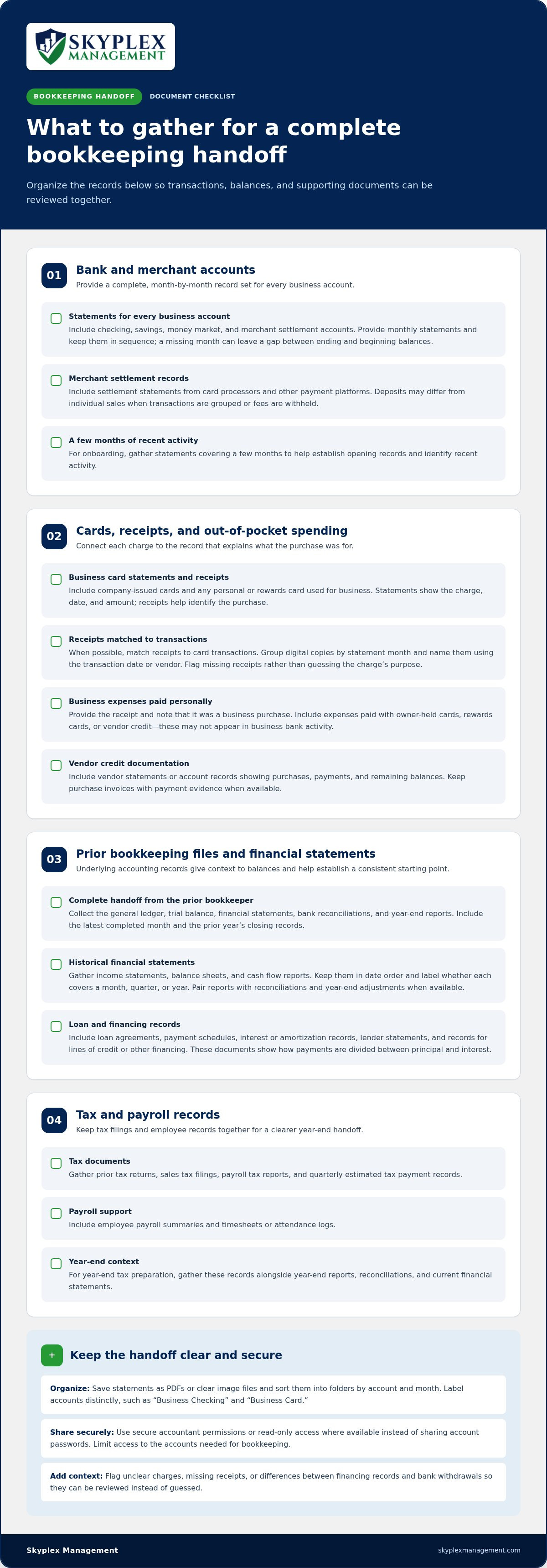
Bank records let a bookkeeper compare recorded activity with what actually happened in your accounts. If you’re asking, “what documents do I need for a bookkeeper,” start with statements for every business account and supporting transaction records. Include receipts and notes explaining unusual activity, so transactions can be reviewed and categorized accurately.
- Collect statements for every business account. Include checking, savings, money market, and merchant settlement accounts. Merchant settlement statements show deposits from card processors and other payment platforms. Deposits may differ from individual sales because transactions are grouped or fees are withheld. Provide monthly statements for all business accounts.
During onboarding, gather statements covering a few months to help establish opening records and identify recent activity. Keep them in sequence. A missing month can leave an unexplained gap between one statement’s ending balance and the next statement’s beginning balance.
- Include business credit card statements and receipts. Provide statements for company-issued cards and any personal or rewards card used for business expenses. A statement shows the charge, date, and amount; the receipt helps explain the purchase. For example, a card charge from an office supplier may need a receipt to distinguish supplies from equipment.
Match receipts to card transactions when possible. Group digital copies by statement month, then name them using the transaction date or vendor. If a receipt is missing, flag the charge rather than guessing its purpose. This gives the bookkeeper a clear item to follow up on.
- Document business spending paid personally. If you paid a company expense from a personal account, provide the receipt and note that it was a business purchase. Include expenses paid with owner-held cards, rewards cards, or vendor credit. These transactions may not appear in business bank activity, so supporting records help connect the expense to the company.
For vendor credit, include statements or account records showing purchases, payments, and any remaining balance. Keep the purchase invoice with payment evidence when available. This connects the vendor charge to the expense and avoids recording a payment without its underlying purchase.
- Share access carefully and keep statements organized. Read-only online banking access can help a bookkeeper review activity without changing transactions. Use secure accountant permissions where available instead of sharing account passwords. Limit access to the accounts needed for bookkeeping.
Save statements as PDFs or clear image files, and sort them into folders by account and month. Label accounts distinctly, such as “Business Checking” and “Business Card.” For anyone still asking, “what documents do I need for a bookkeeper,” a complete, clearly labeled account record set is a practical starting point for reconciling transactions and preparing financial statements.
Prior bookkeeping records and financial statements
U.S. tax records to provide include prior tax returns, sales tax filings, payroll tax reports, and quarterly estimated tax payment records. Payroll records should include employee payroll summaries and timesheets or attendance logs. Share records through secure accountant permissions or read-only access rather than sending account passwords. For year-end tax preparation, gather these records alongside year-end reports, reconciliations, and current financial statements.
- Ask the previous bookkeeper for a complete handoff. Collect the general ledger, trial balance, financial statements, bank reconciliations, and year-end reports. The general ledger lists recorded transactions by account, while the trial balance shows account balances at a point in time. Together, these files help a new bookkeeper trace how balances were built.
Include the latest completed month and the closing records from the prior year. For example, if a balance sheet lists a loan payable, the ledger and reconciliation can show its recorded activity. Don’t substitute a spreadsheet summary for the underlying accounting records when original files are available.
- Provide historical financial statements. Gather income statements, balance sheets, and cash flow reports from prior periods. Comparing past statements with current results can reveal trends or unusual changes. For example, a sudden change in a vendor expense may reflect a real business shift, a miscategorized transaction, or an incomplete record.
Keep reports in date order and identify whether each covers a month, quarter, or year. Pair statements with the accounting records behind them, including reconciliations and year-end adjustments. This context helps explain opening balances and provides a consistent starting point for financial reporting.
- Gather loan and financing documents. Include each loan agreement, payment schedule, and available interest or amortization records. These documents show the original terms and how payments are divided between principal and interest. That distinction matters because a full loan payment should not automatically be recorded as an expense.
Also provide lender statements and records for lines of credit or other financing. If a payment schedule shows one amount but the bank withdrawal differs, flag the difference. The bookkeeper can compare financing records with financial transactions and identify what needs clarification.
- Sort tax and payroll files for year-end. Place tax returns, sales tax filings, payroll tax reports, estimated payment records, payroll summaries, and time records in clearly named folders. Label each file by period and type to make deadlines and reporting periods easier to distinguish. Include relevant payroll details that explain recorded wages or adjustments.
Use a secure document-sharing method with accountant permissions, or provide read-only access to the relevant accounting records. Save files with clear names, such as “Payroll Summary” and the covered period. If you’re organizing a handoff, you can discuss your bookkeeping records and the records needed to make the transition clearer.
Common onboarding delays and recordkeeping mistakes
In the United States, keep bookkeeping records according to their purpose, tax filing needs, and value in explaining business transactions. Retain supporting documents alongside the financial records they explain, so income, expenses, and reported balances can be traced.
- Send complete records before deadlines approach. Bookkeeping onboarding can take anywhere from a few days to a few weeks, depending on business size, record condition, and historical cleanup needs. Waiting until a couple of weeks before a filing deadline can create a heavier workload. Share available files early and identify gaps instead of waiting to assemble a perfect package.
For example, if a prior month’s reconciliation is missing, label that month and share the statements and transaction records you do have. This gives the bookkeeper a clear starting point and helps distinguish missing documents from transactions that need review.
- Use a consistent folder structure. Create separate folders for bank statements, credit cards, payroll, taxes, vendors, customers, loans, assets, and expenses. Within each folder, sort files by period and use descriptive names. “Payroll Summary” plus the covered month is clearer than “scan 4.”
Keep related records together. Pair a vendor bill with its payment evidence, or a business travel receipt with a short note describing its purpose. Add notes to travel and meal receipts when the expenses are business-related. This context helps explain why the cost belongs in the business records.
- Flag unclear transactions instead of guessing. Add a note when a bank description doesn’t identify a purchase, customer, or business purpose. For example, label an unfamiliar transfer as “owner contribution” only if you know that’s what it represents. Otherwise, mark it for review.
Also identify duplicate files, missing receipt details, and personal spending mixed with business activity. A clear note helps prevent an assumption from appearing as fact in financial reports. Keep the note with the transaction record so it remains available during later reviews.
- Maintain an organized record trail over time. Keep each record with the financial transaction or reporting period it supports. A prior-year tax filing, for instance, should remain distinguishable from current-year payroll and income records. Preserve documents that explain balances, adjustments, or changes in the business, not just summaries of those amounts.
Review folders regularly and move completed periods into a clearly labeled archive. If a file supports a tax return, financial statement, or outstanding loan balance, keep it connected to that record. This makes future questions easier to resolve and reduces repeated document requests.
Keep records for as long as they are needed for tax filing and to explain business transactions, balances, adjustments, or changes. Retain supporting documents alongside the financial records they explain.
Customer invoices and payment records
Provide issued invoices, customer payment records, point-of-sale or e-commerce reports, and credit notes. Include receipts and expense records supporting business purchases, with notes to explain unclear transactions.
-
Gather Customer Invoices
Collect every invoice issued to customers, including paid, outstanding, voided, and corrected invoices. Check that each invoice identifies the customer, transaction date, amount, and current status. If an invoice was credited or replaced, include the related credit note or revised copy. Keeping the original and correction together helps prevent duplicate income entries or an old balance being incorrectly listed as unpaid.
-
Compile Payment Records
Gather records showing how customers paid, such as payment processor reports, deposit details, and receipts or confirmations. Match each payment to its invoice when possible, and flag partial payments, refunds, chargebacks, or payments covering multiple invoices. For example, a single customer transfer may settle several invoices, so a brief allocation note helps explain how to apply the payment.
- Include sales summaries from every channel. Provide point-of-sale reports for in-person transactions and sales summaries from each e-commerce platform. These records help account for sales shown as grouped deposits rather than individual customer payments. Identify the sales period and platform on each report. If a report includes refunds or discounts, keep those details visible rather than sending only the net deposit total.
For example, an online store report can connect daily sales with the deposit eventually recorded in the books. The report and related payment records give a clearer view of gross sales, adjustments, and amounts received.
- List open invoices and customer credits. Prepare a current accounts receivable report, which lists amounts customers still owe. Include outstanding and reconciled invoices, credit notes, and customer payment trends. Note disputed balances or promised payment dates instead of changing an invoice amount without supporting documentation.
Compare the report with your invoice records before sharing it. If a customer paid an invoice but the balance remains open, include the payment reference. This gives the bookkeeper a specific transaction to trace and helps prevent income from being counted twice.
- Attach receipts and notes for related expenses. Provide receipts for business purchases connected to customer work, such as materials bought for a job. Add a short description if the vendor or purpose isn’t clear from the receipt. Keep receipts separate from sales invoices: one supports a business expense, while the other records customer income.
Use consistent file names that identify the customer, invoice, or sales channel. A receipt labeled with a project name, for instance, is easier to associate with relevant work than an unexplained image file. This context helps keep income and expenses distinct in the financial records.
Business identity and formation documents
Include records showing who owns the business, how it is registered, and what it does. This identity information helps a bookkeeper connect financial activity to the right business.
- Write down the business’s identifying details. Provide its physical address, business name, applicable EIN, and a clear description of its activity. An EIN is an Employer Identification Number. Use the name shown on business records, and note any trade name used with customers.
For example, if invoices use a trade name but formation papers show another name, explain the relationship. Clear details help prevent confusion when matching documents, accounts, and customer records.
- Gather formation and state registration papers. Share the documents that establish the business and its state registration records. Keep copies together in a folder labeled with the business name. If the business has updated its name or address, include records showing the current information alongside older documents that explain the change.
Organized files make it easier to distinguish current records from historical ones. Don’t send several unlabeled versions without explaining which reflects the business today.
- Summarize ownership and responsibilities. Provide ownership details and identify who handles financial decisions, approves purchases, or contributes funds. If more than one owner is involved, list each owner and describe their role in plain language. This context helps a bookkeeper associate owner-related financial activity with the business.
For example, note whether an owner sometimes pays a business bill personally. The receipt and ownership information can help explain why the transaction doesn’t appear on a business credit card statement.
- Describe the business activity in practical terms. Explain what the company sells or provides, how it earns income, and whether it serves customers through projects, appointments, products, or another model. A short description gives a bookkeeper context for interpreting unfamiliar customer, vendor, or transaction names.
For instance, a contractor might describe work by project, while a service business might bill by appointment. These examples explain the type of activity, not a required accounting method. Keep the description current if the business adds a new line of work.
- Make a simple identity summary. Put the business name, physical address, applicable EIN, ownership details, state registration papers, formation documents, and activity description in one organized handoff folder. Label any name or address differences with a brief note. This gives a bookkeeper a clear reference point for understanding which entity the financial records represent.
For businesses in Singapore, the Inland Revenue Authority of Singapore (IRAS) is a relevant regulatory authority for business recordkeeping. Digital copies of receipts are often acceptable.
Skyplex Management: Small Business Bookkeeping
Skyplex Management helps small businesses turn scattered financial records into organized bookkeeping. Serving businesses across Northeast Ohio, including Cleveland and Akron, the firm provides Small Business Bookkeeping and QuickBooks Online Support & Cleanup for owners dealing with incomplete records or a software transition. Small Business Accounting supports clear financial records, while Payroll Service helps manage payroll bookkeeping needs.
Consider professional bookkeeping support when missing information or unclear transactions make it difficult to understand your business finances. Preparing the documents covered in this guide gives the work a clearer starting point, even if some records still need attention.
If you’d like help organizing your bookkeeping handoff, contact Skyplex Management to discuss the next step.
Turn Your Document Handoff Into a Clear Routine
Preparing a handoff can also help you build a steadier recordkeeping routine. Knowing what documents you need for a bookkeeper is a starting point; deciding who gathers them and how often they’re shared makes the process easier to maintain. Choose someone to collect records, set a recurring review time, and note questions as they arise instead of relying on memory.
You don’t need to delay getting support until every file is perfectly organized. Share what’s ready, identify gaps clearly, and explain unusual transactions or changes in how the business operates. That gives your bookkeeper useful context and helps turn financial records into information you can use to make decisions.
A consistent routine can make financial administration more manageable and give you a clearer view of the business ahead.
Frequently Asked Questions
What documents should a small business give a bookkeeper each month?
Send a consistent monthly packet after deciding which period it covers and who prepares it. Add a brief “items to review” note for unusual activity, delayed documents, or operational changes. For example, tell the bookkeeper that a customer refund is still being processed rather than leaving it unexplained. A repeatable handoff routine keeps each month’s records distinct and makes follow-up questions easier to resolve.
What financial records does a bookkeeper need to set up bookkeeping?
A bookkeeper needs enough information to establish a clear starting point and understand how existing records were maintained. Identify the date bookkeeping should begin, and provide an export or copy of current account categories and transaction history. If you’ve used spreadsheets, explain custom labels such as “job supplies” or “client travel,” so they aren’t mistaken for standard account names.
What bank and credit card statements does a bookkeeper need?
Provide complete statements for accounts used for business activity, including any account opened or closed during the period being organized. For a closed account, include its final statement and note when it stopped being used for business. Also identify any account name that differs from the business name, such as a processor or card account, so the records can be recognized without guesswork.
What documents does a bookkeeper need for a sole proprietor versus an LLC or corporation?
A sole proprietor should clarify which business name appears on customer or vendor records, especially if it differs from the owner’s name. An LLC or corporation should provide current documents reflecting its registered business name and any ownership or name changes relevant to the records. If one owner operates multiple businesses, label each company’s files separately to prevent transactions from being associated with the wrong entity.
Disclaimer
The information provided in this article is for general educational purposes only and should not be considered accounting, tax, or legal advice. Every business is unique. Consult a qualified accounting professional before making financial or tax decisions. Contact Skyplex Management for guidance specific to your business.


