

What happens if you don't reconcile accounts and your books show more cash than your bank account? The difference could come from a duplicate transaction, a missed expense, or an entry recorded for the wrong amount. Until you compare your records with account statements, it can be hard to know which balance to trust.
Reconciliation is a routine bookkeeping task, but it does more than confirm a balance. It helps you catch missing or duplicated transactions, track payments that have not cleared yet, and spot errors while the details are still familiar. When reconciliations fall behind, small discrepancies can become harder to trace, and cash-flow or profit reports may not give you a clear picture.
This guide explains the practical risks of unreconciled accounts, the warning signs to look for, and how to get your records back on track. You’ll also learn when regular bookkeeping, QuickBooks Online cleanup, or outsourced accounting support can help you organize your records and make business decisions with greater clarity.
Key Takeaways
- What happens if you don't reconcile accounts? Missing, duplicated, or incorrectly recorded transactions can make balances and reports unreliable.
- Compare individual transactions, not just ending balances, to find differences a quick balance check may miss.
- If reconciliations have fallen behind, gather statements and bookkeeping records, then work through one account and period at a time.
- Document unresolved differences instead of forcing balances to match, so you can investigate them accurately.
- Set a repeatable reconciliation routine to keep records current and support clearer cash-flow reviews and business decisions.
What happens if you don’t reconcile accounts regularly?
If you’re wondering what happens if you don't reconcile accounts regularly, the short answer is that your books can drift from the activity in your bank and credit-card accounts. A balance may look reasonable while missing or duplicated transactions affect the records behind it. The longer a difference remains unexplained, the harder it can be to identify its cause.
Account reconciliation means comparing transactions recorded in your books with activity on a bank or credit-card statement, then investigating and resolving differences. It helps confirm that balances are supported by the transactions behind them, so your reports and decisions rely on records that have been checked against account activity.
What does account reconciliation check?
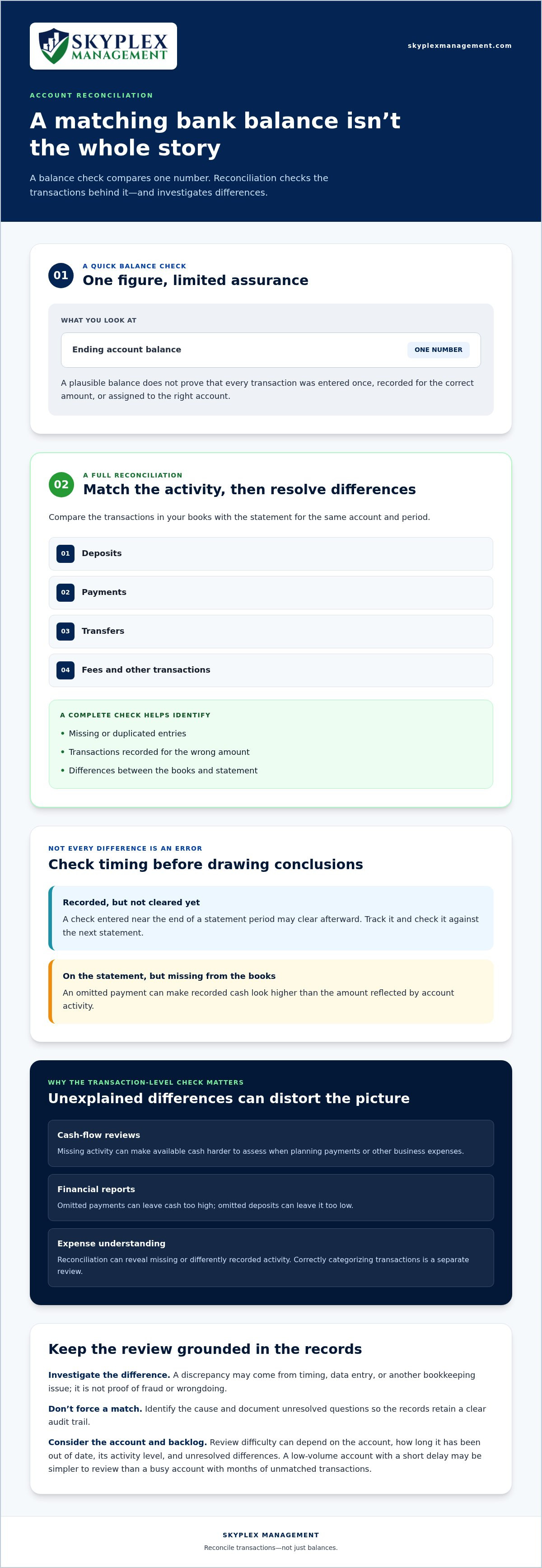
During reconciliation, match deposits, payments, transfers, fees, and other transactions in your accounting records to the statement for the same account and period. A quick look at the current bank balance checks only one number. It doesn’t confirm that each transaction was entered once, recorded for the correct amount, or assigned to the right account.
An outstanding transaction is an item recorded in your books that hasn’t appeared on the statement yet, or statement activity that hasn’t been recorded in your books. For example, a check entered near the end of a statement period may clear afterward. That timing difference isn’t automatically an error, but it should be tracked and checked against the next statement.
Why can an unreconciled balance mislead an owner?
Reconciliation is the process of matching recorded transactions to account statements and resolving differences so business records can be relied on. Without that check, a missing deposit could understate available cash, while a duplicated expense could make costs look higher than they are. A transaction entered for the wrong amount can also distort the account balance.
Those inaccuracies can carry into financial reports. You may misread the cash available for upcoming bills, misunderstand a change in expenses, or make plans using figures that don’t reflect account activity. A discrepancy is a reason to investigate, not proof of fraud or wrongdoing. It may result from timing, data entry, or another bookkeeping issue.
The consequences depend on which accounts are unreconciled, how long they’ve been out of date, how much activity they contain, and whether differences remain unresolved. A low-volume account with a short delay may be simpler to review than a busy account with months of unmatched transactions. Either way, avoid forcing a balance to match just to clear a difference. Identify the cause and document any remaining questions so the records have a clear audit trail.
How unreconciled accounts can affect cash flow and financial reports
An account can appear healthy in your books even after money has left the bank. To understand what happens if you don't reconcile accounts, consider an omitted transaction: the bank statement reflects it, but the bookkeeping record does not. Your recorded cash balance then overstates what’s available, which can make a cash-flow review less useful when you’re planning payments or other business expenses.
What can happen to cash-flow visibility?
Hypothetical example: A business’s automatic supplier payment clears its bank account, but the transaction is missing from its books. The owner reviews the bookkeeping balance and assumes there’s enough cash for another planned expense. Because the payment hasn’t been recorded, that estimate is based on incomplete information. Recording and reconciling the payment would give the owner a more accurate starting point for reviewing available cash.
A transaction that hasn’t cleared the bank yet may simply reflect timing, not an error. Track it and check that it clears as expected. If it remains outstanding, review the date, amount, and supporting details rather than assuming the difference is still routine.
How can unreliable account balances affect reports?
Bank and credit-card reconciliations help support accurate account balances on the balance sheet, which shows what a business owns and owes at a point in time. An omitted payment can leave cash too high; an omitted deposit can leave it too low. For more on reviewing those figures, see this small business balance sheet analysis guide.
Reports are only as dependable as the records and classifications behind them. Reconciliation can identify activity that’s missing or recorded differently from a statement, but it doesn’t confirm that every transaction is classified correctly. For example, an expense might be in the books but assigned to the wrong category. Reviewing income and expense classifications is a separate step in preparing useful financial reports.
Reconciled accounts give you a stronger starting point for reviewing cash flow, expenses, and financial position, but they don’t guarantee every report is correct. Other records and bookkeeping choices may also need review. If incomplete records are making it difficult to assess your cash position, talk with Skyplex Management about bookkeeping support.
Is a matching bank balance enough, or do you still need reconciliation?
A bank balance that looks plausible can offer some reassurance, but it doesn’t prove your books include every transaction. The ending balance is one figure. Reconciliation checks the activity behind it and helps explain differences between your accounting records and the statement. Missing or duplicated entries can remain hidden even when the totals seem close.
What can a bank balance check miss?
A balance-only check won’t reveal whether a deposit was omitted, a payment was entered twice, or a transaction was recorded for the wrong amount. It also won’t explain timing differences, such as a payment recorded in the books that hasn’t cleared the bank yet. The statement’s ending balance can’t confirm that the books contain each item accurately.
Look into recurring unexplained differences, transactions that appear more than once, or statement activity with no matching entry in your books. These are reasons to review the records, not proof of misconduct. Reconciliation can bring discrepancies to light, but it can’t guarantee that every issue will be found or establish a particular cause on its own.
What does a completed reconciliation add?
Matching individual transactions gives you a clearer trail to follow. It helps separate routine timing items from entries that may need correction or follow-up. If accounts are connected to bookkeeping software, a feed can import banking activity, but imported transactions still need review. A feed may not resolve duplicates, confirm that an amount is correct, or explain an unmatched transaction.
- Quick balance check: Compares the account’s ending balance with a figure in your books. It can flag a difference, but won’t show which transactions caused it.
- Transaction-by-transaction reconciliation: Matches statement activity to recorded entries, helping identify missing items, duplicates, incorrect amounts, and timing differences that need tracking.
The balance is a useful starting point, not the full check. If your QuickBooks records have accumulated unmatched activity, this guide to QuickBooks reconciliation and cleanup explains how a careful review can help clarify the records.
If you’d like support reviewing account differences or establishing a consistent bookkeeping routine, contact Skyplex Management about bookkeeping support.
What should you do if you have skipped account reconciliations?
A backlog can feel daunting, but you don’t need to resolve every difference at once. Start by gathering the records, then work through one account and statement period at a time. A steady process creates a clear trail and helps prevent rushed adjustments from hiding the original issue.
How can you begin catching up?
Collect bank and credit-card statements, the corresponding bookkeeping records, and transaction details that may explain activity, such as receipts or payment records. Begin with the oldest unreconciled period and move forward in chronological order. Earlier differences can affect later balances, so completing periods in sequence makes each review more useful.
- Choose one account and period. Compare each transaction in the books with the statement activity.
- Mark what matches. Note items that appear in one record but not the other, and distinguish possible timing differences from unexplained discrepancies.
- Document questions. Record unresolved items, including the date, amount, and any needed follow-up.
- Continue in order. Finish reviewing the period before moving to the next, keeping your notes with the reconciliation records.
Don’t delete historical entries or change amounts simply to force the ending balance to match. An unsupported adjustment can make the records harder to understand later. If you can’t explain a difference from the available information, document it and investigate rather than guessing.
When can professional cleanup support help?
Bookkeeping support may help if several periods are overdue, transactions are difficult to trace, or QuickBooks records no longer provide a clear starting point. A structured cleanup can organize available records, work through historical reconciliation gaps, and document completed work and unresolved items. Skyplex Management provides small-business bookkeeping and QuickBooks Online support and cleanup for businesses in Northeast Ohio.
If the backlog feels difficult to manage, a clear review plan can help you prioritize the records and periods that need attention. Skyplex Management can help organize the bookkeeping and QuickBooks cleanup process.
Build a reliable reconciliation routine with small-business bookkeeping support
Knowing what happens if you don't reconcile accounts can help you set a routine before differences start piling up again. Choose a schedule that reflects how often each account is used and how much activity it handles. An account with frequent transactions may need closer attention than one used only occasionally. Consistency matters: review each statement period and investigate questions while the details are still familiar.
What does a sustainable reconciliation routine include?
Keep bank and credit-card statements, transaction records, and notes about unresolved differences together by account and period. As part of regular bookkeeping, match statement activity to the books, record items that are still outstanding, and follow up on unexplained differences. Don’t carry exceptions into the next review without noting what needs attention.
- Use the same review process for each account and statement period.
- Keep supporting records and explanations with the reconciliation work.
- Track timing items until they clear, and investigate differences that remain unexplained.
- Review completed reconciliations before relying on financial reports for owner discussions.
A repeatable process makes it easier to see what has been reviewed and what still needs follow-up. It also helps keep account balances current, giving you a more useful starting point for discussing cash flow, expenses, and business performance.
How can bookkeeping support provide more clarity?
Ongoing bookkeeping can keep transactions organized and reconciliations moving as part of routine recordkeeping. Skyplex Management supports small businesses with bookkeeping, QuickBooks Online support and cleanup, and financial reporting. When historical records have gaps, QuickBooks cleanup can help organize information and address past reconciliation issues. Clearer records give owners a steadier basis for reviewing reports and discussing business decisions.
For businesses across Northeast Ohio, including Cleveland and Akron, consistent bookkeeping support can help keep financial records organized as activity changes. If you’d like help establishing a manageable reconciliation process or addressing gaps in your records, Skyplex Management can help with bookkeeping and QuickBooks Online support.
Make your financial records more dependable
Understanding what happens if you don't reconcile accounts shows why a plausible balance isn’t enough. Missing, duplicated, or incorrectly recorded transactions can weaken cash-flow reviews and financial reports, making it harder to rely on the numbers behind business decisions.
A consistent routine helps keep records current. Compare transactions with statements, track timing differences, and document questions rather than forcing balances to match. If you’ve fallen behind, work through one account and period at a time to rebuild an organized record.
Skyplex Management provides small-business bookkeeping and accounting, QuickBooks Online support and historical data cleanup, and financial reporting and advisory services. Payroll Services and Outsourced Accounting can also support organized financial operations and give business owners useful records for review.
Clear records are built one careful review at a time. Contact Skyplex Management to discuss bookkeeping support, QuickBooks cleanup, or a more consistent reconciliation routine.
Frequently Asked Questions
What happens if you don’t reconcile your business bank account?
Unresolved differences can make the recorded bank balance unreliable and leave account activity out of your reports. What happens if you don't reconcile accounts depends on the transactions involved and how long the account has gone without review. A missed reconciliation alone doesn’t automatically cause a tax penalty, audit, or loss. Compare the books with statements and investigate differences to learn whether they reflect timing, entry errors, or missing transactions.
Can unreconciled accounts affect financial statements?
Yes. Financial statements use bookkeeping records, so missing or incorrectly recorded transactions can affect reported account balances and make results harder to interpret. Reconciliation is an important accuracy check, but it doesn’t confirm that every transaction is classified correctly or that every report is complete. Investigate differences and review how transactions are categorized. If records remain unclear, bookkeeping support can help organize the information and make financial reporting more useful.
How often should a small business reconcile its accounts?
Use a consistent schedule suited to your transaction volume, account activity, and reporting needs. There isn’t one frequency that fits every business. Regular reviews help surface discrepancies while transaction details are easier to trace, rather than allowing questions to build up across periods. Consider how often you use each account and when you rely on reports to guide decisions, then set a repeatable process that keeps records current.
Is checking my bank balance the same as reconciling an account?
No. A balance check compares a displayed balance with a figure in your books. Reconciliation compares transactions in your records with the statement and investigates differences. Even if the balances look plausible, books may still contain missing entries, duplicates, or transactions recorded for the wrong amount. Reviewing individual transactions gives you a clearer basis for trusting account records and the reports that rely on them.
Can QuickBooks reconcile accounts automatically?
QuickBooks Online can support reconciliation, and imported transactions can help bring account activity into your records. But software doesn’t remove the need to compare activity with statements, review entries, and resolve differences. An imported transaction may still need checking for accuracy or duplication. The owner or bookkeeper should review exceptions rather than assuming the software has identified every error or produced correct books without oversight.
What should I do if I have not reconciled accounts for several months?
Gather the bank and credit-card statements, bookkeeping records, and transaction details, then work through overdue periods in chronological order. Track unresolved differences and avoid changing or deleting entries just to force a match. If the backlog is substantial or QuickBooks records are confusing, bookkeeping support and QuickBooks cleanup can help organize the information and document the catch-up process. Skyplex Management supports small businesses across Northeast Ohio, including Cleveland, Akron, Medina, Strongsville, Brecksville, Hudson, Stow, Cuyahoga Falls, Fairlawn, Brunswick, Wadsworth, North Royalton, Canton, Wooster, Richfield, Macedonia, Broadview Heights, and Solon.
Can unreconciled accounts cause tax problems?
Incomplete or inaccurate records can make it harder to prepare dependable financial information, but an unreconciled account by itself doesn’t establish a tax violation or guarantee a penalty. Any tax implications depend on the facts and the requirements that apply to the business. Focus first on identifying and correcting bookkeeping differences. For tax questions, consult current guidance from the IRS or Ohio Department of Taxation, or seek advice from an appropriate tax professional.
Disclaimer
The information provided in this article is for general educational purposes only and should not be considered accounting, tax, or legal advice. Every business is unique. Consult a qualified accounting professional before making financial or tax decisions. Contact Skyplex Management for guidance specific to your business.


