

What if your business turns a profit, but the owner’s equity balance still goes down? A withdrawal can reduce equity even when the business is profitable, while an owner contribution can increase it without counting as revenue. If you’ve wondered what is a statement of owner's equity and how to read one, start by separating owner activity from the business’s operating results.
It’s easy to confuse money an owner puts into or takes out of a business with sales and expenses. But these transactions affect different parts of the financial picture. When they’re not recorded consistently, it becomes harder to understand business performance or explain changes in equity.
This guide explains what the statement shows, how profit or loss, contributions, and withdrawals affect equity, and how the report connects to the income statement and balance sheet. You’ll also learn how to review the figures and why consistent bookkeeping helps keep equity balances traceable. Skyplex Management provides bookkeeping, accounting, and financial reporting support for small businesses.
Key Takeaways
- Understanding what is a statement of owner's equity helps you see how the owner’s recorded stake changes over a reporting period.
- Follow the beginning balance, contributions, profit or loss, and withdrawals to understand changes in equity. Presentation can vary by business structure and accounting context.
- Read the income statement, statement of owner’s equity, and balance sheet together. Each report answers a different question about the business.
- Compare the beginning equity balance with the prior period’s ending balance, then trace contributions and withdrawals to supporting records.
- Record business activity consistently so the ending equity balance is easier to explain and review.
What Is a Statement of Owner’s Equity, and What Does It Show?
If you’ve asked what is a statement of owner's equity, the short answer is that it tracks changes in the owner’s recorded equity over a reporting period. Equity generally represents the owner’s remaining claim in the business after its liabilities are considered. The statement explains what caused the balance to change, while the balance sheet shows the business’s financial position on a specific date.
The statement may also be called a statement of changes in equity. The Statement of changes in equity describes the broader role of this report in showing how equity balances change. For a small business, the details and labels can vary with its structure and accounting practices.
What information appears on an owner’s equity statement?
Most versions help you follow the balance from the start of the period to the end. They may include:
- Beginning equity: The recorded balance at the start of the reporting period.
- Owner contributions: Money or other value the owner puts into the business. A contribution is owner activity, not sales revenue.
- Business profit or loss: The period’s operating result, which increases or decreases equity.
- Withdrawals: Value the owner takes out of the business. A withdrawal is not an ordinary operating expense.
- Ending equity: The balance after the period’s activity is reflected.
Together, these items show whether the change came from business performance, the owner’s decisions, or both. Consistent bookkeeping helps keep each item properly categorized and traceable.
A profitable period doesn’t guarantee that the same amount of cash is available to withdraw. For example, a business might record an $8,000 profit while some customer invoices remain unpaid and cash is used to pay bills or purchase supplies. If the owner also withdraws money, the statement reflects that activity. It does not mean profit and cash are interchangeable.
Who uses the statement and when?
Owners use the statement to understand why their recorded stake changed and to review the effects of business results and personal contributions or withdrawals. It can also help identify items that need follow-up, such as a withdrawal recorded as an expense.
Lenders and other readers may review it alongside the income statement and balance sheet to understand performance, equity changes, and the business’s financial position together. Clear reporting can support more informed conversations about the business, whether you operate in Cleveland, Akron, or elsewhere in Northeast Ohio. If the equity balance is difficult to explain, accurate bookkeeping and financial reporting can help show how the figures were built.
How Is Owner’s Equity Calculated? Follow Each Change
A simple teaching aid for following owner’s equity is:
Beginning equity + owner contributions + profit − withdrawals − losses = ending equity
This framework shows how recorded activity can change the balance over a reporting period. Ending equity is the result of the recorded increases and decreases in the owner’s equity balance during the period. The statement’s format and treatment of specific items can vary with the business entity and accounting context. Wall Street Prep’s guide to preparing a statement of owner’s equity explains common components and adjustments. The IRS’s small-business recordkeeping guidance highlights the role of records in supporting reported business income and expenses, which helps owners trace the activity behind their financial statements.
How do contributions, profit, and withdrawals affect equity?
An owner’s additional investment generally increases the owner’s recorded equity. Business profit can also increase equity, while a loss can reduce it. These are different kinds of changes: a contribution is not sales revenue, and profit reflects the business’s operating results rather than the amount the owner deposits.
Withdrawals or distributions generally reduce the owner’s equity balance. They aren’t automatically operating expenses. Recording a personal withdrawal as a business expense can misstate both the business’s results and its equity, so accurate categorization matters.
A simple example of changes during a reporting period
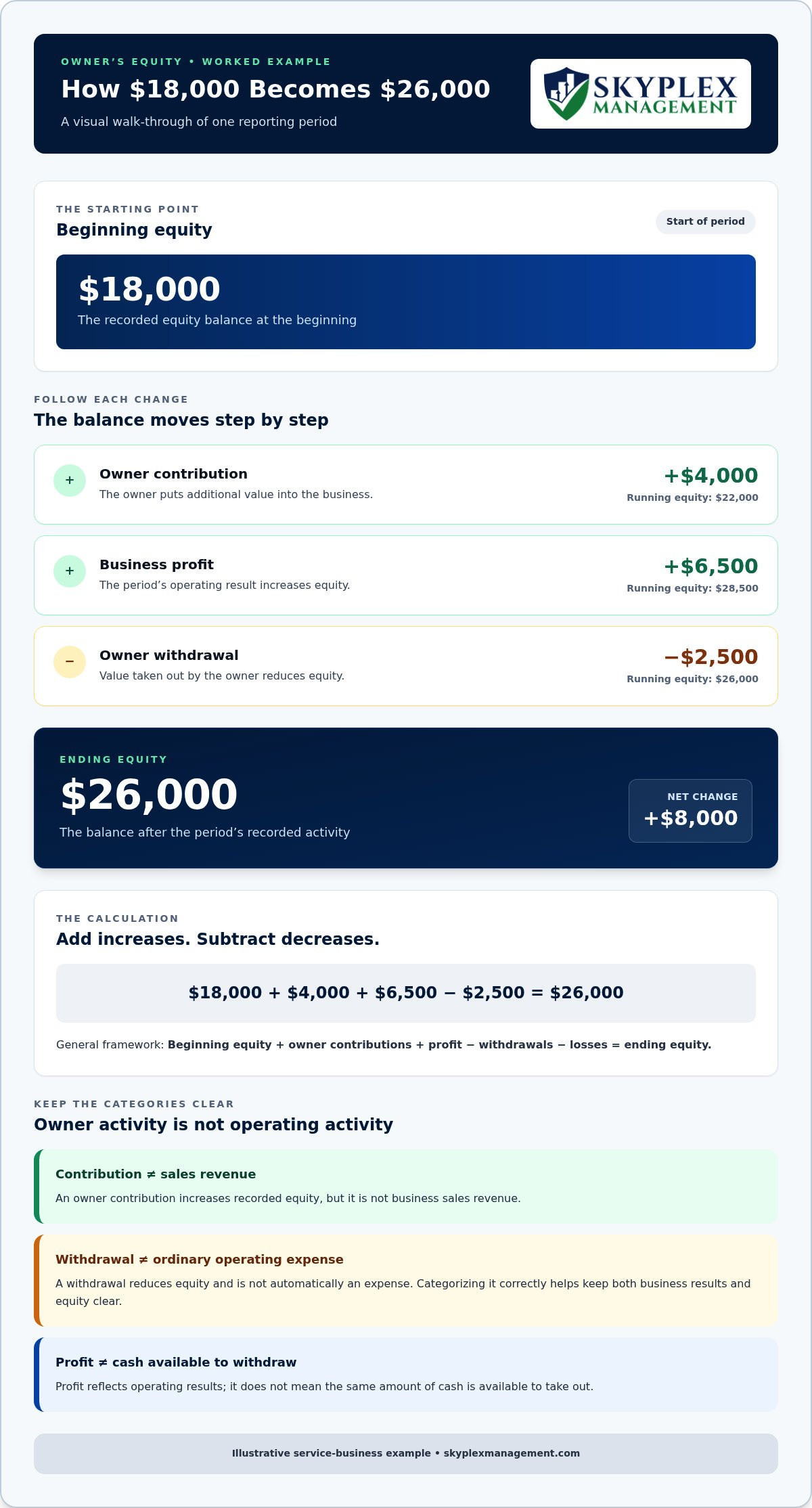
Consider an illustrative service business with beginning equity of $18,000. During the period, its owner contributes $4,000, the business records a $6,500 profit, and the owner withdraws $2,500.
- Beginning equity: $18,000
- Add owner contribution: +$4,000, bringing the balance to $22,000
- Add business profit: +$6,500, bringing the balance to $28,500
- Subtract owner withdrawal: −$2,500
- Ending equity: $26,000
The calculation makes each movement visible: $18,000 + $4,000 + $6,500 − $2,500 = $26,000. The $4,000 contribution isn’t revenue, and the $2,500 withdrawal isn’t automatically an expense. This example is educational, not a substitute for entity-specific accounting treatment. If your recorded balances don’t reconcile or the categories are unclear, contact Skyplex Management about your bookkeeping for practical reporting support.
How Does the Statement Relate to Profit and the Balance Sheet?
Knowing what is a statement of owner's equity becomes more useful when you see how the report connects business performance to the balance sheet. Each statement focuses on a different part of the financial picture. Read together, they help explain what the business earned, what changed in the owner’s recorded equity, and what the business owns and owes on a particular date.
| Financial statement | What it shows | The question it answers |
|---|---|---|
| Income statement | Revenue and expenses over a period, resulting in profit or loss | Did the business earn a profit during this period? |
| Statement of owner’s equity | Changes in the owner’s equity during a period | What caused the owner’s recorded stake to change? |
| Balance sheet | Assets, liabilities, and equity at a specific date | What is the business’s financial position right now? |
What does the income statement tell an owner?
The income statement summarizes revenue and expenses for a set period and shows whether the business had a profit or loss. Profit can increase equity, but it’s only one possible change. Owner contributions and withdrawals can also affect equity, so profit alone doesn’t explain the full movement in the owner’s balance.
Profit also doesn’t necessarily mean the same amount is available in cash. A business may record revenue from work completed while waiting for customers to pay invoices. Meanwhile, cash may be needed for payroll, supplies, or other bills. The income statement measures business results, not the cash currently in the bank.
What does the balance sheet add?
The balance sheet is a snapshot of assets, liabilities, and equity on a specific date. Assets are resources the business owns, while liabilities are amounts it owes. The equity section reflects the owner’s recorded claim after liabilities are considered. The ending equity reported for a period generally carries into the equity shown on the balance sheet for that same reporting date, subject to the entity’s accounting presentation.
That connection gives the statement of owner’s equity its practical role: it helps explain how the equity balance reached the amount shown on the balance sheet. If the reports don’t appear to align, compare their dates and review the underlying bookkeeping records. For connected reporting support, explore small business accounting services. Reviewing assets, liabilities, and equity together can also help put the balance sheet in context.
How Can Owners Review an Equity Statement for Accuracy?
Understanding what is a statement of owner's equity also means knowing how to check the figures behind it. Start by comparing the statement’s beginning balance with the prior period’s ending balance. If they differ, look for an adjustment or a change in reporting context before assuming the statement is wrong.
Next, trace the changes during the period. Contributions and withdrawals should connect to supporting records and appear in bookkeeping under categories that distinguish owner activity from ordinary business transactions. Then compare the reported profit or loss with the income statement for the same period. Matching dates matter: reports covering different periods may not align even when their underlying entries are accurate.
An unexplained change is a reason to review records, not to jump to conclusions about an error or misconduct. Look for missing transactions, incorrect categories, duplicate entries, or opening-balance adjustments, and document what you find.
Which records help support the reported changes?
Useful records include bank statements, documentation of owner transactions, and reconciled bookkeeping records. Reconciliation means comparing recorded transactions with bank activity and resolving differences. Clear categorization makes it easier to identify whether money moved into the business as an owner contribution or out of it as a withdrawal. If balances won’t reconcile, review the underlying records and transaction history before relying on the equity statement.
When might bookkeeping or accounting support help?
Consider getting help if unexplained balances keep recurring, historical records are incomplete, or financial reports show inconsistent figures from one period to another. A review can trace balances to available records and identify bookkeeping entries that need clarification. Regular monthly bookkeeping and financial reporting also make changes easier to follow, rather than leaving a backlog to sort through later.
Skyplex Management provides bookkeeping support for small businesses in Northeast Ohio. Monthly bookkeeping and financial reporting can help organize transaction records and make owner’s equity changes clearer.
How Can Better Bookkeeping Make Owner’s Equity Reporting Clearer?
A useful owner’s equity statement depends on consistently recorded business activity, not the report alone. Timely entries help show whether changes came from owner contributions, operating profit or loss, or withdrawals. If transactions are missing or miscategorized, the ending balance may be harder to explain, even when the statement is formatted clearly.
For a business owner asking what is a statement of owner's equity, accurate bookkeeping is what makes the report’s movements traceable. Reconciliations and consistent categories connect each balance to the underlying records, so you can review the figures with more context.
What ongoing bookkeeping contributes to clearer reporting
Recording transactions regularly preserves the details needed to distinguish owner activity from business income and expenses. Reconciliations compare bookkeeping records with bank activity and help identify differences to review. Consistent categories make financial reports more useful, while QuickBooks Online cleanup can help organize historical records that need a closer look.
That ongoing recordkeeping supports more than the equity statement. It also gives you a clearer basis for reviewing business performance and financial position together. Keep a simple file of documents related to owner transactions, such as deposit records or notes describing the purpose of a withdrawal, so those entries can be traced to their source.
A practical next step for Northeast Ohio business owners
If a balance is unclear, gather the recent income statement and balance sheet, the owner’s equity statement, bank records, and available documentation for contributions or withdrawals. Compare the reports for the same period, then trace any unexpected change to the related transaction or entry.
Skyplex Management supports small businesses with bookkeeping, QuickBooks Online support and cleanup, accounting, and financial reporting and advisory services. The firm serves businesses in Cleveland, Akron, Medina, Strongsville, Brecksville, Hudson, Stow, Cuyahoga Falls, Fairlawn, Brunswick, Wadsworth, North Royalton, Canton, Wooster, Richfield, Macedonia, Broadview Heights, and Solon. Organized records and connected financial reporting make it easier to review how equity changed.
For a practical review of your bookkeeping and reporting needs, discuss your bookkeeping needs with Skyplex Management.
Use Clear Equity Reporting to Guide Your Next Decisions
A statement of owner’s equity explains how contributions, business profit or loss, and withdrawals changed the owner’s recorded stake over a reporting period. If you’ve wondered what is a statement of owner's equity, remember that it tracks those changes, while the balance sheet shows the resulting financial position on a specific date.
Reliable reporting starts with consistent bookkeeping. Compare the beginning balance with the prior period, trace owner transactions to supporting records, and read the statement alongside the income statement and balance sheet. Profit affects equity, but it doesn’t necessarily mean the same amount is available as cash.
Skyplex Management supports small businesses with bookkeeping and accounting, QuickBooks Online support and cleanup, and financial reporting and advisory services. If your equity balances are difficult to follow, accurate records and a connected review of your reports can bring the figures into focus.
With clear records, you can better understand your business’s financial story and make informed decisions about what comes next.
Frequently Asked Questions
What is a statement of owner’s equity?
Put simply, what is a statement of owner's equity? It’s a financial statement that summarizes changes in an owner’s recorded equity during a specific period. Depending on the business and its accounting presentation, it may show beginning equity, contributions, profit or loss, withdrawals or distributions, and ending equity. The statement explains how the ending figure was reached, but it doesn’t show how much cash the business has available.
How do you calculate ending owner’s equity?
A simple educational framework is to start with beginning equity, add owner contributions and profit, then subtract withdrawals and losses. A contribution increases the balance, while a withdrawal reduces it. The exact presentation depends on the business’s structure and accounting records. Use the calculation to follow changes, then compare it with the bookkeeping and related financial statements rather than treating the formula as a complete accounting method.
Is a statement of owner’s equity the same as a balance sheet?
No. A statement of owner’s equity explains changes over a reporting period, while a balance sheet presents the business’s assets, liabilities, and equity on a particular date. The statement’s ending equity should relate to the equity shown on the balance sheet for the corresponding date, though presentation can vary. Read both reports together to understand how equity changed and what the business’s financial position looks like at that point in time.
What is the difference between owner’s equity and net income?
Net income is the result of revenues and expenses over a reporting period. Owner’s equity is a broader recorded balance that can change with income or loss, owner contributions, and withdrawals or distributions. Profit may increase equity, but it doesn’t mean the business has the same amount of cash on hand. Unpaid customer invoices or cash used for business bills can affect available funds, so review both figures alongside other records.
Can an owner’s equity statement show a negative balance?
Yes, an owner’s equity statement can show a negative balance in some circumstances, depending on the business’s history and accounting records. The figure alone doesn’t explain why the balance occurred or what action may be appropriate. Review the reporting period, underlying transactions, and related financial statements. If the balance is unexpected or difficult to trace, bookkeeping or accounting support can help clarify how the records produced it.
How often should a small business prepare a statement of owner’s equity?
Businesses commonly prepare the statement for a defined reporting period as part of their financial statements. The right frequency depends on reporting needs, the bookkeeping process, and business circumstances. Consistent reporting makes changes easier to review over time, so keep the statement and supporting records aligned to the same period. Skyplex Management supports small businesses across Northeast Ohio, including Cleveland and Akron, with bookkeeping, accounting, and financial reporting support.
Disclaimer
The information provided in this article is for general educational purposes only and should not be considered accounting, tax, or legal advice. Every business is unique. Consult a qualified accounting professional before making financial or tax decisions. Contact Skyplex Management for guidance specific to your business.


